From: U.S. Department of Justice website
Compiled by: Jordan, PANews
On the evening of March 26, the U.S. Department of Justice disclosed on its official website that the cryptocurrency exchange KuCoin and its two founders are charged with violating the Bank Secrecy Act and unauthorized money transmission, with the lawsuit being filed by the U.S. Commodity Futures Trading Commission (CFTC).
Why is KuCoin being prosecuted by the U.S. Department of Justice?
According to the disclosed information, Damian Williams, the federal prosecutor for the Southern District of New York, and Acting Special Agent Darren McCormack of the Homeland Security Investigations ("HSI") announced the prosecution of the global cryptocurrency exchange KuCoin and its two founders, CHUN GAN (also known as "Michael") and KE TANG (also known as "Eric"). The related charges include:
- Operating an unlicensed money transfer business;
- Violating the Bank Secrecy Act of the United States;
- Intentionally failing to maintain an adequate anti-money laundering ("AML") program designed to prevent KuCoin from being used for money laundering and terrorism financing;
- Intentionally failing to maintain reasonable procedures to verify customer identities;
- Failing to submit any suspicious activity reports;
- Operating an unlicensed money transmission business.
U.S. Attorney Damian Williams explained the prosecution as follows: "As alleged in today's indictment, KuCoin and its founders intentionally concealed the fact that a significant amount of U.S. users were trading on the KuCoin platform. It is alleged that KuCoin, leveraging its large U.S. customer base, has become one of the world's largest cryptocurrency derivatives and spot trading platforms, with daily trading volumes reaching billions of dollars and annual trading volumes reaching tens of trillions of dollars. However, financial institutions like KuCoin that take advantage of unique opportunities in the United States must also comply with U.S. law to help identify and eliminate criminal and corrupt financing schemes, but KuCoin intentionally chose not to do so. It is alleged that KuCoin even failed to implement basic anti-money laundering policies, resulting in it being used as a safe haven for illegal money laundering, handling over $5 billion in suspicious funds and criminal funds exceeding $4 billion. This prosecution also sends a clear message to other cryptocurrency exchanges: if you plan to serve U.S. customers, you must comply with U.S. law, plain and simple."
Acting Special Agent Darren McCormack of the Homeland Security Investigations office in New York pointed out that KuCoin has served more than 30 million customers, but the investigation found that the exchange failed to comply with the legal requirements necessary to ensure the security and stability of global digital banking infrastructure.
What other information does the indictment reveal?
According to the disclosed information in the indictment, FLASHDOT LIMITED (formerly "Phoenixfin Limited"), PEKEN GLOBAL LIMITED, and PHOENIXFIN PRIVATE LIMITED are three entities jointly conducting business as the global cryptocurrency exchange KuCoin.
KuCoin solicited business from U.S. customers through its spot trading platform and subsequently launched a futures trading platform in July 2019. Since its establishment in 2017, KuCoin has become one of the world's largest cryptocurrency trading platforms, with daily cryptocurrency trading values reaching billions of dollars. KuCoin's website promotes the public ranking of cryptocurrency exchanges, showing that it has entered the top five globally, with one public ranking listing it as the fourth largest cryptocurrency derivatives exchange and the fifth largest cryptocurrency spot trading platform. The U.S. Department of Justice believes that KuCoin, GAN, and TANG attempted to and in fact have served numerous customers located in the United States and the Southern District of New York.
Therefore, the U.S. Department of Justice believes that KuCoin needs to register its money transfer business with the Financial Crimes Enforcement Network ("FinCEN") of the U.S. Department of the Treasury and register with the U.S. Commodity Futures Trading Commission ("CFTC") as a money transfer enterprise and futures commission merchant. In addition, KuCoin must comply with applicable provisions of the Bank Secrecy Act of the United States, which requires maintaining appropriate anti-money laundering programs, including customer identity verification or "know your customer" ("KYC") processes. AML and KYC programs can ensure that financial institutions like KuCoin are not used for illegal purposes, including money laundering.
The U.S. Department of Justice also pointed out that KuCoin attempted to conceal the presence of U.S. customers in order to appear unconstrained by U.S. AML and KYC requirements. According to examples, in 2022, KuCoin lied to at least one investor about the location of its customers, falsely claiming that it did not have U.S. customers, when in fact KuCoin has a large U.S. customer base and actively promotes to U.S. customers in many social media posts. For example, in a Twitter post in April 2022, KuCoin stated, "U.S. users do not support KYC, but KuCoin does not require KYC. Normal transactions can be made using unverified accounts" — suggesting that KuCoin's policy of not requiring KYC is indispensable to its growth and success.
Is the final outcome a settlement?
The prosecution of cryptocurrency exchanges by the U.S. Department of Justice is not uncommon, and if we look at other similar prosecutions, it is not difficult to see that the most likely outcome is a settlement after paying fines.
The most typical example is undoubtedly Binance. At the end of last year, Binance and its CEO CZ agreed to plead guilty to criminal and civil charges under an agreement reached with the U.S. Department of Justice. Binance will also pay a total of $4.368 billion in fines, including $3.4 billion from the Financial Crimes Enforcement Network (FINCEN) of the U.S. Department of the Treasury and $968 million from the Office of Foreign Assets Control (OFAC). The settlement also marks the end of long-term litigation against CZ and Binance.
Just after being disclosed to be prosecuted in the U.S., KuCoin posted on social media that it is operating well and that users' assets are secure. It has been informed of the relevant reports and is currently investigating the details through lawyers, and also added that it respects the laws and regulations of all countries and strictly complies with compliance standards.
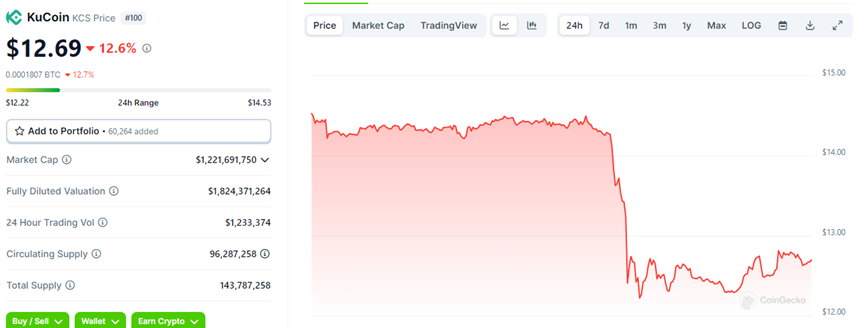
However, KuCoin's native token KCS has experienced a decline. Coingecko data shows that after the news of the lawsuit was released, KCS fell to the $12 range, with a 24-hour decline of over 12%.

It is worth mentioning that the U.S. Commodity Futures Trading Commission stated in its legal complaint against the operator of the cryptocurrency exchange KuCoin that Bitcoin, Ethereum, and Litecoin are commodities, which may be considered as a unique "good news" for the cryptocurrency industry.
From the general response of the crypto community, it is possible that the two parties will reach a settlement in the future, and we will have to wait and see how the situation develops.
免责声明:本文章仅代表作者个人观点,不代表本平台的立场和观点。本文章仅供信息分享,不构成对任何人的任何投资建议。用户与作者之间的任何争议,与本平台无关。如网页中刊载的文章或图片涉及侵权,请提供相关的权利证明和身份证明发送邮件到support@aicoin.com,本平台相关工作人员将会进行核查。