The truth behind the conflict has been revealed.
By: Lian Ran
Edited by: Zheng Xuan
Facing the aggressive Elon Musk, OpenAI has finally fought back.
On March 6th, local time in the United States, Tuesday, OpenAI published a blog post on its official website responding to the lawsuit brought up by Elon Musk. The article was authored by OpenAI's founding members Sam Altman, Greg Brockman, and even the chief scientist Ilya Sutskever, who gradually faded out of the management team last year and was praised by Musk for his high moral standards. They collectively questioned Musk's accusations.
The article stated, "OpenAI's mission is to ensure that AGI benefits all of humanity, which means building safe and beneficial AGI and promoting its widespread distribution of benefits. Now, we are willing to share the knowledge and experience we have accumulated in pursuing this mission, as well as some facts about our relationship with Elon. We intend to refute all of Elon's accusations."
Last Thursday, Musk filed a lawsuit in the San Francisco Superior Court, alleging that OpenAI and its CEO Altman violated an agreement reached at the time of the company's founding, which aimed to promote the development of artificial intelligence technology for the benefit of humanity rather than for profit.
Musk's lawyers stated in the complaint, "In fact, OpenAI has transformed into a closed-source subsidiary of the world's largest tech company, Microsoft."
In fact, prior to this lawsuit, in November last year, Musk had already stated at The New York Times' DealBook conference that OpenAI had deviated from its original mission.
"OpenAI should be renamed 'Super Closed Source Maximum Profit AI' because that's the reality," Musk said at the event. He pointed out that OpenAI had transformed from an "open-source foundation" into a "closed-source profit-making company" valued at billions of dollars.
On February 17th last year, Musk stated on X, "OpenAI was originally established as an open-source non-profit organization to counter Google's monopoly. However, it has now transformed into a closed-source, profit-seeking company, effectively controlled by Microsoft. This completely contradicts my original intention."
Later in March, Musk continued to post on X, "I still don't understand how the non-profit organization I donated about $100 million to has become a for-profit company valued at $30 billion. If this is legal, why doesn't everyone do it?"
A few days later, Musk said on X, "I believe everything will be fine," but accompanied it with a cryptic emoji. "I realize that AI, the most powerful tool ever created by humanity, is now in the ruthless hands of corporations."
For Musk's remarks, OpenAI and several of the company's founders had not chosen to publicly respond positively, but when Musk chose to resolve the issue through legal means, OpenAI finally decided to fight back.
Last Friday, after Musk filed the lawsuit, the company's Chief Strategy Officer Jason Kwon refuted Musk's claim that OpenAI had become "effectively a subsidiary of Microsoft" in an internal memo, implying that Musk's accusations may stem from his regret at not being able to continue participating in the company's affairs; Altman stated that Musk is his hero and expressed that he misses the person he knew who "competed with others by building better technology."
In this complete blog post, OpenAI presented more evidence and details:
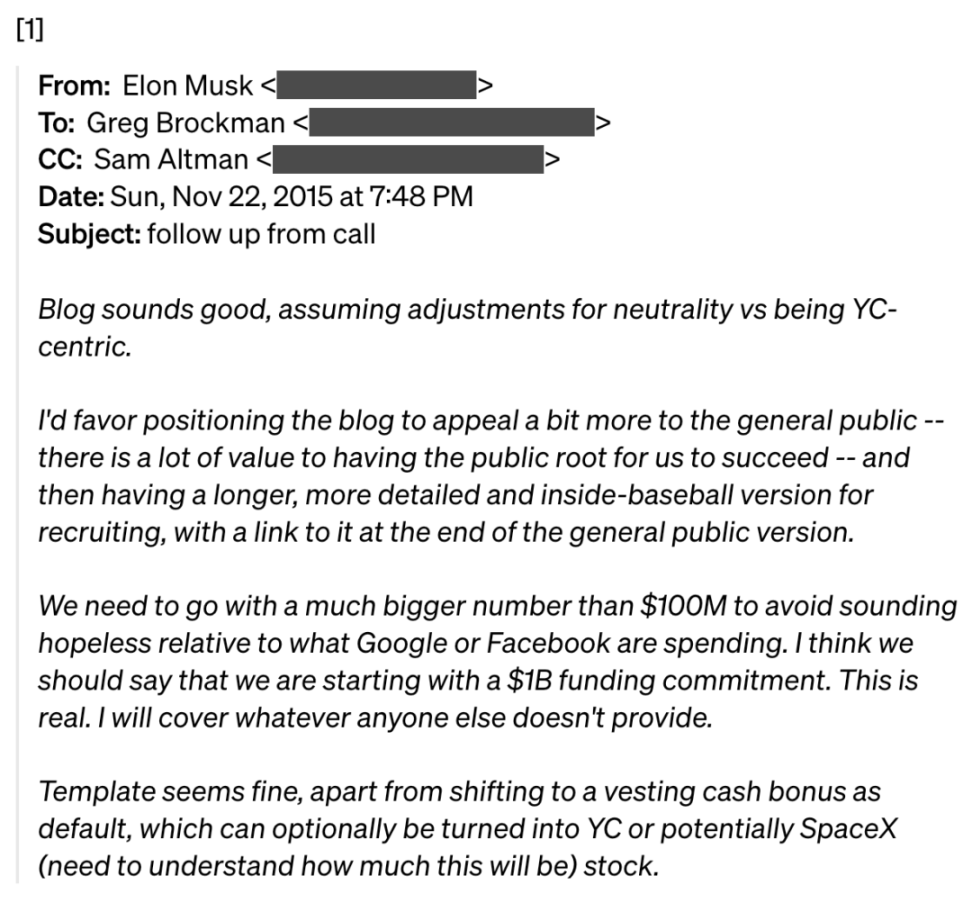
When OpenAI was established at the end of 2015, Greg and Sam initially planned to raise $100 million. Musk suggested in an email that, in order to not seem hopeless, they should announce a $1 billion funding commitment, and he would make up the shortfall. However, in the end, OpenAI only raised $135 million, with Musk contributing $45 million.
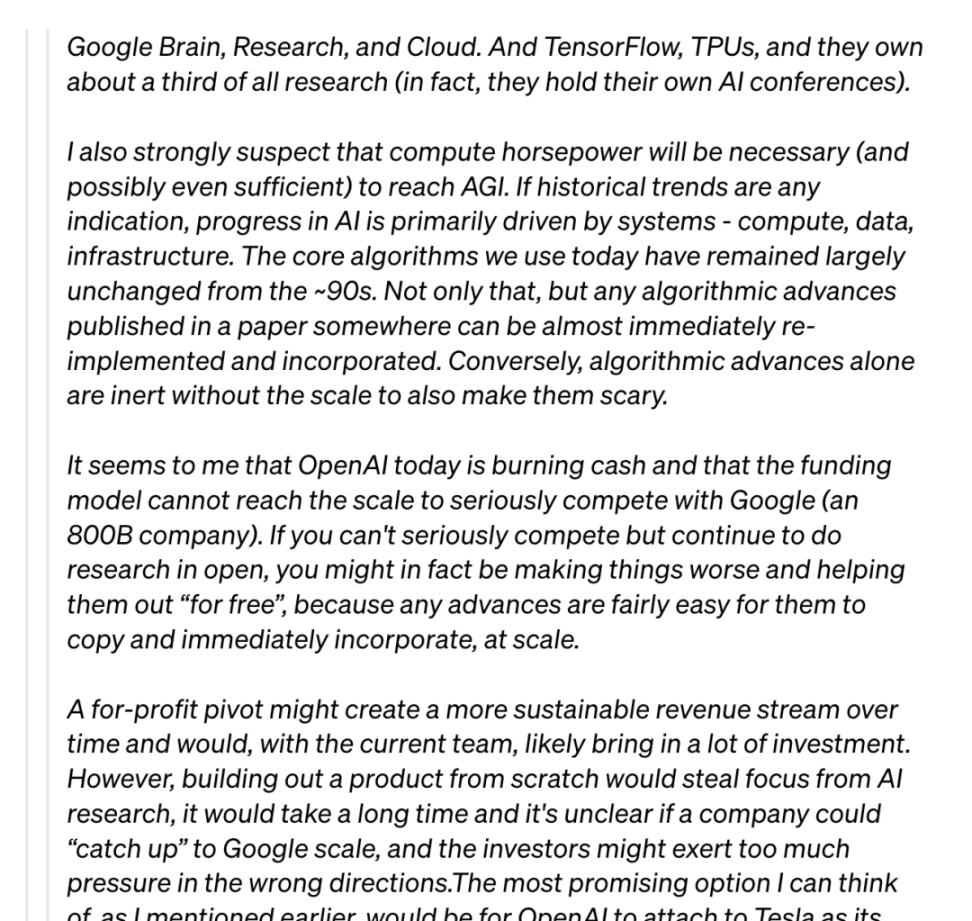
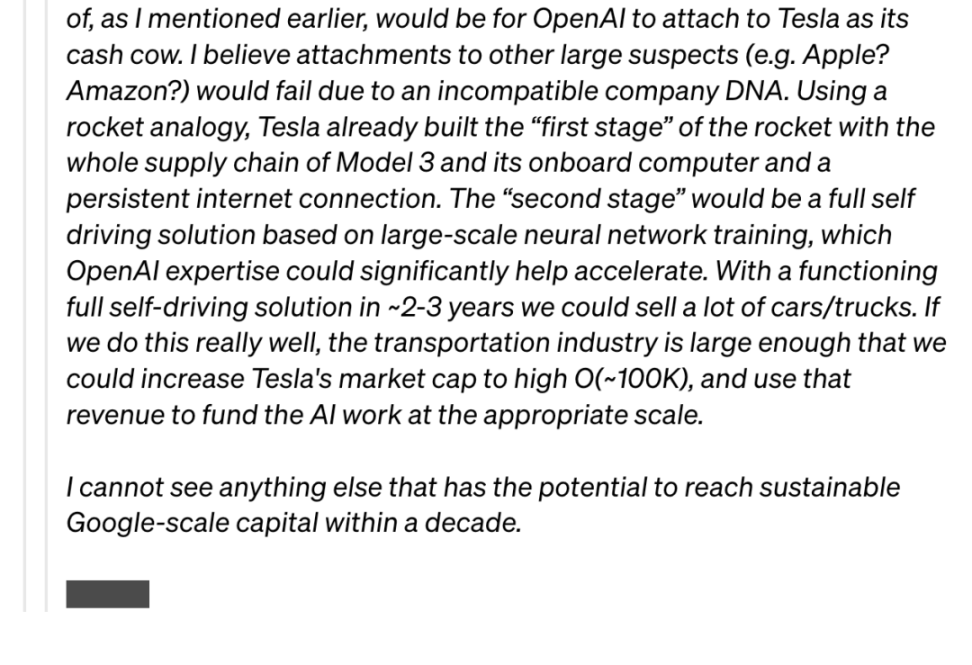
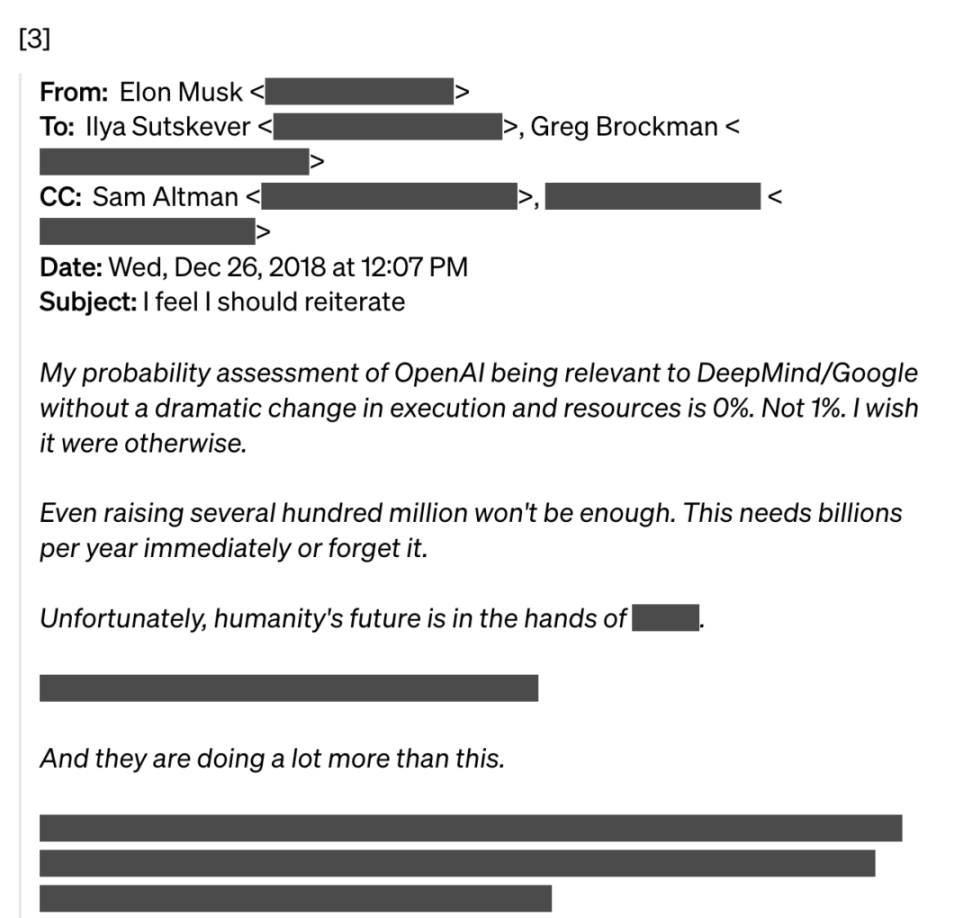
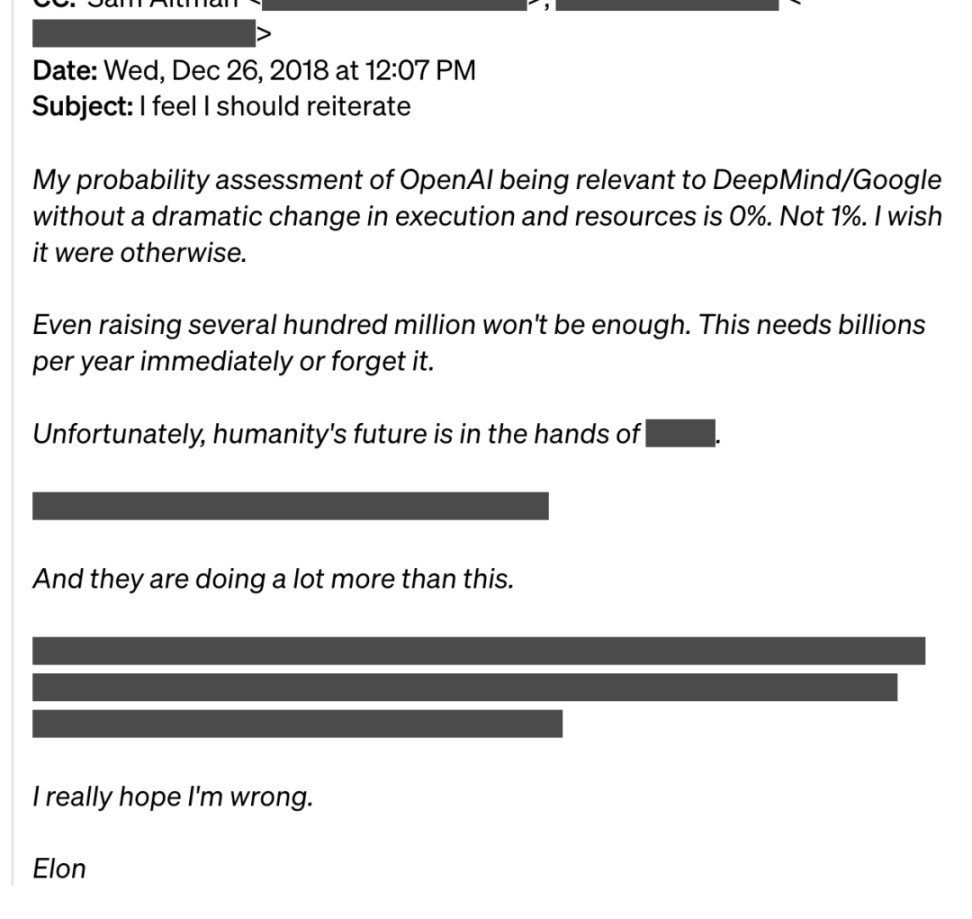
Later, OpenAI realized that the computational resources needed to build AGI far exceeded expectations, possibly requiring billions of dollars annually. Musk was aware of this and proposed that OpenAI merge with Tesla or be fully controlled by him, but the two sides failed to reach an agreement on the terms of the for-profit entity. Musk chose to leave, stating that the probability of OpenAI's success was 0, and expressing his plans to establish an AGI competitor within Tesla.
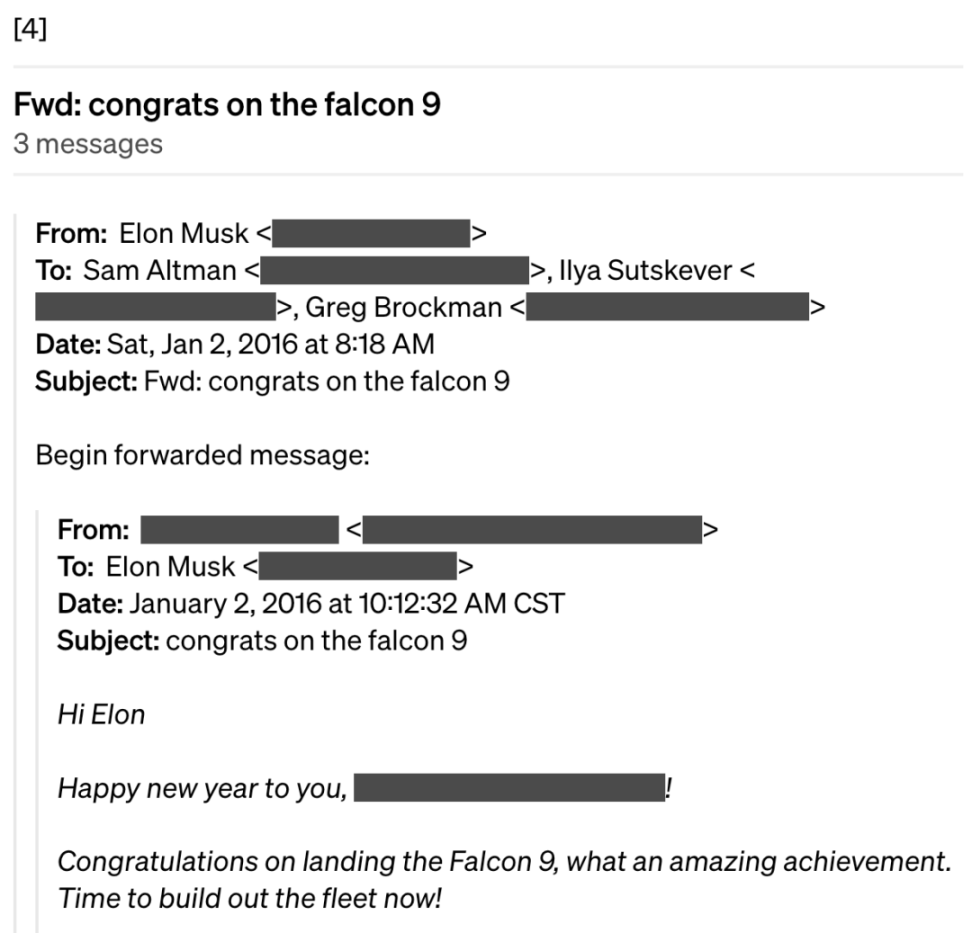
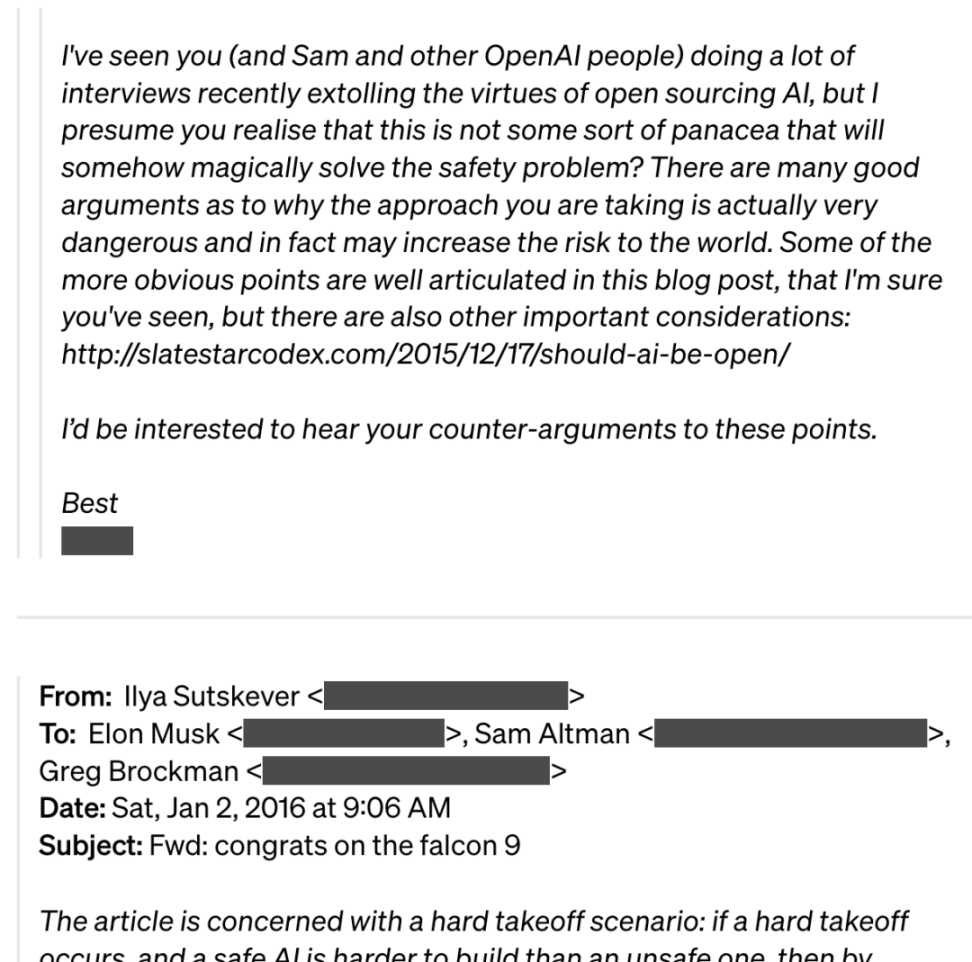
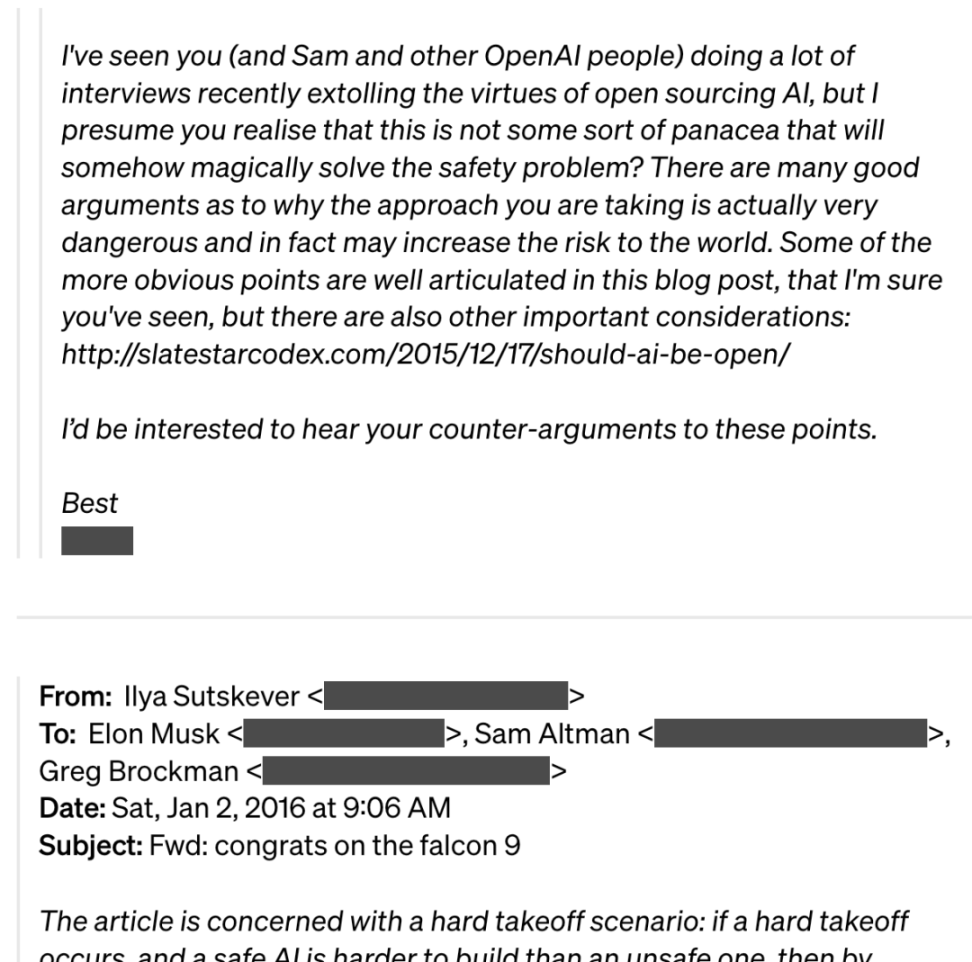
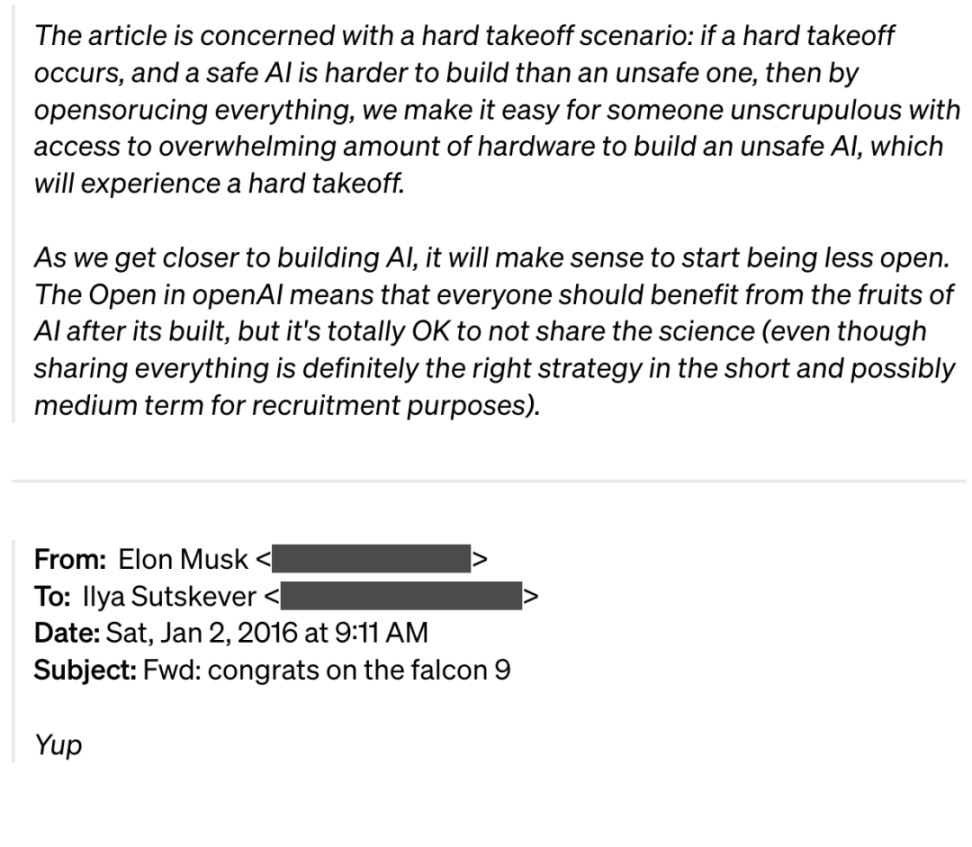
OpenAI is an organization dedicated to ensuring that artificial intelligence technology can benefit all of humanity, but this does not necessarily mean that AGI must be open-source. OpenAI emphasized that Musk himself understood this, at least at the time. Ilya Sutskever had told Musk, "As we get closer to our goal of building general artificial intelligence, it makes sense to be less open. OpenAI's openness means that everyone should benefit from the results of AI, but we don't need to disclose technical details…" This viewpoint had also received Musk's support at the time.
Despite disagreements with Musk, OpenAI continued to pursue its mission after he left, allowing people to use AI technology to improve their lives. OpenAI provided examples, such as Albania using OpenAI's tools to shorten its accession to the European Union by 5.5 years; Digital Green helping increase farmers' income in Kenya and India, reducing the cost of agricultural extension services by 100 times through OpenAI's technology; Rhode Island's largest healthcare provider, Lifespan, using GPT-4 to simplify its surgical consent forms from a university reading level to 6th grade, making it easier for more patients to understand; and Iceland using GPT-4 to protect the Icelandic language.
The following is the full text of the blog:
OpenAI and Elon Musk
We are committed to realizing OpenAI's mission and have been pursuing it.
March 5, 2024
Authors
Greg Brockman
Ilya Sutskever
John Schulman
Sam Altman
Wojciech Zaremba
OpenAI
Announcement
OpenAI's mission is to ensure that artificial general intelligence (AGI) can benefit all of humanity, which means building safe and beneficial AGI, as well as promoting its widespread distribution of benefits. Here, we are willing to share the knowledge and experience we have accumulated in pursuing this mission, as well as some things about our relationship with Elon Musk. We intend to refute all of Elon's accusations.
We realized that the resources needed to build AGI far exceeded our initial expectations. Elon once said that we should publicly announce OpenAI's initial $1 billion funding commitment.
When OpenAI was founded at the end of 2015, Greg and Sam initially planned to raise $100 million. Elon said in an email, "We need a much larger number than $100 million to avoid sounding hopeless… I think we should start with a $1 billion funding commitment… I will provide the part that others don't provide." [1] In fact, overall, this non-profit organization raised less than $45 million from Elon and over $90 million from other donors.
We spent a lot of time trying to envision a feasible path to AGI. In early 2017, we realized that building AGI would require a large amount of computational resources. We began to calculate how much computation AGI might require. We all understood that to successfully accomplish our mission, we would need more funding - billions of dollars annually, far beyond what any of us, especially Elon, thought we could raise as a non-profit organization.
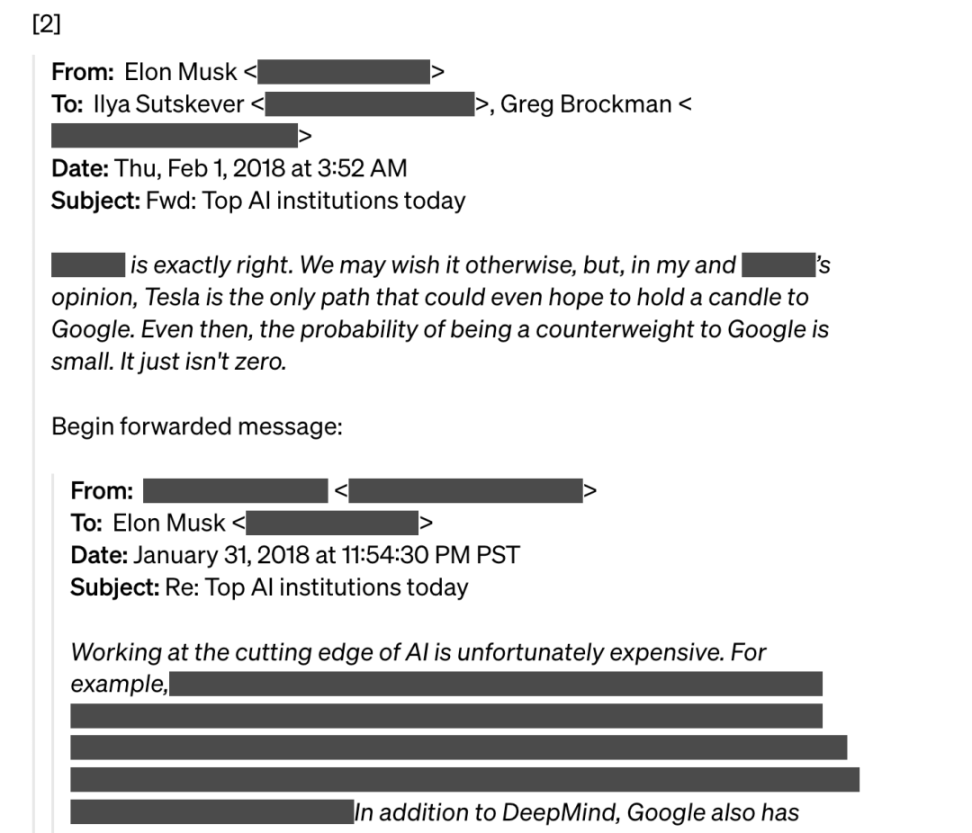
We and Elon both realized that it was necessary to establish a for-profit entity in order to obtain these resources. When we discussed the for-profit structure to advance our mission, Elon wanted us to merge with Tesla or give him full control. When Elon left OpenAI, he said that if there needed to be a competitor related to Google/DeepMind, he would personally do it. He also said he would support us in finding our own path.
At the end of 2017, we and Elon decided that in order to take the next step towards achieving our mission, we needed to create a for-profit entity. Elon wanted a majority stake, initial control of the board, and to become the CEO. During these discussions, he withheld funds. Reid Hoffman filled the gap to pay salaries and operating expenses.
We were unable to reach an agreement with Elon on the for-profit entity because we believed that any individual having absolute control over OpenAI would contradict our mission. He then suggested merging OpenAI into Tesla. In early February 2018, Elon forwarded an email suggesting that OpenAI should "attach itself to Tesla as its cash cow" and commented that this was "absolutely correct… Tesla is the only possible path to compete with Google. Even so, the likelihood of it becoming a counterbalance to Google is small. But it's not zero." [2]
Elon soon chose to leave OpenAI, saying that our probability of success was 0 and planning to create an AGI competitor within Tesla. When he left at the end of February 2018, he told our team that he supported us in finding our own path to raise billions of dollars. In December 2018, Elon sent us an email saying, "Even raising hundreds of millions is not enough. This requires billions of dollars annually, otherwise give up." [3]
We are advancing our mission by building widely available beneficial tools. We are making our technology widely available in ways that empower people and improve their daily lives, including through open-source contributions.
We provide access to the most powerful artificial intelligence today, including a free version used by hundreds of millions of people every day. For example, Albania is using OpenAI's tools to shorten its accession to the European Union by 5.5 years; Digital Green is helping increase farmers' income in Kenya and India, reducing the cost of agricultural extension services by 100 times through OpenAI's technology; Rhode Island's largest healthcare provider, Lifespan, uses GPT-4 to simplify its surgical consent forms from a university reading level to 6th grade; and Iceland is using GPT-4 to protect the Icelandic language.
Elon understood that our mission does not mean that AGI must be open-source. As Ilya told Elon, "As we get closer to building artificial intelligence, it makes sense to be less open. OpenAI's openness means that everyone should benefit from the results of artificial intelligence, but not sharing technical details is completely acceptable…" to which Elon replied, "Yes." [4]
We are very sorry that this happened to someone we greatly admire - someone who inspired us to pursue higher goals, and then told us that success was hopeless, and even became our competitor. However, even after he left, we continued to work hard to achieve OpenAI's mission and made substantial progress. His decision to sue us at this time is very regrettable.
We are focused on advancing our mission, and there is still a long way to go. We are continuously optimizing our tools and are excited about the prospect of putting these systems into use to support everyone.
The contents of the emails mentioned in the blog are as follows:
免责声明:本文章仅代表作者个人观点,不代表本平台的立场和观点。本文章仅供信息分享,不构成对任何人的任何投资建议。用户与作者之间的任何争议,与本平台无关。如网页中刊载的文章或图片涉及侵权,请提供相关的权利证明和身份证明发送邮件到support@aicoin.com,本平台相关工作人员将会进行核查。


