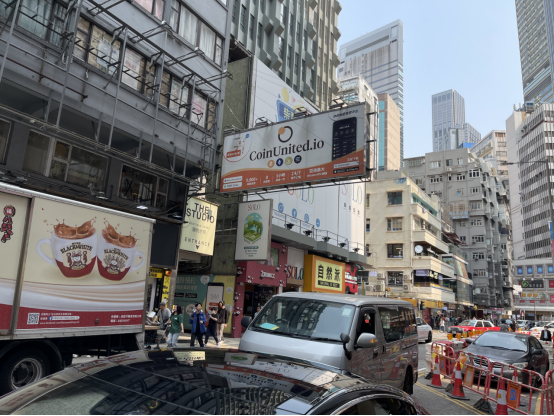
If you are observant, you will notice that there are many cryptocurrency exchange shops scattered on the streets of Hong Kong.
In these shops, users can freely exchange cash and cryptocurrencies without any KYC identity authentication - that is, without being asked any questions. According to on-site visits, a single exchange shop could exchange up to 1 million Hong Kong dollars at a time last year, and the exchange party only needed to provide a phone number or email. Compared to the high fees of Hong Kong digital exchanges, the exchange rate at these shops is undoubtedly more cost-effective and convenient. In a sense, this reflects the characteristic of financial freedom in Hong Kong, but it has also raised concerns among some industry insiders about anti-money laundering.
However, the good times have not lasted long. Hong Kong has announced plans to issue new rules to prohibit OTC exchanges, and the aforementioned companies are likely to face challenges of restricted business or even expulsion due to imminent regulation.
The concept of OTC is not unfamiliar to industry insiders. As the name suggests, any place where independent matching transactions occur outside of regular exchanges can be considered an OTC exchange. Generally, cryptocurrency OTC mainly covers three main channels: online platforms mainly matched by social media, offline physical exchange shops, and cryptocurrency ATMs.
According to preliminary on-site observations by Hong Kong law enforcement agencies, there are approximately 200 physical virtual asset OTC exchange shops in Hong Kong (including OTC exchange shops operated by ATMs) and about 250 active virtual asset trading service providers online. According to Chainalysis investigations, exchange shops are a significant part of off-exchange cryptocurrency trading, accounting for a major portion of the $64 billion in digital assets flowing through Hong Kong as of June.
Upon closer examination, the main reasons for the regulation are the inherent anti-money laundering flaws in OTC, disorderly market order, and lack of effective investor protection. Especially in the highly publicized JPEX and Hounax incidents last year, some cryptocurrency exchange shops became key players, and false advertising platforms had obtained compliance licenses. Data shows that in the JPEX incident, investors lost $180 million, and in the Hounax scam, 145 victims collectively lost $18.9 million, with most investors' funds still unrecovered.
Against this backdrop, on February 2, 2024, Hong Kong Financial Secretary and Treasury Secretary Christopher Hui announced that the government believes there is a need to regulate virtual currency OTC exchanges and will soon begin consulting on the proposed regulatory framework, hoping that citizens and stakeholders will actively express their opinions. A few days later, on February 8, the Hong Kong government launched a public consultation on the proposed legislation to establish a licensing system for virtual asset OTC service providers, with the consultation period ending on April 12.
According to the legislative proposal, Hong Kong plans to establish a licensing system under the Customs and Excise Department, including online platforms, offline entities including ATMs, for anyone engaging in any virtual asset spot trading services in Hong Kong, must apply for a license from the Commissioner of Customs and Excise. Licensed virtual asset OTC operators must comply with the anti-money laundering and counter-terrorist financing provisions stipulated in the Anti-Money Laundering Ordinance and other regulatory requirements. In short, cryptocurrency OTC service providers need to collect customer records and increase personnel to monitor improper trading behavior, officially marking the end of the era without KYC.
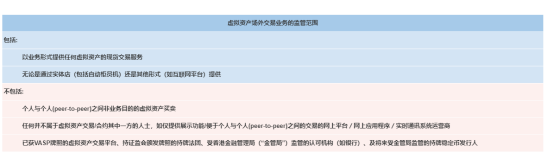
Regulatory scope of virtual asset OTC business, source: Junhe
Furthermore, the types of currencies that users can trade will also be restricted. The proposed services provided by licensed virtual asset OTC traders may only cover tokens traded by retail investors on at least one virtual asset trading platform licensed by the Securities and Futures Commission and stablecoins issued by issuers licensed by the Hong Kong Monetary Authority (HKMA) after the proposed stablecoin issuer licensing system is implemented.
The proposal also specifies penalties for violations of relevant regulations. Anyone engaging in regulated virtual asset OTC trading services without a license, upon conviction through due process, may be fined $1 million and imprisoned for two years. In addition, licensed persons who engage in improper behavior (such as violating other regulatory requirements) may be subject to administrative penalties, including temporary suspension or revocation of the license, reprimand, order to make corrections, and/or fines (not exceeding $500,000).
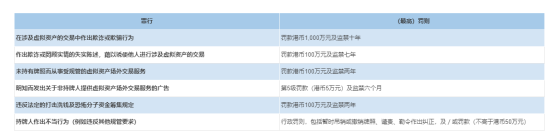
Proposed offenses and (maximum) penalties in the "Virtual Asset OTC Consultation Document," source: Junhe
From a macro perspective, with the introduction of virtual asset OTC trading into the regulatory framework, coupled with the existing VATP licenses, the upgraded Type 1 virtual asset trading license system, the upgraded Type 4 virtual asset advice license, the management of portfolios containing virtual assets, the SFC's guidance on tokenized securities business, and the upcoming stablecoin issuer licensing system, it undoubtedly signifies that Hong Kong's governance framework for the cryptocurrency field is gradually maturing, forming a relatively complete regulatory mechanism with licenses as the core, covering both on-exchange and off-exchange activities.
On the other hand, the deadline for applications from licensed entity exchanges is also approaching. According to the rules manual formulated by the Securities and Futures Commission in mid-2023, licensed exchanges must obtain or apply for a license by February 29.
However, considering the differential impact of regulations on different entities, opinions vary widely.
Chengyi Ong, APAC Policy Manager at Chainalysis, which tracks digital asset transactions, said that the OTC framework in the legislative proposal "will lead to the integration and reorganization of existing institutions as providers must manage crime, cybersecurity, and other operational risks, and the frequency of OTC platforms as gateways for cryptocurrencies will be greatly reduced."
Jason Chan, a partner at Howse Williams, a law firm specializing in financial regulatory consulting, said that the legislative proposal will involve the Customs and Excise Department of Hong Kong and other institutions, which may give the public the impression of "overly fragmented regulation."
In response, a spokesperson for the Financial Services and the Treasury Bureau stated that given the Customs' own business functions, the Customs and Excise Department is the most suitable institution to regulate providers of off-exchange cryptocurrency trading services. The spokesperson added that the rules manual provides necessary risk controls and maximum investor protection.
For exchange shops caught in the regulatory whirlpool, the sharp rise in compliance costs is an inevitable trend.
One Satoshi is one of Hong Kong's chain OTC companies. According to its co-founder Roger Li, the company mainly serves retail investors, usually conducting small transactions of 10,000 Hong Kong dollars or less.
Li stated that although the company has conducted some anti-money laundering and KYC checks, the new requirements related to compliance personnel and record-keeping may increase costs. In this situation, OTC trading companies "either have to stop cryptocurrency business or apply for new licenses." He is currently also waiting for more clear policy guidance to be issued.
This regulation does not affect the application for licenses by cryptocurrency exchanges. Currently, there are only two licensed digital asset exchanges in Hong Kong, HashKey Exchange and OSL Group. According to disclosures on their official websites, as of February 27, a total of 19 institutions, including OKX, Bybit, Crypto.com, and HKVAX associated with Binance, have submitted license applications. It is noteworthy that HTX, under the guidance of Justin Sun, withdrew its application three days after submission without disclosing the reason for the withdrawal.
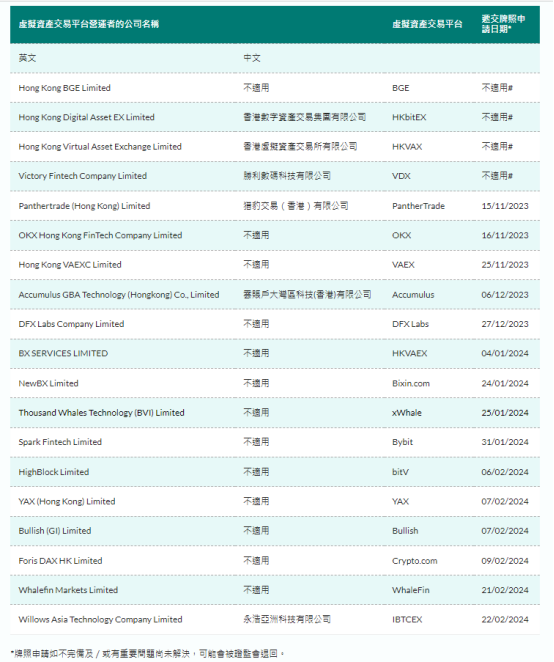
List of licensed institutions, source: Hong Kong Securities and Futures Commission official website
Taking a global perspective, despite the United States taking the lead, Hong Kong still faces a battle for dominance in the cryptocurrency asset business with regions such as Singapore and Dubai. Therefore, Hong Kong has always insisted on leading the way in policy formulation that balances inclusiveness and innovation. Previously, the Hong Kong Securities and Futures Commission allowed exchange-traded funds to directly invest in cryptocurrencies; and even before the approval of Bitcoin spot ETFs in the United States, the Hong Kong Securities and Futures Commission had already stated that it was "ready to accept applications for the approval of virtual asset spot ETFs"; just recently, the Hong Kong Monetary Authority announced that it is in the process of formulating rules for stablecoins.
From a regulatory perspective, industry professionals generally consider this move to be foreseeable. Vince Turcotte, a cryptocurrency exchange consultant, stated: "Bringing off-exchange trading into the regulatory structure is a natural extension of the system and can further promote the legalization of the cryptocurrency market in Hong Kong."
However, considering the numerous offshore cryptocurrency platforms and the difficult-to-track P2P transactions globally, the standardized regulation of the industry and off-exchange trading in Hong Kong is by no means an easy task. Carlton Lai, Head of Blockchain Research at Daiwa Capital Markets, stated: "The decentralization of cryptocurrencies presents a huge challenge to regulation, as users can easily access offshore cryptocurrency exchanges and applications, even while avoiding government oversight."
Indeed, the cryptocurrency crime rate in Hong Kong has doubled in the past three years, with cryptocurrency cases on record in 2023 involving nearly 4.4 billion RMB (approximately $611 million). The Securities and Futures Commission (SFC) of Hong Kong recorded 1,397 and 2,336 cryptocurrency crime cases in 2021 and 2022, respectively.
This number rose to 3,415 in 2023. Of course, the increase in numbers also indicates a rise in the popularity of cryptocurrency in Hong Kong.
Ultimately, for Hong Kong, the cryptocurrency journey is far from reaching the point of overcoming numerous obstacles. Apart from public misconceptions and the still-developing regulatory framework, the most important "capital flow" has only just begun to exert its influence. Fortunately, every step taken by Hong Kong is still a work in progress, and with the current surge in mainstream cryptocurrencies, Hong Kong's position as a wealth management center also has the potential to flourish with new vitality.
References:
Bloomberg: Hong Kong Prepares Sweeping Rules to Foil Stealthy Crypto Purchases;
Junhe Legal Evaluation: Hong Kong OTC Legislative Consultation - Filling the Regulatory Gap for Virtual Asset Trading.
免责声明:本文章仅代表作者个人观点,不代表本平台的立场和观点。本文章仅供信息分享,不构成对任何人的任何投资建议。用户与作者之间的任何争议,与本平台无关。如网页中刊载的文章或图片涉及侵权,请提供相关的权利证明和身份证明发送邮件到support@aicoin.com,本平台相关工作人员将会进行核查。


