Regardless of whether you are bullish on the EigenLayer ecosystem airdrop, you can use Pendle to speculate on them or simply to earn additional income.
Author: THE DEFI INVESTOR
Translator: DeepTechFlow
Introduction
This article aims to list some innovative DeFi products that I have been using frequently recently. By practicing on-chain applications, it is easier to understand cryptocurrency-related concepts compared to just reading about them. More importantly, early adopters have often received generous returns through airdrops, which have resulted in significant profits in many cases. In this issue, I will introduce several interesting DeFi products that I highly recommend.
Pendle's Liquidity Re-Staking Pools
As some may already know, Pendle is the largest yield trading protocol.
By using it, you can bet on whether the yield of a certain opportunity will increase or decrease, and earn fixed income from your capital, and so on.
However, in this article, I will mainly focus on its newly launched liquidity re-staking pools, as Pendle has done a great job in leveraging the narrative of re-staking.
So far, Pendle has launched yield trading pools for 3 types of liquidity re-staking tokens:
rsETH from Kelp DAO
eETH from EtherFi
ezETH from Renzo Protocol
All these liquidity re-staking protocols are built on EigenLayer, which provides a real-time scoring program for its ETH depositors.
What's interesting about the re-staking pools on Pendle is that through them, anyone can speculate on the airdrop value of EigenLayer and liquidity re-staking projects.
Here is an example of the rsETH pool on Pendle:
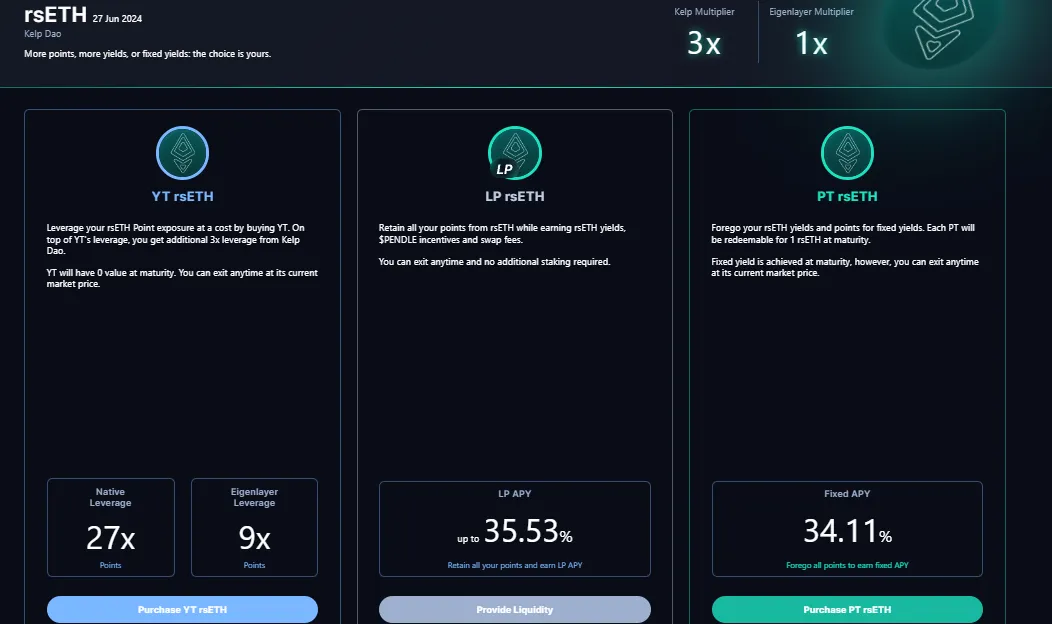
If you believe that the EigenLayer and Kelp DAO airdrops will be very successful: buy YT rsETH on Pendle to receive up to 27 times Kelp DAO points and 9 times EigenLayer points (this is a high-risk strategy because you can only make money if these points are of considerable value, you are actually buying points).
If you think these airdrops are overvalued, and you would rather earn over 30% fixed APY on ETH instead of airdrop points, then buy PT rsETH.
If you want to retain your EigenLayer points while earning additional income on your ETH, you can provide liquidity for the rsETH pool.
Regardless of whether you are bullish on the EigenLayer ecosystem airdrop, you can use Pendle to speculate on them or simply to earn additional income.
Rabby Wallet
If you are still using Metamask, I strongly recommend trying Rabby.
Rabby is a crypto wallet for Ethereum and all EVM chains, built by the team behind the most popular Web3 portfolio tracker DeBank.
I like it for several reasons:
- Pre-signature check for security: This is the first reason I recommend Rabby. The wallet displays many useful details of each transaction you attempt to sign

Smoother multi-chain experience: When you use a dApp, the wallet automatically switches to the corresponding chain based on the website you visit
Transaction simulation results: For each interaction with a dApp, the wallet shows your estimated balance change
Token authorization revocation: As an additional security measure, you can check which dApps can access your funds and easily revoke their permissions
In addition, performing specific actions on Rabby can earn you Rabby points, which may qualify you for Rabby airdrops in the future.
Its points program was launched just a few weeks ago.
Whales Market
Whales Market is a decentralized over-the-counter (OTC) exchange.
It seems to be the most interesting native Solana dApp. What sets it apart from other OTC DEXs is that, in addition to tokens and NFTs, it also allows trading points and future airdrop quotas.

Whales Market has enabled its users to trade points for EigenLayer, FriendTech, and Hyperliquid, and will soon enable trading for Blast, Kamino, Drift, and MarginFi points.
If you are collecting airdrops and want to sell your future airdrop quotas, or if you want to buy future airdrop quotas, you may want to check out this platform.
I also find it useful for estimating the potential value of the airdrops you want to collect.
For example, the current price of 1 Hyperliquid point on Whale Market is $2, but it has fluctuated significantly in the past few weeks.
RocketX
There are now many different cryptocurrency bridges.
But the problem with most bridges is that they only support a few blockchains, usually the most popular ones.
If you want to bridge your funds to Cosmos L1 or other less popular chains, you may find it difficult to do so without using a centralized exchange in many cases.
RocketX is essentially a hybrid CEX and DEX aggregator.
For every cross-chain exchange you want to make, it searches for the best price for your order among dozens of bridges and centralized exchanges.
What's interesting about it is that it supports asset transfers on over 200 blockchains, so almost every relevant blockchain is supported.
For those who sometimes find it difficult to find bridges that support specific cross-chain transactions, I recommend trying RocketX.
Picasso

On Ethereum, re-staking is undoubtedly the hottest topic at the moment.
There is not much discussion about re-staking on other blockchains, but Solana is undoubtedly one of the hottest ecosystems at the moment.
Just last week, Picasso launched the first re-staking project on Solana.
Users can now deposit SOL or SOL liquidity staking tokens in Picasso's re-staking vault. These re-staked assets will be used to secure validators in the upcoming Solana-IBC connection.
In simple terms, due to Picasso's re-staking, Solana will seamlessly interoperate with IBC-enabled chains in a minimal trust manner for the first time.
IBC-enabled chains include Cosmos Hub, Cosmos SDK chains, Polkadot, and Kusama parallel chains, among others.
On Picasso, SOL re-stakers are currently receiving a 71% APY reward on their capital through token issuance. The protocol's treasury cap is currently full, but will be increased soon.
In the long run, re-staking has the potential to significantly increase the demand for L1 tokens, so it's great to see re-staking expanding to chains other than Ethereum.
Orca
Orca is a product built by Kujira, a Cosmos L1 project, with its core team developing a wide range of products.
In essence, this product offers discounted asset prices through liquidation.
Typically, only bots can participate in the liquidation process in currency markets and exchanges.
Orca democratizes this process by allowing anyone to bid on liquidated collateral without the need for coding skills or bots.
On the Kujira network, users can borrow USK stablecoins using a variety of collateral assets. If their loan-to-value ratio rises too high, their position will be liquidated, and their collateral will be auctioned on ORCA.
Orca users now have the opportunity to purchase these liquidated assets at a discount below the current market price. All they need to do is decide after accessing the platform:
Which liquidated assets to bid on
Bid amount
Bid discount (discount)
After completing these operations, Orca will take care of the rest.
Currently, the bid value of the liquidated collateral is relatively low (only $26,000 in the past 7 days), so not many bids are being executed.
But as the Kujira ecosystem grows, this value is likely to increase.
Avocado Wallet
Avocado Wallet is a smart contract wallet with advanced account abstraction features.
Created by Instadapp, one of the most popular DeFi projects on Ethereum with over $20 billion in total locked value (TVL).
For users who use DeFi on many different blockchains, Avocado makes your on-chain activities easier, thanks to some key features:
Network abstraction: Like Rabby, the smart contract wallet automatically connects to the correct network for every dApp you interact with
Gas abstraction: Avocado abstracts gas fees by using a unified USDC gas reserve. You only need to deposit USDC on any network, and then transaction fees on major chains including Ethereum, Polygon, Avalanche, etc., will be priced in USDC (It's worth noting that Avocado charges a 20% fee on gas fees)
Cross-chain transfers: You can easily send funds from one blockchain to another directly from the wallet
As it is a smart contract wallet and not a regular wallet, you can connect to Avocado just like you would connect to any other dApp using Metamask or another wallet.
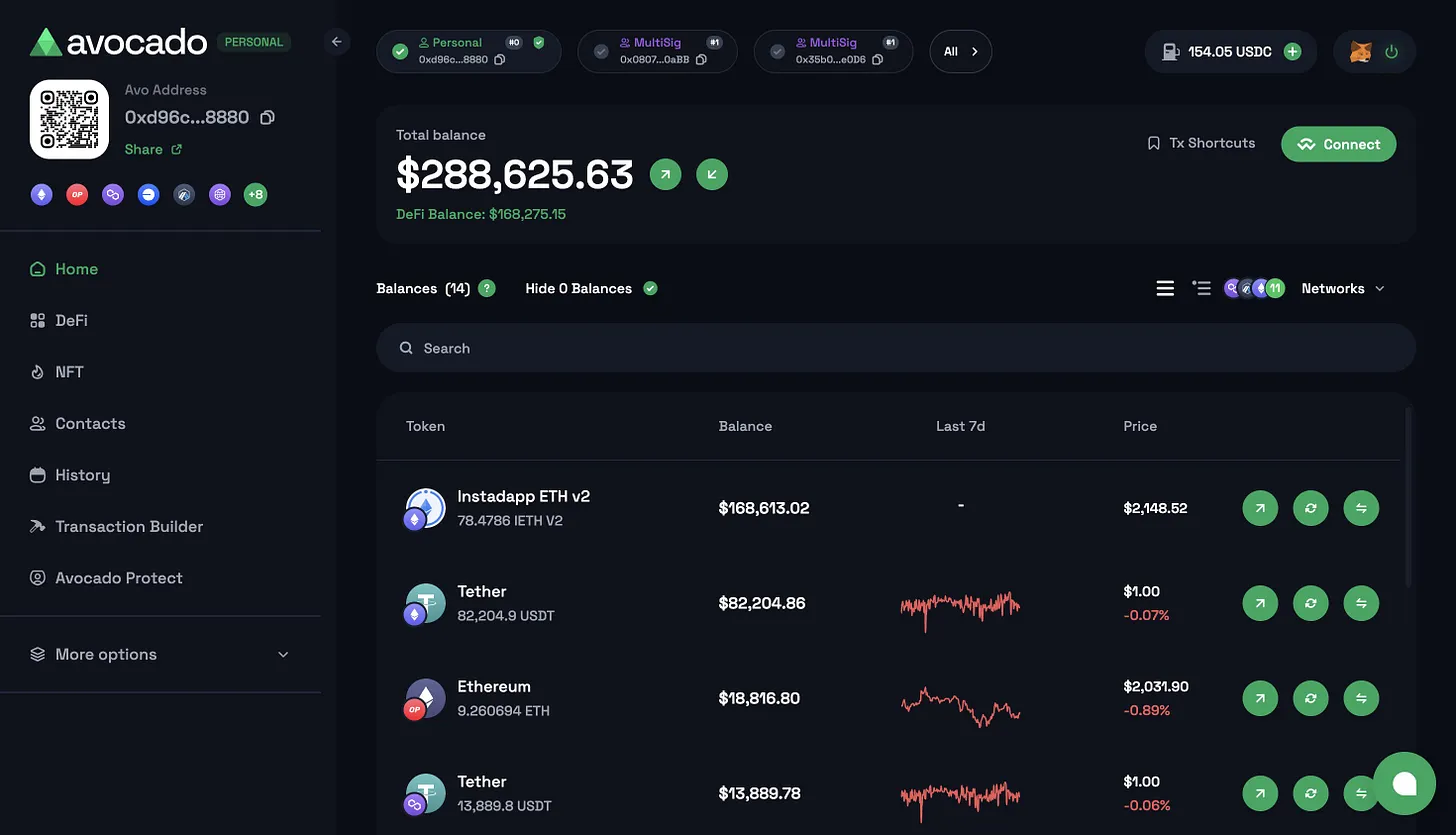
You don't need to download any extensions. Poor cross-chain user experience is one of the biggest issues in the crypto space, and the Avocado wallet is one of the wallets providing one of the best solutions for this.
免责声明:本文章仅代表作者个人观点,不代表本平台的立场和观点。本文章仅供信息分享,不构成对任何人的任何投资建议。用户与作者之间的任何争议,与本平台无关。如网页中刊载的文章或图片涉及侵权,请提供相关的权利证明和身份证明发送邮件到support@aicoin.com,本平台相关工作人员将会进行核查。


