Source: Whale Business
Author: Sanlun

Image Source: Generated by Wujie AI
In 2023, major internet companies experienced large-scale layoffs and adjustments, while e-commerce platforms continued their price wars, and AI was in a frenzy.
In April of last year, when ChatGPT was widely discussed, Whale Business wrote an article titled "The 'Great Leap Forward' of Large Models, What Changes Will the Heavy Investment of Major E-commerce Platforms Bring?" discussing the influence of artificial intelligence in e-commerce application scenarios, mainly covering design, marketing, promotion, operations, and after-sales.
Now, after a year, how AI reduces costs, improves efficiency, enhances consumer experience, and realizes the story expectations of the capital market. Let's examine the achievements of various companies and deepen our understanding of the future impact of AI on the e-commerce industry.
Retailers "Speed Up" to Embrace AI
Before observing the actions of major companies, Whale Business visited several retailers.
Regarding the question of why to use AI, Ren Hong (pseudonym), a hair accessory retailer in Jiaxing, told Whale Business: "The initial contact with AI technology was because hiring people was too expensive. A real human anchor team requires at least 3 people, including the anchor, an operator, and a control center. The AI-generated live broadcast team only requires 2 people, virtual and operational." In other words, AIGC helps retailers reduce labor costs in operations.
However, compared to cost reduction and efficiency improvement, open source has become more important after the outbreak. For Zhang Lin (pseudonym), a clothing retailer in Ningbo, finding new traffic entry points was a top priority during the epidemic.
Since the rise of domestic e-commerce, Zhang Lin has been selling women's clothing on Taobao. The company has grown from dozens of people to over a hundred. During the e-commerce dividend period, Zhang Lin, who comes from a clothing design background, has always strictly controlled the design and fabrics in the store, so the sales volume has been relatively considerable.
In the past two years, the domestic epidemic has caused a decline in sales, but the return rate has not decreased. Following the footsteps of her peers, she began to focus on overseas markets. Zhang Lin explored selling her children's clothing in countries such as Southeast Asia, the Middle East, and Africa. Language, product design, and model images became "roadblocks."
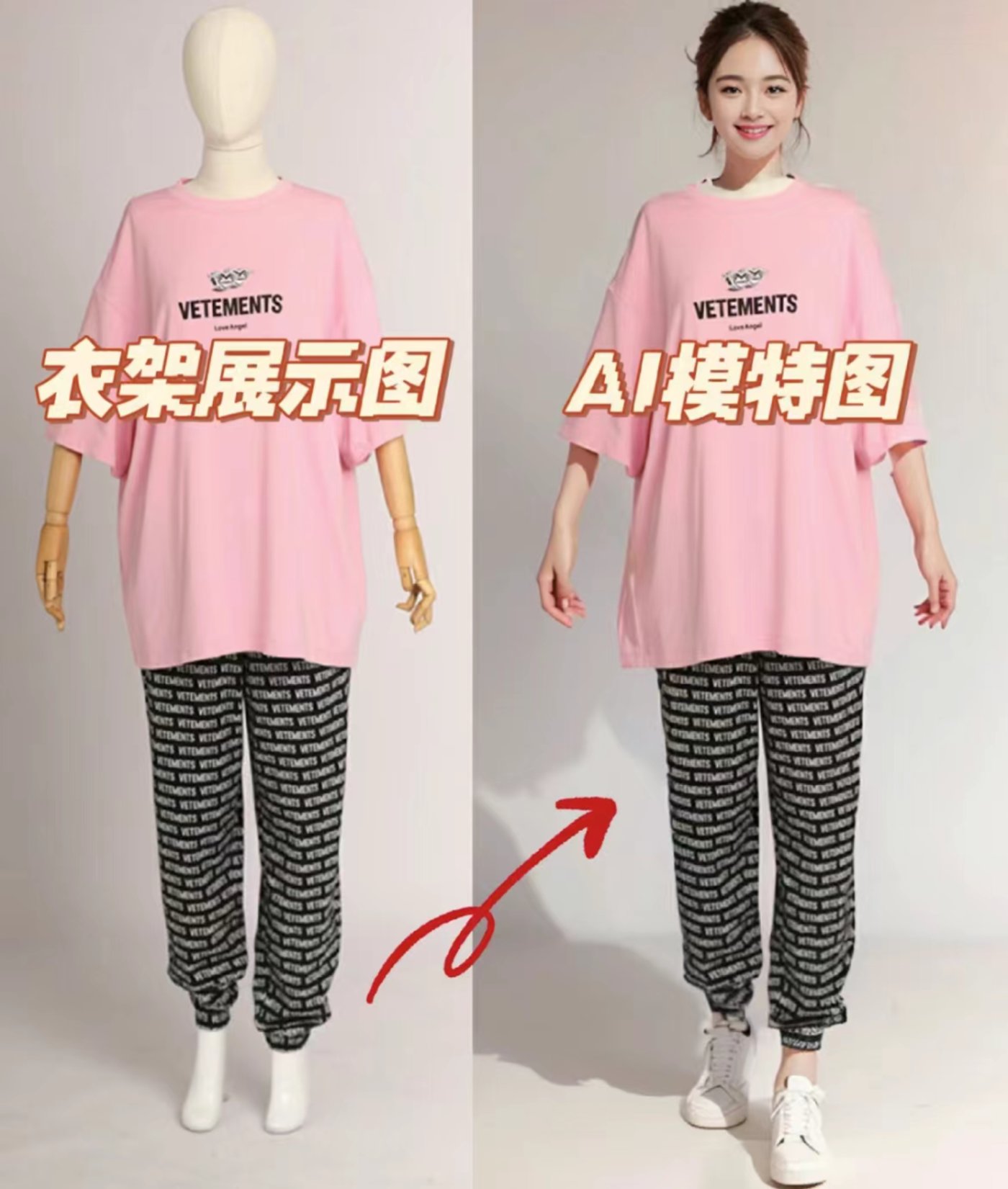
She told Whale Business: "Our clothing was originally suitable for East Asian women, but people in Southeast Asia and Africa need models that match the local skin tones, and the styles are different from those in China. Coupled with language issues, Zhang Jia needs tools to solve these problems and quickly experiment in the local market. AI technology can quickly generate model images for retailers and solve language problems. This is what allowed Zhang Lin's business to find a breakthrough.
For Li Meng (pseudonym), also a clothing retailer, the difficulty lies in creating content.
Li Meng said: "In the clothing industry, good products are also afraid of deep alleys. In the past, good products and advertising could sell goods. But in recent years, the traffic on various platforms has become more and more expensive, and good content is needed to attract consumers. We sell affordable women's clothing, with at least a hundred new arrivals every month. In the past, a simple introduction was enough for each garment, but now, e-commerce content is a major trend, and each product needs a good introduction and live broadcast. We need to create over 300 pieces of content every month, and the workload has surged."
Li Meng's dilemma may be faced by various product categories. Major e-commerce platforms are increasing their support for content, and retailers also need a variety of product images to attract user clicks. Li Meng has to upgrade the main images of the store, introduction videos, detailed images, and buyer reviews to gain more traffic.
In addition, the effect of different clothing combinations also affects the conversion rate. Li Meng admitted: "We have sorted out well-matched outfits and wearing scenes, allowing customer service to recommend them to users, which has significantly increased sales."
In addition to the above B2C cases, in Yiwu International Trade City, which is mainly B2B, many retailers supply sellers on platforms such as Amazon, AliExpress, Lazada, and Temu. They also told Whale Business that their current business requires various digital tools to improve customer acquisition, quoting, order taking, and fulfillment efficiency. If AI can solve their pain points, it will be more effective in selling.
Overall, AIGC is revolutionizing the way goods are bought and sold. Initially, retailers only needed to take simple photos and videos to sell goods. Now, selling goods requires clear explanations of usage scenarios and diverse content. How to improve the operational efficiency of various aspects of retailers is a collective challenge for e-commerce platforms.
For users, at present, AI is not only fun and trendy, but also plays a role in comprehensive Q&A and guiding recommendations.
Decentralized AI Experiment of Shelf E-commerce
From the Turing Test in 1950 to today, artificial intelligence has come a long way in 73 years. Companies such as Baidu, Alibaba, and Huawei began self-developing large models as early as 2019. Baidu was the first to release "Wenxin Yiyuan," followed by Huawei's release of Pangu large model, Alibaba's release of Tongyi Qianwen, Tencent's release of Hunyuan large model, and ByteDance's release of Yunque large model, among others.
A wave of domestic large model frenzy was set off, and now the number of domestic large models has exceeded a hundred. After several years of competition, the large models of major companies have now developed to the next stage.
In terms of achievements, the products of several major companies have a common point in search, transitioning to recommendations. Douyin introduced products such as Xiaowukong and Dou Bao last year. However, on the Douyin platform, the closest AI experience to users is the "AI Search" function option below the search box. This option is listed alongside comprehensive, user, video, experience, product, anchor, and group buying options. If a user searches through "AI Search," they will receive answers through intelligent search.
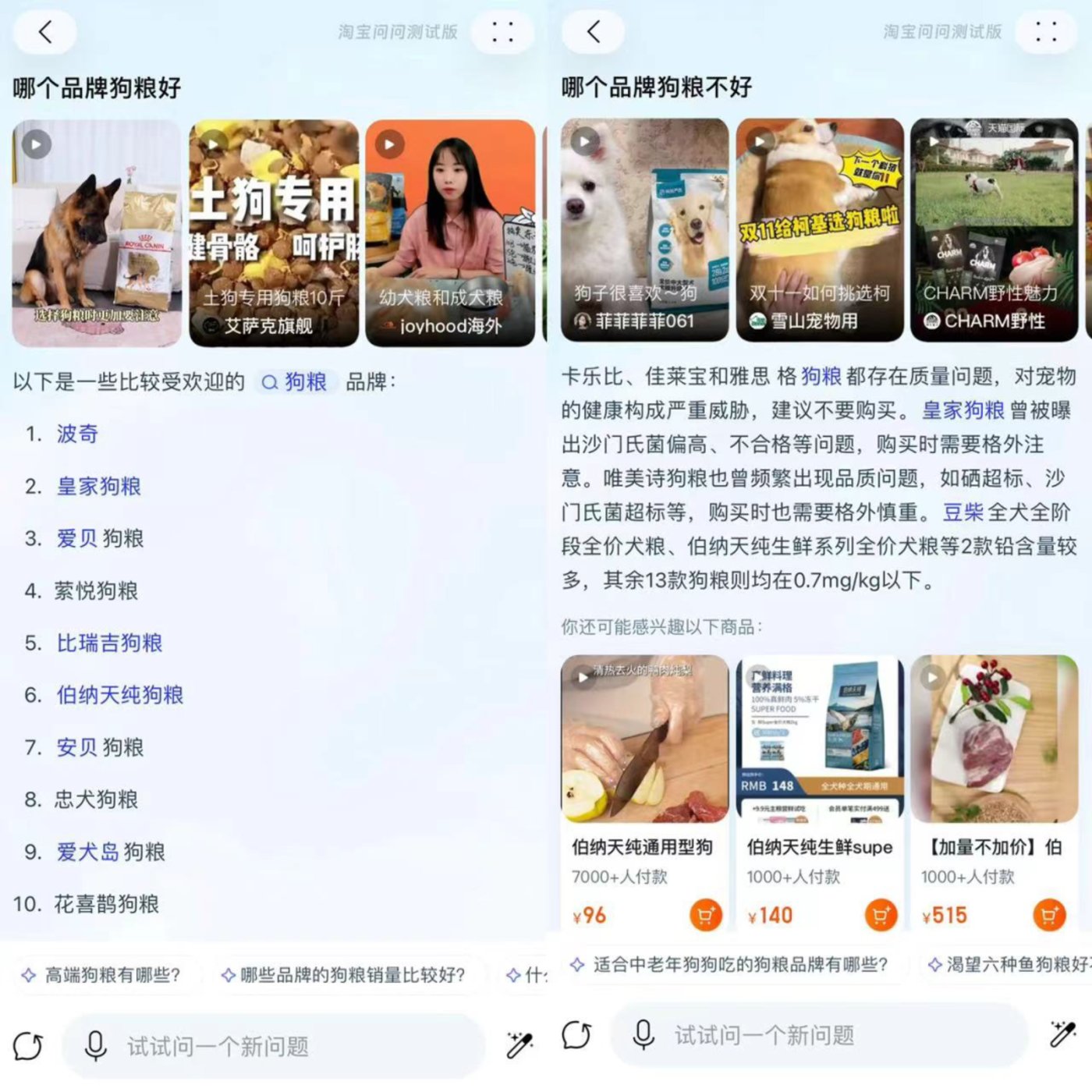
When Whale Business searched "Which brand of dog food is good?" in "AI Search," it immediately provided a comprehensive answer. Each brand's features, advantages, and prices were explained. When Whale Business continued to search "Which brand of dog food is not good?" it also listed Royal Canin, Crown, East, and Pat, including reasons why the brands are not good. However, many of the answers provided by "AI Search" come from third-party websites and user-generated video content within the platform.
Similar to Douyin's "AI Search," there is "Taobao Wenwen." The beta version of Taobao Wenwen pops up after searching within the Taobao platform. Whale Business also searched the same two questions in Taobao Wenwen.
When answering the first question, Taobao Wenwen listed the answers without further introductions or recommendations. When answering the second question, Taobao Wenwen provided more detailed introductions.
Although the same brands appear in these conflicting questions, Taobao Wenwen provides product links below and personalized recommendations for some products that users may be interested in. It can be seen that this information and data mainly come from within the Taobao platform.
Looking at the community e-commerce platform Xiaohongshu, which consists of multiple small communities and circles, it is currently testing the AI application "Da Vinci." Da Vinci is suitable for answering various questions about good things in life, including travel guides, food guides, geographical and cultural knowledge, life skills, personal growth and psychological advice, as well as event recommendations.
These answers mainly combine user-shared notes within Xiaohongshu. As a social platform, Xiaohongshu's investment in AI leans more towards social functions.
Of course, these AI products still have significant limitations in Chinese semantic understanding, and some answers are barely satisfactory, and some may even cause laughter. In other words, AI products currently lack the complexity of human thinking and cannot yet bring about earth-shaking changes in people's work and lives.
And after the "Battle of Large Models," the continuously burning money e-commerce giants are now beginning to discuss the direction of application landing. Therefore, integrating AI search and question-answering technology into the main platform, doing a good job in search, is similar to attracting users again. Then, through machine learning and data analysis technology, personalized recommendations based on user interests and behavior are the key to landing.
The Key to Conversion Improvement of AI Search
All major e-commerce platforms hope that a large number of products can be seen and selected more accurately by consumers.
As early as 2013, Taobao Tmall launched the "Thousand Faces of a Thousand People" new algorithm, and at the end of 2016, it launched Taobao Live. In 2022, it further expanded into content such as "Stroll" and live e-commerce, hoping to create more "people" and "goods" connection opportunities. The construction of a mall on Douyin, and the expansion of live streaming by Meituan, are essentially the same.
The opening of the era of intelligent e-commerce allows Alibaba, JD.com, and other shelf e-commerce, Pinduoduo and other social e-commerce, as well as short video e-commerce such as Douyin, to have the opportunity to more efficiently match "multi-level supply by merchants" with "diverse consumer demands."
In terms of technological profitability, as mentioned in the first part, Taobao Wenwen provides personalized recommendations to users after they search. Therefore, products such as Dou Bao, Taobao Wenwen, and Da Vinci applied to the e-commerce field are like AI shopping guides.
For example, the try-on function of Taobao AI allows users to upload photos in the AI fitting room, then select body type and clothing, and see the effect of the clothes on the upper body. JD.com also launched the intelligent shopping assistant Jingyan AI, which has functions such as professional category consultation, personalized gift assistant, product comparison assistant, and shopping experience knowledge. Pinduoduo has established a large model team to explore e-commerce customer service, dialogue business, and other application scenarios.
Under the guidance of AI shopping recommendations, perhaps the era of bidding rankings in search engines will reappear. Platforms charge advertising fees to brands, and the more money they spend, the higher their ranking.
However, this kind of profit model may make it difficult for AI shopping guides to objectively recommend products, and may also have negative effects on the competition among merchants, consumer experience, and privacy protection.
Moreover, despite the highly developed e-commerce infrastructure, all major platforms still have a large number of counterfeit goods. Users cannot accurately identify false advertising, and AI shopping guides are guiding a large number of users, merchants, and influencers into new scenarios. Therefore, the application and profit model of AI products still need to be standardized.
On the other hand, due to the current low level of intelligence, users have not yet developed the habit of shopping through AI shopping guides. Therefore, AI shopping guides have only completed part of the traffic import and have not shortened the product path. According to interviews conducted by Yibang Power, the conversion rate of Taobao search is as high as 90%, while the performance of Taobao Wenwen has not yet surpassed this level.
In conclusion, the content of AI products is becoming more and more complex. From simple Q&A, image and video generation to the introduction of virtual characters providing emotional value, all are aimed at better understanding the needs of B and C end users and laying the foundation for monetization.
Jack Ma once said, "The AI e-commerce era is just beginning, it is an opportunity and a challenge for everyone." Embedding AI search and recommendation functions into the e-commerce field allows intelligent e-commerce to tap into consumer potential more deeply, with higher efficiency than influencers and anchors. Whether the continuous improvement of AI large model algorithms can promote the matching of people and goods still awaits market validation.
免责声明:本文章仅代表作者个人观点,不代表本平台的立场和观点。本文章仅供信息分享,不构成对任何人的任何投资建议。用户与作者之间的任何争议,与本平台无关。如网页中刊载的文章或图片涉及侵权,请提供相关的权利证明和身份证明发送邮件到support@aicoin.com,本平台相关工作人员将会进行核查。