Reports in the past few weeks detail that bad actors are targeting two privacy coin projects, Monero and Zcash, adding to concerns about the growing rate of security incidents involving blockchain networks. Such incidents, as well the repeated 51% attacks on the Ethereum Classic network or the Electrum wallet breach, suggest criminals are becoming more sophisticated.
Still, bad actors sometimes use less sophisticated methods and appear to get away with it. For instance, the security breach targeting Monero users emerged after scammers created a fake Mymonero android app URL.
In a post on Reddit urging users to ignore the fake link, Monero developers claimed this to be the work of the “same group of scammers that have been targeting Myetherwallet since at least 2016.” According to these developers, “every time it gets reported (the fake Myetherwallet) and taken down, they manage to come back up again.”
Explaining why they issued an alert, the XMR Core team believes its “very likely that the app can be used to steal user’s funds” and is thus urging users to “report the fake web address to Google.”
Meanwhile, another privacy-focused crypto, the Zcash project appears to have been targeted as well after attackers created a fake Twitter account, according to Tim Ismilyaev, CEO and Founder at Mana Security.
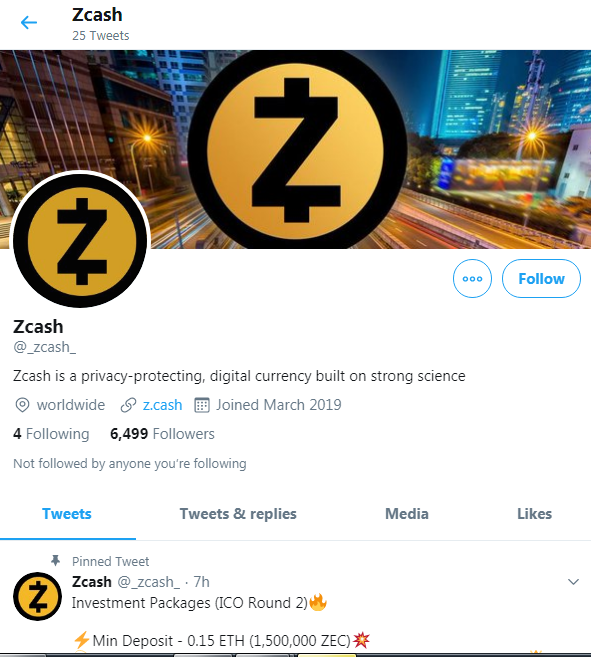
According to Ismilyaev, “the account (which now boasts more than 6,000 followers) even publishes information about fake distributions of the crypto and contains Ethereum addresses for fundraising.”
Explaining why the privacy coins are apparently getting targeted now, the Mana Security founder says for criminals, this is more logical than aiming for bigger coins.
“The key reason for this is the simplicity to get to the top-3 positions in search results. It’s orders of magnitude more challenging to get the same places for Bitcoin and Ethereum,” explains Ismilyaev.
Still, the CEO is also blaming the Google Play store, which he says does not “manually verify each update of apps like Apple does for its store.”
As a consequence, Google’s store “contains at least dozens thousands of counterfeit apps.” It costs less than $25 “for an attacker to publish a new fake wallet” after “spending just a couple of days making the app.”
It also appears that attackers target users that “don’t want to take extra steps to verify wallets from multiple sources.” Security experts like Ismilyaev say that “before installing a new crypto wallet” it would be wise to “find references about the particular wallet on the internet.”
Other steps that new users can take in order to protect themselves include triple-checking wallets. “Developers usually post recommended wallets to use. Also, users can find reviews of specific wallets on the internet: all good wallets have a handful of youtube/blog reviews posted in 2018/2019,” says Ismalyaev.
Meanwhile, as law enforcement and cybersecurity tech firms make advances in the arena of blockchain analysis and tracing, there is a likelihood that transactions on privacy-focused networks will become traceable. Just recently, Ciphertrace claimed it now has tools capable of tracing Monero transactions even as other experts doubt this claim.
Whichever is the case, Ismilyaev is urging crypto buyers not to take chances when acquiring coins such as Monero.
“Buy crypto in batches — to minimize the likelihood of buying stolen funds. Limit the first purchase of a cryptocurrency to $10 and withdraw the coin at any crypto exchange. If it works well, then buy the rest of the coins.”
Despite Google Play’s alleged failure to flag fake apps, the CEO says users can still check an application’s installations, ratings, and reviews for guidance.
“It’s a good practice to install only apps with 100k+ installs, four-star+ rating, and 1000+ reviews,” Ismaliyaev argues.
免责声明:本文章仅代表作者个人观点,不代表本平台的立场和观点。本文章仅供信息分享,不构成对任何人的任何投资建议。用户与作者之间的任何争议,与本平台无关。如网页中刊载的文章或图片涉及侵权,请提供相关的权利证明和身份证明发送邮件到support@aicoin.com,本平台相关工作人员将会进行核查。


