

Author: Biteye
Similarly, with technology stocks plummeting, some managed to break even within three months after buying the dip, while others waited in vain for 16 years.
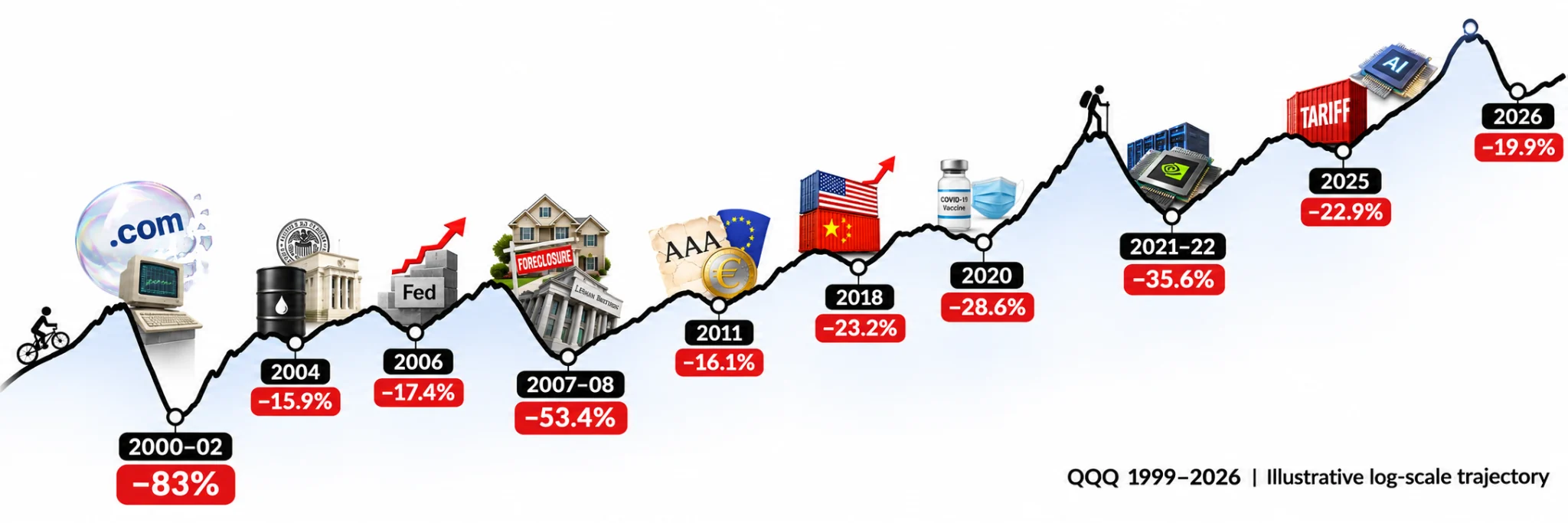
In 2000, the internet bubble burst, and QQQ plummeted 83%; in 2008, during the global financial crisis, QQQ was cut in half; during the pandemic in 2020, QQQ fell nearly 30% in less than a month.
Now, with increasing concerns about an AI bubble, QQQ is facing another drop of nearly 20%.
This time, is it an opportunity to buy the dip, or the beginning of a prolonged bear market?
Biteye reviews ten significant pullbacks of QQQ over the past 27 years, showing what the market was excited about back then and what caused the crashes.
📌 TL;DR
- Monetary tightening: The Federal Reserve's interest rate hikes and balance sheet reductions are common triggers for technology stock crashes.
- Frequency of pullbacks: Since 2020, QQQ has experienced drops of over 20% more frequently.
- Recovery cycles: Drops triggered by external shocks typically recover quickly, while the bursting of a valuation bubble may lead to a prolonged bear market.
- Narrative risk: From the internet to AI, when corporate profits fail to meet market expectations, popular narratives may become a catalyst for crashes.
🌟2000: The Internet Bubble Burst
- Pullback period: 2000.03.27—2002.10.09
- Maximum pullback: 83.0%
At the end of the 1990s, personal computers and the internet became rapidly widespread, with portal sites and e-commerce becoming the hottest investment narratives in the capital market. Companies like Yahoo, Amazon, and Cisco were highly sought after.
Wall Street popularized the concept of the "New Economy," believing the internet could improve productivity, allowing the economy to maintain rapid growth while keeping inflation low. Some investors even thought that traditional P/E valuation methods were no longer applicable.
However, many internet companies were unable to achieve profitability, and with the Federal Reserve continuously raising rates, the financing environment worsened, leading to massive bankruptcies of internet enterprises. QQQ ultimately plummeted 83%.
🌟2004: Recovery After the Internet Bubble and First Rate Hike
- Pullback period: 2004.01.26—2004.08.12
- Maximum pullback: Approximately 15.9%
After the internet bubble burst, the Federal Reserve lowered interest rates to 1%, and the U.S. economy gradually recovered. Broadband internet, search engines, and personal computers became growth hotspots in the tech industry, with Google going public that year.
However, the economic recovery and rising international oil prices intensified inflation concerns, leading the Federal Reserve to begin a new round of rate hikes in June 2004, causing the market to start digesting the valuation pressures from monetary tightening.
🌟 2006: Globalization Boom and Inflation Crisis
- Pullback period: 2006.01.11—2006.07.21
- Maximum pullback: 17.4%
At the time, the investment narrative in global markets revolved around the "BRICS" and the super cycle of commodities. Emerging economies like China were rapidly developing, and the U.S. real estate market was flourishing, leading investors to generally expect a soft landing for the economy.
However, with international oil prices nearing $80, the Federal Reserve raised rates consecutively 17 times, increasing interest rates from 1% to 5.25%. The market began to worry that prolonged monetary tightening would lead to an economic recession, resulting in sell-offs in technology stocks.
🌟 2007: Real Estate Bubble and Global Financial Crisis
- Pullback period: 2007.10.31—2008.11.20
- Maximum pullback: Approximately 53.4%
At that time, the U.S. real estate market had experienced years of prosperity, with financial innovation flourishing on Wall Street. Financial products such as MBS and CDOs packaged mortgage loans for sale, believed to disperse risk.
However, as home prices fell and mortgage default rates rose, these financial products quickly devalued. In 2008, the bankruptcy of Lehman Brothers triggered a global liquidity crisis.
To repay debts and address redemptions, financial institutions were forced to sell off large amounts of assets, and technology stocks were no exception.
🌟 2011: Rise of Mobile Internet and Sovereign Debt Crisis
- Pullback period: 2011.07.26—2011.08.19
- Maximum pullback: Approximately 16.1%
After the financial crisis, the Federal Reserve stimulated the economy through quantitative easing. Meanwhile, the iPhone, Android, mobile internet, and social networks became the new narratives in the tech industry.
However, the European sovereign debt crisis continued to brew, with countries like Greece facing debt repayment difficulties. The United States also faced a downgrade of its sovereign credit rating in August due to disputes over the debt ceiling.
Global markets began to worry about government debt risks and the potential for a second economic recession, causing technology stocks to decline.
🌟 2018: FAANG Bull Market Faces Rate Hikes and Trade War
- Pullback period: 2018.08.29—2018.12.24
- Maximum pullback: 23.2%
After years of mobile internet development, cloud computing, streaming, and social media became popular narratives in the capital market. The FAANG group, consisting of Facebook, Apple, Amazon, Netflix, and Google, became representatives of the U.S. bull market.
However, the Federal Reserve raised rates four times in 2018 while also reducing its balance sheet, coupled with the escalation of the U.S.-China trade war, leading the market to lower expectations for global economic and tech company earnings, resulting in QQQ falling into a technical bear market.
🌟 2020: COVID-19 Pandemic and Global Economic Standstill
- Pullback period: 2020.02.19—2020.03.16
- Maximum pullback: 28.6%
At the beginning of 2020, 5G, cloud computing, and electric vehicles became popular investment directions in the tech industry. The U.S. and China signed the Phase One trade agreement, and the market held expectations for global economic recovery.
However, the COVID-19 pandemic suddenly swept the globe, causing factory shutdowns, flight cancellations, and a stall in consumer activity, leading to four instances of market circuit breakers in just ten days.
Subsequently, the Federal Reserve initiated massive quantitative easing, and the pandemic fostered new demands such as remote work and e-commerce, allowing tech stocks to rebound swiftly.
🌟 2021: The End of Zero Interest Rate Frenzy
- Pullback period: 2021.11.19—2022.12.28
- Maximum pullback: 35.6%
Fueled by zero interest rates and massive quantitative easing, investment narratives surrounding electric vehicles, the metaverse, SPACs, meme stocks, and NFTs exploded, bringing a frenzy to global risk assets.
However, the Federal Reserve's previous assessment that inflation was merely transitory gradually lost credibility. Combined with the Russia-Ukraine conflict, the U.S. CPI surged 9.1% year-on-year in June 2022.
The Federal Reserve then raised rates four consecutive times by 75 basis points, leading to a rapid increase in funding costs, resulting in a large-scale repricing of overvalued tech stocks.
🌟 2025: AI Bull Market Faces Trump's Tariff Shock
- Pullback period: 2025.02.19—2025.04.08
- Maximum pullback: 22.9%
After ChatGPT triggered the AI revolution, GPUs, large models, and AI data centers became global investment hotspots, with the "Magnificent Seven" in U.S. stocks becoming the main driving force of the bull market.
At the same time, the market was also trading on the policy dividends from Trump's tax cuts and deregulation.
However, on April 2, Trump announced a large-scale reciprocal tariff policy, leading to concerns about rising global supply chain costs, inflation rebounds, and economic recession, resulting in concentrated sell-offs of tech stocks.
🌟 2026: Is a Valuation Test Coming for the AI Industry?
- Pullback period: 2026.10.06—2026.11.20
- Maximum pullback during the phase: 19.9%
The AI investment narrative gradually expanded from large models and GPUs to AI agents, computing power leasing, data centers, electricity, and financing for AI infrastructure.
As the capital expenditures of tech giants continue to expand, the market began to question whether AI business revenues could cover the enormous investment costs and whether the debts accumulated from data center construction were sustainable.
Entering November, changes in Nvidia's management, the U.S. SEC disclosed an investigation into its accounting issues, coupled with U.S. inflation exceeding expectations and rising Federal Reserve rate hike expectations, dampened market confidence further.
🌟 Is the Crash of Tech Stocks Becoming More Frequent?
Reviewing the historical trends of QQQ, Biteye found an interesting phenomenon:
From 2010 to 2019, QQQ had only one year with a drop of over 20%, while in the last seven years, there have already been three occurrences, with the current AI market correction also approaching 20%.
With the concentration of tech giants' weights in the index and AI becoming a common growth narrative among several tech companies, once the market's profitability expectations for AI change, multiple leading enterprises may face simultaneous valuation adjustments.
Looking back at history, technology stocks often manage to recover after external shocks subside and monetary policy shifts, but if the business models or profit expectations of companies are discredited, the market may experience a longer valuation cleanup.
Now, the AI revolution is ongoing, but Wall Street has started to shift from trading the speculative space of AI to assessing the actual commercial returns of AI.
How much profit can the enormous funds invested by tech giants actually create? This may be the key factor determining the depth and duration of this round of pullback.
免责声明:本文章仅代表作者个人观点,不代表本平台的立场和观点。本文章仅供信息分享,不构成对任何人的任何投资建议。用户与作者之间的任何争议,与本平台无关。如网页中刊载的文章或图片涉及侵权,请提供相关的权利证明和身份证明发送邮件到[email protected],本平台相关工作人员将会进行核查。