Author: Chao Xiang Research
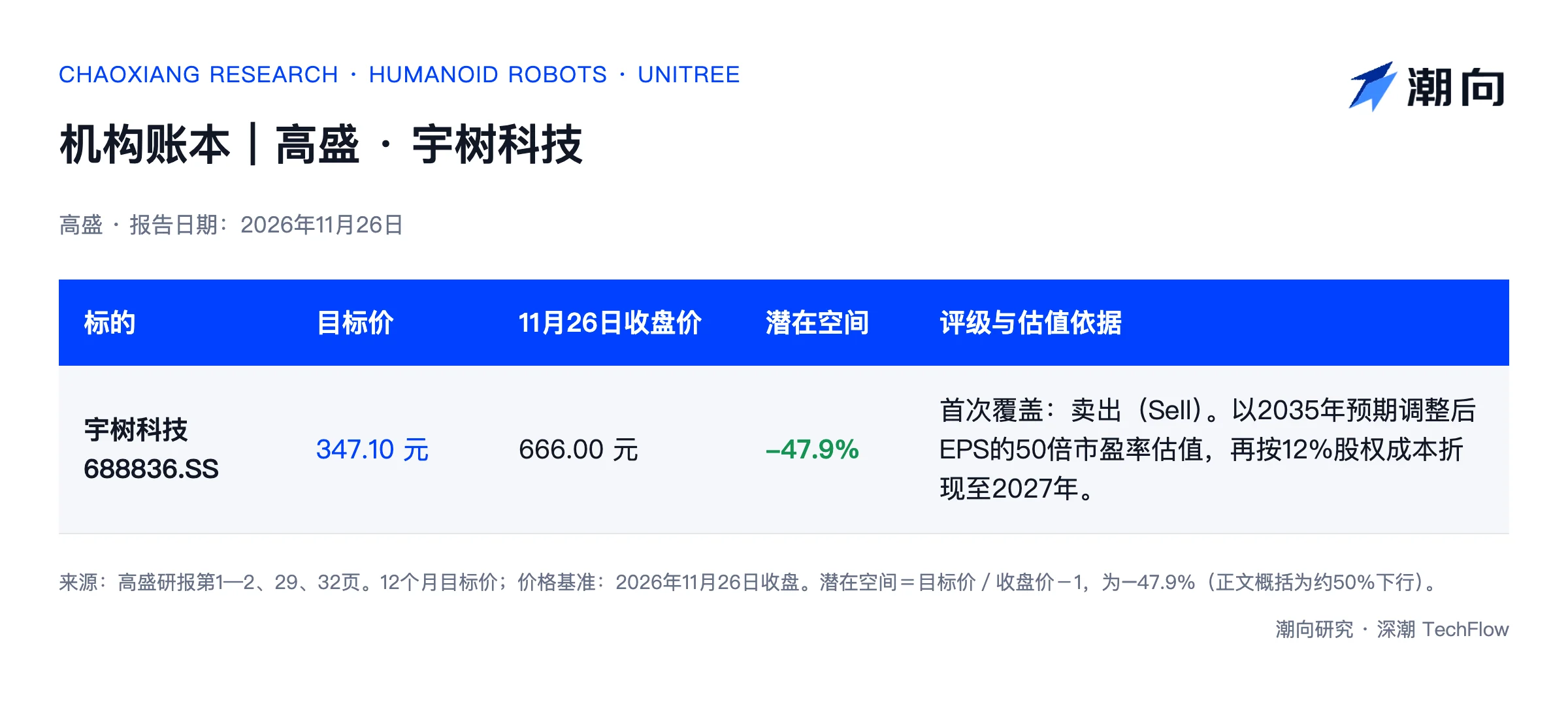
The leading commercial robotics company, Yushu Technology (688836.SS), has welcomed cautious pricing from foreign investment banks. The Goldman Sachs Asian Industrial Technology Analysis Team (Jacqueline Du) released its initial coverage report on November 26, 2026, giving Yushu Technology a "Sell" rating, setting a 12-month target price of 347.10 Yuan, implying a 47.9% decline from the current stock price of 666.00 Yuan. Goldman Sachs recognizes Yushu's first-mover advantage in low-cost actuators and motion control but believes that the current valuation has already over-anticipated global top-three market share and long-term high-profit margin expectations.
Industrial Implementation Approaches, Early Shares May Gradually Decline
Leading shipment volume in the early phase does not directly lock in the final market structure.
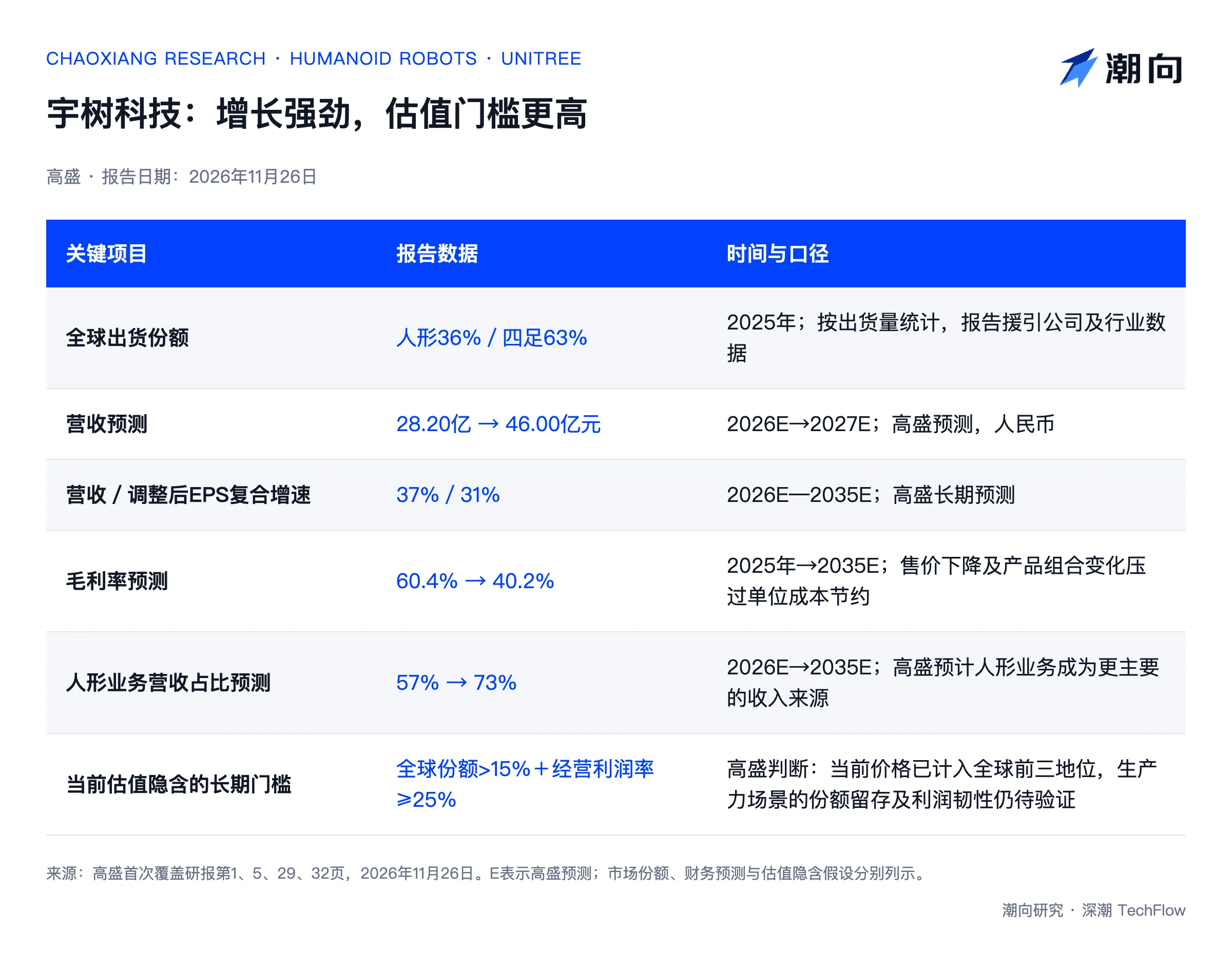
In 2025, Yushu Technology secured 36% of global humanoid robot shipments and 63% of quadruped robot shipments, thanks to its strong motion control capabilities, self-developed low-cost actuator integration, and insights from research developers. However, the competitive landscape has begun to shift. Data from third-party organizations indicate that in the first half of 2026, Zhiyuan Robotics (AgiBot) achieved approximately 8,400 units in global humanoid robot shipments (44% share), surpassing Yushu's approximately 5,900 units (31% share).
The true test lies in the transition of downstream demand. Currently, Yushu Core's shipments are highly dependent on the G1 platform launched in 2024, primarily directed towards research and education, stage performances, and data collection centers. Goldman Sachs expects that as the industry focus shifts towards "productivity scenarios" like factory manufacturing and commercial services, customer procurement standards will shift toward agile operation, task reliability, and deployment economics—areas where Yushu's industrial validation appears to be lacking.
A dramatic change in demand structure will directly lower overall market share. Goldman Sachs predicts that the share of research and education in global humanoid robot shipments will shrink from 26% in 2026 to 2% in 2035, while industrial applications will increase from 26% to 39%. As Yushu is expected to maintain a 10% to 12% share in research and education and commercial consumer areas, but only 5% in industrial applications, its globally weighted market share for humanoid robots is forecasted to gradually decline from 36% in 2025 to 6% in 2035 (with a 40% probability of entering the global top three with a 15% share).
Limited Barriers to Self-Developed AI, Integration of External Models May Pressure Profits
The commercial watershed of embodied intelligence depends on the value distribution between the "brain" and the "body."
Yushu excels in hardware and motion control (cerebellum), with a 100% self-development rate for motors and 97% for both lidar and optical cameras. However, in the area of the AI software stack (brain) that determines general intelligence, Goldman Sachs believes Yushu has not yet established significant differentiation compared to leading competitors globally and in China.
The company is attempting to bridge the gap through capital expenditures. According to the IPO prospectus disclosed in August 2026, Yushu plans to invest about 20 billion Yuan (48% of the approximately 42 billion Yuan in raised funds) into the development of AI foundational models, with 39% allocated to large models (brain) and 37% to motion control (cerebellum).
However, industry technological paradigms are undergoing subtle evolution. As cutting-edge multimodal large models like GPT-6 Astra and Claude Fable penetrate the physical world, the intelligence of robot high-level reasoning is gradually moving toward modularization and externalization. If future third-party cutting-edge large models directly empower low-cost bodies, Yushu, with its high cost-performance hardware and mass production scale, could become a commercial platform for third-party AI models, thereby relieving the burden of expensive foundational development.
But the other side of this double-edged sword is homogenized competition. When multiple hardware manufacturers can access the same level of external large models, the differentiated barriers for complete machine manufacturers will be weakened, leading competition toward purely cost comparisons and iterative speed involutions, thereby posing downward pressure on long-term profit margins.
Price Wars and Rising Domestic Shares, Gross Margin Returns to 40%
The sweet period of high gross margins is facing the direct impact of an industry price drop.
Goldman Sachs statistics show that the pace of new humanoid robot product launches globally has continued to accelerate, with over 91 new products introduced in just the first half of 2026. To capture early market share, Goldman Sachs predicts that the industry’s average selling price (ASP) will decline by about 6% per year between 2026 and 2035. With Yushu’s product pricing already being extremely aggressive (for instance, G1 with a starting price of 13,000 USD and R1 starting at 4,000 USD), its average humanoid robot price is expected to decrease by about 4% annually, from 133,000 Yuan in 2026 to 90,000 Yuan in 2035.
Cost reductions in the supply chain are difficult to fully offset the price war. Although Yushu expects to achieve a unit cost reduction of 11% and 2% in 2025-2030 and 2030-2035 respectively through automation of the motor production line (reducing labor costs by 57%) and vertical integration, the decline in selling prices and changes in regional structure pose an even more severe erosion to profits.
Fluctuations in the share of overseas high-margin markets further amplify the pressure. In 2025, Yushu's gross margin for overseas operations reached 69%, far exceeding the domestic margin of 54%. Due to geopolitical factors and U.S. chip export controls (e.g., new regulations from BIS issued on November 16, 2026, involving remote computing power restrictions, while Yushu's G1/H1 and H2 Plus utilize Nvidia Orin and Thor chips respectively), the share of domestic low-margin orders is expected to rise. Goldman Sachs predicts that Yushu's overall gross margin will gradually decline from 60.4% in 2025 and 54.9% in 2026 to 40.2% in 2035, with operating profit margins similarly dropping from 23.4% in 2026 to 15.2% in 2035.
Long-term Valuation Overdraws Expectations, Sensitivity Tests Indicate Downward Risks
Setting aside short-term enthusiasm, Yushu Technology's fundamental growth remains impressive, but the stock price has surged too quickly.
Goldman Sachs forecasts that benefiting from the global humanoid robot shipment volume rising from 75,000 units in 2026 to 6.5 million units in 2035, Yushu Technology’s total revenue compound annual growth rate (CAGR) from 2026 to 2035 will reach 37% (from 2.82 billion Yuan to 47.779 billion Yuan), and net profit CAGR will be 31% (from 693 million Yuan to 7.815 billion Yuan). Additionally, based on approximately 5.92 billion Yuan in net fundraising from the Sci-Tech Innovation Board IPO and an extremely short cash turnover cycle (around 9 days), the company has ample net cash, with an average cash return on capital employed (CROCI) of 38% from 2026 to 2030, firmly positioning it within the top tier of Goldman Sachs' coverage of the Chinese industrial technology sector.
The issue lies in the valuation multiples. The current stock price of 666.00 Yuan corresponds to a total market capitalization for Yushu of 269.4 billion Yuan, equivalent to a 60 times forecast price-to-sales (P/S) for 2027 and a 154.5 times forecast price-to-earnings (P/E) for 2028. Goldman Sachs employs a long-term earnings discounting method, assigning a 50 times price-to-earnings ratio for its 2035 forecast earnings per share (EPS) and discounting it to 2027 at a 12% cost of equity, resulting in a 12-month target price of 347.10 Yuan (corresponding to a 31 times forecast price-to-sales ratio for 2027).
Sensitivity tests reveal an extremely asymmetric risk-reward ratio. Goldman Sachs estimates that unless Yushu can maintain a top-three global market share (over 15%) and sustain an operating profit margin of over 25% by 2035, the current stock price faces significant valuation adjustment pressure. Goldman Sachs warns that if the conversion of productivity scenarios in factories exceeds expectations, pricing in the industry slows down, or the monetization speed of cooperation with third-party cutting-edge large models increases, it may constitute upside risks.
This article summarizes and interprets third-party broker research reports by Chao Xiang Research. The forecasts, metric breakdowns, and related judgments quoted in this article are solely the viewpoints of the respective broker analysts and represent their institution's stance, not the views of Chao Xiang Research, nor do they constitute any investment advice.
The market has risks, and decisions should be made independently. This article should not serve as a basis for buying or selling any securities.
免责声明:本文章仅代表作者个人观点,不代表本平台的立场和观点。本文章仅供信息分享,不构成对任何人的任何投资建议。用户与作者之间的任何争议,与本平台无关。如网页中刊载的文章或图片涉及侵权,请提供相关的权利证明和身份证明发送邮件到[email protected],本平台相关工作人员将会进行核查。