Author: insights4vc
Translation: Deep Tide TechFlow
Deep Tide Introduction: In 2026, global venture capital exhibited intense structural fragmentation. SpaceX and Anthropic collectively sold nearly $180 billion in shares during their IPOs, yet no venture capital fund cashed out. By midyear, the median return of U.S. venture capital funds from 2017 only returned 37% of paid-in capital, highlighting an increasingly evident gap between paper wealth and cash returns.
On the incremental funding side, AI accounted for over 90% of the global venture capital year-over-year increase in the third quarter, with Nvidia further binding itself to downstream cloud computing clients through hundreds of billions in equity investments and lease guarantees. Beyond AI and fintech, construction robotics, nuclear fusion energy, grid hardware, and defense technology are stepping in with large checks, shifting the venture capital logic from asset-light software to asset-heavy manufacturing and long-cycle delivery.

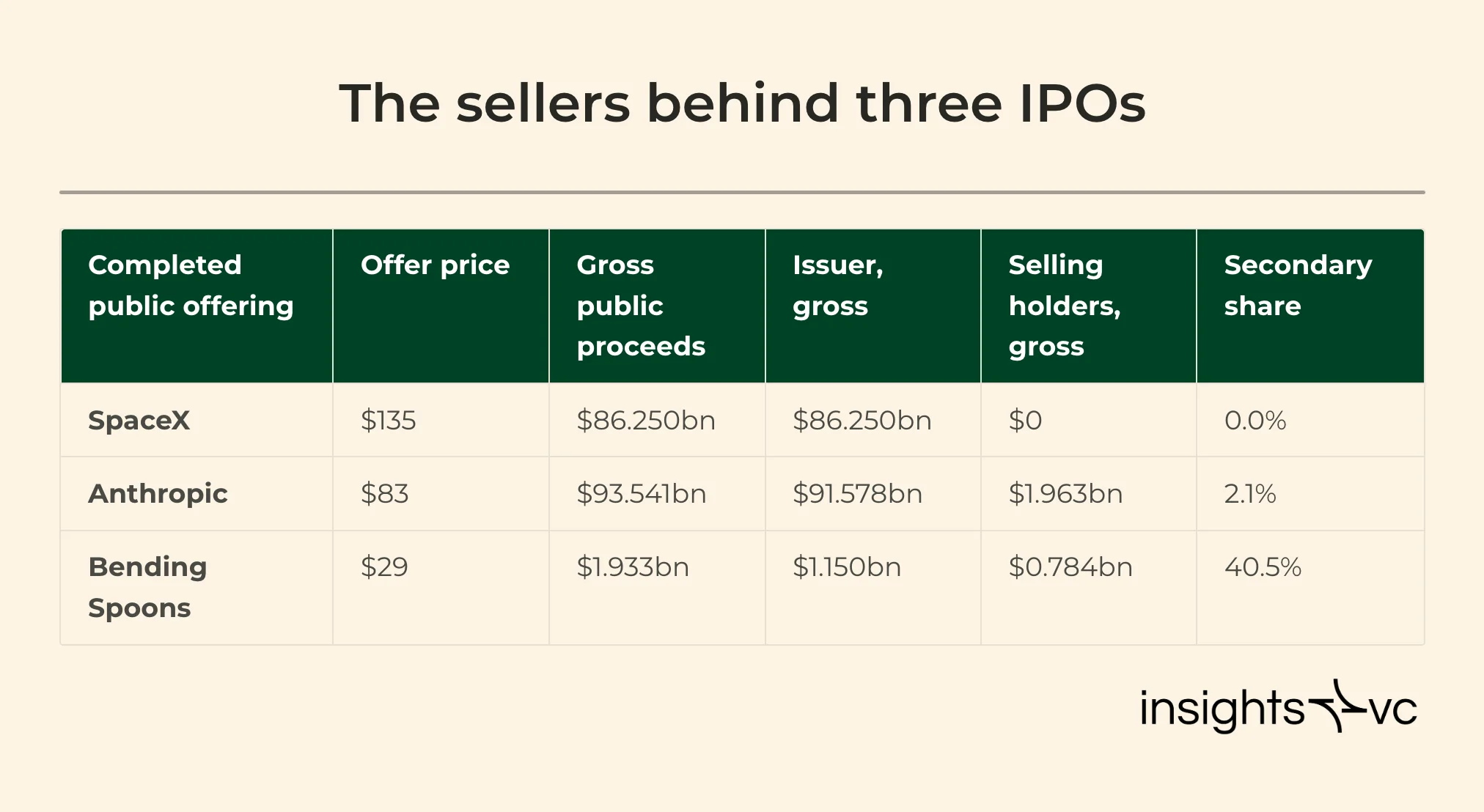
In the IPOs of SpaceX and Anthropic in 2026, nearly $180 billion worth of stocks were sold, but none of the venture capital funds were shareholders. Before underwriting fees, nearly $178 billion flowed directly into the companies, and approximately $2 billion of secondary market shares were completely owned by the seven founders of Anthropic (refer to Anthropic prospectus, Anthropic IPO completion announcement, and SpaceX prospectus).
The financing boom is similarly concentrated in other dimensions. According to Crunchbase report, global venture capital funding in the third quarter increased by $55 billion year-over-year, with AI companies alone claiming about $50 billion. For the investors of older funds (LPs), capital allocation remains worrisome: as of June 30, Carta tracking data shows that the median U.S. venture capital fund from 2017 returned only $0.37 for every dollar paid in (including cash and stock distributions).
This article will analyze what investors have actually gained from these heavyweight listings, how Bending Spoons acquired established software companies at significantly lower prices than historical valuations, why Nvidia is heavily investing in its customers, and the latest landscape in fintech and crypto. Meanwhile, we will track the capital flowing into robotics, nuclear fusion energy, and defense technology, where the latest rounds of large checks are used for equipment procurement, factory construction, and forming deployment teams on-site.
SpaceX, Anthropic, and Bending Spoons
SpaceX
On November 14, SpaceX successfully captured the upper stage of the Starship returning from orbit for the first time. According to the announcement for the 15th test flight, this flight deployed 26 Starlink V3 satellites, with the company stating that this batch of payload adds network capacity equivalent to 10 Falcon 9 missions carrying V2 Mini satellites.
The commercial value of this breakthrough lies in delivering higher bandwidth in a single launch and ultimately achieving complete reuse of the launch vehicle. However, the Super Heavy booster was damaged in the same mission, and the goal of recovering both the first and second stage in a single flight remains unfulfilled.
The newly added satellite capacity is continuously being injected into a business that has already turned profitable: according to SpaceX's third-quarter financial report, its connectivity business segment contributed $5.25 billion in revenue and $2.37 billion in operating profit in the third quarter. However, the group's capital allocation has long exceeded the realm of satellites and launch vehicles.
Out of $48.1 billion capital expenditures for the first nine months of 2026, $40 billion (83%) flowed into the “Super Intelligence” division, which encompasses its AI infrastructure, Grok, Cursor, and X. The IPO in June brought a net fundraising amount of $85.7 billion to the company. Hence, what investors hold is both a profitable connectivity business and an AI expansion that consumes most of the group's capital expenditure. The progress of Starship reinforces the investment logic of the former, while whether the much larger AI construction can yield returns remains another independent test.
Anthropic
Anthropic's IPO completed in November and simultaneous private placement raised a total of about $117.6 billion. Its seven selling founders cashed out approximately $1.96 billion (before taxes), while venture capital funds were entirely absent from the shareholder list (refer to prospectus and official announcement). The majority of this funding is used to support the company's next stage of development, with immediate secondary market liquidity going to the founders.
The prospectus reveals the realistic motives behind such substantial fundraising. As revenue rapidly expands on a locked-in computing capacity basis, the proportion of computing and infrastructure expenses to revenue decreased significantly from 172% in the first nine months of 2025 to 57% in the same period of 2026. Nevertheless, Anthropic still incurred $6.5 billion in expenses on short-term computing contracts, with the company indicating that these short-term procurement costs are significantly higher than those secured through longer-term agreements.
This provides a clear usage for the newly enriched balance sheet: procuring capacity more in advance can lessen dependence on expensive short-term supply. However, this also shifts risk, as Anthropic must lock in infrastructure before real demand arises, then create enough customer utilization to absorb this capacity. The recent improvement in the ratio of computing costs to revenue proves that this strategy is effective, but to maintain this trend, customer demand and contracted capacity must continue to grow in sync.
Bending Spoons
Bending Spoons has been acquiring mature software businesses at prices far below earlier paper valuations, while its own valuation has been climbing. The company's post-investment valuation in February 2024 was $2.55 billion, leaping to $11 billion pre-investment in October 2025. Based on an IPO issue price of $29, the total equity value corresponding to fully exercised over-allotment options after the offering is approximately $18.6 billion (refer to IPO prospectus).
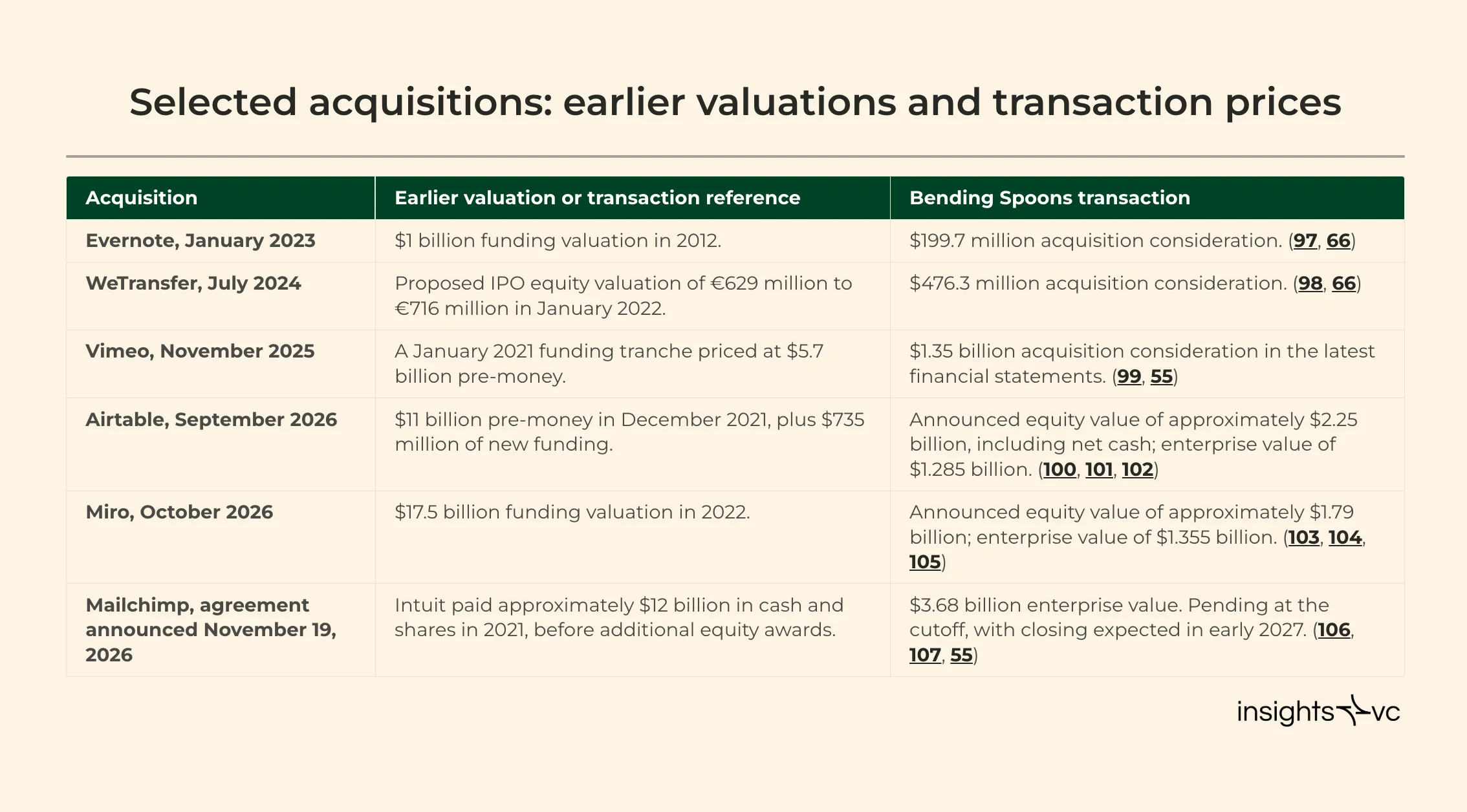
The Miro acquisition illustrates how mergers can provide liquidity while retaining some exposure to future growth. The equity value announced for Miro’s deal was approximately 90% lower than its 2022 financing valuation, but some shareholders reinvested $295 million of the transaction proceeds back into Bending Spoons upon closing (refer to SEC disclosure document).
Meanwhile, Bending Spoons' own IPO yielded approximately $784 million in gross proceeds for selling shareholders, including $377 million secured by Galileo Quattordici and $237 million obtained by managed funds under Baillie Gifford. Capital is simultaneously flowing back to sellers through both merger transactions and the acquirer's public listing.
The latest operational performance reveals what kind of logic the new shareholders of Bending Spoons are buying into. According to the third-quarter financial report, the company’s revenue surged 125% to $780 million for the quarter, but the company’s defined organic growth rate was only 3%. Despite the IPO bringing in a net fundraising amount of $1.09 billion, its net debt stood at $4 billion as of September 30.
This data drives acquisition pricing, operational improvements, and financing costs to the core of investment logic. Acquiring a former unicorn at a significant discount certainly creates opportunities, but ultimate returns still depend on profitability and cash flow performance post-acquisition.
AI Captures Most of the Financing Increment
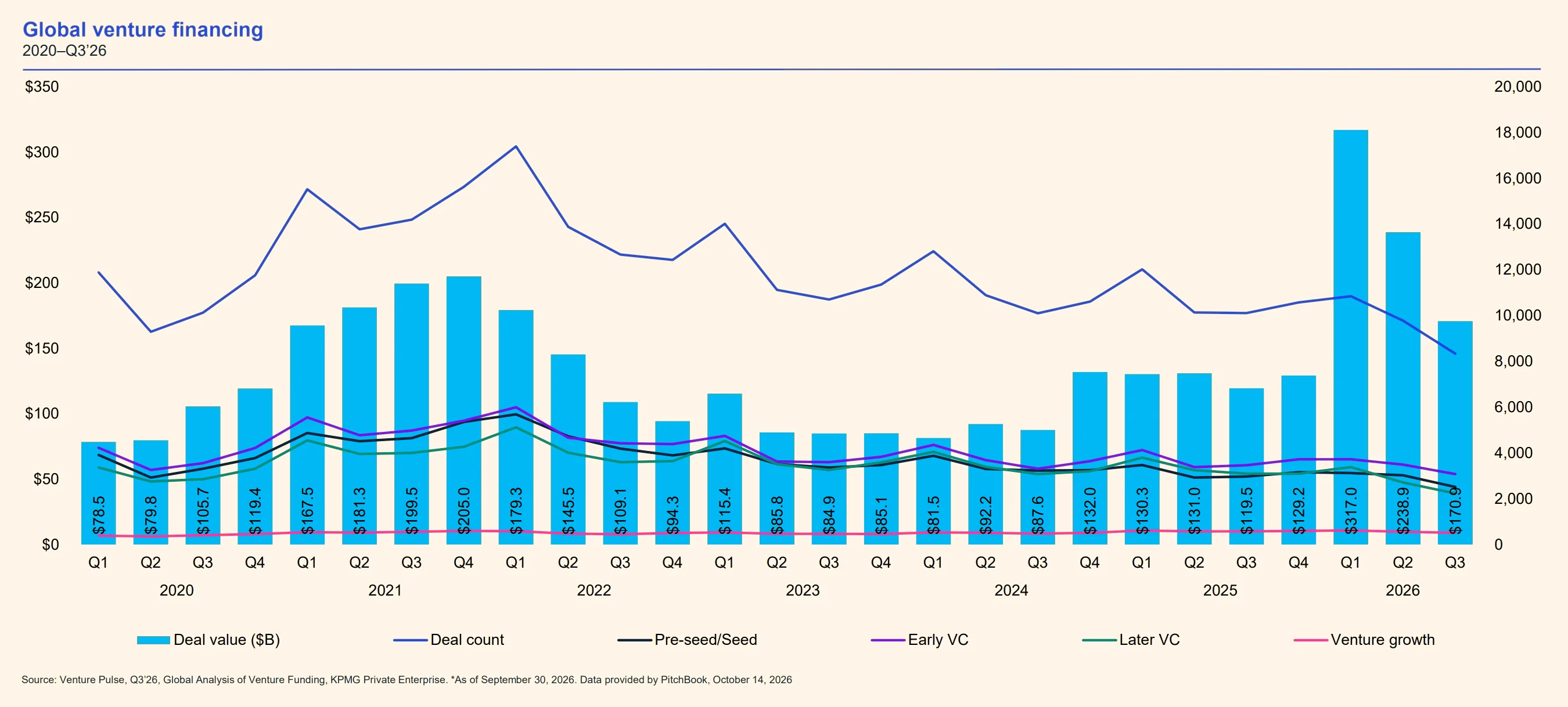
Chart: Quarterly venture capital amounts retreat from record peak in the first quarter
According to Crunchbase statistics, by the end of September, total global venture capital for 2026 reached $679 billion. The financing amount in the third quarter decreased by 25% compared to the $212 billion in the second quarter, but it is still 53% higher than the $104 billion in the same period last year. The share of AI in total financing rose to 64%, up 14 percentage points year-over-year; after deducting reported AI financing amounts, funds available for other industries totaled only about $57 billion.
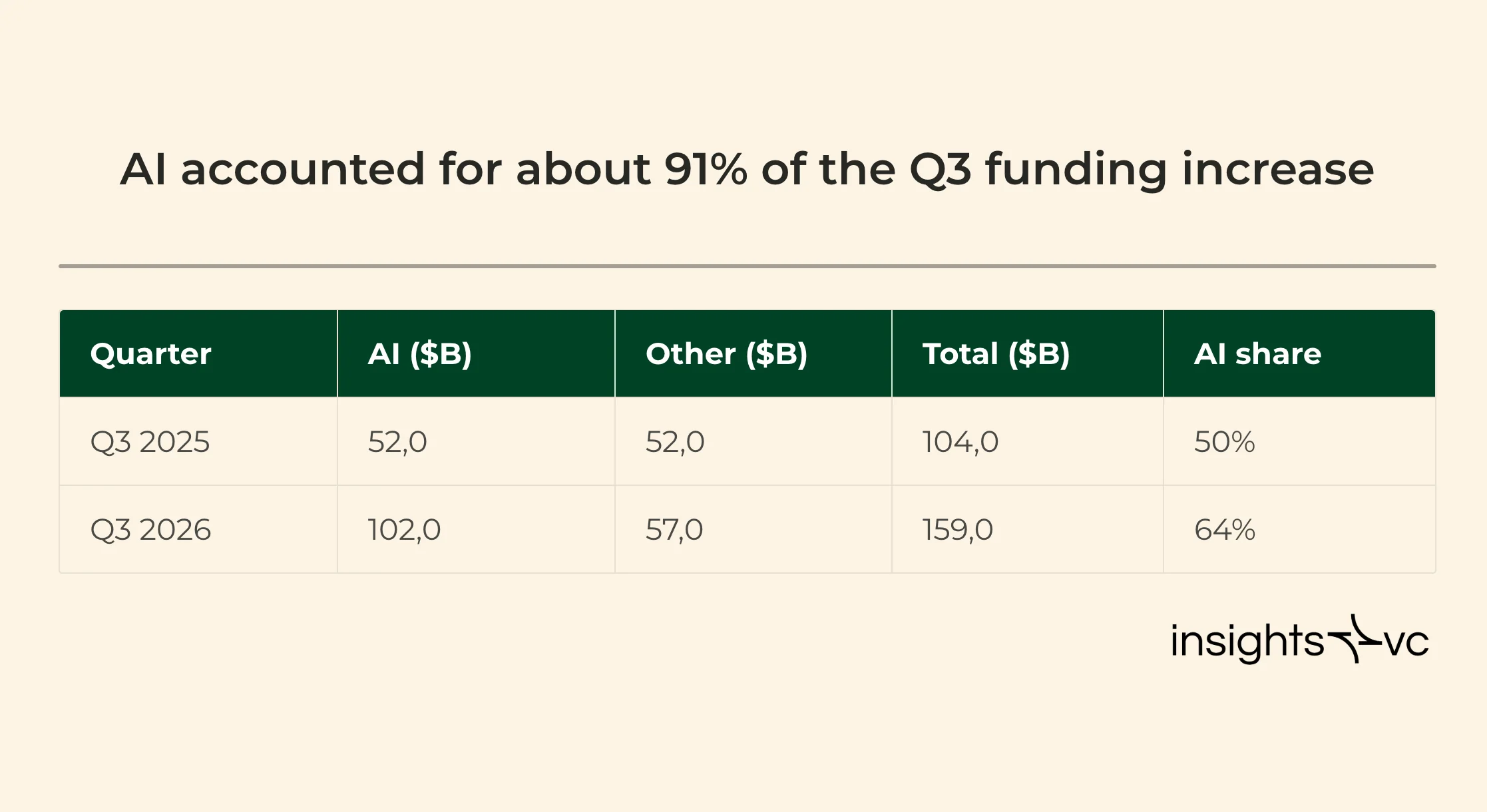
Data from October further confirms this trend. On November 3, Crunchbase disclosed that total global financing in October was $59 billion, a year-over-year increase of 45%, with 66% classified as AI-related. Alone, DeepSeek’s single round financing of $15.9 billion accounted for about 27% of the total global financing that month.
KPMG and PitchBook's third-quarter venture pulse report recorded a total of 8,341 transactions globally, amounting to $170.9 billion, a year-over-year increase of 43.0% but a quarter-over-quarter decrease of 28.5%. Among these, the top five deals totaled $19.1 billion, and the top ten deals reached $29.9 billion, accounting for 17.5% of that quarter's total financing.
Even when excluding these top ten transactions from the third quarter of 2026, the remaining financing amount still stood at $141 billion, higher than the overall level of $119.5 billion in the same period of 2025. It should be noted that this calculation only excluded the major deals of that period and still included AI financing outside the top ten, while also following KPMG's accounting method based on publicly declared round sizes.
For instance, this statistic includes Crusoe's expected $3.9 billion Series F financing. However, the Form D document submitted by Crusoe on September 17 indicates that the actual sold amount was $3.109 billion as of that date, which includes previously issued Simple Agreements for Future Equity (SAFE). The company disclosed that its contracted computing capacity exceeded 6 GW, but only 1 GW is operational, with most of the contracted capacity still under construction.
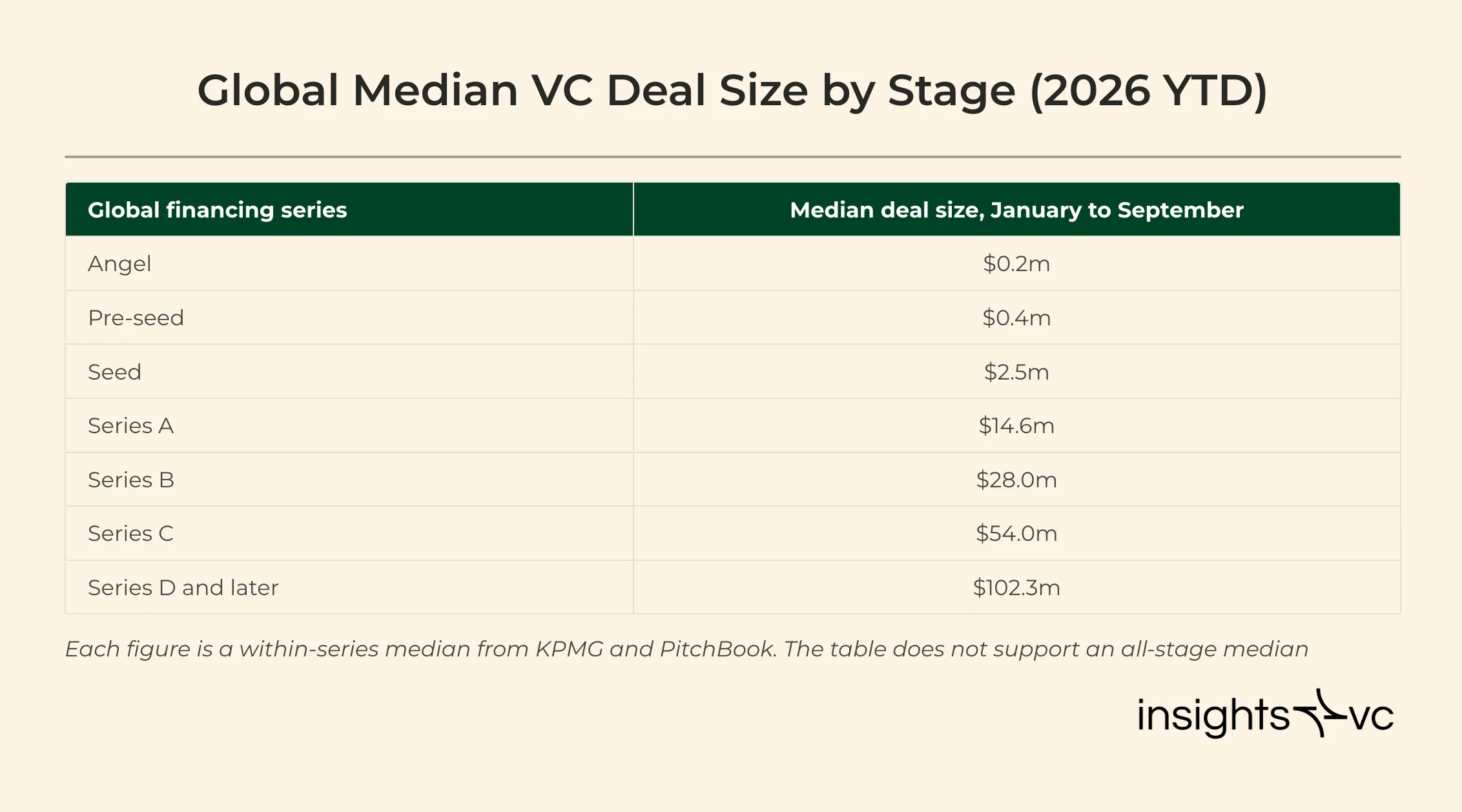
From a phased perspective, Crunchbase categorized the $105 billion from the third quarter into late-stage financing (up 73% year-over-year) and $40.6 billion into early-stage financing (up 25%). Within the total of $13 billion in seed rounds, $2.6 billion flowed into super seed rounds with at least $100 million per round, accounting for one-fifth. KPMG's statistics show that the median global financing in the first nine months rose sharply from $400,000 in the Pre-Seed round to over $100 million in Series D and beyond.
How Much Capital Truly Flows to Funds and Their LPs?
As of the end of September, U.S. companies received a total of $515.8 billion in venture capital. In the same period, according to PitchBook-NVCA Venture Monitor report, 699 U.S. venture capital funds that completed their final close recorded only $108.5 billion in committed contributions.
These two data sets cannot be directly reconciled: PitchBook uniformly attributes commitments to the final closing year (even if LP signed agreements earlier); corporate financing can utilize previous old funds, overseas investors, or corporate balance sheet funds; and the commitments for new funds are typically paid in over several years.
Fundraising is highly concentrated at the top. Funds sized at $500 million and above account for only 6% of the total closed funds but attract 78.1% of the committed capital; the 81 first-time funds collectively secured a mere approximately 4.5% of the committed amounts.
PitchBook recorded a closed size of $23.8 billion for just Andreessen Horowitz (a16z). In January this year, a16z announced that it raised $6.75 billion for its growth funds, with $1.7 billion each for applications and infrastructure funds, and $1.176 billion for the American Dynamism fund; on August 31, it increased the total size of the fifth growth fund to $8.5 billion (adding the growth fundraising in January and August will overlap the count of the first closing part).
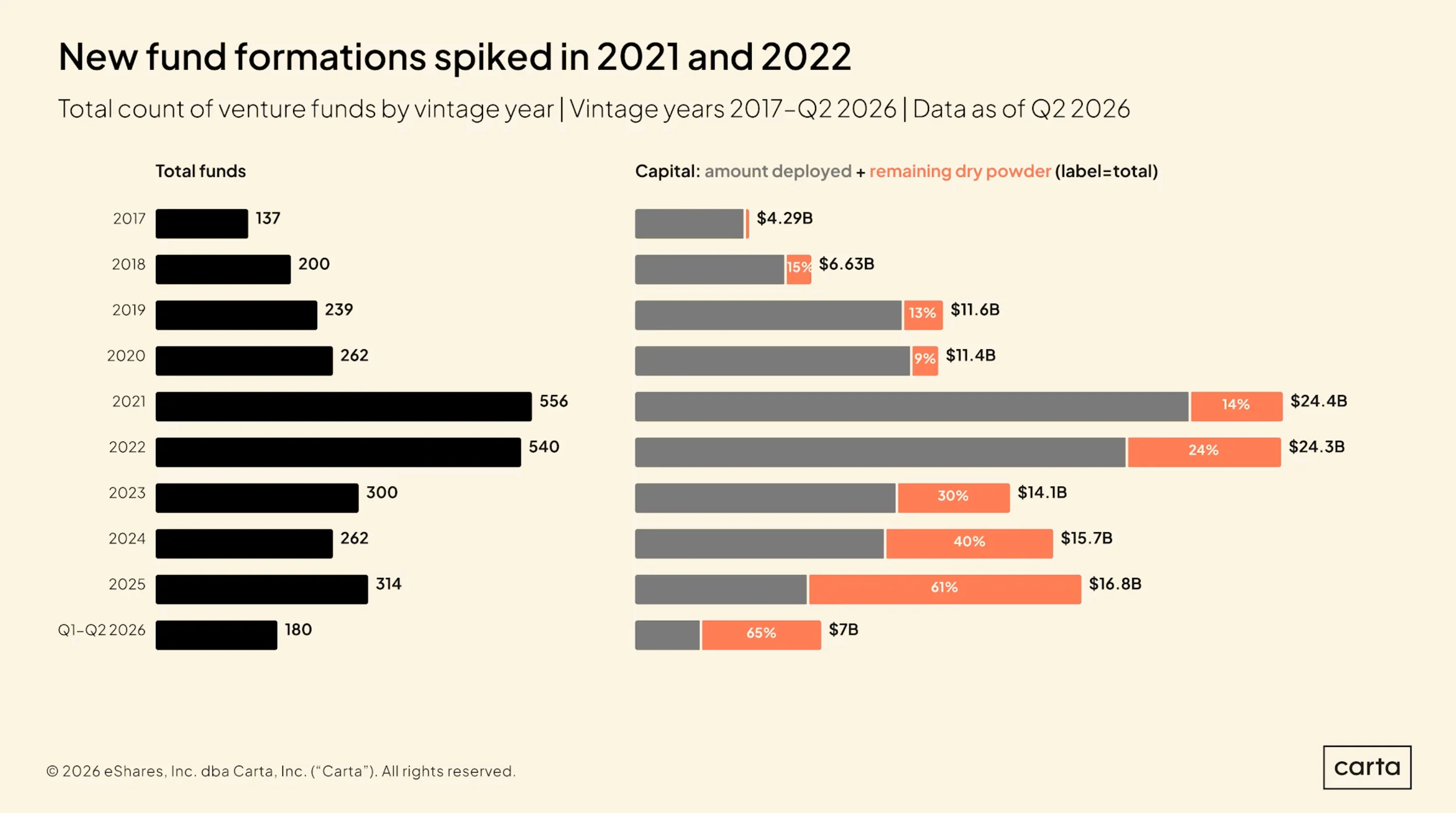
Previously raised unfunded commitments can still contribute to capital calls. PitchBook disclosed that as of September 30, 2025, U.S. venture capital dry powder (unused funds) amounted to $278.5 billion; while NVCA's 2026 yearbook shows a conflicting figure of $299.3 billion (prior reports had indicated this amount as of June 30, 2025). Both observations cannot represent the true scale of unpaid funds at the cutoff point of this report.
Data on returns is even more severe. As of June 30, the median distribution to paid-in capital multiple (DPI) for U.S. venture capital funds according to Carta statistics was as follows: for 2017 funds, it was 0.37x; for 2018 funds, it was 0.15x; and for 2019 funds, it was only 0.04x; the net total value multiple (TVPI) median for the 2017 funds was 1.72x.
DPI measures the total amount received for each dollar paid in, while TVPI includes remaining portfolio book value beyond distribution amounts. It is noteworthy that distribution amounts may include physical stock deliveries, meaning LP who receive stocks still need to monetize them in the secondary market to fulfill their cash spending needs (refer to ILPA report definitions).
A deep analysis released by Carta in October provides perspectives not revealed by a single median: it calculated the proportion of realized value out of total value within each fund. For 2017 funds, this realized ratio’s median was 23.9%. Simply dividing 0.37 by 1.72 would yield different results since the median funds corresponding to the two indicators are not the same. Carta's publicly disclosed cohort charts encompass 137 funds from 2017, 200 from 2018, and 239 from 2019, but did not disclose how many samples each median actually adopted or distinguish how many were distributed in cash form.
Canoe’s analysis on second-quarter fund notifications and statements on November 16 showed that within their venture capital sample, cumulative distribution amounts to $2.89 billion with paid-in capital at $1.92 billion, net cash inflow at $970 million. However, among all venture strategies tracked excluding venture debt, the number of funds called for cash exceeded those distributing cash, with the net inflow largely stemming from a few funds with large payouts.
Another liquidity channel has emerged in the private market. In the first half of the year, Carta handled 71 tender offers from private companies, totaling about $3 billion; Lazard estimates that during the same period, GP-led secondary market transactions in the private equity field reached $61 billion. Employees can cash out through tender offers, and LPs remaining within the fund can choose to extend their shares or cash out, but the volume of these transactions cannot equate to the actual cash distribution totals of venture LPs.
AI Financing Touches Both Ends of Hardware Transactions
In March, OpenAI announced it secured $122 billion in committed capital, with a post-investment valuation of $852 billion; of this, SoftBank's $30 billion investment was paid in three installments on April 1, July 1, and October 1. On November 6, Reuters reported that OpenAI completed about $11 billion in its first close for a new financing round valuing $12.5 trillion, but this latest term is disclosed by media, and the final completion scale has not been officially confirmed.
In May, Anthropic also completed a $65 billion financing with a post-investment valuation of $965 billion. Both massive rounds were announced outside the third quarter, although one of SoftBank's installments fell within it.
Anthropic ultimately disclosed in its prospectus that its third-quarter revenue was $16.956 billion, with computing and infrastructure expenditures at $9.863 billion. Annualizing the third-quarter revenue (multiplying by 4) amounts to $67.824 billion, whereas the actual revenue for the past four quarters as of September 30 totals $35.282 billion. Based on a fully diluted equity value of approximately $12.5 trillion, these revenue denominators correspond to sales multiples of 22.1 and 42.5 respectively; according to the basic equity value of approximately $10.97 trillion, this translates to a multiple of 16.2 times the annualized third-quarter revenue.
None of these denominators represent the forecast annual sales. Anthropic also disclosed a run-rate revenue metric of $81 billion based on recent usage and subscriptions as of October 31. The company typically books computing capacity 12 to 18 months in advance, which means once locked in, they face significant exposure risk if there’s a slowdown in demand.
On the hardware supply chain’s other end, Nvidia (NVIDIA) bought $2 billion of CoreWeave common stock at $87.20 per share in January. Its 13F filing submitted in November shows that as of September 30, Nvidia held 47.2 million shares of CoreWeave stock valued at $4.11 billion (this total encompasses shares acquired at other points in time). Nvidia plays both supplier and shareholder roles for this listed cloud computing operator, and any drop in customer demand will not only cut hardware orders but will simultaneously impact the value of its equity holdings.
Looking at the entire group, according to Nvidia's supplemental financial information, during the nine months ending October 25, Nvidia spent $58.1 billion on equity securities, far exceeding the $4.952 billion of the same period last year. The company’s balance sheet for private market securities soared from $22.251 billion to $61.65 billion; net new investments contributed $46.436 billion, unrealized gains contributed $8.308 billion, reclassifications reduced by $13.349 billion, while impairments and losses netted a reduction of $1.996 billion. Moreover, in the third fiscal quarter, three direct customers contributed to 36% of Nvidia’s revenue, though the financial report did not disclose the end users behind these sales.
As of October 25, Nvidia also disclosed $20 billion of future equity investment commitments and conditional agreements for cloud operators up to $32 billion (subject to conditions of financing, deployment, and equipment acceptance). Additionally, there’s a separate lease guarantee in Ohio, with the total guarantee potentially reaching $105 billion as various data centers start operations (the first batch is expected to be activated in fiscal 2029), and no guarantees have yet been paid. Regarding Nvidia's additional $10 billion subscription in Anthropic's private placement, it falls under November's figures. If these numbers are simply summed up as a “total investment,” it confuses historical cash expenditures with conditional future risk exposures.
In terms of corporate governance, on November 11, Nvidia's board accepted Jensen Huang’s decision to resign from the roles of President, CEO, and Board Member, appointing CFO Colette Kress as interim CEO, and the company officially announced this on November 12. Subsequently, on November 22, the board reinstated all three roles to Jensen Huang and disclosed that Kress remains on as CFO. Both personnel changes occurred after the October financial report cut-off date.
Fintech Transaction Counts and Crypto Financing Scale
According to Crunchbase statistics, there were a total of 687 financing transactions in the global fintech sector during the third quarter, totaling $10.64 billion, while about $13.5 billion across 995 transactions in the same period last year. Based on this data, although total financing dropped by approximately 21% and the transaction count fell by 31%, the average financing amount per transaction increased from $13.6 million to $15.5 million.
Year-on-year comparisons show that financing amounts for rounds below $100 million dropped by 31.4%, while rounds $100 million and above only saw a 7% decline. Compared to the second quarter, based on the rounded figures, larger rounds accounted for about 92% of the total financing decline (Crunchbase report stated approximately 93%).
However, the definition of industry scope has a significant impact here. FinTech Global’s retrospective report in November recorded 897 transactions totaling $27.4 billion, a year-over-year increase of 35%, but its scope covers corporate cybersecurity company Island. The samples tracked by the two data agencies are essentially different companies.
In the Crunchbase dataset, Ant International’s $1.2 billion Series A financing comprised most of Singapore’s $1.28 billion fintech financing during the season; Saudi payment company barq funded $329.5 million, and Indonesian investment platform Ajaib raised $270 million.
Earlier this year, TCV led Mercury's $200 million Series D financing (valuation $5.2 billion); in January, ICONIQ led stablecoin payment infrastructure Rain’s $250 million financing, while payment network Mesh raised $75 million. Every dollar flowing into stablecoin payment rounds may simultaneously be categorized as fintech and crypto financing across different data agencies.
In the software sector targeting financial teams, Accel led Basis’ $100 million Series B financing, subsequently appointing auditing and consulting firm Baker Tilly as its service provider for reconciliation and accounting entries support. On the other hand, Unit21 is selling AI tools for investigating fraud and anti-money laundering alerts, but its product launch announcement did not quantify the false negative rate, time saved, or profitability improvements for customers.
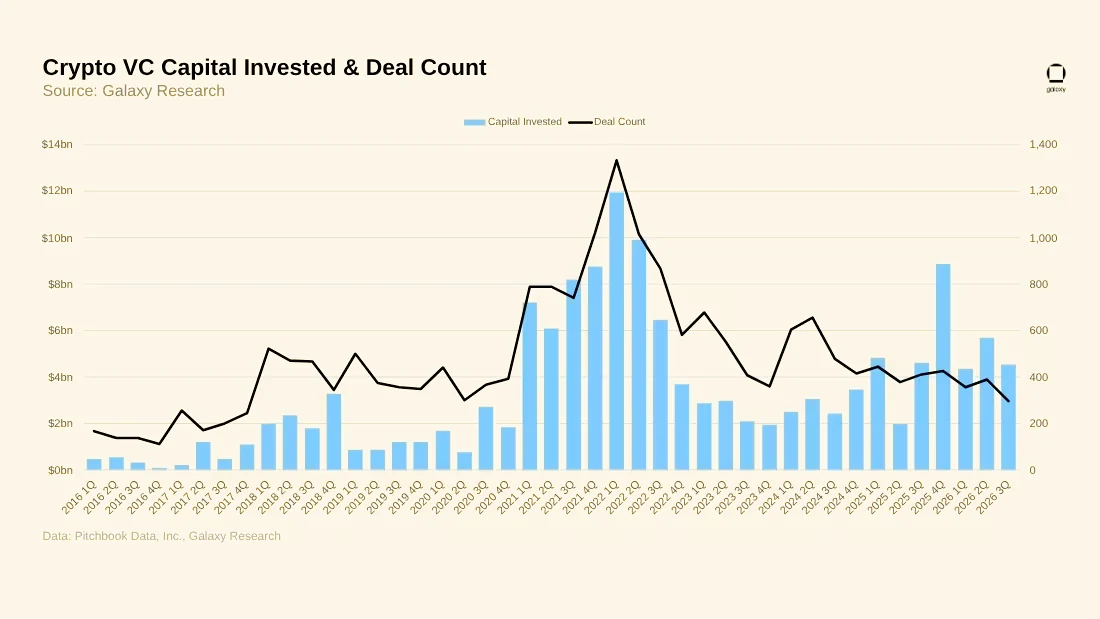
In the crypto domain, according to Galaxy report, a total of 296 transactions amounting to $4.519 billion were completed in global crypto and blockchain venture capital during the third quarter; their second-quarter report featured 384 transactions totaling $5.683 billion. Based on these two sets of data, financing amounts fell by 20.5% and transaction counts dropped by 22.9% (the third-quarter report's text states transaction counts fell by 24%, but does not provide a revised denominator for the second quarter).
In the segmented sectors, transactions, exchanges, investments, and lending projects accounted for $2.37 billion through 34 transactions, with an average of $69.7 million per single transaction; the remaining 262 transactions had an average of only $8.2 million, with Galaxy estimating a market median of approximately $3 million. Over 90% of funds in the trading segments flowed to later-stage companies; in terms of transaction count, payment and rewards segments topped with 38 deals, leading over trading segments with 34 deals and DeFi with 31 deals.
Fields Accelerating Their Financing in 2026
Construction Robotics attracted $1.6 billion in financing within 2026 up to October 29, exceeding four times the total of $389 million for all of 2025 (refer to Crunchbase sector snapshot). Yet, the number of financing rounds only slightly increased from 28 to 30, indicating that the acceleration of funding mainly stems from massive bets on a few firms.
The demand logic in this sector is very direct: construction contractors facing skilled labor shortages need to squeeze higher output from existing equipment. Bedrock’s $600 million financing completed in October closely followed its rollout of a paid operating autonomous excavator in August. The company’s next spending focus is on forming deployment teams and operational systems on site, which are necessary infrastructures for unmanned equipment to operate stably across multiple job sites. This also provides investors with a clear standard for assessment: can a successful localized deployment transform into a replicable service that contractors are willing to pay for continuously.
Nuclear Fusion Energy has achieved significant leaps in both total financing amounts and large transaction counts. According to Dealroom statistics, as of October 6, this sector’s venture capital funding reached $4 billion (compared to $2.1 billion for the entirety of 2025), with 11 transactions of $100 million or more, up from only 5 in the same period last year.
Commonwealth Fusion Systems (CFS) completed a $1 billion equity financing in July, attracting pension funds, sovereign wealth funds, and industrial capital to support the construction of demonstration devices and planned commercial nuclear fusion power plants. Google and Eni Group have signed agreements to secure more than half of the planned ARC power plant's power output (CFS expects to start supplying power by the early 2030s). Despite the clear future buyers appearing in the investment logic, how to finance and tackle engineering landing challenges remains a core challenge several years before actual sales generate revenue.
The AI expansion has also driven capital into grid hardware and optical interconnects, targeting two significant physical bottlenecks: delivering power to computing devices and high-speed data transfer between processors. By midyear, PitchBook recorded that grid technology investments achieved the strongest consecutive performances since the peak in 2021. Heron Power completed a $140 million Series B financing, and thereafter Vantage booked its power conversion equipment with over 1 GW capacity.
In the optical interconnect sector, Ayar Labs raised a cumulative $650 million in 2026, while Lumilens announced it secured over $700 million in new financing, stating that its first products have started shipping to AI data centers in production. Such suppliers can benefit from infrastructure spending by multiple large model developers and cloud operators, with their economic value lying in accelerating computing power launch and enhancing the collaborative efficiency of expensive chips; hence, capabilities for mass production and customer qualifications become key to investment success or failure.
Defense Technology has raised a total of $77.5 billion under PitchBook’s broad accounting as of the end of September, marking a 36.8% increase compared to the total for 2025 (refer to PitchBook’s third-quarter defense technology report). Even excluding Blue Origin's $10 billion financing, the investment amount in the third quarter alone reached a historical high of $27.9 billion. The report noted that in addition to missiles, ammunition, and hypersonic weapon financing reaching record highs, funding commitments aimed at capacity expansion continue to increase.
A statement from Quantum Systems in October visually displayed underlying demand: the German government will fund the procurement of tens of thousands of interceptor drones for Ukraine, expanding the capacity of systems already deployed in combat. For investors, besides autonomous control software, this creates opportunities in the manufacturing sector and part supply chains as well. Government procurement provides a clear payer, while mass production ramp-up speed, reliability, and delivery cycles determine how much actual demand these young companies can fulfill.
Conclusion
Most of the capital raised in 2026 is being used to support the next stage of business expansion, whereas established venture funds are still struggling to return cash to their investors. Although IPOs have reopened liquidity paths and mergers offer exit channels for some projects, the transaction prices are often significantly lower than earlier financing valuations.
At the same time, the massive commitments flowing into robotics, energy, and defense will also test the ability of venture capital institutions to provide financing for manufacturing and real deliveries over a longer period. For LPs, the clearest signal of whether the market can welcome a genuine broad recovery in 2027 will be whether more funds and different vintage funds return to cash distributions, thereby freeing up space for a new round of commitments.
免责声明:本文章仅代表作者个人观点,不代表本平台的立场和观点。本文章仅供信息分享,不构成对任何人的任何投资建议。用户与作者之间的任何争议,与本平台无关。如网页中刊载的文章或图片涉及侵权,请提供相关的权利证明和身份证明发送邮件到[email protected],本平台相关工作人员将会进行核查。