When sorting out the services of the Hong Kong and Singapore cryptocurrency platforms for EU users, the determination logic of DAC8 obligations and the key points of CARF equivalent rules.
Written by: FinTax
Key Points
- The applicability judgment of DAC8 for non-EU platforms depends on whether they provide services involving reportable users' relevant cryptocurrency assets, and whether they have the connection points stipulated by EU member states. Merely having EU users does not automatically create a reporting obligation.
- The group's headquarters, the contracting entity for customers, the actual service provider, and the trading execution entity may belong to different legal entities. Businesses need to clarify service relationships, authorization status, and reporting responsibilities according to each entity.
- Whether a user is deemed a reportable user primarily relies on tax residency status and due diligence results. IP addresses, nationality, and account registration locations can only serve as verification clues.
- Hong Kong and Singapore have completed the local legislative process for CARF, and the relevant rules will be implemented starting in 2027. Local CARF reporting, MCAA information exchange, and DAC8 equivalent exemption still require different levels of legal judgment.
Introduction
In November 2026, Hong Kong officially published the "2026 Taxation (Amendment) (Cryptocurrency Reporting Framework and Revised Common Reporting Standard) Ordinance," with Hong Kong's CARF rules scheduled to take effect from January 1, 2027. Singapore also announced CARF implementation regulations in August 2026, effective from January 1, 2027. Both regions plan to start exchanging tax information on cryptocurrency transactions with relevant partner jurisdictions in 2028.
For cryptocurrency platforms headquartered in Hong Kong or Singapore that provide services to global users through websites and mobile applications, local CARF has entered the implementation preparation phase. At the same time, the EU's DAC8 will take effect from January 1, 2026, with data collection for the first reporting year already underway. Does completing registration and obtaining local licenses in Hong Kong or Singapore mean that businesses do not need to consider DAC8? Do groups with EU users need to register and report in the EU? Can local CARF meet DAC8's equivalent reporting requirements?
These questions need to be judged based on the actual services provided by the business, the legal entity arrangements of the group, the tax residency status of EU users, and the information exchange arrangements between non-EU jurisdictions and relevant member states. The location of the group's headquarters can only indicate part of the business connections and cannot independently determine its tax information reporting obligations in the EU.
1. Identifying Reporting Entities from Service Activities
DAC8 applies reporting obligations to Reporting Crypto-Asset Service Providers (RCASP). According to Annex VI Section IV, RCASP includes two types of entities: one is cryptocurrency service providers (Crypto-Asset Service Provider, CASP) authorized or permitted by member states based on MiCA; the other is cryptocurrency operators that meet DAC8's definition. Both types of entities must meet the relevant service and transaction conditions, meaning they provide cryptocurrency services facilitating exchange transactions for reportable users or on behalf of reportable users.
1. Determining if the Platform Facilitates Reportable Transactions
The names used by the platform, such as exchange, wallet service provider, broker, or digital asset management platform, do not directly determine their DAC8 identity. Businesses need to verify whether the actual services provided involve relevant cryptocurrency transactions, including exchanges between cryptocurrencies and fiat currencies, exchanges between different relevant cryptocurrencies, and other transactions that meet the regulations. DAC8's definition of Crypto-Asset Service refers to MiCA and explicitly includes staking and lending services; however, whether a service makes a business an RCASP still requires judgment based on whether it facilitates relevant exchange transactions for reportable users. Affiliates providing only technical development or general support services do not automatically become reporting entities merely by participating in group business.
For example, a Singapore platform offers spot trading, stablecoin exchange, asset custody, and staking services. Spot trading and stablecoin exchange directly involve asset exchanges, and the platform needs to identify the legal entities facilitating the transactions and their customer relationships. Custody and staking services should be judged in conjunction with specific service arrangements, relevant transactions, and the DAC8 definition, and cannot simply be grouped together based on product names.
2. Separating MiCA Market Access from DAC8 Reporting Determination
MiCA regulates market access and operational requirements for businesses providing cryptocurrency services in the EU, while DAC8 regulates qualified service providers' tax due diligence and information reporting. The customer-initiated service exception (reverse solicitation) in MiCA Article 61 pertains to the authorization judgment for third-country enterprises. ESMA strictly interprets this exception, indicating that if a business, its affiliates, or third parties acting on its behalf proactively market or solicit EU clients, it generally cannot simply declare the service as client-initiated based solely on contractual statements. The transition period for MiCA ended on July 1, 2026, and unauthorized CASPs must orderly cease relevant EU business in accordance with ESMA requirements.
The client-initiated service exception does not constitute an independent exemption from DAC8. Businesses must separately determine whether they can provide services to EU clients under MiCA, and whether they meet DAC8's regulations regarding reporting entities and connection points.
2. Confirming Reporting Responsibilities along Group Structure
Cross-border cryptocurrency platforms typically employ a multi-entity operational structure. The group holding company is responsible for strategic management, while Hong Kong or Singapore companies handle client contracts and daily operations, with other affiliates responsible for custody, technical development, or transaction execution. Some EU markets may be served by local subsidiaries or branches. When determining DAC8 obligations, it is necessary to break this down to specific legal entities, confirming who establishes service relationships with clients, who actually provides services, and who facilitates relevant transactions.
1. Verifying EU Authorized Entities and Non-EU Operating Entities
If the group has a CASP authorized under MiCA in the EU, that entity falls under the category prescribed by DAC8 Section I A(1), and it must identify reporting obligations based on its actual services and client transactions. The presence of a MiCA authorized entity within the group does not automatically mean that authorization extends to all affiliates.
For Crypto-Asset Operators that have not obtained MiCA authorization or permission to provide services in the EU, DAC8 Section I A(2) specifies four types of connection points: the business or individual is a tax resident of a member state; the business is established or organized under that member state's laws, possessing legal personality or relevant reporting obligations; the business is managed from that member state; or the business or individual has a permanent establishment in that member state. Non-EU operating entities need to determine whether they bear reporting and due diligence obligations in a member state based on these connection points.
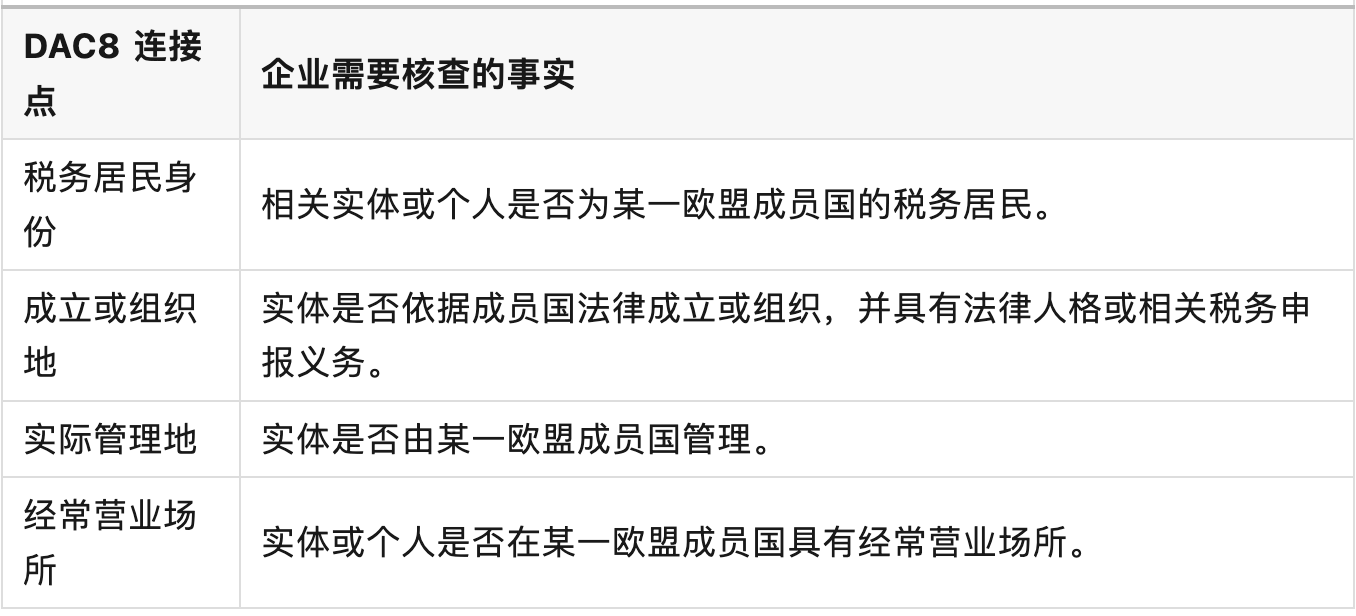
The mere existence of EU users is not one of the aforementioned four connection points. Suppose a Hong Kong exchange accepts registrations from users in France and Germany through a global website, with the customer agreements, management team, and actual operation all handled by the Hong Kong entity, and that entity has no branches or other legal connections in the EU. Simply having users residing in France or Germany does not directly deduce that the Hong Kong entity needs to register under DAC8.
2. Independently Verifying EU Branches
Branches represent another independent judgment. DAC8 Annex VI Section I B states that when reporting service providers facilitate relevant transactions through branches located in member states, they must fulfill local reporting and due diligence requirements for those transactions facilitated by the branch. Branches are legally distinct from independent subsidiaries: the former is subject to branch rules, while the latter must identify reporting responsibilities based on their service activities, authorization status, and connection points.
For qualifying Crypto-Asset Operators, DAC8 also establishes a single registration mechanism in the EU. Businesses need to determine the member state for registration based on relevant connection points and complete registration as required by that country. The group structure diagram can only illustrate legal relationships; businesses should align customer agreements, service products, personnel arrangements, transaction execution, and asset custody to specific entities, forming verifiable entity identification records.
3. Distinguishing EU Users from Reportable Users
After confirming that a business is a reporting entity under DAC8, it is also necessary to identify which customers qualify as reportable users. Generally, reportable users are individuals or entities identified as tax residents of EU member states through due diligence; for qualifying entity customers, it is also necessary to determine whether their controllers are reportable persons. This judgment is based on tax residency status, not on account registration location or the country where the platform is accessed.
1. Identifying Users through Tax Residency Declaration
Suppose a Singapore exchange finds that a large number of registered IP addresses on the platform come from users in France, Germany, and Spain. This information can serve as clues for customer profile verification but cannot directly prove that the users are tax residents of the respective countries. A user residing long-term in Singapore may access the platform via a French network; a user with an account registered in Germany might also be a tax resident of another country. Businesses need to obtain a tax residency self-certification and verify its reasonableness alongside existing customer due diligence data.
Individuals' self-certifications should cover information such as name, address, tax residency jurisdiction, corresponding TIN, and date of birth. For entity users, it is also necessary to determine whether they are excluded persons or active entities; for other entities, the controllers must be identified, and it should be determined whether the controllers are reportable persons. Businesses should correspond customer declarations with KYC/CDD information, resolving any discrepancies between tax residency information and existing identity data.
2. Distinguishing Due Diligence Timing for Existing Users and New Users
For users establishing new customer relationships, reporting service providers should obtain self-certification upon establishing the relationship. For existing individual and entity users, DAC8 requires that relevant declarations be obtained before January 1, 2027, and that their reasonableness be verified based on existing information. If businesses discover changes in customer circumstances that render the original declarations incorrect or unreliable, they should obtain new valid declarations or retain reasonable explanations and appropriate supporting materials that account for the validity of the original declarations.
This means the original KYC process needs to connect with tax due diligence requirements. Existing identity information, address proof, and entity controller data can be used for verification, but businesses still need to confirm whether they cover the tax residency information required by DAC8. For clients using different accounts across multiple regions, it should also be ensured that user identity, tax residency declarations, and actual service entities correspond with each other.
4. Verifying if CARF Equivalent Arrangements are Applicable
For platforms that have already established CARF reporting systems in Hong Kong or Singapore, it is necessary to further determine whether local reporting arrangements meet DAC8's equivalent requirements. DAC8 Annex VI sets the concepts of Qualified Non-Union Jurisdiction and Effective Qualifying Competent Authority Agreement. These mechanisms allow qualifying reporting service providers to avoid duplicating certain due diligence and reporting obligations in the EU and non-EU jurisdictions when statutory conditions are met.
1. CARF Local Legislation Does Not Automatically Grant DAC8 Exemption
Suppose a Singapore platform has established customer due diligence and annual reporting processes according to CARF Regulations 2026 and plans to submit reports to IRAS. The platform still needs to verify whether it meets the applicable conditions of the DAC8 equivalent mechanism, as well as whether there is an effective competent authority agreement between Singapore and relevant EU member states. Local CARF registration, MCAA signing, and DAC8 exemptions represent different legal statuses and cannot substitute for each other.
DAC8 sets conditions for duplicate due diligence and reporting at the reporting service provider level, as well as for duplicate reporting of reportable user information. Businesses need to confirm whether the relevant non-EU jurisdiction qualifies as a Qualified Non-Union Jurisdiction as defined by DAC8, whether the information exchange agreement is valid, whether reporting information meets corresponding requirements, and whether the business has already completed the relevant reporting in that jurisdiction.
2. Verifying Information Exchange Agreements and Reporting Years
According to DAC8 Annex VI Section IV, a Qualified Non-Union Jurisdiction refers to a non-EU jurisdiction that has effective competent authority agreements with all member states listed in its published reportable jurisdiction list. DAC8 Article 8ad also stipulates that where OECD CARF is identified as the minimum or equivalent standard, relevant information may be considered to meet commensurate information requirements, but there must still be a competent authority agreement between the relevant member states and the non-EU jurisdiction.
The Irish tax authority's published CARF/DAC8 reportable jurisdiction list includes Hong Kong and Singapore as jurisdictions expected to commence the first exchange in 2028, with agreement types marked as MCAA. This indicates that the CARF exchange arrangements published by Ireland cover both locations, but the list itself does not prove that Hong Kong or Singapore has met all the conditions for DAC8's Qualified Non-Union Jurisdiction, nor does it imply that other EU member states have established similar arrangements with both locations. Businesses need to verify each member state based on target member states, agreement effectiveness status, and reporting years.
3. Progress of CARF Implementation in Hong Kong and Singapore
As of November 2026, both Hong Kong and Singapore have completed the local legislative process for CARF, and the relevant rules will take effect starting January 1, 2027. Both regions plan to start the first information exchange with partner jurisdictions in 2028, but local reporting arrangements and technical requirements should still be confirmed according to the latest guidelines from local competent authorities.
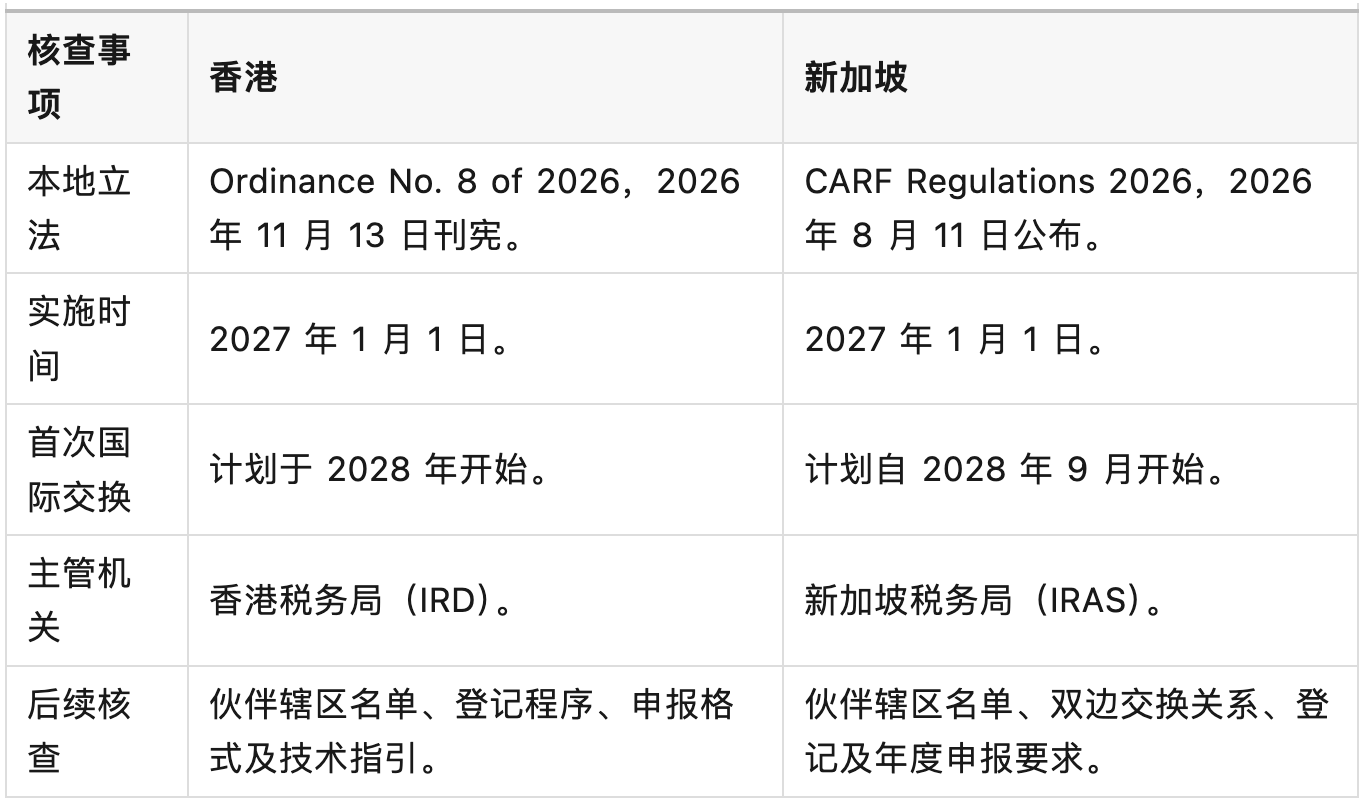
Businesses should continuously pay attention to the lists of partner jurisdictions and exchange relationships published by both regions. The first exchange of local CARF is scheduled for 2028, which does not independently prove that the arrangements for the 2026 reporting year meet DAC8's equivalent conditions. For platforms serving multiple EU countries simultaneously, it is necessary to verify the competent authority agreements and local implementation requirements for relevant member states one by one.
5. Implementing Applicability Judgments in Group Operations
For platforms operating in Hong Kong, Singapore, and EU markets simultaneously, DAC8 judgments need to be applied to legal entities and actual business operations. Suppose a group is headquartered in Hong Kong, has a primary operating company in Singapore, and provides trading services to EU users through a local website; the group also has a subsidiary in Germany that has obtained MiCA authorization. The business needs to confirm the scope of services provided by the Hong Kong, Singapore, and German entities, identifying which entity contracts with clients and provides services, and then judge whether each entity constitutes a reporting entity under DAC8.
If the German subsidiary qualifies as an authorized or permitted service provider under DAC8 Section I A(1), it must fulfill relevant reporting obligations based on its actual business. The Singapore company needs to determine whether it assumes obligations based on its service activities, EU connection points, and branch arrangements, and further verify the CARF equivalent conditions. The Hong Kong parent company should also perform separate evaluations based on its actual services and legal relationships. If one entity within the group has completed CARF or DAC8 reporting, it does not automatically cover other independent legal entities.
Businesses can organize applicability judgments as continuously updated internal documentation, recording at least the following content:
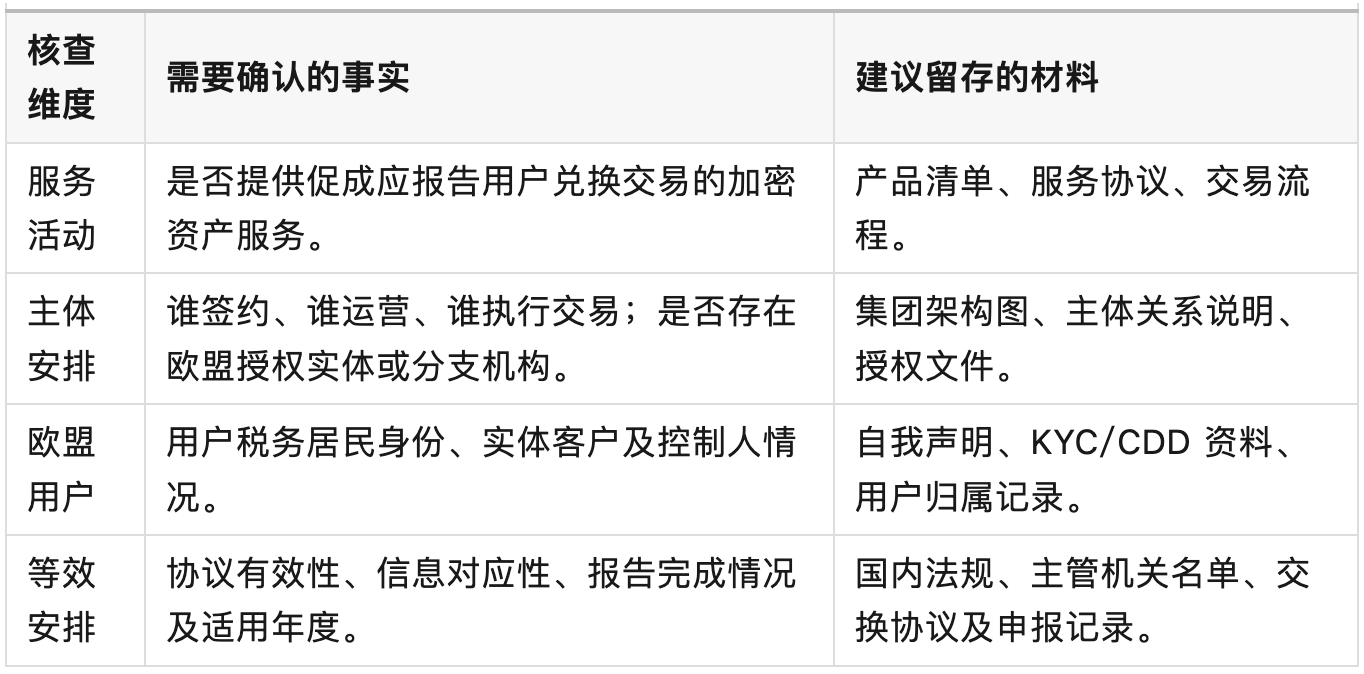
When the group adds EU business, establishes local subsidiaries, adjusts the contracting entity for clients, or changes transaction execution arrangements, the previous DAC8 judgments may change accordingly. Businesses should update entity relationships, reporting connection points, and information exchange arrangements synchronously, and implement conclusions into customer due diligence, data collection, and reporting processes.
Conclusion
For cryptocurrency platforms headquartered in Hong Kong or Singapore and operating in the EU market, DAC8 applicability judgments involve service activities, legal entities, users' tax residency status, and cross-border information exchange arrangements. Businesses need to first confirm the actual service-providing entities, then verify their legal connection points with EU member states, subsequently identify reportable users, and judge whether local CARF meets DAC8's equivalent reporting requirements.
CARF in Hong Kong and Singapore will enter the implementation phase in 2027, and businesses can incorporate local customer due diligence, transaction data collection, and annual reporting preparation into their existing compliance systems. Meanwhile, the group needs to maintain EU legal entities, branches, and relevant reporting responsibilities separately, verifying effective exchange arrangements by target member states and reporting years.
For cross-border operating platforms, being able to correspond specific legal entities, service activities, customer tax residency status, and reporting jurisdictions is the basis for conducting tax due diligence and reporting preparation. Businesses should integrate this judgment into processes for business launch, entity adjustments, and annual compliance reviews.
Frequently Asked Questions
1. Does a cryptocurrency exchange headquartered in Hong Kong or Singapore serving EU users necessarily need to fulfill DAC8 obligations?
No, not necessarily. Businesses need to determine this by considering actual service activities, MiCA authorization status, and the connection points specified in DAC8 Annex VI Section I. The mere existence of EU users does not automatically constitute a reporting connection point for non-EU Crypto-Asset Operators.
2. If CARF registration has already been completed in Hong Kong or Singapore, is there still a need to assess DAC8?
Yes, there is a need. CARF local registration and reporting cannot automatically replace DAC8 obligations. Businesses still need to verify whether there are effective competent authority agreements between the local area and relevant EU member states and confirm the information's correspondence, reporting completion status, and applicable year.
3. Can the client-initiated service exception in MiCA exempt from DAC8 reporting obligations?
No, it cannot. The exception in MiCA Article 61 pertains to market access requirements for third-country businesses. DAC8 has independent reporting entities, connection points, and duplicate reporting exemption rules, which need to be assessed separately.
免责声明:本文章仅代表作者个人观点,不代表本平台的立场和观点。本文章仅供信息分享,不构成对任何人的任何投资建议。用户与作者之间的任何争议,与本平台无关。如网页中刊载的文章或图片涉及侵权,请提供相关的权利证明和身份证明发送邮件到[email protected],本平台相关工作人员将会进行核查。