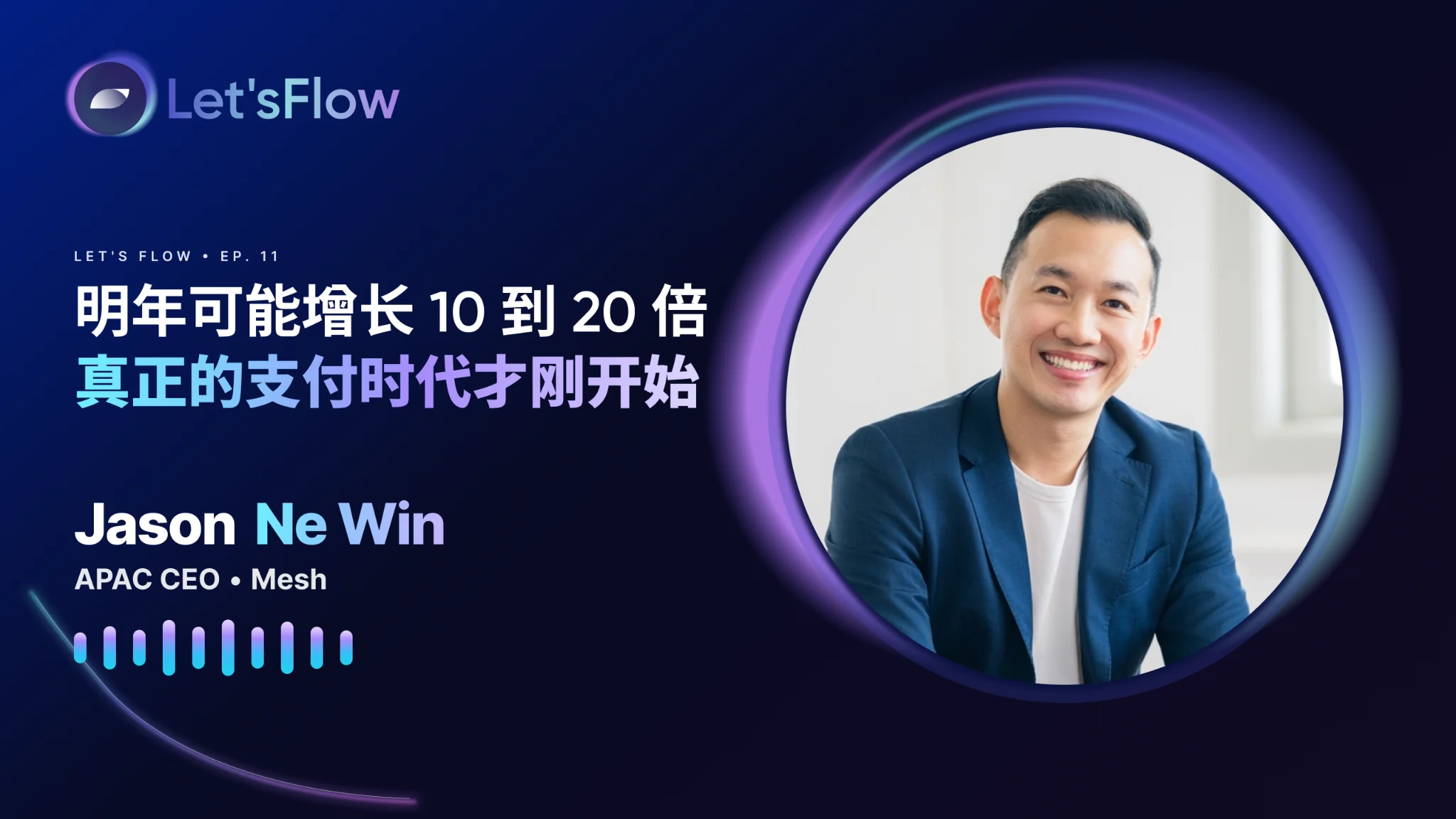
In the past, young people in T-shirts discussed crypto applications; this year, 75% of people are dressed in suits discussing payments and rails.
As the CEO of Mesh APAC, this is Jason Ne Win's most intuitive observation of this year's Token2049 in Singapore.
Despite the topic's popularity and extensive discussions about real-world applications, Jason still believes that crypto payments are still in a very early stage for the following reasons:
Experiential friction remains significant: regular users wanting to buy a pair of shoes have to repeatedly wrestle with insufficient wallet balances, cross-chain exchanges, and gas fees;
The ecosystem is highly fragmented: up to $2.6 trillion in crypto assets is scattered across various exchanges, wallets, and public chains, creating barriers to interoperability.
Assets are already distributed on-chain, but payments have not yet truly entered the real world. What’s missing is not a new chain or a new card, but a "super adapter" that can tightly connect these two worlds.
This is precisely the ecological position Mesh aims to occupy, and it is Mesh's core positioning: a payment orchestration network.
From connecting over 300 partners to collaborating with Visa to launch Tap to Pay, reaching 175 million merchants globally; from using the "grandma test" to reshape frictionless payment experiences, to leading the layout of intelligent payment networks to embrace the AI era, how does Mesh make crypto more convenient and secure to access the global commercial payment network?
Meanwhile, as everyone competes to become the next winner in crypto payments, how can Mesh, as a "super adapter" for crypto payments, confidently assert that "no matter who wins, Mesh will benefit"?
With these questions in mind, we conducted an in-depth conversation with Jason, CEO of Mesh APAC.
Think Like a Founder
Deep Tide TechFlow:
We are very glad you could join our podcast. Please introduce yourself briefly first.
Jason:
Hello everyone, I am Jason Ne Win, currently the CEO of Mesh APAC. Before joining Mesh, I worked at Binance for five years.
My core responsibility is to oversee Mesh's business development in the Asia-Pacific region, which includes establishing regional market footprints, deepening relationships with strategic partners, and participating in the company's product planning and business strategies.
However, my work is not limited to Asia-Pacific. The crypto industry and capital flows are inherently global, with close ties between different markets in Asia-Pacific, the Middle East, Europe, etc. Therefore, I also drive collaboration across regions to help Mesh build a broader global partnership network.
Deep Tide TechFlow:
You served as the Chief of Staff for two Binance CEOs, one being CZ and the other Richard. How do you think this experience shaped you?
Jason:
My experience at Binance was perhaps one of the best learning opportunities in my six-year career in crypto. I was fortunate to learn from both CZ and Richard. They are two distinctly different but outstanding leaders.
From CZ, I learned a lot, especially the most important lesson "think like a founder": treat projects as your "children," nurturing them, and proactively seeking solutions when facing problems.
Another critical ability is adaptability in high-pressure environments: you might attend numerous meetings in a day, each requiring substantial energy, but you need to quickly adjust to invest your best in the next task. This resilience and focus are something I saw exceptionally demonstrated in CZ. One could say that without CZ and Binance, there wouldn't be today's me, and I am very grateful for that.
Richard provided me with a different management perspective. As a professional managerial CEO, he helped me to understand more deeply professional management, institutional collaboration, regulation and compliance, and how to drive business growth through systems and organizational management.
Of course, I benefited greatly not only from those two individuals. Binance has a group of exceptionally capable co-founders and executives, including He Yi, as well as many managers who are not often visible in the public eye. I learned a lot from each of them.
Now, in my work, I often ask myself two questions:
If it were CZ, what would he do? If it were Richard, what would he do?
Through long-term accumulation, this has led to three management principles:
The first is resilience and problem-solving ability. I firmly believe that no problem is insurmountable. The key is to clearly understand the problem, think through the solution, and then execute it decisively.
The second is execution power. While strategy and roadmap are important, actually completing things quickly is equally important. If the direction is wrong, then adjust quickly.
The third is recognizing and utilizing people. One person's ability is ultimately limited, but an excellent team can exponentially amplify organizational efficiency. Finding the right people and placing them in appropriate positions is also crucial.
The "Super Connector" of Stablecoin Payment Networks
Deep Tide TechFlow:
During Token2049 in Singapore, many noticed the numerous Mesh logos and event appearances, so we would like to ask you to introduce Mesh and what the team is currently working on.
Jason:
It's great to see that our investment in Token2049 has had very tangible impacts, and it indeed has brought us opportunities to communicate with more partners.
To put it simply, Mesh is a layer of payment orchestration network. Currently, approximately $2.6 trillion in crypto assets are scattered across various exchanges and wallets, and what Mesh does is connect these fragmented assets and liquidity.
Mesh has already established connections with over 300 partners, connecting around 900 million crypto asset holders and millions of merchants, which is the most basic layer of Mesh.
Our partners include Binance, Coinbase, OKX, as well as PayPal, Shift4, Nuvei, Kalshi, etc. From exchanges, wallets to major payment service providers and payment gateways, our list of collaborations continues to grow. Just two weeks ago, we announced our partnership with Visa for Tap to Pay; we are currently one of Visa's pilot partners, and this is a cardless payment product that allows stablecoin payments to reach around 175 million merchants covered by the Visa network.
Through this partner network, we can connect crypto assets to those who wish to accept crypto payments, such as e-commerce, prediction markets, merchants, and payment service providers.
In summary, what Mesh does is simple: making crypto assets scattered across different platforms really enter the global commercial payment network.
Deep Tide TechFlow:
Before diving deeper into Mesh, many may not be familiar with the overall landscape of stablecoins or payments. Can you outline the entire value chain of stablecoins: who are the main players in each layer, who are the key names, and where does Mesh fit into this?
Jason:
Looking at today's industry ecosystem, I believe it has formed a complex neural network.
There are possibly more than ten roles, with key roles including:
The first type is issuers. Representative players include Circle, Tether, Ripple, and PayPal, among which Circle and Tether are still the largest. Additionally, there are alliance-type stablecoins like USDG.
The second type is networks. This includes mature public chains like Ethereum, Solana, and emerging payment networks like Arc and Tempo.
Below that, there are licensed institutions, payment service providers managing fiat deposits and withdrawals, and the well-known distribution layer, i.e., exchanges and wallets. Additionally, custodial, OTC, and other services are also important parts of the entire industry ecosystem.
Mesh is positioned in the middle of this neural network: whether you are an exchange, wallet, stablecoin, or network, we hope to connect and orchestrate in a neutral way.
I like to use a very simple analogy: if you've been using an iPhone for the past ten years, you might have switched charging cables and interfaces many times. Mesh is like a super adapter, capable of connecting whatever you have, whether it's USB-C or USB 2.0.
Deep Tide TechFlow:
We have seen Mesh founder Bam recently mention that Mesh's problem-solving angle primarily revolves around user experience. Where do you think the payment experience of stablecoins is currently stuck? To what extent will Mesh address these pain points?
Jason:
Bam has proposed a standard called the "grandma test": if grandparents were to use this product, could they easily complete a payment?
Over the past few years, crypto payments have clearly not passed this test. But if we hope stablecoins to truly go mainstream and enable funds to flow frictionlessly, this situation must change.
In this regard, Web2's Visa, Apple Pay, Google Pay, and Amazon have done very well, where users do not need to understand the underlying clearing networks, nor do they need to care about how funds flow; they just need to complete the payment.
What Mesh aims to do is bring this Web2-level payment experience to Web3. Specifically, users only need to authorize their wallet or exchange account, while the complex processes are handled by Mesh. We hope to reduce the choices, clicks, and judgments users need to make, making payments simpler under secure conditions.
For example: suppose you want to purchase a pair of shoes for $100 and plan to pay using USDC or USDT, but your wallet only has $20 USDC. In the traditional way, this transaction may directly fail. You would need to return to your wallet, top up your stablecoin, and possibly prepare corresponding blockchain gas fees before initiating payment again.
But with Mesh's smart funding, the system will dynamically recognize your asset status. If you have only $20 USDC, but also have assets like ETH in your wallet, Mesh can help you complete the necessary asset conversions based on the transaction requirements. At the same time, we will also check whether the corresponding network's gas is sufficient and address related issues.
A series of operations that originally needed to be completed by the users can be handled in the background. Users only need to complete the payment without understanding the complexities behind it.
This is our understanding of user experience upgrade: not to have users learn more technology, but to make the process simpler without changing the payment methods consumers and merchants are accustomed to.
Deep Tide TechFlow:
You just mentioned that Mesh is positioned in the middle of the entire structure. Why did Mesh choose to focus on the network layer, and has the team considered making a card or developing its own wallet?
Jason:
In fact, six years ago, Mesh began as a B2C company, primarily providing financial products to consumers, and had accumulated hundreds of thousands of users with good growth. But our founder Bam later realized that if we open up our underlying technological capabilities to serve more enterprises and partners, it could yield greater scale effects.
Thus, the company gradually shifted its focus: B2C was our past, while B2B and B2B2C are now and in the future. Over the past two years, we have also completed Series A, B, and C financing, with shareholders including well-known institutions like PayPal, Coinbase, and Dragonfly.
As for making wallets or payment cards, these are not on our product roadmap; we prefer to leave those parts to well-established and experienced partners. What we aim to do is the rails, the backend work that users may not necessarily care about, but as long as we are in place, things can run smoothly.
Our goal is not to replace our partners but to help them become stronger. Ultimately, these capabilities pass on to consumers, facilitating payments to be more convenient, faster, and cheaper, without needing to know whether they are using stablecoins or fiat currency.
Because Connecting Everyone: No Matter Who Wins, Mesh Will Benefit
Deep Tide TechFlow:
Once stablecoin payments truly scale, which segment of the value chain will long-term take the most value? Is it existing networks, acquiring institutions, issuers, exchanges, or players like Mesh? Who do you think will become the most important as we move forward?
Jason:
I believe that participants throughout the entire industry chain can all emerge as winners. While this view may sound politically correct, I genuinely hold it.
In the past two years, the popularity of stablecoins has been high. If you've attended Token2049 for the past few years, you would see that previously, many young people were discussing crypto applications in T-shirts, but this year approximately 75% are dressed in suits discussing payments and rails. The industry is evolving, and the significance and value of stablecoins are also evolving.
Yet, even with such heat, stablecoins are still in the early stage: adoption rates are still in the single digits, and there are around 200 kinds of stablecoins globally, but dominating them are dollar stablecoins, making up about 99.5% of circulation. This is not reasonable in the real world, where each country has its own currency and a vast foreign exchange market which is almost absent in stablecoins.
Therefore, we anticipate that the growth of non-dollar stablecoins will rise, and stablecoins will gradually become a more accurate reflection of "money." If the yen represents about 5% of global currency in fiat terms, then theoretically, yen stablecoins should be close to that ratio. Hence, every participant now, as long as their direction and execution are correct, will be structural winners.
Of course, the ways to "win" are different and will change over time. For example, many believe that issuers are the net beneficiaries of stablecoin growth, but now issuers are thinking differently; most of their past income and profits came from interest, but with the emergence of USDG, issuers and partners are starting to rethink profit sharing and revenue sharing.
This is also why we see many issuers have not stagnated in the past two years but are starting to create their own networks and expand into custodial and payment services, rather than just issuing stablecoins themselves.
Ultimately, we believe that no matter who wins, Mesh will benefit because we connect everyone. The more fragmented and the more friction there is, the more Mesh is needed to come in and solve the problems, making it easier for everyone and facilitating the flow of funds.
Deep Tide TechFlow:
We know that Mesh announced its partnership with Visa a few days ago, which will provide stablecoins with more real-world use cases, especially on the merchant side. Now that the partnership has been realized, what are the top three priorities for the team going forward?
Jason:
First, filter partners and determine cooperation priorities. Currently, there is a very high interest in this collaboration, with many institutions wanting to participate in subsequent launches or pilots. But we need to carefully assess each partnership relationship, including economic models, collaboration methods, and different partners' priorities. Because for Mesh, partnerships are not one-off projects but long-term relationships.
Second, determine execution and pacing. A lot of behind-the-scenes work still needs to be pushed forward, including recruitment, team building, and various specific implementation matters.
The third is to think about how to embed into the market. We need to further research which locations have the most urgent needs, where product acceptance is the highest, and which regions and markets this service should be prioritized for launch. Payment environments in different markets vary, and we also need to develop implementation strategies according to local conditions. In this aspect, Visa and other partners provide substantial help, but we also need to conduct continuous research ourselves.
Deep Tide TechFlow:
As more stablecoins and wallets launch, we see a trend: could solving problems create new fragmentation instead? How do you view this issue? Between "unified settlement assets" and "unified network layers," which do you value more?
Jason:
Undeniably, to solve fragmentation, the industry could indeed create new fragmentation.
But for Mesh, this is not an insurmountable problem. Our role is to accommodate this fragmentation. New stablecoin issuers can enter the market, and new underlying networks can keep emerging, while what Mesh has to do is integrate them through connection and orchestration.
As I previously mentioned the "super adapter": we do not need to stop new interfaces from appearing but let different interfaces connect with each other. Fragmentation may continue to exist, but users should not bear the complexity of it.
As for between "unified settlement asset" and "unified network layer," I value the latter more, which is precisely what Mesh is doing.
Moreover, constructing a unified settlement asset is not easy: different countries have distinct currency systems, regulatory requirements, and financial interests, making it challenging for all countries to accept the same stablecoin as the core settlement asset. Especially for some countries, they do not wish their financial systems to become overly reliant on dollar stablecoins but hope to introduce their own versions, whether central bank digital currencies or regulated stablecoins priced in their own currencies; this relates to their considerations of capital flow and outflow.
Deep Tide TechFlow:
Exchanges are also promoting their own cards, such as Binance, Bybit, Bitget, etc., which seem more like a closed-loop traffic strategy, with some of those exchanges being your partners too. Can you share how Mesh convinces exchanges or other partners to entrust payment rails to an external network? What were their primary concerns when securing these collaborations?
Jason:
In fact, we haven't had to put too much effort into convincing partners. Many times, it is they who have proactively reached out to us because, from the product perspective, the capabilities we offer have already spoken for themselves.
Previously, exchanges’ core business was crypto trading: buying and selling crypto assets, contracts, and perpetuals. But in the past two years, they have had two new commercial directions:
One is RWA, tokenized stocks, traditional assets, and in the future, private credit, real estate, etc., making it possible for users to access attractively worldwide rights and other assets.
The other new direction is payments; exchanges want to provide more real-world usage scenarios for crypto assets, aiming to become the "WeChat" in the crypto world, integrating trading, payments, and daily applications into one ecosystem.
What Mesh provides is quite simple: helping them better achieve their goals in payments, and we are probably the only player capable of helping them do it quickly.
So our so-called "convincing" is essentially informing them: with Mesh, you can offer users exponentially more utility and real-world scenarios, and through big partners like PayPal and Shift4. This process has been a relatively smooth dialogue; we are not competitors but partners.
Looking Forward to the J-Curve Growth of AI Payments
Deep Tide TechFlow:
Currently, both stablecoin payments and AI are hot topics. If more and more AI agents can complete payments, what will be the key metrics for a payment network change from DAU? Will it be payment success rates, delays, API settlement depth, compliance release rates, etc.?
Jason:
I believe that these metrics will continue to exist, but their importance will change.
For example, daily active users remain a reference value, but as AI agents increasingly represent users to complete payments, simple daily activity may no longer be the best metric to measure payment network usage.
In contrast, payment success rates, transaction volumes, and TPV (total payment volume) will remain important metrics. Because these data measure the actual amount of economic activity that has occurred, not just how many users have opened the product.
Thus, I think in the future, some traditional metrics will gradually fade out, but core metrics like TPV will continue to play a role long-term.
Deep Tide TechFlow:
Is Mesh currently preparing for this trend? Or what has been done already?
Jason:
Yes, we have started preparing. About a month ago, Mesh launched the Agentic Payments Network, and we are currently having in-depth discussions with many interested partners.
Of course, I believe the whole industry is still at a very early stage. But we hope to be ready for that critical inflection point in advance.
We are not looking for a smooth growth curve but rather a J-shaped curve. When agentic payments truly experience an explosion, the market may undergo massive changes in a short period. No one knows when this inflection point will arrive; it could be tomorrow or two years from now, but we cannot wait until it appears to begin laying the groundwork; we need to prepare for that future in advance.
Deep Tide TechFlow:
So, what are the current core KPIs inside Mesh? What are the three things you are most focused on right now?
Jason:
The first thing is always people: finding the right people and ensuring they have enough resources and tools to grow, ultimately allowing them to reach their maximum value; this will not change.
The second is building better products for partners. We need to continuously accelerate our product development and iteration speed. We mentioned Visa Tap to Pay twice earlier; this is one new product direction. But product development isn't just about expanding new payment scenarios; it also includes supporting more assets, underlying networks, and so forth.
The third is preparing for the future, especially in the domains of AI and intelligent payments. Who will emerge victorious in this race? What protocols and operational mechanisms will ultimately form? Many questions remain unanswered, so we need to continue researching and experimenting to be ready for different possibilities.
Singapore may become the Hub for Cross-Border Payments, with Stablecoin Adoption Expected to Increase 10-20 Times by 2027
Deep Tide TechFlow:
As the CEO of Mesh APAC, you should have a more in-depth observation of the Asia-Pacific market. Looking at the entire Asia-Pacific region from mainland China, Hong Kong, Japan, South Korea to Southeast Asia, what stage do you think the adoption of stablecoins is in different markets? Which markets present opportunities worth paying attention to?
Jason:
I typically view the Asia-Pacific market from two dimensions.
The first is cross-border payments. This is also a direction where I invest a lot of energy, but cross-border business is not limited to a specific country or region.
The second is application scenarios within a single country or region. From this perspective, I believe that mainland China's potential is enormous, with almost no limits. However, at present, I believe that the Chinese government is still conducting very cautious evaluations of this. We look forward to further market openness and are eager to participate in the future.
Additionally, Japan and South Korea are two very important markets in the Asia-Pacific region. They have large domestic economies, and even focusing solely on Japan or South Korea's local markets, there are opportunities to develop billion-dollar businesses. Therefore, we have invested a lot of time in these two markets, such as our recent announcement of a joint venture collaboration with SBI and Money Forward in Japan.
Overall, Southeast Asia is also a very large market, but there are significant differences in regulatory environments across countries. Markets like Vietnam, Thailand, and Indonesia still have quite a few restrictions on stablecoin payments or crypto payments. What we can do at this stage is to build infrastructure and partnerships in advance, so that we can quickly meet demand when the market further opens.
Deep Tide TechFlow:
You just mentioned South Korea and Japan. In your view, what are the main obstacles currently present in the practical implementation of stablecoin payments?
Jason:
The main obstacles are still regulatory.
Japan is currently relatively open and has begun piloting yen stablecoins. South Korea has not yet reached this point; they have more factors related to financial and national security that need to be weighed. However, from a business demand perspective, both Japanese and South Korean companies are very eager to推动这件事的进展。
They are waiting for further regulatory clarity, and so are we, because there is indeed enormous potential here: using blockchain technology can enable more financial activities and payment scenarios to be brought on-chain, allowing end users to complete payments in a smoother, more convenient, and cost-effective manner.
Deep Tide TechFlow:
If we look solely at next year, which market in the Asia-Pacific region do you think is most likely to achieve large-scale stablecoin payments first? Why?
Jason:
I believe the first likely to achieve scaling will be cross-border payments, and Singapore would be a great hub. We can start from Singapore to connect other countries and regions in Asia-Pacific, including Southeast Asia, and even extend further to the Latin American market.
Deep Tide TechFlow:
You mentioned earlier that the entire stablecoin payment structure will win together in the future. In your view, how many years will it take for this structure to truly win?
Jason:
I believe that by the end of 2027, we will see stablecoin adoption rates increase by at least 10 times, or even 20 times. At the same time, the market value of stablecoins will better reflect the real currency structure, with more stablecoins priced in local currencies emerging.
免责声明:本文章仅代表作者个人观点,不代表本平台的立场和观点。本文章仅供信息分享,不构成对任何人的任何投资建议。用户与作者之间的任何争议,与本平台无关。如网页中刊载的文章或图片涉及侵权,请提供相关的权利证明和身份证明发送邮件到[email protected],本平台相关工作人员将会进行核查。