Ethereum News Today: Vitalik Says Chip Security Is Crypto's Next Test
Ethereum news today is about a long, detailed post from co-founder Vitalik Buterin on something few crypto users think about: the computer chips inside their devices.
In the post, published on November 26, 2026, he argues that keeping keys safe also means being able to trust the hardware that stores them.
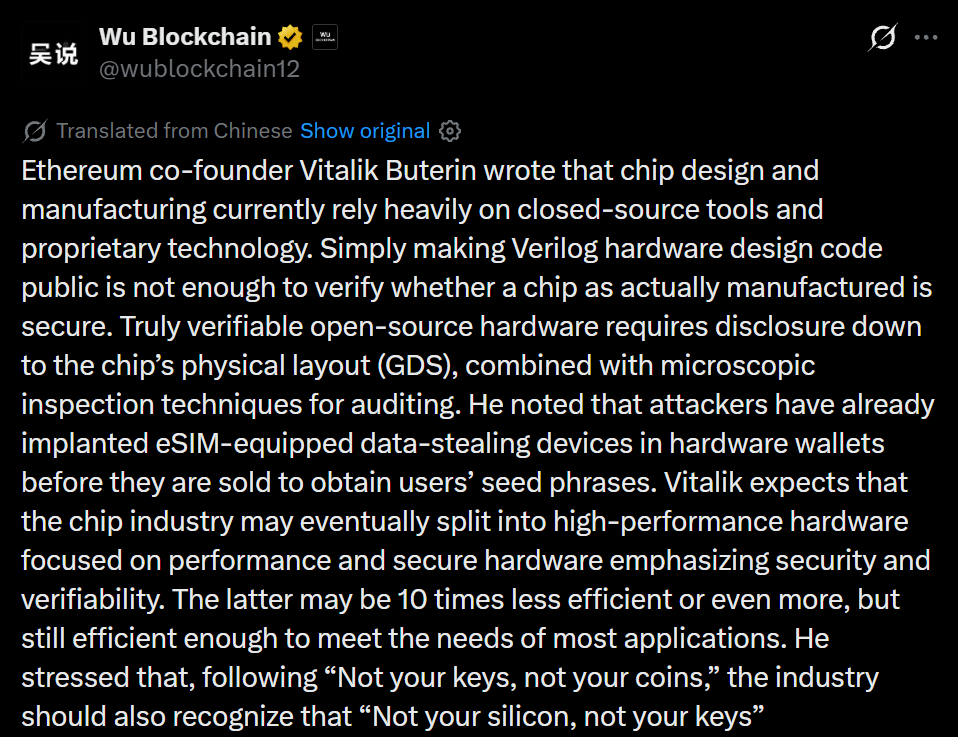
Source: Wu Blockchain Post
This article explains the post in and shows where the ETH price stands at the time of writing.
ETH Price Snapshot: Where Ethereum Stands Today
Ethereum news today also includes the market picture. Here is the snapshot taken from live price data:
Metric | Value |
Price | $1,691.58 |
24h change | +2.79% |
Market cap | $206.8B |
24h trading volume | $12.97B (+21.5%) |
Volume to market cap | 6.27% |
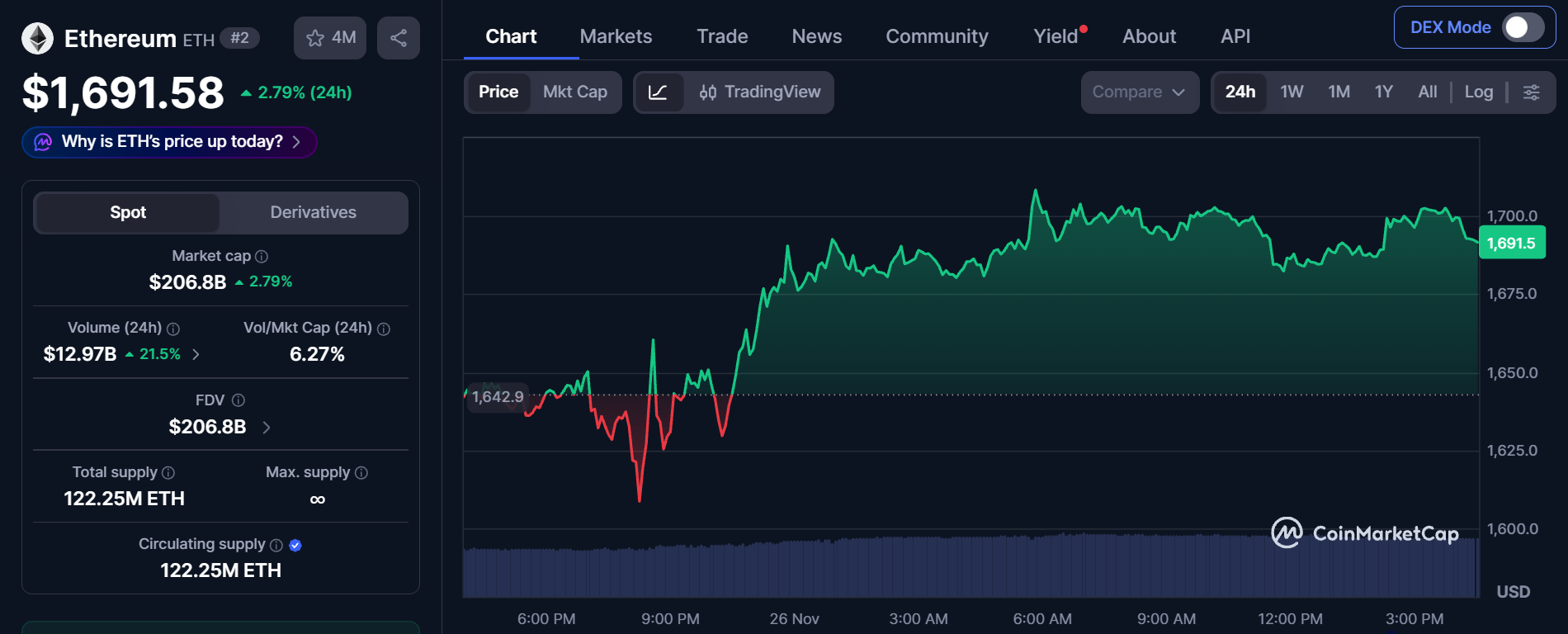
Note: This data is as of 26 November 2026, around 4:30 AM, the time shown on the CoinMarketCap chart. Prices and market figures change every minute, so check the live price page before making any decision. This is not financial advice.
Source: CoinMarketCap live data
On the 24-hour chart, ETH started near $1,642.9. It dipped to roughly $1,610 in the evening of 25 November, climbed to about $1,710 in the early morning, and then eased to $1,691.5.
The dip and peak are read by eye from the chart, so treat them as approximate. Trading volume rose by 21.5%, which means more activity than the day before.
The write-up covered below is about hardware security, and nothing in it links to this price move.
Vitalik Buterin's New Post: Why Chips Matter for Crypto
The entry is titled "A shallow dive into open-source chip design." Its starting point is simple: to fully understand, improve, or verify any computer, you eventually have to look at the hardware itself.
The goal is to give readers used to software a first introduction to how chips are designed and built.
He describes the chip world as closed and secretive. Working with a leading factory usually means proprietary tools and signing many confidentiality agreements.
He calls hardware a "total proprietary dystopia" and says it is even worse than software was about 25 years ago.
How a Chip Is Designed: Six Stages in Plain Words
He explains that people write instructions in high-level languages, and these are turned step by step into more detailed ones.
The lower the stage, the more it depends on one specific factory and its process.
To show this, he walks through a tiny circuit that keeps multiplying a number by 3.
Stage | What it describes | In simple words |
Higher-level code (optional) | Short programs turned into designs | A plain-language recipe |
Verilog | Values and when they change | Written instructions for how the chip behaves |
Netlist | Individual parts and how they connect | A parts list with wiring |
GDS | The polygons of every layer | The final drawing of the chip |
Mask data | What the machines will print | Instructions for the printers |
Finished product | The physical device | What you hold in your hand |
Why Sharing Code Is Not Enough
The central argument is that the right level of openness is the final drawing, called GDS. Most open-source chips today share only the written instructions.
With those, a factory can print a chip that works the same way, but even with an excellent microscope you cannot easily check a finished product against them.
With the final drawing, there is an intended layout to compare against. He says this is not just theory.
He describes attacks seen today, where attackers place a spy device with an eSIM inside a hardware wallet before it is sold, so the seed phrase (the secret recovery words) is sent out as soon as the buyer starts using it.
He warns that future attacks could swap a chip for a look-alike with hidden extra features that the naked eye cannot spot. Checking chips is hard but possible.
He points to these ideas:
Microscopes and light: a leading method called IRIS looks inside chips using light of different wavelengths.
Destructive checks: subtler tampering needs methods that take the device apart layer by layer.
Easier-to-inspect designs: chips can be built so small parts can be switched on and tested one at a time.
Less advanced chips: older, less efficient manufacturing sizes work better with inspection methods like IRIS.
He adds that ordinary users should not expect a pocket scanner. This is expected to be work for professional auditors, journalists, and civil society groups.
Open Factories, Costs and the Road Ahead
No practically useful factory is fully open, he says. But a few publish their design kits and do not require confidentiality agreements.
He names four:
The GlobalFoundries factory in Singapore (GF180 process)
The SkyWater factory in Minnesota (SKY130 process)
IHP in Frankfurt (Oder), Germany (also at the 130 level)
ICsprout in Hangzhou (ICS55), which is only partly open, with a preview release for research and prototyping, not mass production
Costs also matter. Small teams can share one production run through multi-project wafer companies, and hobbyists can use Tiny Tapeout, which puts hundreds of circuits from different people on a single chip.
Among Ethereum news today, this blog entry stands out because it ties a crypto slogan to physical equipment.
Conclusion
In the 2010s, people said, "Not your keys, not your coins." He adds a new line for the 2020s: "not your silicon, not your keys." Vitalik does not expect all hardware to become open.
He hopes the industry splits into performance hardware and secure hardware, where the secure kind may be 10 times less efficient or more, yet still good enough for almost everything.
For anyone following Ethereum news today, the message is clear: real security reaches down to the chip.
Disclaimer
This article is for educational and informational purposes only and is not financial or investment advice. Crypto assets are high risk, their prices can be very volatile, and you can lose some or all of your money. Always do your own research and consider speaking with a licensed financial advisor before making investment decisions.
免责声明:本文章仅代表作者个人观点,不代表本平台的立场和观点。本文章仅供信息分享,不构成对任何人的任何投资建议。用户与作者之间的任何争议,与本平台无关。如网页中刊载的文章或图片涉及侵权,请提供相关的权利证明和身份证明发送邮件到[email protected],本平台相关工作人员将会进行核查。