Author: Sachin (@SachinHMx)
Compiled by: Shenchao TechFlow
Introduction by Shenchao: In today's world, where complex derivatives have evolved from financial primitives such as trading, lending, and cross-chain transactions, insurance, regarded as the "fourth cornerstone," has fallen into years of contraction. As AI tools significantly reduce the costs of exploiting vulnerabilities in smart contracts and launching attacks, the total amount stolen in DeFi has repeatedly hit new highs, yet less than 2% of on-chain assets are covered by insurance.
The core bottleneck lies in the "self-referential risk" of traditional underwriting models, where highly volatile on-chain assets such as ETH are used as collateral to insure the same assets, resulting in a synchronous collapse of collateral value and underwriting capacity during crises. The latest generation of protocols is attempting to introduce external uncorrelated asset collateral or insurance scoring mechanisms to break this vicious cycle.

Core Overview (TL;DR)
AI Accelerates Attack Threats: DeFi hacker attack losses have reached $9 billion in 2026, with AI tools significantly enhancing the efficiency of vulnerability hunting and exploit attack development, reducing costs by up to 100 times.
Severe Underinsurance Coverage: The total value locked (TVL) across the DeFi ecosystem is currently about $68 billion, but the insured proportion is less than 2%. The entire insurance sector's TVL has plummeted from its peak of $1.85 billion in 2021 to just $132 million now.
Clearly Defined Coverage Boundaries: DeFi insurance specifically provides coverage for predefined risk events (such as smart contract exploits, oracle failures, stablecoin de-pegging, and staking penalties) and does not cover regular market price fluctuations or ordinary trading losses.
High Concentration of Oligopoly: Nexus Mutual and Firelight account for nearly 90% of the total insurance TVL in the sector. Since its launch in 2019, Nexus Mutual has paid over $24.7 million in claims to affected users.
Five Core Barriers to Scaling: Inefficient capital use, lack of risk pricing, insufficient hedging of highly correlated risks, difficulty in claims assessment, and security issues within the insurance infrastructure itself, remain serious barriers to the sector's expansion.
The DeFi ecosystem boasts up to $68 billion in locked assets, yet the proportion of funds protected by insurance protocols is less than 2%.
Since 2021, DeFi has evolved from its most basic spot trading and lending liquidity pools into fixed-rate lending, tranching, and diverse structured income products. However, the development trajectory of insurance protocols has been entirely in the opposite direction: the combined locked-in amount across the sector has dramatically decreased from its peak of $1.85 billion in 2021 to a mere $132 million today.
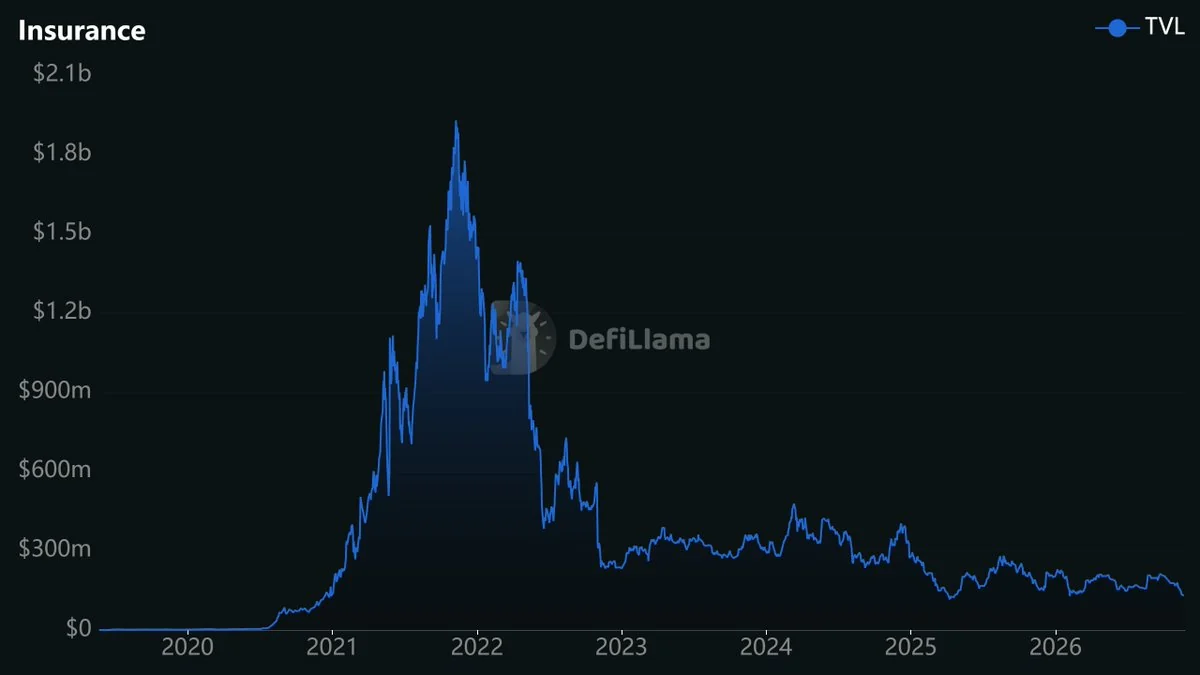
Figure: DeFi Insurance TVL Has Sharply Declined Since Its Peak in 2021
Insurance: The Missing Fourth Financial Cornerstone of DeFi
To date, DeFi has established three core underlying financial primitives:
1. Automatic Market Makers (AMM): Enabled permissionless decentralized spot trading;
2. Lending Markets: Provided on-chain credit expansion, leverage, and income basis;
3. Cross-chain Bridges: Facilitated asset transfer pathways between multi-chain ecosystems.
These three work in synergy, creating liquidity while also creating and dispersing complex financial risks. However, the fourth critical primitive remains severely lacking: a mechanism capable of scientifically pricing extreme downside scenarios and smoothly transferring risk, which is "insurance."
Code audits and real-time on-chain monitoring can only detect potential security vulnerabilities in advance, but cannot absorb financial losses after an attack occurs; only insurance can provide users with a systematic financial safety net through clear coverage limits and payout conditions.
When AI accelerates the speed of smart contract vulnerability scanning and attack script creation while reducing costs to one percent of prior rates, why has the expansion of DeFi insurance stalled? Is it a flaw in the design of insurance protocols, a severe deficiency in the supporting infrastructure, or insufficient genuine hedging demand from institutional and individual investors?
Before discussing why DeFi insurance struggles to scale, we first need to clarify which real risk scenarios existing on-chain insurance products cover.
What Risks Does DeFi Insurance Cover?
Depositing assets into DeFi protocols involves far more than simple market fluctuations. Smart contract vulnerabilities, oracle price feed failures, on-chain governance attacks, liquidation mechanism failures, stablecoins or wrapped assets de-pegging, Ethereum slashing penalties, and custody failures can all lead to assets becoming worthless.
For example: a hacker exploiting a contract vulnerability can completely drain $10,000 deposited in a lending protocol, even if the investor has made no trading mistakes, and the position will evaporate instantly.
DeFi insurance is precisely aimed at covering these "predefined specific loss events," rather than ordinary secondary market price drawdowns or losses from bad trades.
According to the Onchain Risk Map project (onchainriskmap.com), current DeFi risks can be categorized into six major types:
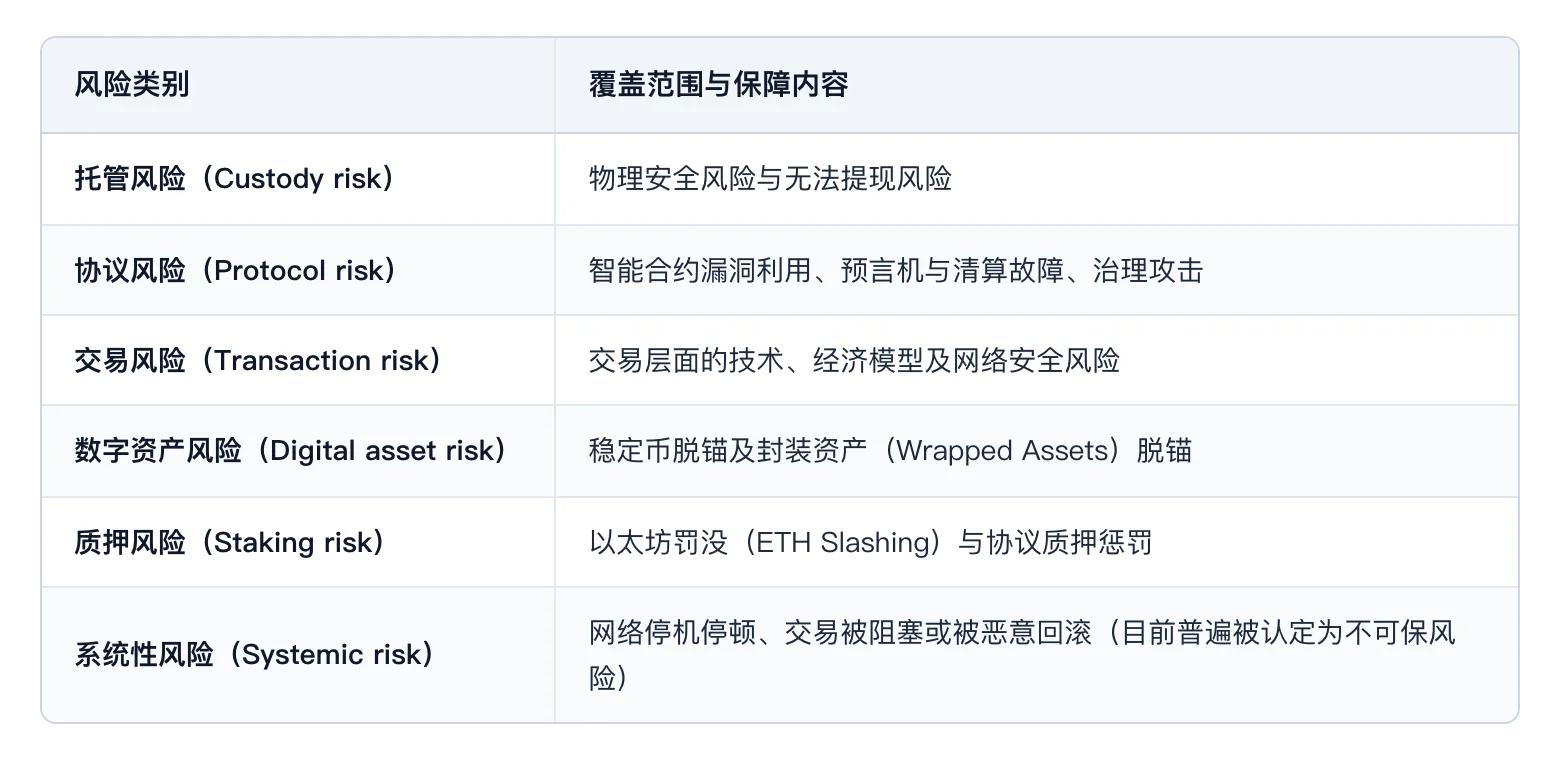
Figure: The Six Core Categories of DeFi Risks (Source: onchainriskmap.com)
It is particularly important to note that the sixth category "systemic risk," due to its disastrous consequences involving a total halt of a public chain, is commonly defined within the industry as an uninsurable absolute tail risk.
How Do Existing DeFi Insurance Mechanisms Operate? An Example with Nexus Mutual
As the most representative longtime leader in the sector, Nexus Mutual offers a classic example for observing the underlying operations of existing DeFi insurance.
Nexus Mutual operates on Ethereum in the form of a "Discretionary Mutual," where the core logic is that mutual members jointly contribute to a capital pool to insure designated protocol risks.
Its complete business loop includes four core steps:
Step One, Capital Provision: Holders of governance tokens ($NXM) stake or delegate their tokens into various specialized underwriting pools;
Step Two, Risk Selection: Pool managers assess and select protocols and risk types allowed for underwriting and set corresponding premium prices;
Step Three, Purchasing Policies: Ordinary users pay premiums to gain coverage for a specified period against predefined loss events;
Step Four, Claims Adjustment: Once a loss event is triggered, submitted claims are verified and adjudicated on-chain by a claims committee. If the claim is approved, the mutual will use the public fund pool to fulfill payment and destroy the corresponding staked NXM tokens from the underwriting pool to achieve capital settlement.
Policy prices dynamically fluctuate based on supply and demand, with coverage periods usually flexibly configured between 28 and 365 days.
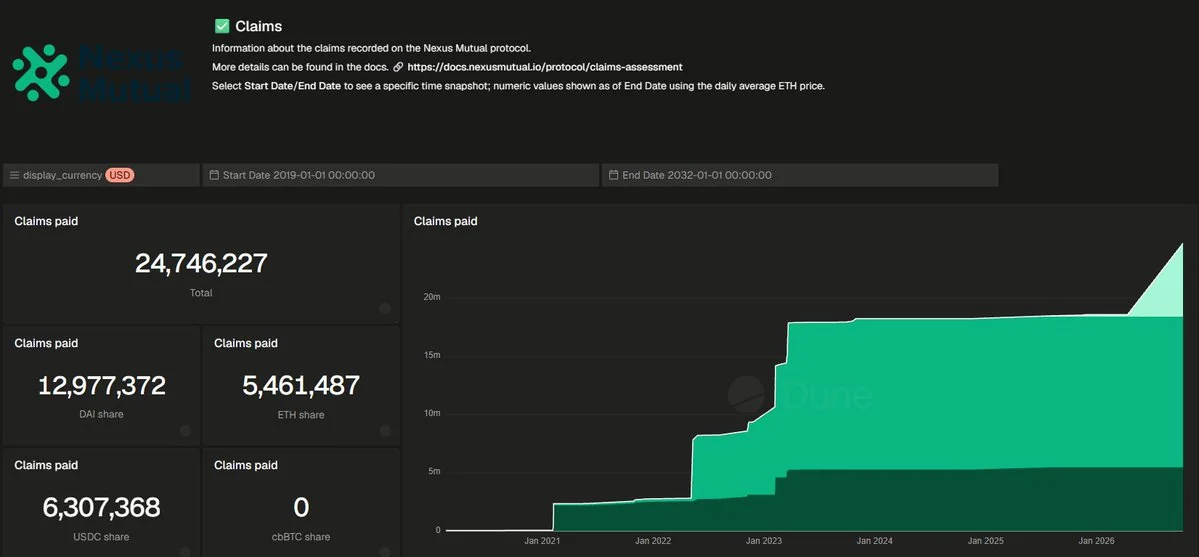
Figure: Cumulative Claims Expenditures of Nexus Mutual Since 2019
Official historical claims records show that since its founding in 2019, Nexus Mutual has paid over $24.7 million in real money to policyholders affected by security incidents.
Current State of the DeFi Insurance Ecosystem
Currently, the total locked amount in the DeFi insurance sector is approximately $132 million, with Nexus Mutual and the emerging protocol Firelight accounting for nearly 90% of this substantial share. The majority of other long-tail protocols have generated almost no sustainable premium income, highlighting the extreme oligopolistic nature of this sector, which is still in a very early predicament.
Currently active ecosystem projects mainly include:
Nexus Mutual (@NexusMutual): A decentralized mutual insurance protocol governed by members, providing coverage for DeFi smart contract risks through collective capital contribution and issuing policies;
Firelight (@Firelightfi): Innovatively utilizes staked FXRP as external collateral to provide coverage for deeply integrated DeFi yield vaults;
EaseDeFi (@EaseDeFi): Formerly known as Armor, proposes a "Uninsurance" model, striving to enable users to obtain policy coverage without prepaying high premiums through mutual coverage;
Ensuro (@Ensuroproject): An on-chain insurance and reinsurance protocol that connects decentralized capital providers with real-world underwriting capabilities;
Cozy Finance (@cozyfinance): Builds an automated hacker protection trading market for ordinary retail and protocol participants;
Ante Finance (@AnteOrg): Enables on-chain verification of various technical commitments and security assurances of protocols through on-chain staked smart contract testing suites (Ante Tests);
Sherlock (@sherlockdefi): Deeply integrates comprehensive security audits of smart contracts with hack vulnerability insurance, with audit teams providing financial backing for the code they have audited;
USD8 (@usd8_fi): An asset protection stablecoin backed by USDC reserves, distributing coverage amounts and claim payments through shared coverage pools and dynamic "insurance scoring" mechanisms, currently in public testing.
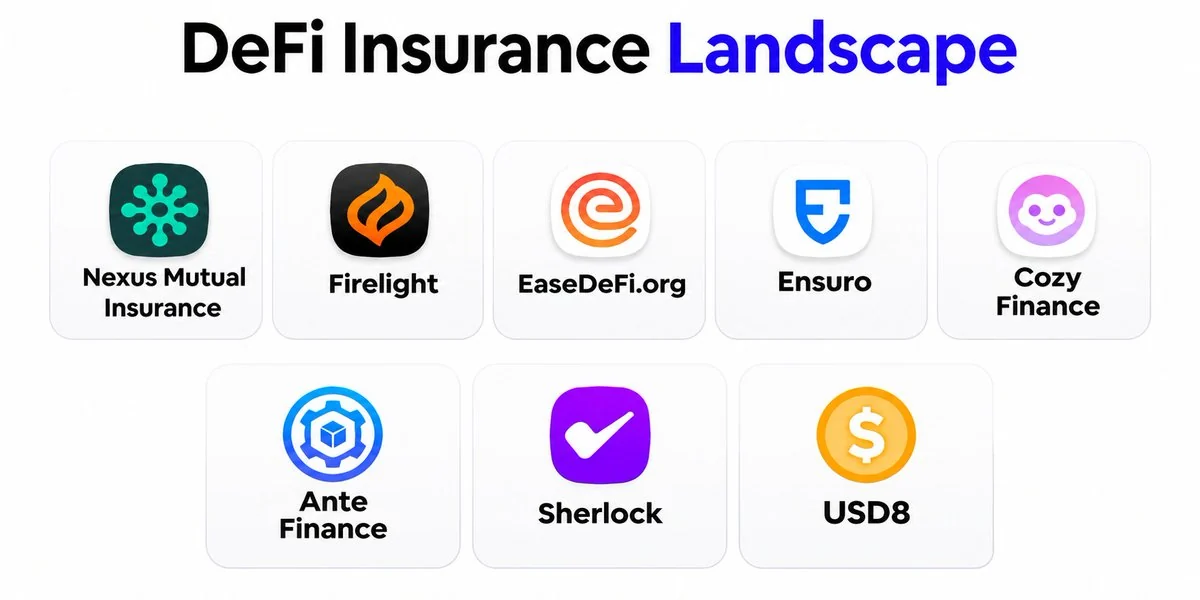
Figure: Overview of Mainstream DeFi Insurance Protocols and Security Providers
It is important to point out that simply measuring TVL does not fully gauge an insurance protocol's actual solvency. Active Cover, fund utilization efficiency, Minimum Capital Requirements (MCR), and historical claim performance are the key criteria for assessing its true underwriting capacity and financial health.
Why Is DeFi Insurance Always Difficult to Scale?
The early DeFi insurance model had a fatal underlying flaw: the collateral assets relied upon by the insurance pool are themselves exposed to the same set of crypto risks that they attempt to protect against.
When a black-swan crisis occurs in the entire market, claims often explode exponentially, while the underlying assets serving as collateral (such as ETH) face sharp declines in price.
In other words: at the most critical moment when claim liabilities are the most rigid and need to be liquidated for compensation, the value of collateral shrinks the most severely.
Additionally, early underwriting capital pools were shallow, unable to accommodate the asset risks of major leading protocols amounting to billions of dollars, let alone satisfy the hedging allocation needs of institutional players with multimillion-dollar amounts.
In response, the emerging protocol Firelight is trying to explore a completely different asset structure: using external capital based on XRP to insure DeFi risks. Users deposit FXRP into dedicated vaults on the Flare network and receive yield-bearing certificates (stXRP), and the massive asset pool accumulated will specialize in providing hedge payouts for partnered DeFi vaults.
Its funding operational logic is: $XRP holders → $FXRP → Firelight reserve vault → providing protection for DeFi protocols.
This structure attempts to break the reliance on highly correlated collateral within DeFi, but whether it can fully alleviate secondary market liquidity shocks and cross-asset correlation risks still requires real testing in bull and bear cycles.
Addressing the core issues of early traditional insurance models, Firelight founder Jesus Rodriguez (@jrdothoughts) pointedly noted in an interview with The Wolf of All Streets:
"The biggest pain point the previous generation of peers encountered was: they were constantly trying to insure ETH with ETH."
"The actual breakthrough point is, why not try using external assets that are not strongly correlated with the traditional DeFi ecosystem, such as XRP, XLM, or even Bitcoin to some extent, to build a safety net for top yield-bearing assets in DeFi?"
"This way, your capital holding costs will be extremely low, even close to zero. Because native XRP and XLM on-chain have never had any significant native yield paths, and the yields on Bitcoin on-chain are also very low."
"But if you take these idle assets to provide insurance backing for Sentora vaults, Morpho lending pools, or the Aave lending market, the entire business logic runs through completely. Users stake XRP in the deposit vault, and it never directly interacts with the underlying target protocol, yet it can稳. capture the yield premium income paid by the target protocol for risk hedging."
Path to Breakthrough: What Changes Are Needed in DeFi Insurance?
According to statistics from Diligence Security, in just the first quarter of 2026, the DeFi sector suffered serious losses of up to $137.7 million due to various hacker attacks, with only about $9 million successfully recovered. Such a massive net security exposure underscores the extreme urgency of financial protection; however, to build a self-sustaining healthy insurance market, the following five mountains must be overcome:
1. Capital Efficiency Bottleneck: Insurance institutions must retain extremely large redundant liquidity in vaults to deal with potential claims, but how to keep these immense reserve funds highly productive remains a challenge in economic model design;
2. Lack of Dynamic Risk Pricing: Smart contract vulnerabilities and composite economic model attacks have extremely strong suddenness and randomness, lacking the long-term historical statistical data required by traditional actuarial science, which often leads to premiums being set either too high to scare off buyers or too low, causing underwriters to incur losses;
3. High Transmission Risk Correlation: Market-wide liquidity squeezes often trigger domino effects, with multiple protocols experiencing a series of failures simultaneously, creating a catastrophic resonance with the decline in the price of insured assets;
4. Subjective Disputes in Claims Assessment: Not every on-chain incident can be easily characterized as a hacker attack meeting the conditions for claims; economic model arbitrage logic, white-hat interventions, or team exit scams can easily trigger serious governance divergence and trust crises between victims and the insurance pool;
5. Security Backlash Against Insurance Layers Themselves: Ironically, even the infrastructure dedicated to providing protection for others often becomes a target for hackers. For example, Cozy Finance, which aims to build protective markets, was itself hacked in September 2026 and lost $170,000. Even a shield meant to protect others has vulnerabilities that can be breached.
These intertwined challenges require insurance protocols to accumulate enough capital to absorb catastrophic losses while also having a precise risk quantification system to set reasonable premiums and robust code security mechanisms to ensure claims are paid in full when users face storms.
The DeFi world has established exceptionally sophisticated trading, lending, and composite yield markets over the past few years, yet it has only stalled on the fundamental aspect of "risk transfer and digestion." For on-chain insurance to genuinely break through its bottlenecks, it must introduce deeper and uncorrelated underlying capital pools, build more trustworthy dynamic risk actuarial models, and create more transparent and objective claims adjudication infrastructures.
Whether it is the exploration of external collateral using uncorrelated assets by Firelight or the shared coverage pools and quantitative safety scores being attempted by USD8, both are seeking new solutions for this industry. Only by achieving substantial breakthroughs in these core areas can insurance truly become the genuine fourth cornerstone of DeFi, following AMM, lending, and cross-chain bridges; otherwise, it will inevitably remain a marginalized observer in the decentralized financial wave worth hundreds of billions.
免责声明:本文章仅代表作者个人观点,不代表本平台的立场和观点。本文章仅供信息分享,不构成对任何人的任何投资建议。用户与作者之间的任何争议,与本平台无关。如网页中刊载的文章或图片涉及侵权,请提供相关的权利证明和身份证明发送邮件到[email protected],本平台相关工作人员将会进行核查。