Organized & Compiled: Deep Tide TechFlow
Deep Tide's Introduction: While the entire technology industry is immersed in the narrative of the rapid advance of large language models (LLMs), ordinary investors are facing an unprecedented crisis of asset differentiation. In the past bull market cycle, retail investors could accompany Amazon or Microsoft as they grew from billions to trillions of dollars in market value; however, in the current AI wave, most unicorns have long ago carved up massive excess valuations during their privatization stages, delaying their public offerings and even depriving the public of the chance to share in the technological dividends.
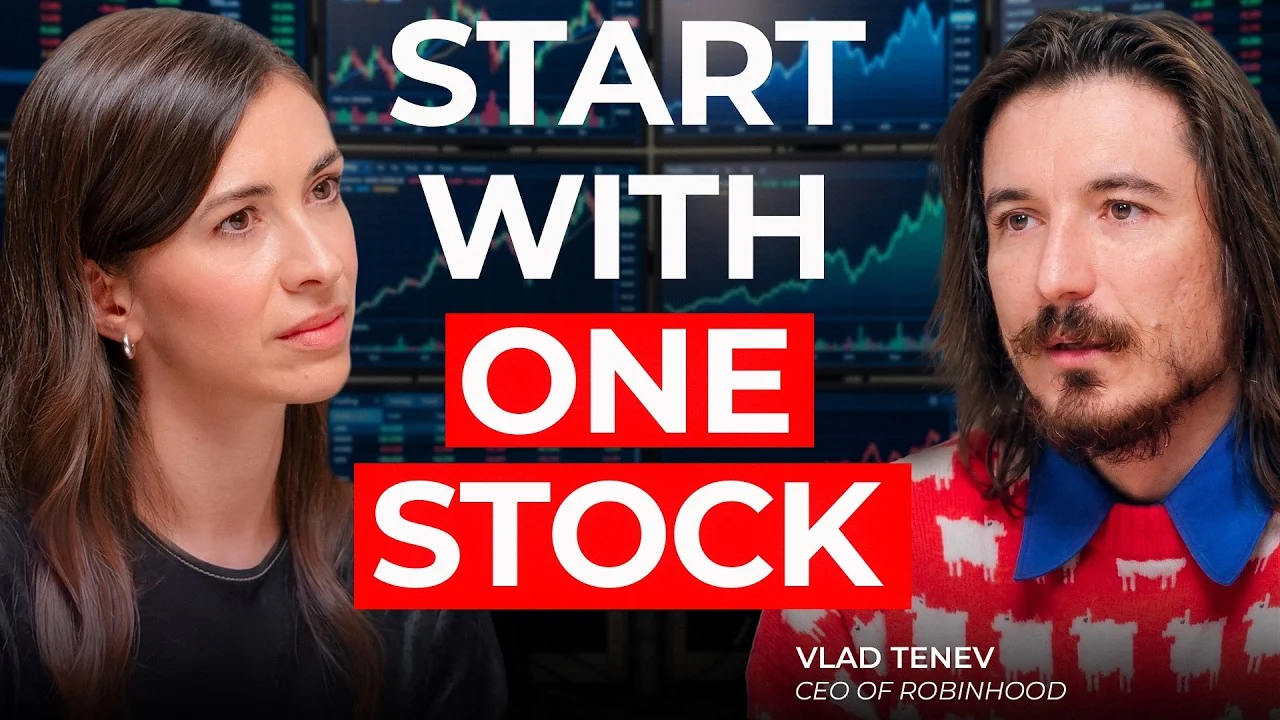
In the face of this predicament, Robinhood co-founder and CEO Vlad Tenev comprehensively dissected the paths to wealth in the AI era in a one-hour in-depth interview on Silicon Valley Girl. He discussed how Robinhood provides compliant automated trading pipelines for AI agents through technical architecture, why the directive "help me make money" is the most dangerous open-ended command; how business leaders can reshape employees into managers of dozens of 24/7 "agents," and why mere statistical code generation cannot lead to AGI, emphasizing that only the combination of formal mathematical proof can solidify a reliable foundation. Vlad, with his hardcore engineering background and as a leading figure in fintech, offers a highly practical framework for understanding wealth and cognition.
Guest: Vlad Tenev (Co-founder and CEO of Robinhood, Founder and Chairman of the mathematical formalization AI company Harmonic)
Host: Marina Mogilko (Founder of Silicon Valley Girl, Technology Podcast Producer and Entrepreneur)
Podcast Source: Silicon Valley Girl (https://www.youtube.com/watch?v=drrMoBocXZ0)
Original Title: Robinhood CEO: How to Build Wealth in the AI Era (Before It's Too Late)
Broadcast Date: Beijing Time: 2026-11-25 01:20
Key Points Summary
The pre-IPO privatization phase has consumed the vast majority of AI wealth dividends: The traditional wealth creation myth is built on the foundation of early public listings, where retail investors could accompany giants valued at several hundred million dollars to grow alongside them; nowadays, leading AI giants (like OpenAI, Anthropic, SpaceX) have already reached valuations exceeding hundreds of billions during their private phases, and the vast majority of growth dividends have been monopolized by venture capital and ultra-high-net-worth groups. Robinhood is tackling underlying regulations and clearing pathways, aiming to open a regulated private unicorn equity investment window for the general public.
The cornerstone of AI agent trading for clients is independent sub-accounts and strict sandbox risk control: Unconstrainedly connecting the main financial account to a general large model poses significant catastrophic risks. Robinhood advocates for setting up dedicated "AI isolation sub-accounts" for ChatGPT or Claude via API, establishing extremely strict limits on fund allocation, asset whitelists, and mandatory stop-loss conditions, with automated schedulers executing predefined logic at specified times or market conditions, never granting open-ended fund access to black-box AI.
"Help me make money" is the most dangerous and doomed-to-fail speculative prompt: Simply issuing open-ended profit commands to AI will inevitably lead the model to chase leverage and fall into the speculative traps of purchasing high-risk poor-quality assets. An effective personal finance prompt must include rigorous quantitative constraints and defensive logic, clearly defining asset pools, price-earnings ratio ranges, valuation safety margins, and hard stop-loss lines, thereby framing model actions with precise rules.
Relying solely on statistical AI for coding cannot lead to superintelligence (AGI): Existing programming large models are essentially probabilistic imitations of open-source code, which cannot guarantee 100% absolute logical integrity when faced with complex financial systems, aerospace, or underlying core architectures. Harmonic, co-founded by Vlad, is pushing for formal mathematical verification through lean language, emphasizing that only with every line of code passing strict mathematical logic checks can AI completely depart from illusions and become a reliable foundational element.
Corporate organizational restructuring: Every employee should transform into a manager overseeing 24/7 agents: At Robinhood, AI is not a chat toy to assist typing but a multiplier of organizational structure. Exceptional employees are transitioning into managers commanding 5 to 10 specialized vertical agents, responsible during the day for setting strategic goals and auditing output quality, with the scheduler driving agents to continuously conduct stress tests, data cleansing, and code generation at night, achieving seamless organizational productivity around the clock.
The CEO's core growth principle: One must decisively "fire their past self" at every new cycle: The competencies required as a company grows from 2 to 20 to thousands of employees are entirely different. Confronted with the retail surge crisis of 2021 and macroeconomic reversals, Vlad realized that founders who indulge in the technical minutiae and lone struggles of the startup phase become the bottlenecks for corporate development; only by mentally courageously firing that old version of themselves can they reshape into the mature leader necessary for a hundred billion dollar scale.
Insightful Points
"If a company goes public at a market value of $10 billion and later grows to $100 billion, public investors can share in tenfold epoch dividends; but if a company faces a valuation of $150 billion in the privatization phase before considering an IPO, then the most explosive value creation curve has already closed its doors to ordinary people. Breaking the class barriers of private markets is the most urgent battle for financial democratization in the AI era."
"Never tell your AI assistant 'help me make money'; it's as absurd as handing a three-year-old a gun and saying 'help me solve life problems.' The model will unhesitatingly rush into a liquidity-drained, high-leverage casino to satisfy your command. The essence of finance is always risk management; what you need to provide is a defensive manual, not greedy directives."
"Software is not dead, but the old world of writing and distributing software has ended. In the past, you needed to hire dozens of engineers and spend half a year building a rough backend prototype; now, anyone with clear logic can drive an agent to assemble a complete product over a weekend using natural language. Productivity inflation means mediocre code becomes worthless, while tight business insight and architectural judgment become extremely precious."
"Current AI programming assistants act more like highly skilled stenographers, producing seemingly gorgeous code, but you cannot mathematically prove whether it has fatal edge collapse vulnerabilities. In financial trading and core infrastructure, '99% correct' is equivalent to 0. This is why formal mathematical verification is so important, providing code with the absolute certainty characteristic of Euclidean geometry."
"As an entrepreneur and CEO, your biggest enemy is often not your competitors, but that old version of yourself who once led you to early successes. At every key growth turning point, you need to calmly stand in front of a mirror, looking at the past you from the cold perspective of the board, saying: 'Thank you for your efforts, but you are no longer suited for today’s scale; you are fired.' Then step back into the role with a brand-new professional manager identity."
Complete Dialogue Organization
Retail Investors Missed Huge Dividends Before IPO: Breaking Through from Secondary Markets to Private Equity
Marina Mogilko: Vlad, in today’s technology investment circle, everyone is discussing the tremendous wealth effect brought by AI. However, many ordinary wage earners or retail investors often feel a strong sense of powerlessness: leading companies like OpenAI, SpaceX, or Anthropic have seen their valuations balloon to astonishing figures, yet they are not trading on public stock markets. How do you view this wealth disconnect faced by ordinary people in the AI wave?
Vlad Tenev: Marina, you have pinpointed the most severe structural problem currently facing global capital markets.
We can look back at history: in the 1990s and even early 2000s, great companies like Amazon, Microsoft, or Apple chose to go public at extremely early stages, with market values only in the hundreds of millions or a few billion dollars. What does that mean? It means that any ordinary retail investor, as long as they have basic industry knowledge, could buy their stocks for a few hundred dollars in the public market and grow hundreds or even thousands of times over the next twenty years alongside them. The public enjoyed a sweet segment of the value curve of the technological revolution.
However, in the last ten to fifteen years, the entire gaming rules of the capital market have undergone severe distortion. With an abundance of venture capital, sovereign wealth funds, and ultra-high-net-worth private equity in the primary market, today's startups tend to stay in the private market for as long as possible. They complete seed rounds, Series A through F funding, in non-public markets, with valuations skyrocketing from $1 billion to $50 billion or even $150 billion.
This has led to a harsh reality: when a company finally rings the bell on the New York Stock Exchange or Nasdaq, its most explosive growth phase has already ended. Retail investors in the public market often can only buy in at high valuations at the peak, seeking a regular return of 8% to 10% annually, while the earlier hundreds of times of excess wealth have been divided up by a few privileged classes in closed-door meetings.
In the current AI revolution, this phenomenon has been amplified to the extreme. OpenAI's valuation has reached $157 billion, and Anthropic and SpaceX are also at astonishing levels. Retail investors simply can't buy their primary equity.
This is also one of the core directions we are vigorously tackling at Robinhood. We are exploring a series of compliant technical architectures and financial tools in an attempt to segment and legitimize the liquidity of private markets, allowing ordinary registered users to indirectly hold economic rights to first-class private unicorns at a very low entry threshold. Enabling every ordinary person to equally share in the upper-level prosperity brought by AI productivity has been our unwavering mission since our inception.
Why Beginners Should Start by Buying Their First Stock
Marina Mogilko: Many financial advisors often tell young people: "Don’t pick individual stocks; investing in the S&P 500 index or broad market ETFs is the only wise choice." But I know you encourage beginners to seriously buy their first stock in many instances; what’s the logic behind that?
Vlad Tenev: From a purely modern portfolio theory (MPT) and statistical expected return perspective, financial advisors’ advice is certainly correct; passive investing in broad indices is the most robust asset defense method for the majority of people.
But people are not cold mathematical models; they are beings with emotions and a thirst for knowledge. If you tell a young person just entering society in their early twenties, "Throw your money into something coded VOO, then turn off the screen and wait forty years," it’s hard for them to develop any real passion for investing or deep thought.
I recommend beginners start by buying their first specific stock to establish "skin in the game" for cognitive immersion.
You can select a company you are extremely familiar with and love in your daily life: perhaps the smartphone brand you use every day, the coffee you have each morning, or the software you browse daily. The moment you truly invest your own hard-earned money to buy even one share or a fractional share (Fractional Shares) of it, a wonderful chemical reaction occurs.
You begin to pay attention to the company's quarterly reports, care about what its competitors are doing, think about how supply chain disruptions affect its gross margins, and even start to mind how macro interest rates influence its valuation multiples. That small investment is effectively purchasing a lifelong ticket to understanding the business world and macroeconomic cognition for yourself.
Once this business intuition and understanding is gradually established, you can naturally expand your portfolio into a broad range of ETFs and solid assets. First ignite curiosity through specific stocks, then build a defensive system through asset allocation; this is the sustainable growth path.
The Safety Red Line of Connecting AI to Financial Accounts
Marina Mogilko: Many people are now trying to connect ChatGPT, Claude, or customized AI agents to their financial brokerage accounts through APIs, allowing the large models to automatically scan the market and place orders. As someone managing millions of users’ assets, do you think it's safe to directly connect AI to bank or stock accounts?
Vlad Tenev: This is an extremely serious and hazardous topic. My direct answer is: under the current maturity of large language models, if you give a black-box LLM global control permissions over your main financial account, it is akin to a financial suicide gamble.
We must recognize the underlying mathematical nature of large language models: they are probabilistic completion models trained on vast amounts of corpus, lacking true logical certainty. They suffer from significant hallucinations, are susceptible to prompt injection attacks, and lack a hard causal understanding of physical and financial realities.
If given unconstrained access and authority for customer trading, a large model could potentially initiate extremely irrational trading activities in a very short period due to misinterpreting an unverified Twitter news post or being lured by maliciously constructed web data, even converting all your principal into illiquid junk micro-cap stocks.
Thus, in Robinhood’s engineering design, we emphasize "safe sandboxes and the principle of least privilege":
First, strict account isolation must be implemented. If you want to use AI-assisted trading, you cannot let it touch your main account or long-term retirement accounts, but rather should set up a dedicated "AI experimental sub-account," containing only a small amount of risk capital that, even if lost, would not affect your normal life.
Second, hard deterministic risk control gates must be set at the code level. This includes: a hard upper limit on the maximum amount for a single transaction, daily transaction limits, allowing transactions only for pre-approved compliant large market asset whitelists, and a mandatory power-off stop-loss mechanism when declines reach specific thresholds.
The large model can only provide trade recommendations or execute predetermined actions within these ironclad theft-protection nets and must never be given the highest privileges to bypass the rules.
Why "Help Me Make Money" is the Worst AI Prompt
Marina Mogilko: Many newcomers to AI investing often input prompts like, "I have ten thousand dollars, please help me make as much profit as possible in the US stock market next month." Why do you believe such prompts are catastrophic?
Vlad Tenev: This is a classic case of misaligned objective functions. When you tell AI "help me make money" or "pursue maximum profit," how does the model’s optimization algorithm understand that?
Mathematically, to chase the highest potential return in a very short time, the only path is to assume extreme tail bankruptcy risks: fully investing in deep out-of-the-money short-term call options or over-leveraging to gamble on the after-hours volatility of small-cap stocks. The system might yield extraordinary profits in extremely rare circumstances, but in 99% of path evolutions, this strategy ultimately leads to total loss.
The timeless core of financial investment is not in pursuing peak returns, but in "managing downside risk while ensuring survival." A professional investor always first calculates how much loss they can tolerate and then seeks the corresponding risk premium.
Therefore, a qualified, actionable AI financial prompt must be filled with rigorous conditional constraints. For example, you should instruct the model like this:
"Please filter through S&P 500 constituent stocks to find robust candidates with free cash flow yields in the top 20%, net debt ratios below the industry median, and pullbacks exceeding 15% over the past three months. Each investment amount must not exceed 3% of the total assets of the sub-account, and a strict 7% hard trailing stop must be set after purchase. If no opportunities matching the above factors arise, maintain a cash position."
You see, within this framework, you are not asking it to create miracles; rather, you are letting it act as a tireless machine that rigorously enforces quantitative discipline. The more constraints, the more predictable the AI actions, and the more authentic the value it brings.
Software is Not Dead, but the World of Writing and Distributing Software Has Completely Changed
Marina Mogilko: Recently, a radical narrative has been circulating in Silicon Valley that "software is dead" because anyone can use AI to write a line of code in minutes, rendering traditional software moats obsolete. You also come from a technical background; do you agree with this statement?
Vlad Tenev: I completely disagree with this sensational statement. Software is not dead; on the contrary, human society's demand for software is experiencing an exponential explosion.
The so-called "software is dead" essentially refers to the death of the "traditional expensive and slow software development and outsourcing delivery model."
In the past, if a small business wanted to customize an internal customer management or logistics scheduling system, it needed to find an outsourcing team, spending hundreds of thousands of dollars and a six-month development cycle, only to end up with a often hard-to-maintain clunky system. Today, with cutting-edge tools like Cursor and Claude 3.5 Sonnet, a business leader without any formal computer background can simply describe their business processes using clear natural language and build a fully usable, highly agile software that meets their needs in a weekend.
This means that supply-side costs for software have been reduced to nearly zero, and software is becoming a ubiquitous infrastructure akin to electricity. Every small business process that was originally completed through paper, Excel, or manual memory can and should be softwareified.
Thus, the number of lines of code in software itself has completely lost its moat attribute. The real moats are irreversibly shifting to both ends:
On one end is "deep proprietary data and regulated financial network infrastructure," such as the broker clearing channels, compliance licenses, and real-time matching engines that Robinhood has spent years building, things that cannot be replaced by any AI-generated code; on the other end is "a profound understanding of real-world business pain points and architectural taste," knowing what problems to solve is often a thousand times more difficult than knowing how to code.
Formal Mathematical Verification and Harmonic: The True Foundation for Superintelligence
Marina Mogilko: In addition to managing Robinhood, you also founded and serve as chairman of a hardcore AI company focused on mathematical and logical verification called Harmonic. Why are you so fascinated by the extremely dry and abstract "formal mathematical verification" while others pursue large language models to tell stories and write soft articles?
Vlad Tenev: This stems from my profound anxiety regarding the underlying deficiencies of existing large models.
The current transformer architecture essentially conducts pattern matching and statistical inference in an enormous high-dimensional parameter space. When it writes an engaging essay or a common web page frontend code, humans are highly tolerant of possible small flaws.
However, in core pillar fields of human civilization, such as highly reliable aerospace systems, foundational code controlling nuclear power plants, and modern financial settlement systems that handle trillions of dollars in flow, the tolerance for error is strictly zero. A single logical breach or null pointer exception in these areas can lead to hundreds of millions lost instantly, or even loss of life.
Yet, existing AI programming assistants, no matter how smart they may seem, still generate code with unpredictable hallucinations and logical hazards. You must send seasoned engineers to spend several times longer auditing and debugging line by line.
The premise of Harmonic is to bring "formal mathematical verification" into artificial intelligence. Under the framework of formal mathematics (for instance, through interactive theorem proving languages like Lean), the correctness of a logical statement or piece of code is not determined by human intuition or sampled through a few unit tests but can be mathematically proved by a computer using absolutely rigorous logical steps.
Once the code passes formal verification, its correctness is as irrefutable as Euclid's geometric theorems, 100% immune to logical flaws.
I believe true AGI (Artificial General Intelligence) cannot emerge from a black-box system filled with statistical illusions. The future of superintelligence must possess rock-solid logical reasoning capabilities, and formal mathematics is the most hardcore foundation for granting AI cognitive certainty of truth. The technologies we accumulate at Harmonic will also feed back into frontline risk control in financial systems.
How Robinhood Implements AI Internally: Employees Become 24/7 Agent Managers
Marina Mogilko: As the CEO of a public company with thousands of employees, how do you promote AI adoption among all employees at Robinhood? Many people worry that introducing AI will lead to layoffs or that employees will merely use it to draft emails.
Vlad Tenev: Organizational change is never achieved by simply issuing directives or holding a few training sessions. At Robinhood, we are implementing a management philosophy that fundamentally reconstructs the human-machine collaboration paradigm: we require every engineer and key business personnel to learn to transform from traditional "first-line executors" to managers overseeing multiple autonomously operating "agent managers".
In the traditional model, a senior engineer's day is usually divided into: meetings, writing dozens of lines of code, waiting for lengthy code reviews, manually debugging, and submitting for test environments. Human biological clocks are limited, and progress halts after work hours.
In our new workflow, an engineer's core energy should focus on macro-architectural design and the precise definition of system specifications. Subsequently, they can call upon multiple AI agents fine-tuned for specific code libraries:
Agent A is responsible for writing underlying interfaces according to specifications; Agent B automatically traverses thousands of extreme edge conditions to generate unit tests in the background; Agent C conducts static performance analysis and memory leak checks on the entire code library overnight.
When the engineer wakes up the next morning to open their laptop, they are met not with a blank code editor, but with pull requests (PRs) that each agent has already completed, complete with detailed validation reports. The human role shifts to being the highest-level system architect, code reviewer, and quality arbiter.
We measure the team’s embrace of AI not by "how many prompts you write" but by whether your business delivery cycle has reduced from weeks to hours and whether your system has achieved tenfold throughput and robustness without increasing labor costs. This leveraging effect, once rolled out across the entire company, will generate a dimensional leap in organizational competitiveness.
The CEO's Cognitive Transformation: Why You Must "Fire Your Past Self" at Every New Scale
Marina Mogilko: Vlad, from being a graduate student in mathematical physics at Stanford, founding high-frequency trading systems, to leading Robinhood to become a global giant with tens of billions in trading scale, you've experienced countless highlights, as well as extreme tests like the 2021 retail investor battle against Wall Street (GameStop incident). Reflecting on this journey, what is your most important insight as a manager?
Vlad Tenev: If the past decade of entrepreneurial experience has taught me one crucial principle, it is this: founders must have the courage to decisively "fire their past selves" at every key growth node.
Many founders of early-stage startups fall victim to their own advantage traps. In the early stages of a company with just five to ten people, the most competent founders are often the hardcore super individuals: you personally write the core matching algorithms, deal directly with the server rooms, and handle each serious online bug. This extreme obsession with micro-details is the sole reason startups can break through from scratch.
But as companies grow to 500, 3,000 people, facing complexities of public company compliance, global geopolitical regulations, capital market expectation management, and vast organizational coordination networks, if you are still attempting to grasp every piece of business code, if you still cling to the notion of being "the smartest person in the company" making singular decisions, you will become the largest single point of failure and bottleneck for the entire company.
During the extreme liquidity stress test that shocked the world in 2021, I experienced one of the most profound moments of realization in my life. I realized that the Vlad who once fought with geek inspiration in a Palo Alto garage was no longer suited for the role of managing a public institution overseeing the financial trust of tens of millions of users.
I had to mentally fire that old version of myself. I needed to build a new understanding system for system dynamics, organizational empowerment, risk governance, and public communication.
To this day, I still maintain this periodic psychological review mechanism: every twelve to eighteen months, I step back and pretend to be a cold-hearted, objective independent board member, assessing current business challenges and my management radius. If certain past thought habits are obstructing the company's next evolution, I must unhesitatingly bury them and recast myself as a new CEO adapted to the challenges of the next decade.
Video Segment Suggestions
Segment 1: From Billion-Dollar Unicorns to Retail Deserts: Why Ordinary People Have Completely Missed This Round of AI's Most Profitable Wealth Creation Curve?
Timing: Approximately 03:13 to 07:57 (Duration about 4 minutes 44 seconds)
Core Content: Vlad sharply contrasts the essential differences between Amazon’s IPO in the 1990s and the current development of AI giants. He reveals that unicorns like OpenAI and SpaceX raised amounts in the privatization phase often exceeding hundreds of billions, monopolizing explosive growth, leaving retail investors in the public market to merely pursue residual thin profits, diving deep into the breakthrough channels that Robinhood is building in private markets.
Key Quote: "In past bull markets, ordinary people accompanied Amazon, valued at several hundred million, and grew a thousand times; but now, during this AI wave, giants have valuations soaring to $150 billion in the privatization phase, and the most explosive wealth curve has already closed its doors to the public."
Promotional Value: Highly penetrating reality with class resonance, hitting the wealth anxieties of many technology investors and middle-class groups precisely, making it easy to inspire repost discussions among secondary market investors and practitioners.
Segment 2: Never Tell AI "Help Me Make Money"! Robinhood CEO Dissects the Real Prompt Logic of Client Trading
Timing: Approximately 17:36 to 22:31 (Duration about 4 minutes 55 seconds)
Core Content: Dissects the deadly misconceptions people have when connecting large language models to financial accounts. Demonstrates why open-ended profit prompts inevitably lead the model to leverage and bet on extreme worthless assets, providing standardized prompt templates with rigorous risk control constraints, cash flow screening, and hard stop-loss mechanisms.
Key Quote: "Telling AI 'help me make money' is like handing a three-year-old a gun and saying 'help me solve life problems.' The model will rush into a non-liquid casino to meet your command; the essence of finance is always defense, what you need to provide is a rules manual, not greedy desires."
Promotional Value: Extremely practical guide that directly answers the misconceptions and fervor surrounding "AI automated trading," making it suitable as a popular short video clip for cognitive correction and dissemination.
Segment 3: Lines of Code Are Worthless: Why Coding Solely Based on Statistics Will Never Give Birth to True AGI?
Timing: Approximately 30:05 to 34:46 (Duration about 4 minutes 41 seconds)
Core Content: Vlad, from the practice of founding the formal mathematics AI company Harmonic, deeply analyzes the fatal weaknesses of existing programming tools (like Copilot and Cursor) based on probabilistic matching. He elaborates that in finance, aerospace, and high-precision industrial fields, 99% accuracy equates to disaster; only by introducing mathematical proof and formal verification (Lean) can we eliminate model illusions and forge an absolute certainty foundation for superintelligence.
Key Quote: "In financial settlement and core infrastructure, '99% correct' equates to 0. Existing large models are excellent probabilistic stenographers, but you cannot mathematically prove whether they have fatal flaws; only formal mathematical verification can give AI code the absolute certainty characteristic of geometric theorems."
Promotional Value: A high-level rebuttal to the currently popular "software is dead" discourse in Silicon Valley, with a strong hardcore engineering and computer science background, providing high intellectual stimulation to programmers, large model developers, and hard tech investors.
Segment 4: Practical Organizational Restructuring: How to Implement "Each Employee Manages 10 24/7 AI Agents" In Your Company?
Timing: Approximately 34:46 to 40:14 (Duration about 5 minutes 28 seconds)
Core Content: Publicly reveals the true workflow of Robinhood’s employees embracing AI. Employees are no longer just code-writing cogs on the front line but strategic managers coordinating multiple vertical agents: during the day, humans abstract demands and make architectural decisions, while at night, the scheduler drives agents to conduct stress testing and automated validation, achieving tenfold reductions in R&D cycles.
Key Quote: "Outstanding employees should not play the role of executing cogs in front of keyboards but should transform into managers commanding 5 to 10 specialized vertical agents; responsible for strategy setting and quality auditing during the day, while the scheduler drives systems for automated testing at night, ensuring organizational productivity operates seamlessly 24/7."
Promotional Value: Essential organizational upgrade methodologies for tech company management and startup CEOs, with extremely high practical reference significance and value in corporate management dissemination.
Segment 5: The Darkest Realization of Billion-Dollar Founders: Why Every Exceptional CEO Must "Fire Their Past Self" at Critical Moments?
Timing: Approximately 43:36 to 50:46 (Duration about 7 minutes 10 seconds)
Core Content: Deep retrospective on the extreme crisis tests brought by the GameStop retail wave and payment freezes in 2021. Discusses why founders easily become the bottleneck for their companies, explains how to decisively fire the old self who only understands micro-technology and lone struggles, and transform into a mature business leader capable of adapting to larger scales and complex systems.
Key Quote: "The biggest enemy of the founder is always that old version of themselves who once led them to success. At every critical turning point, you need to calmly stand in front of a mirror and say to your past self: 'Thank you for your contributions, but you are no longer suited for today’s scale; you are fired.' Then re-enter the stage with a fresh persona."
Promotional Value: Highly evocative personal portraits and mentor-level psychological retrospectives, blending emotional tension and cognitive density, making it very suitable for use as a closing quote in long texts or as a core clip for commercial videos.
免责声明:本文章仅代表作者个人观点,不代表本平台的立场和观点。本文章仅供信息分享,不构成对任何人的任何投资建议。用户与作者之间的任何争议,与本平台无关。如网页中刊载的文章或图片涉及侵权,请提供相关的权利证明和身份证明发送邮件到[email protected],本平台相关工作人员将会进行核查。