DeFi is growing larger, while insurance is becoming smaller.
Written by: Sachin
Translated by: Chopper, Foresight News
The total value locked (TVL) in DeFi is $68 billion, with less than 2% covered by insurance.
Since 2021, DeFi has evolved from basic lending and liquidity markets to fixed rate lending, yield layering, and structured yield products; however, insurance protocols have gone in the opposite direction, with a total TVL declining from $1.85 billion in 2021 to just $132 million today.
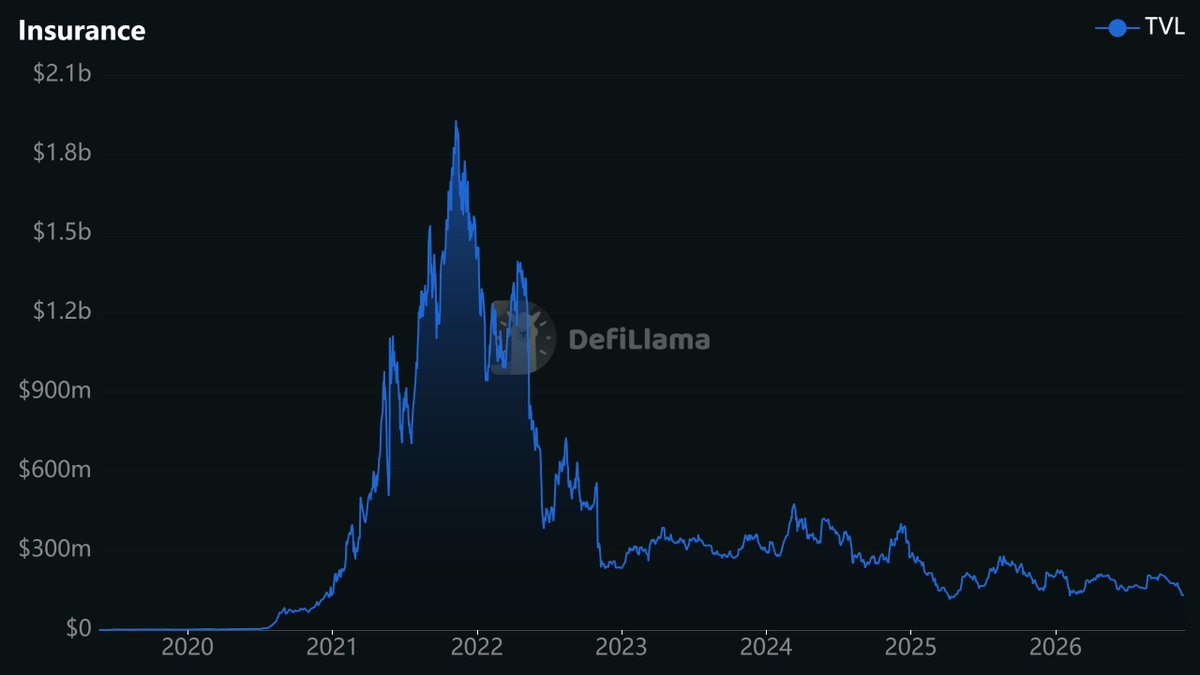
The TVL of DeFi insurance has significantly decreased from its peak in 2021
Insurance as the Fourth Primitive of DeFi
DeFi has established three core financial building blocks:
- AMM enabling decentralized trading;
- Lending markets providing credit and yield;
- Cross-chain bridges enabling cross-chain transfers.
These three collectively create and distribute financial risk. But insurance has always been absent, that ability to price and transfer downside risk. Auditing and monitoring can identify failures but cannot absorb losses; insurance defines "financial protection" through coverage limits and payment conditions.
In an era where AI has accelerated vulnerability discovery and attack speeds by 100 times, why does DeFi insurance still lag behind? Is the issue with the insurance protocols themselves, the lack of supporting infrastructure, or insufficient demand from users and institutions?
Before assessing why DeFi insurance struggles to scale, we first need to clarify what risks existing products actually cover.
What Risks Does DeFi Insurance Cover?
Depositing assets into DeFi comes with more than just market risk. Smart contract vulnerabilities, oracle failures, governance attacks, liquidation failures, de-pegging, staked asset forfeiture, and custodian failure can all result in losses.
For example, a single vulnerability attack drained $10,000 deposited by a user into a lending protocol, even if they never made a wrong trading decision, their position still went to zero.
The goal of DeFi insurance is predefined loss events, rather than ordinary market fluctuations or trading losses.

Six Types of Risks Facing DeFi
Systemic risk is currently deemed uninsurable.
How Existing DeFi Insurance Models Operate: A Case Study of Nexus Mutual
Nexus Mutual is a good example to understand the existing model. It operates on Ethereum and is a discretionary mutual organization where members pool capital to insure specific risks.
Its operational process is as follows:
- Contributors: NXM holders stake or delegate tokens to the underwriting pool.
- Risk Selection: The pool manager decides which protocols and risks to cover and sets the premiums.
- Purchasing Policies: Users pay premiums to gain protection against predetermined loss events.
- Claims Settlement: Claims are evaluated by a claims committee. Approved payouts are made using the mutual organization's capital, while a corresponding amount of staked NXM is burned to complete the payout.
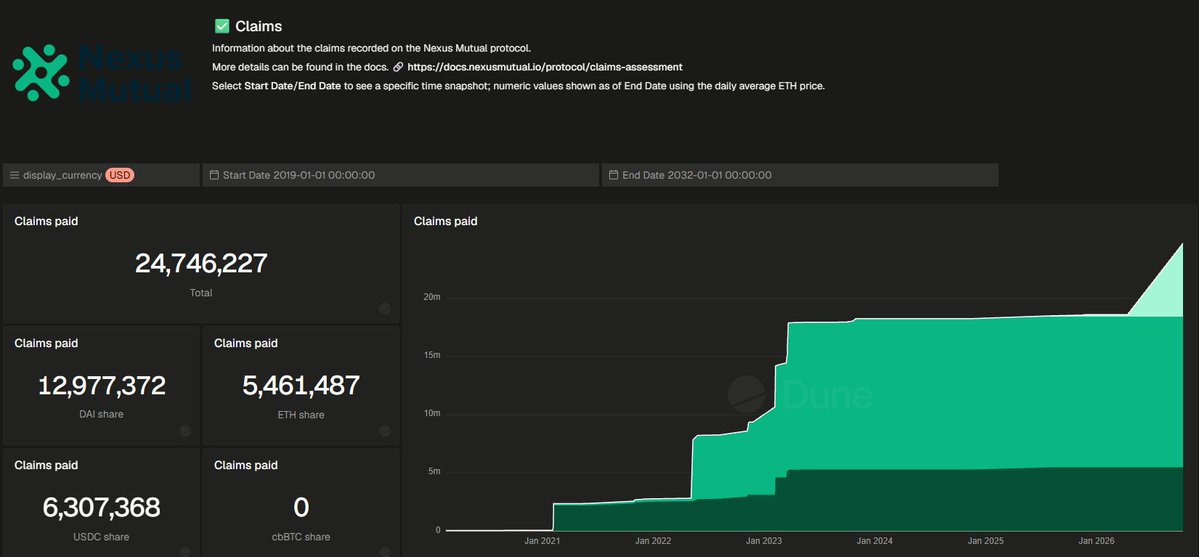
Nexus Mutual's cumulative claims payouts since 2019
Premiums are dynamically priced based on supply and demand, and policy terms typically range from 28 to 365 days. Based on recorded claims history, Nexus Mutual has paid out over $24.7 million since 2019.
DeFi Insurance Ecosystem
The total TVL of the entire DeFi insurance sector is about $132 million, with Nexus Mutual and Firelight accounting for roughly 90%. Most of the remaining protocols have little to no income, indicating that this sector is highly concentrated and still in its early stages.
Key participants in the ecosystem include:
- Nexus Mutual: A collectively-owned mutual organization that pools capital to insure and provide protection for DeFi risks.
- Firelight: Uses staked FXRP as external collateral to provide coverage for DeFi treasuries.
- EaseDeFi: A DeFi insurance protocol that offers coverage without the need for upfront premiums through a "Uninsurance" model.
- Ensuro: An on-chain insurance and reinsurance protocol connecting capital providers and underwriters.
- Cozy Finance: Builds an automated insurance market for DeFi users and protocols.
- Ante Finance: Tests staked smart contracts on-chain, making commitments of the protocols verifiable.
- Sherlock: Combines smart contract security auditing with vulnerability payouts.
- USD8: A stablecoin backed by USDC, providing coverage for losses of designated DeFi tokens. Unlike policy-based coverage or FXRP collateral underwriting, it allocates coverage and payouts using a shared protection pool and insurance scoring.
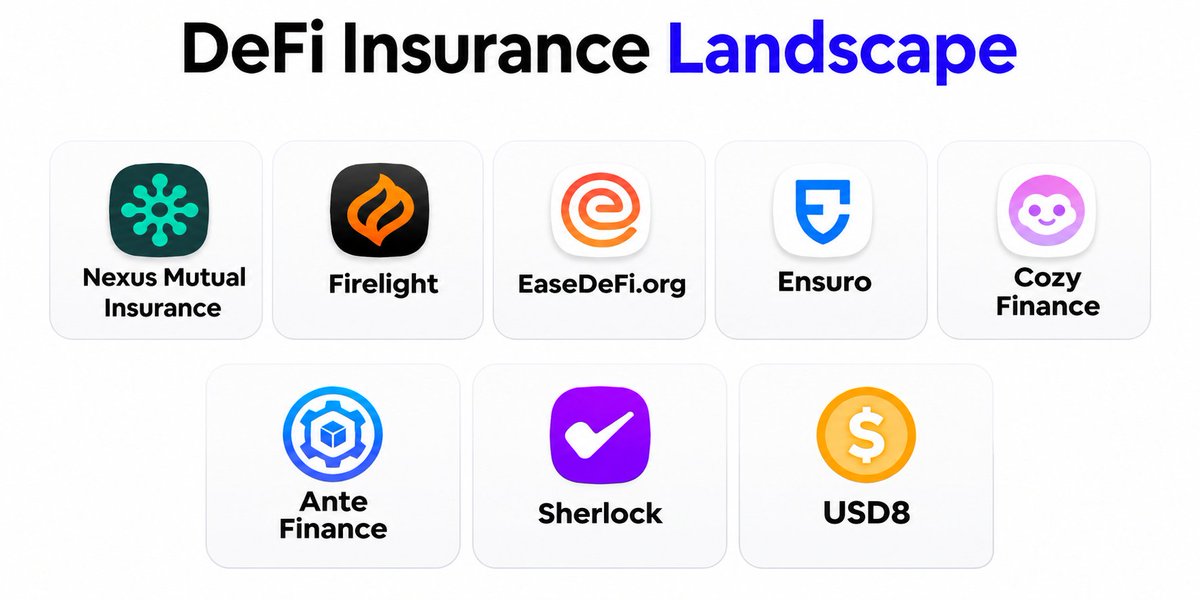
Main DeFi Insurance Protocols
Looking at TVL alone does not reflect an insurance protocol's payout capabilities. Effective coverage amounts, capital efficiency, minimum capital requirements, and historical payout records provide clearer insights into their underwriting capacity and financial health.
Why DeFi Insurance Struggles to Scale
Early DeFi insurance models often used capital derived from the insured risks as collateral.
Once the market enters a crisis, claims rise while supporting assets like ETH simultaneously depreciate. As liabilities increase, the value of collateral decreases.
Early funding pools were also unable to underwrite large protocols and institution-level positions.
Firelight took a different path: supporting DeFi insurance with XRP-based capital. Users deposit FXRP into the treasury on Flare and receive stXRP in return; centralized capital provides coverage for the integrated DeFi treasury.
Flow of funds: XRP holders → FXRP → Firelight treasury → DeFi insurance.
This design aims to reduce dependence on "collateral sourced from DeFi," but market, liquidity, and correlation risks remain.
Firelight founder jrdothoughts commented on the issues with early insurance models, saying, "A pain point for our predecessors was that they used ETH to insure ETH."
What Changes are Needed for DeFi Insurance
DeFi losses due to attacks reached $138 million in the first quarter of 2026, yet only about $9 million was recovered. This gap highlights the necessity of financial protection, but establishing a sustainable insurance market faces many challenges:
- Capital Efficiency: Underwriters must hold enough capital to meet potential claims while maintaining the productive use of this capital.
- Risk Pricing: There is limited historical loss data, and accurately pricing smart contract and protocol risks is challenging.
- Correlation Risk: Market-wide shocks can trigger claims across multiple protocols simultaneously, while the crypto assets supporting the insurance pool depreciate at the same time.
- Claims Evaluation: Not every reported attack qualifies for a payout. Payments depend on policy terms, exclusions, and claims verification.
- Security of the Insurance Layer Itself: The protection-driven market Cozy Finance has also been attacked. The infrastructure used for providing protection is also at risk of being attacked.
These challenges create a delicate balance: insurance protocols must have enough capital to absorb losses, accurate risk assessments for pricing coverage, and reliable infrastructure to actually execute payouts when users need them.
DeFi has built mature trading, lending, and yield markets, but the risk transfer aspect remains incomplete. To scale insurance, deeper funding pools, better risk pricing, and reliable claims infrastructure are needed. Firelight supports DeFi insurance with external FXRP collateral, while USD8 uses shared protection pools and insurance scoring for payouts.
Only in this way can DeFi insurance potentially become a core financial component; otherwise, it may remain confined to a niche field for the long term.
免责声明:本文章仅代表作者个人观点,不代表本平台的立场和观点。本文章仅供信息分享,不构成对任何人的任何投资建议。用户与作者之间的任何争议,与本平台无关。如网页中刊载的文章或图片涉及侵权,请提供相关的权利证明和身份证明发送邮件到[email protected],本平台相关工作人员将会进行核查。