Author: Gu Yu, ChainCatcher
In recent weeks, the cryptocurrency market has continued its decline, with BTC prices hitting a nearly two-year low. The main reason for this downturn is not internal industry developments or regulatory issues, but rather the resonance of external macroeconomic conditions: a strong dollar, hawkish interest rate expectations, the retreat of a technology stock rebound, and heightened risk aversion due to the situation in the Middle East.
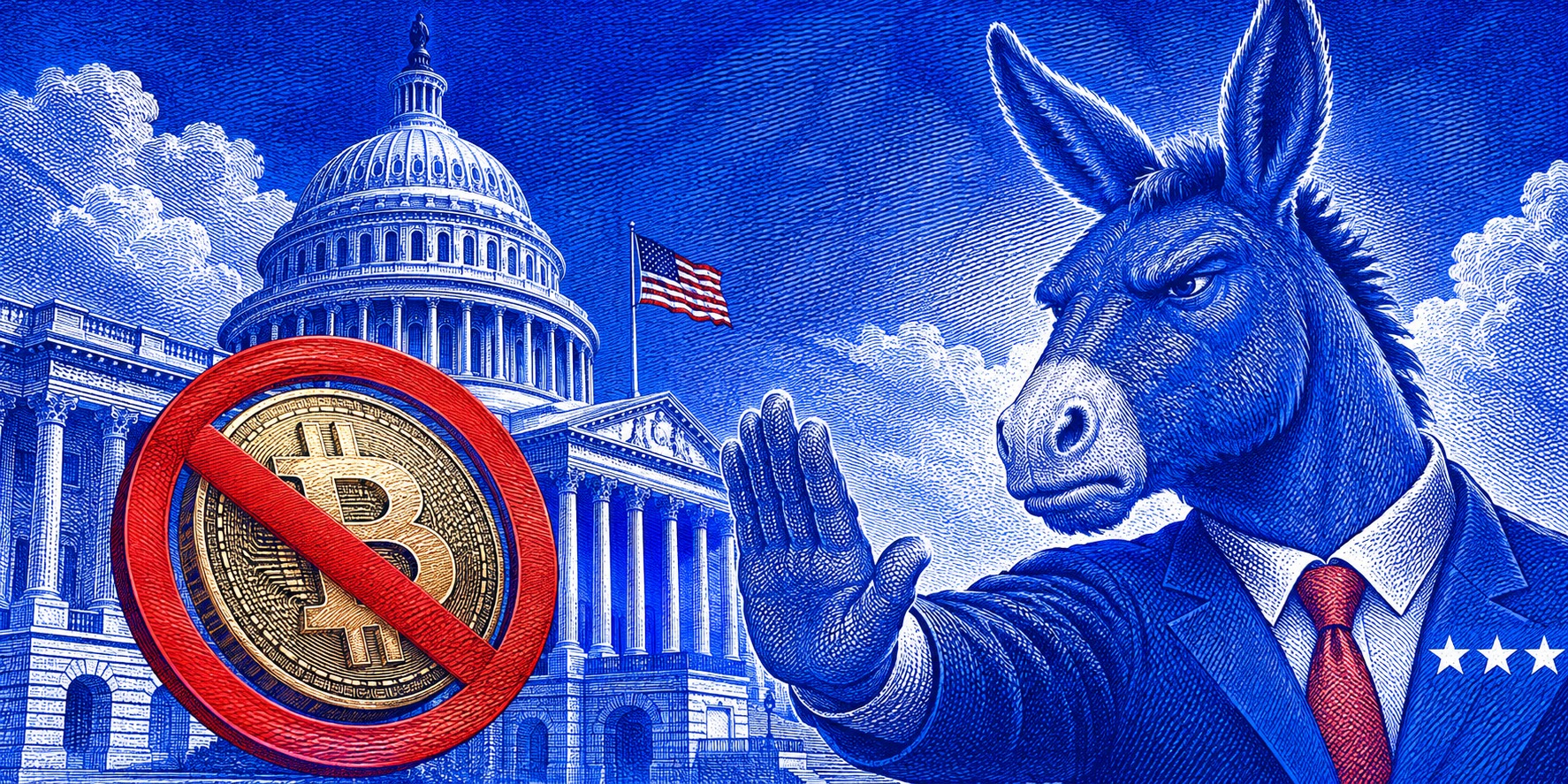
Looking at a longer time frame, we can see that the fluctuations in the cryptocurrency market over the past few years have become increasingly closely linked to political dynamics, especially with the Trump administration in the United States.
Since Trump took office in early 2025, the industry has faced a clearly friendly government for the first time: the SEC dropped its lawsuit, pro-crypto officials were appointed, the GENIUS Act became law, and strategic Bitcoin reserves entered the agenda. Each of these was quickly factored into prices by the market, making policy the most sensitive switch for market movements.
On November 4, this switch was turned to the other side. The “blue wave” of the U.S. midterm elections landed, with the Democratic Party winning control of both houses of Congress on the same day and set to take over the new Congress in January 2027. WLFI, TRUMP, and other Trump-related assets tumbled by 10-20%, with declines exceeding 75% for the year.
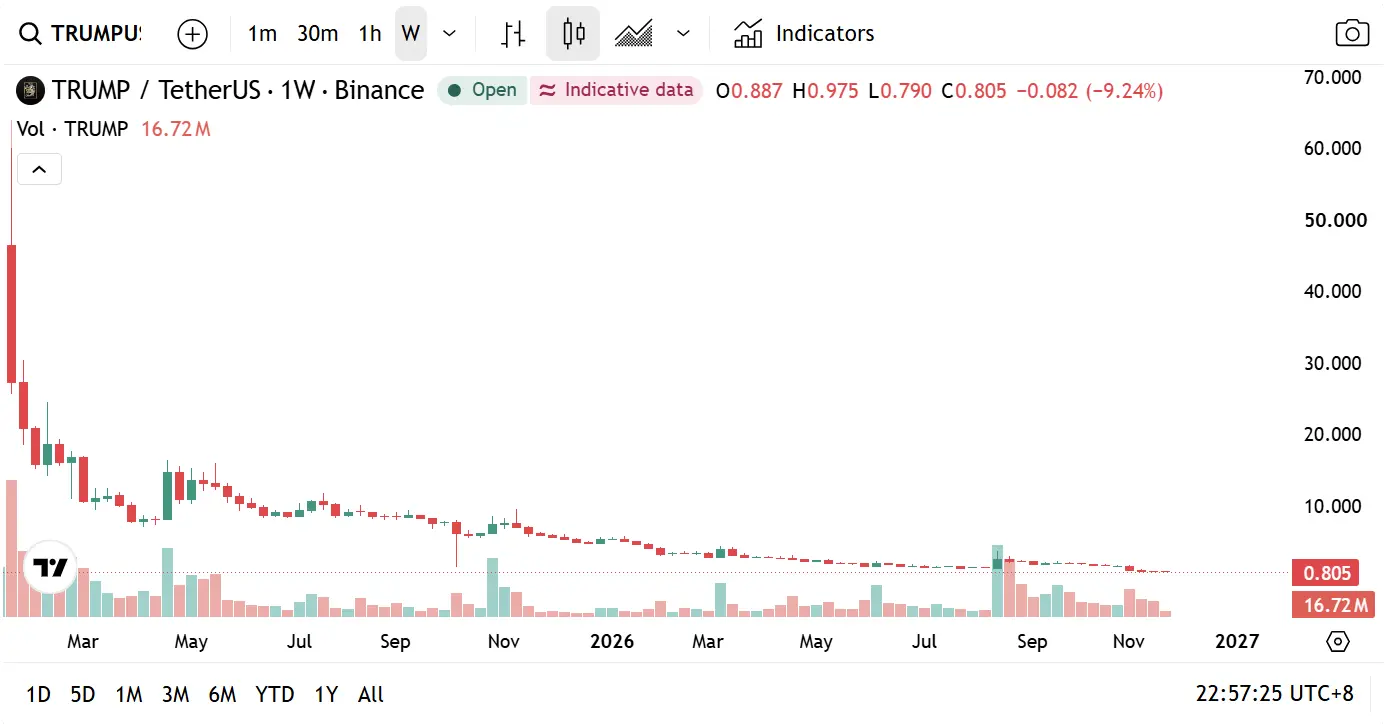
Over the past two years, proximity to the White House had been a valuation boost; now it has become a risk item that requires discounting. This is not a routine adjustment of politically sensitive assets, but a concentrated revaluation of the political premium in the cryptocurrency industry. Now, the cryptocurrency industry must best prepare for the post-Trump era.
When the “Trump Trade” Comes Before Trump Exits
If all changes are attributed to the Democrats' victory, it underestimates the industry's own issues. In fact, fractures had already appeared before the midterm elections.
On September 15, the U.S. Senate failed to advance the procedural vote for the CLARITY Act, with 49 votes in favor and 50 against, far from the required 60 votes. Triple Point Strategy noted in its recap on November 17 that the core obstacle to the bill was not simply the qualification of tokens but the ethical controversy triggered by the cryptocurrency interests of public officials and their families.
This means that even if the Republicans still control Congress, the cryptocurrency industry has failed to convert its political advantages into a piece of market structure legislation. The midterm elections merely amplified existing contradictions, rather than creating new ones.
More complicated is that Trump is not only the most important political driver for the industry but also the source of conflict of interest controversies. A Reuters survey estimated on October 27 that from mid-2024 to April 2026, the Trump family derived about $2.3 billion in revenue from cryptocurrency businesses. The Trump camp has consistently denied that its business interests conflict with presidential duties, but this has not eliminated political resistance.
“Many key figures in the crypto field have bound themselves deeply to the Trump family, and these costs are likely to have to be realized one by one,” said Austin Campbell, a part-time professor at NYU Stern School of Business and former banker, to Bloomberg.
Essentially, when regulatory friendliness and presidential family gains coincide, crypto policies become difficult for opponents to view as neutral technical policies. Trump had helped the industry open the gates of Washington but also saddled the whole industry with an expensive partisan label.
Bipartisanship Cannot Just Be About Dividing Money to the Other Side
The industry was not unprepared.
Pre-election statistics from Reuters showed that by the end of October, crypto-related groups had invested about $176 million in this midterm election cycle, covering over 100 campaigns, attempting to establish a Congressional alliance that could transcend Trump's tenure. Colin McLaren, Head of Government Relations at the Solana Policy Institute, referred to this spending as “a forward-looking investment,” aimed at ensuring clear regulatory rules for the industry over the “next 100 years.”
From a partial results perspective, this money was not entirely ineffective. Triple Point Strategy statistics indicated that, as of November 17, candidates supported by the Fairshake network won 33 out of 36 races in the November runoff elections. However, in the most crucial Ohio Senate race, over $60 million in crypto-related spending failed to prevent long-time industry critic Sherrod Brown from returning to the Senate.
This comparison is closer to reality than “a devastating defeat for the industry” or “a major victory for the industry”: political funding can still influence some elections but cannot automatically purchase legislative consensus.
More alarmingly, Reuters found that many advertisements run by crypto political action committees hardly mentioned crypto and instead focused on issues like taxes and immigration. This suggests that the industry is more about establishing political deterrence rather than securing clear public authorization for digital assets.
After the election, Ripple CEO Brad Garlinghouse stated: “New Congress, same mission: to establish clear rules in the U.S.” Crypto Innovation Council CEO Ji Kim also emphasized: “Digital assets have always been a bipartisan issue; we are ready to work with both new and old legislators from both parties.”
However, a real bipartisan approach cannot just be about handing checks to both sides. If the industry calls for depoliticization on one hand while rejecting conflict-of-interest constraints, consumer protection, and clearer regulatory responsibilities on the other, this is not demoralization but merely transforming a single political dependency into a long-term lobbying cost.
Compliance Turns from a Dividend to a Threshold
Changes in the political winds do not mean that the institutional gains of the past two years will be wiped out overnight.
The GENIUS Act has become federal law, and its repeal requires new legislation. The Office of the Comptroller of the Currency (OCC) issued the final rules implementing the Act on October 21, covering reserve assets, redemption, risk management, auditing, and capital requirements, set to take effect on January 18, 2027.
While legislative stagnation persists, administrative regulation is still underway. Two days after the CLARITY Act was blocked, the U.S. Securities and Exchange Commission (SEC) launched a temporary “innovation exemption” for tokenized stock trading on September 17. SEC Chairman Paul Atkins acknowledged in a statement that this measure is merely a transitional arrangement and “must ultimately be sustained by enduring rules.”
Thus, the regulatory landscape over the next two years is likely not a comprehensive retreat but a slowdown in legislative activity in Congress with ongoing administrative rules being laid, although their long-term effectiveness remains constrained by the courts and the next government.
For businesses, this brings about a more realistic change: compliance is no longer just a scarce story to boost valuation but will become a basic cost that continuously consumes capital, labor, and management efforts. Large institutions can share these costs, while smaller teams may find themselves shut out by licensing, auditing, and legal expenditures.
Regulatory certainty is a public good, but compliance capability may become a private moat. The industry once hoped for regulation to clear uncertainties, but now must answer: do clear rules promote competition, or do they assist a few large institutions in “getting in and closing the door”?
Returning to Real Demand Instead of Pursuing Narratives
“I think the trend of regulatory relaxation is nearly over; at most, there will be another CLARITY Act next year, and regulatory arbitrage has reached its end. The next wave of market movement will return to the original narrative, and given the current cyclical bottom position, the next wave of enthusiasm for decentralization might be coming (maybe in 2028),” crypto KOL Chen Mo stated.
As political dividends weaken, market focus may revert to the decentralization narrative, with stablecoin payments and asset tokenization being placed under high expectations. However, these two mainlines also need to eliminate narrative bubbles.
Visa Onchain Analytics data shows that by June 2026, the adjusted trading volume of stablecoins reached $17.9 trillion, a 125% year-on-year increase. This metric has filtered out some bot transfers, exchange fund transfers, and repeated smart contract transactions, indicating that on-chain dollar settlements are indeed expanding.
However, the “adjusted trading volume” still includes activities such as DeFi and liquidity management, and cannot all be viewed as real payments. It proves the resilience of stablecoins as settlement infrastructure, yet it has not demonstrated that the public payment revolution has been completed.
Tokenized stocks also exhibit a similar contrast. RWA.xyz data from early November indicated that the relevant asset size was approximately $3.9 billion; however, as OKXICE prepared to launch on November 23, Bloomberg statistics showed that 67 companies had opposed its plan. Among the initial 62 companies, 56 raised objections, while the remaining six that did not publicly oppose were all linked to the crypto industry.
“Many stock issuers have not prioritized tokenized stocks,” said Ian De Bode, acting CEO of Ondo Finance, “the existing system works well for them.”
This is more worthy of attention than the growth in the scale of tokenized assets: the crypto industry can quickly build trading venues but may not be as swift in convincing issuers, institutions, and users to migrate.
Regulation provides access, not demand; licenses provide qualifications but not moats.
Infrastructure can precede, but issuers may not necessarily follow. The crypto industry has excelled in moving financial products onto the blockchain, yet has seldom proven these products are cheaper, more transparent, or easier to use on-chain than existing systems. If technological innovation can only deliver new trading venues but not new trust structures, the "original narrative" remains just packaging.
Conclusion
In recent years, Trump has helped the cryptocurrency industry pry open the doors of Washington, but he has also burdened the industry with a harder-to-eradicate conflict of interest label, which may even become a potential “liability” for the industry.
Labels are easy to affix, but hard to peel off—they do not disappear automatically with an election and do not reset just because a new president takes office. Political dividends can elevate valuations but cannot replace real demand. The retreat of premium is not necessarily a bad thing; it simply returns valuations to business fundamentals.
The post-Trump era will not be defined by who occupies the White House in 2028 but rather by a more direct question: what will be left of the cryptocurrency industry when Washington ceases to provide additional premiums?
Neither a red nor blue government can fulfill product innovation for the industry, and “returning to innovation” cannot serve as an excuse to revert to unlimited token issuance, regulatory arbitrage, and subsidy-driven practices. The political retreat is not the end but a forced return—back to the fundamental questions of whether the system can protect users, whether products can create value, and whether demand truly exists. Only when these questions are answered can the industry genuinely cross this low point cycle.
免责声明:本文章仅代表作者个人观点,不代表本平台的立场和观点。本文章仅供信息分享,不构成对任何人的任何投资建议。用户与作者之间的任何争议,与本平台无关。如网页中刊载的文章或图片涉及侵权,请提供相关的权利证明和身份证明发送邮件到[email protected],本平台相关工作人员将会进行核查。