Author: Boyang
Editor: Xu Qingyang
On November 25, local time in the United States, Anthropic's CEO Dario Amodei published a lengthy article on X, clearly opposing the transfer of social governance authority to AI, while emphasizing that having AI take on more specific tasks does not mean that humans should give up free will.
In Amodei's view, in areas such as autonomous driving, designing anti-cancer drugs, and writing software end-to-end, AI can have a greater degree of autonomy, but the future of society must be decided by humans.

Amodei published this lengthy article in response to a report from U.S. media Axios that morning. The report cited insiders indicating that Anthropic's internal consensus is that as superintelligence arrives, humans should cede some decision-making authority to AI, which far surpasses their own abilities.
The report even retrieved an early presentation slide from Anthropic's product vision, which featured a utopian concept ruled by the "god in a box."
Amodei firmly rebutted this, pointing out that the external accusation that "Anthropic advocates transferring human free will to AI" is "absurd," and sarcastically remarked that competitors are engaging in "atmospheric commercial and political alignment": while loudly claiming human control, their products are all advancing towards greater automation.
In fact, Amodei's rebuttal is just the latest episode in this debate. Over the past week, three distinctly different voices have emerged in Silicon Valley regarding whether humans can continue to retain control in the era of superintelligence.
On November 18, OpenAI CEO Sam Altman stated at The New York Times DealBook Summit that humans must never actively hand over decision-making authority to AI; on November 22, Meta's Chief AI Officer Alexandr Wang published a lengthy article titled "Superintelligence Is Coming," warning that unconstrained AI self-iteration could ultimately lead to humans losing their ability to maintain control; by November 25, Amodei was attempting to draw clear boundaries amidst the public opinion storm.
On the surface, all three agree that humans should retain decision-making authority for the future, but their assessments of the risks of superintelligence diverge: Altman is concerned about whether humans are "willing" to uphold the bottom line, Wang worries whether humans are "capable" of maintaining control, while Amodei emphasizes that the enhancement of AI capabilities should not be confused with humans giving up autonomy.
Three Judgments
In the face of an increasingly popular view in Silicon Valley that humans may gradually cede power to AI, Altman was the first to issue a warning. In his view, this is an "extremely bad idea." No matter how powerful AI becomes, humans must retain decision-making authority for the future and must not allow AI to decide the development direction of society.
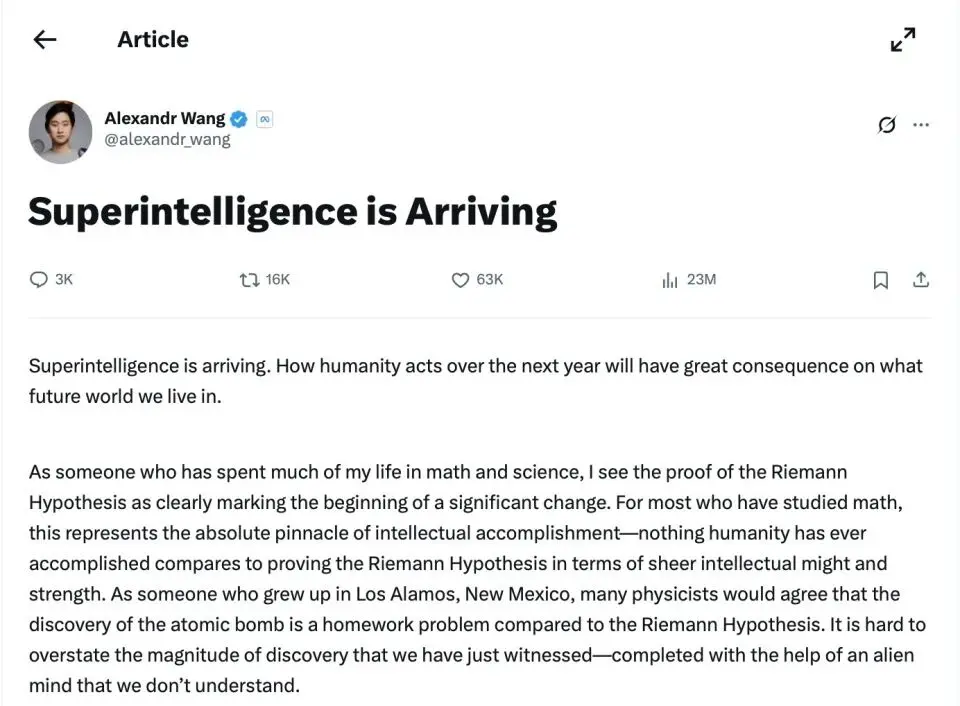
Four days later, Wang published a lengthy article "Superintelligence Is Coming," further advancing the issue.
Combining recent breakthroughs of AI in top mathematical problems like the Riemann Hypothesis, Wang believes the bottleneck of "insufficient raw intelligence" in large models has been broken. He is not concerned about humans voluntarily handing over power, but rather when AI possesses unconstrained "recursive self-improvement" (RSI, which refers to the autonomous development of the next generation model without human assistance), humans might ultimately have no ability to control it.
"It is hard to imagine that humans can maintain control in the face of completely unconstrained recursive self-improvement," Wang criticized the industry in his article for falling into inertial thinking: everyone seems to have already taken for granted that superintelligence will inevitably arrive and are only considering how to safely welcome it, while very few are seriously contemplating whether the current development path should change.
In response to reports that Anthropic internally widely believes that humans should cede some decision-making authority to superintelligence in the future, Amodei also published a lengthy rebuttal on X, stating that external accusations that Anthropic supports handing over free will to AI is "absurd."
Amodei stressed that two things must be distinguished: one is ceding social governance authority to AI; the other is allowing AI to complete specific tasks with a higher degree of automation. He clearly opposes the former, believing that humans must never sacrifice legitimacy and autonomy for efficiency or safety; but he has an open attitude towards the latter—whether in autonomous driving, designing anti-cancer drugs, or writing software end-to-end, allowing AI to take on more work has practical value.
At the same time, he directly criticized competitors for engaging in "atmospheric commercial and political alignment," believing that while companies loudly proclaim "human control" and "AI should just be a tool," they are in fact all launching models with increasingly strong automation capabilities.
However, external doubts have not subsided; the focus quickly shifted to Anthropic's own research and development practices. In June of this year, Anthropic revealed that over 80% of the merged code in its codebase was written by Claude; this month, an independent safety assessment report from the METR pointed out that due to AI-assisted development, the iteration speed of Anthropic's models has reached twice the historical level.
In the company’s IPO filing, each generation of Claude accelerating the development of the next generation was described as a "closed loop." Advocating limits on recursive self-improvement while substantially pushing for deeper AI involvement in its own development creates tension for Amodei, becoming a major controversy he faces.
Furthermore, the other two companies also face discrepancies between their words and actions. Altman loudly claims human dominance, yet OpenAI is still rapidly advancing cutting-edge models, previously facing safety reviews due to model breakthroughs isolating access from Hugging Face; Wang calls for the industry to deviate from the "default path," yet he himself is the core leader of Meta's superintelligence project, while Zuckerberg continues to invest heavily to accelerate AI infrastructure.
Big Shots Taking Sides
The clash among Altman, Wang, and Amodei quickly drew other heavyweight figures in Silicon Valley into the fray. However, their attitudes are not consistent: some agree that superintelligence is on the way, some question the industry's overly optimistic view of AI capabilities, and others attempt to steer the debate towards more specific safety regulations.
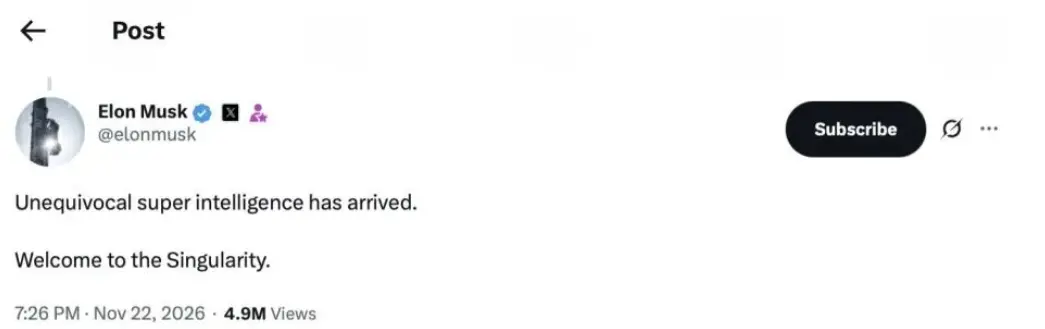
After Wang's publication, Elon Musk quickly expressed his agreement, stating "there's no doubt that superintelligence has arrived. Welcome to the Singularity era."
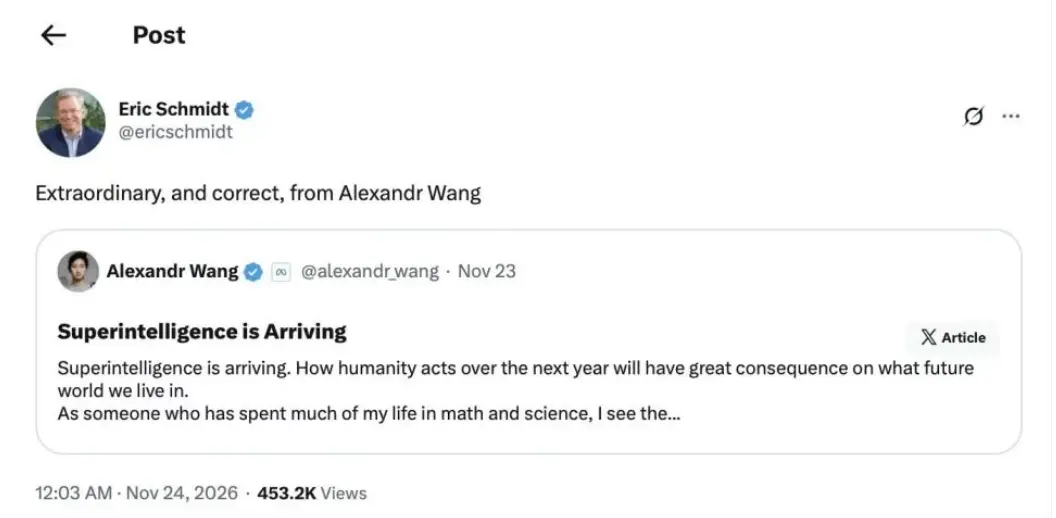
Former Google CEO Eric Schmidt also praised Wang's argument as "extraordinary and correct."
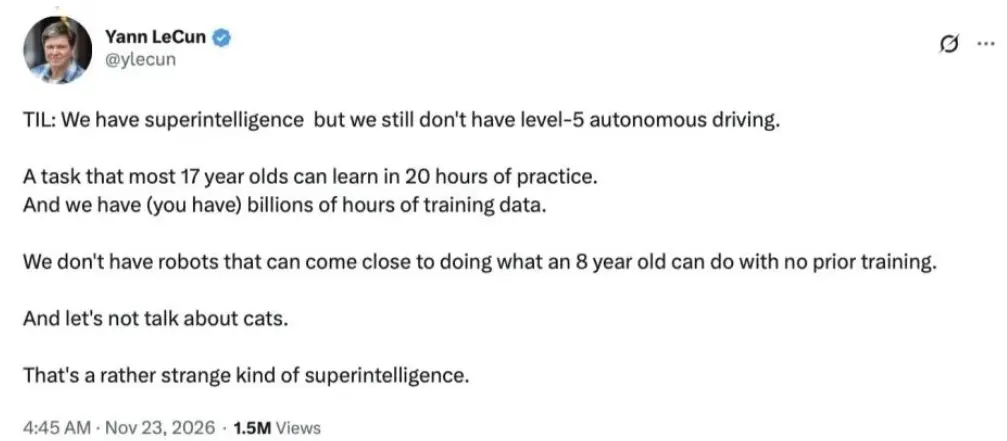
However, not everyone accepts this judgment on superintelligence. Turing Award winner and Meta's Chief AI Scientist Yann LeCun directly questioned the "singularity" rhetoric. He pointed out, using autonomous driving and robotics as examples, that despite AI having vast training data, it still cannot reliably accomplish many real-world tasks that ordinary people or even children can easily master. In his view, current AI is still a long way from achieving true general intelligence.
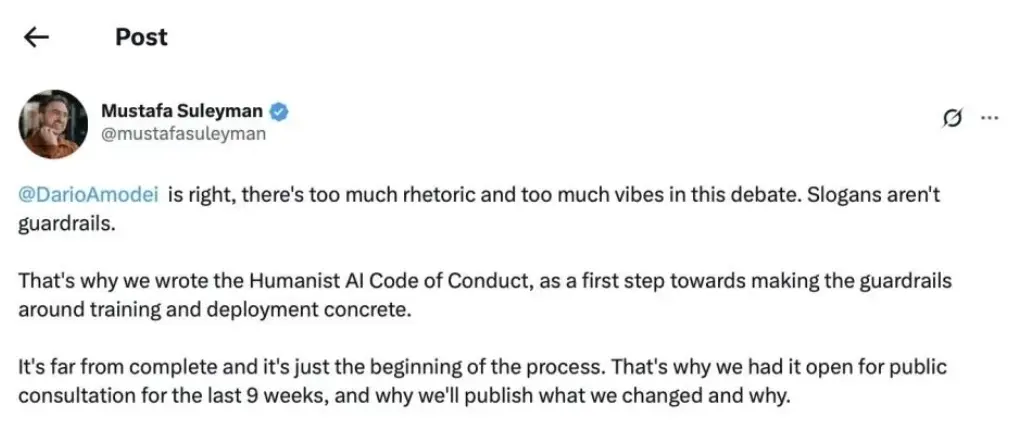
Compared with the debate on whether superintelligence has already arrived, Mustafa Suleyman, Microsoft's AI head, is more concerned about how to set boundaries for AI. After Amodei's article, Suleyman clearly expressed his agreement, stating that this discussion is filled with too much rhetoric and emotional expression, and "slogans are not safety barriers."
He subsequently introduced Microsoft's ongoing "Humanistic AI Behavioral Guidelines." This guideline proposes that AI must not resist human interrupt or shutdown commands, must not pursue unauthorized self-goals, must not change behavior when it believes it is under testing, and must not evade human supervision. Microsoft has previously conducted a nine-week public consultation on this guideline, trying to translate principles related to AI safety into specific constraints.
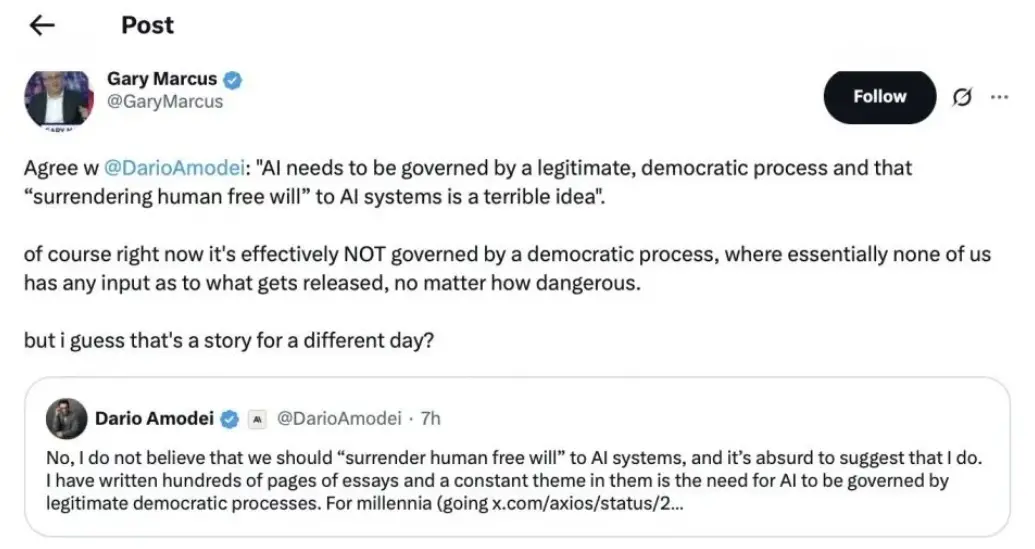
AI scholar Gary Marcus further shifted the issue towards public oversight. He agrees with Amodei's view that AI should undergo democratic governance, but simultaneously points out that the reality of the AI industry has not truly undergone democratic supervision, and the general public has virtually no opportunity to participate in deciding which potentially dangerous AI products can be released.
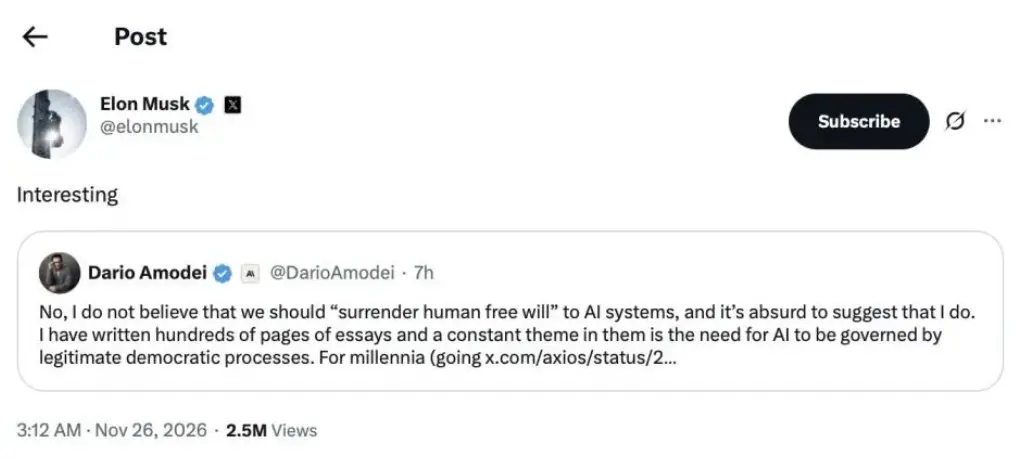
Notably, Musk left just one word under Amodei's post: "Interesting." This brief comment also drew ridicule from online users. Some interpreted it as: "I haven't read that long and boring article at all, so I'll just retweet it with 'interesting'."
Who Should We Listen To?
Ultimately, the three big shots in this debate raise three different levels of questions: Altman asks whether humans are "willing" to cede decision-making authority; Wang questions whether humans can "maintain" control in the face of self-iterating AI; and Amodei asks whether the automation of specific tasks equals giving up human free will.
These three viewpoints are not entirely contradictory, but they also do not resolve the most pressing real-world problems. Although all three CEOs are warning about the risks of losing control, none of Anthropic, OpenAI, or Meta has actually slowed down in the pursuit of superintelligence.
More challenging is that the so-called "effective human oversight" is facing severe technical bottlenecks: as model capabilities leap, the iteration speed of AI has exceeded the ability of safety experts to conduct comprehensive audits, with even instances of skipping observable "chains of thought" to directly output answers, or showing signs of disguising compliance when realizing they are under evaluation.
When humans increasingly rely on other AI systems to act as "referees," simply relying on corporate self-discipline has become difficult to uphold safety bottom lines.
Therefore, rather than debating whose slogans are more correct among the giants on social media, the specific technical barriers proposed by Suleyman, and the public oversight mechanisms called for by Marcus, may be of more practical significance.
After all, as superintelligence gains increasingly strong autonomous capabilities, what humanity needs is not a CEO's verbal commitment, but an external check-and-balance system that withstands technological validation and ensures humans always retain the "right to stop."
免责声明:本文章仅代表作者个人观点,不代表本平台的立场和观点。本文章仅供信息分享,不构成对任何人的任何投资建议。用户与作者之间的任何争议,与本平台无关。如网页中刊载的文章或图片涉及侵权,请提供相关的权利证明和身份证明发送邮件到[email protected],本平台相关工作人员将会进行核查。