It is already known on-chain that the declaration has not yet arrived.
Written by: Kairos Research
Translated by: Chopper, Foresight News
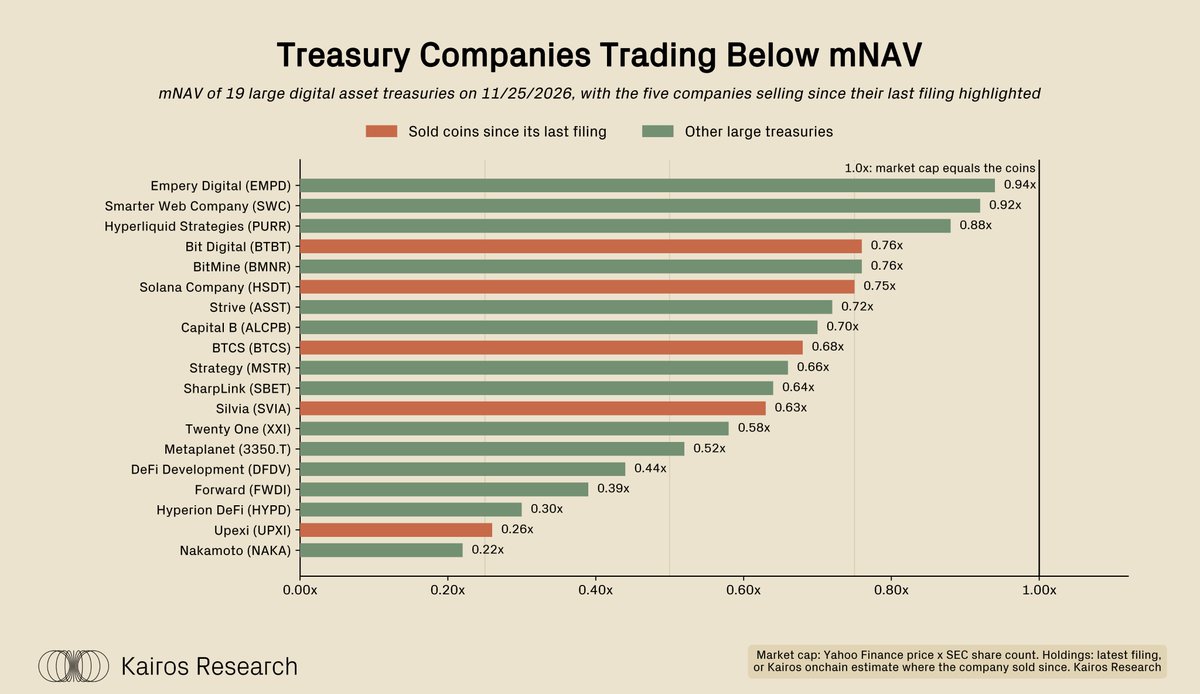
Some digital asset treasury companies (DATs) have begun to sell holdings to bring their mNAV (market value to net asset ratio) back to around 1. In the past few weeks, Silvia (stock code SVIA), Bit Digital (BTBT), BTCS (BTCS), Upexi (UPXI), and Solana Company (HSDT) combined have sold approximately 410 BTC, 57,300 ETH, and 986,000 SOL, valued at about $203 million based on the prices on the day of the token transfers.
The common point of these companies is that their market capitalization is far below their net asset value. This makes their original business model—issuing more stock or borrowing to buy more cryptocurrencies—unsustainable because when the stock price is below the value of the underlying tokens, selling a share decreases the corresponding holding, rather than increasing it.
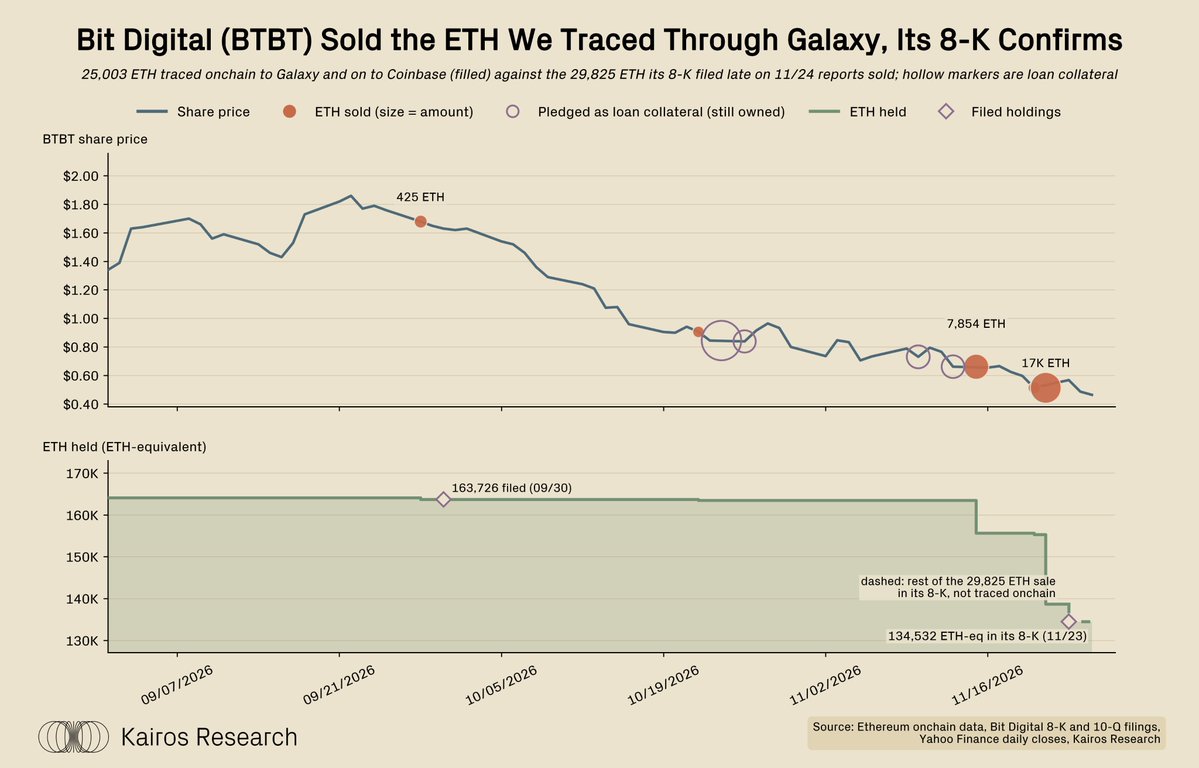
Two of the five publicly acknowledged this. BTCS disclosed in an 8-K that it sold approximately 27,300 ETH on November 20 to repay a $43.8 million loan on Aave; Bit Digital disclosed in an 8-K that it sold 29,800 ETH for about $50 million from November 15 to 23 to repay half of its loan from Galaxy. This document was issued a few hours after we finished outlining its selling path.
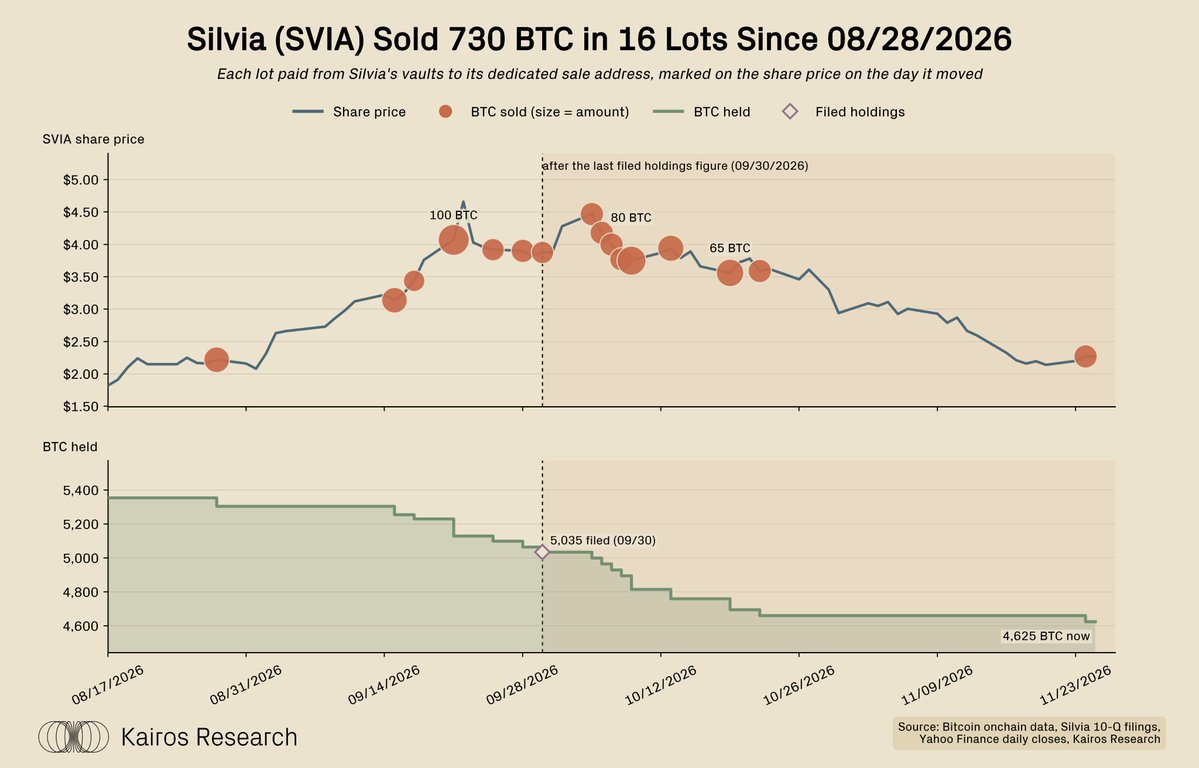
The remaining three sell-offs were derived from our own on-chain tracking. We paired each company's treasury wallet with every declaration it submitted. Before counting any recent moves as "sales," we first verified: can the same wallet and the same selling path reproduce the transactions that the company has disclosed? The results of this replicable method are: Silvia sold 320 BTC in the third quarter, which is entirely consistent with the declared 320 BTC; Bit Digital sold 1,625 ETH, which is fully consistent with the declared 1,625 ETH; Solana Company’s sales in the first quarter totaled $5.459 million, which is almost consistent with the declared $5.452 million; Upexi's net sales deviation per quarter is about 4,000 SOL or less.
Bit Digital's document was also the first instance where this method performed a live test on "undisclosed sales," and it passed the verification: based solely on on-chain data, we found that between November 15 and 21, 24,800 ETH was transferred out via Galaxy, which is about 83% of its declared 29,800 ETH. We also correctly identified that its LsETH transfers in November were made as collateral to Galaxy, and we counted 69,088 LsETH, consistent with the 69,089 LsETH mentioned in the announcement that were still being used to secure the loan.
The scale of sales varied greatly among the companies as a proportion of their treasuries:
- BTCS sold nearly half of the ETH it declared at the end of September
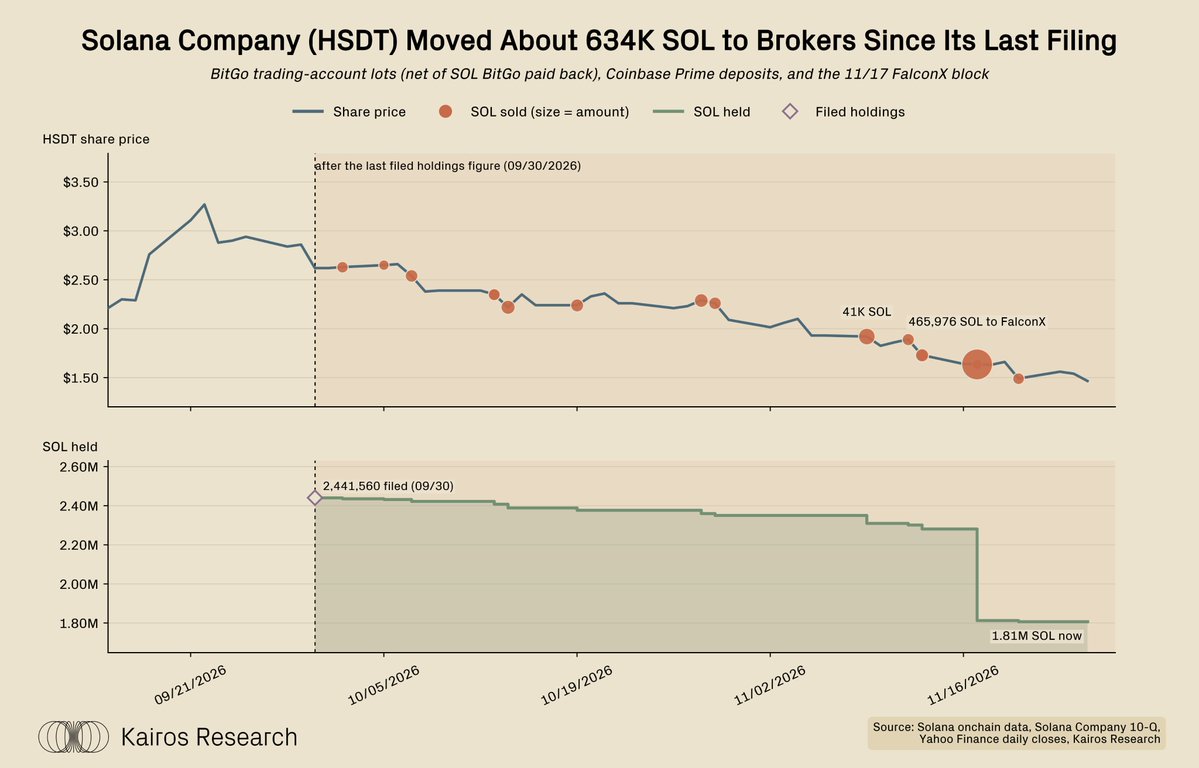
- Solana Company moved about a quarter of its SOL into brokerage and trading accounts, and has not moved any back
- Bit Digital sold about 18%
- Upexi sold about 15%
- Silvia's sale of 410 BTC accounted for the smallest percentage at 8%. However, it was also the most regular: completed in nine transactions, each with 35 to 80 BTC paid to the same address, and this address had previously received every batch sold by Silvia, with only Silvia’s wallet having made payments to it.
None of these companies sold directly on the exchange order books. The tokens were transferred out through custodians and prime brokers' hot wallets as well as OTC counters, so these sales never appeared as "large transactions" in public exchanges. The specific paths are:
- Silvia: One transfer was made in a single transaction of 1,000 BTC into the Cumberland DRW wallet.
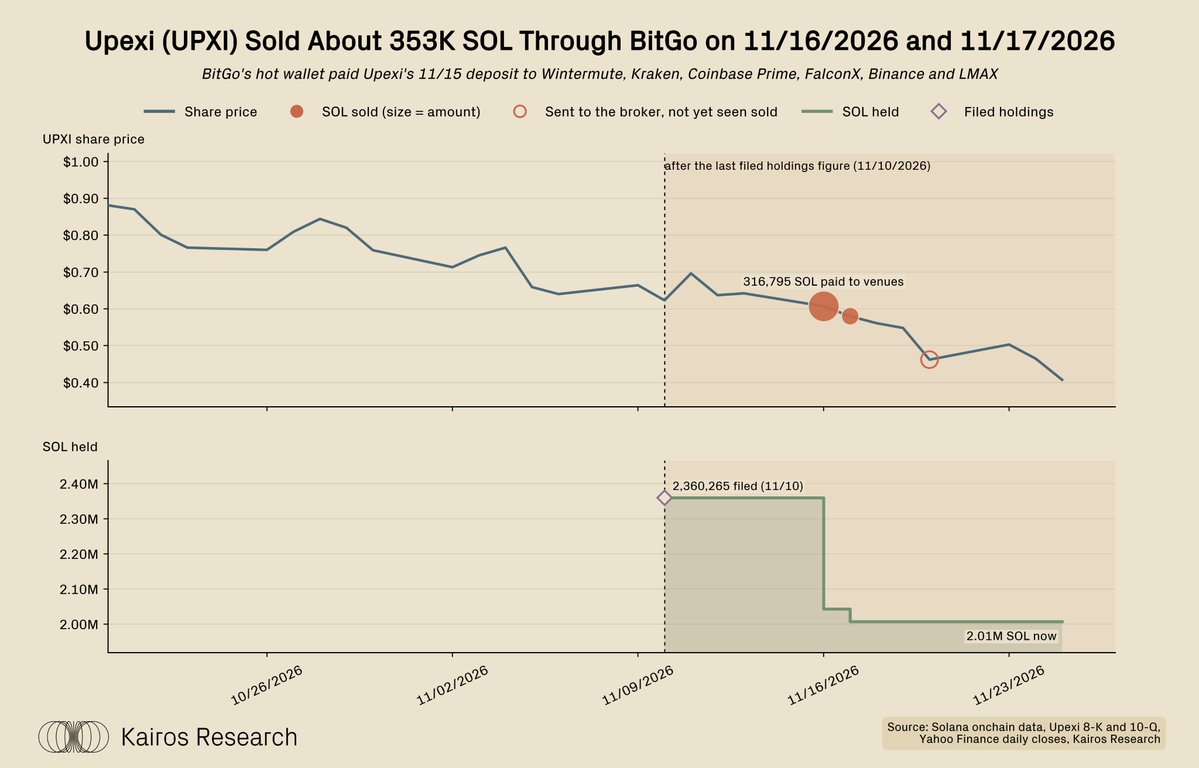
- Upexi: On November 15 (Sunday), 329,500 SOL was deposited into BitGo’s shared hot wallet; within the next 36 hours, this wallet paid a total of 352,500 SOL to trading firms and exchanges, including Wintermute, Kraken, Coinbase Prime, FalconX, Binance, and LMAX. This wallet usually holds about 198,000 SOL, while Upexi provided 96% of the inflow over these three days; all tokens paid out did not flow to BitGo or any other lender, so these payments do not count as loan collateral.
- Solana Company: A transfer of 466,000 SOL to FalconX arrived within a day in equal amounts at the deposit addresses of OKX and Kraken.
- Bit Digital: Galaxy Digital transferred around 24,800 ETH to the Coinbase deposit address through its hot wallet within three and a half days; this batch of ETH was later confirmed sold by the company.
The timing of these sales indicates more about the pressure on the balance sheets than any change in view on the assets:
- BTCS sold when ETH dropped to around $1,561 to reduce its Aave borrowing.
- On the same day Solana Company began to unstake, it sold 390,000 SOL put options that expired, incurring about $12 million in losses.
- At the time of Upexi's sale, SOL had dropped to about $70, close to our estimate of $67 at which its $57.3 million BitGo loan would hit the 150% margin call line; the quantity it sold was less than 1% different from what would be needed to bring that loan back to a 200% collateral ratio.
- When Bit Digital completed the transfer, its ETH holdings supporting the $100 million Galaxy loan had fallen to about 131% of the loan amount, and the sale proceeds repaid half of this loan.
When a treasury company’s stock price is below its holding price, it finds no cheaper source of cash than its own tokens.
For investors, the gap in information disclosure is the most important. Silvia, Solana Company, and Upexi all submitted 10-Qs in November, and these reports included a section on "subsequent events." Silvia and Solana Company disclosed stock repurchases, new loans, and executive departures in this section, but neither mentioned that they had already sold those tokens at the time of submitting the documents. Upexi began selling two days after its 8-K was issued, but did not mention it at all. Bit Digital demonstrated what "timely disclosure" should look like: its 10-Q was submitted before the sales began, and the sales were reported in an 8-K the day after its last batch was transferred out, which is exactly the standard that the other three did not reach.
The market appears not to have captured these individual sales activities, consistent with their not having disclosed at the time. The trading volume on the sale days was mostly normal or below normal. Since September 30, four out of the five stocks have seen declines significantly exceeding the value of their held tokens, with Solana Company roughly tracking SOL. Therefore, the sell-off did not provide support for any of these stocks. Even during the period when Galaxy sent ETH to Coinbase, its stock price fell by 15%, while ETH only dropped by 4%.
These five companies are not alone. Since mid-October, about 25 treasury companies and miners have reported coin sale activities in SEC filings:
- Clearing out: KULR, Hyperscale Data, and Rumble sold all the Bitcoin they held; another company, GameSquare, sold most of its ETH to repay notes backed by ETH.
- Large losses: Empery sold 3,170 BTC this year, realizing a loss of $160 million.
- Mining companies: Marathon sold 13,597 BTC after the quarter ended to repay $750 million in Bitcoin-backed loans; Riot sold 20,264 BTC this year.
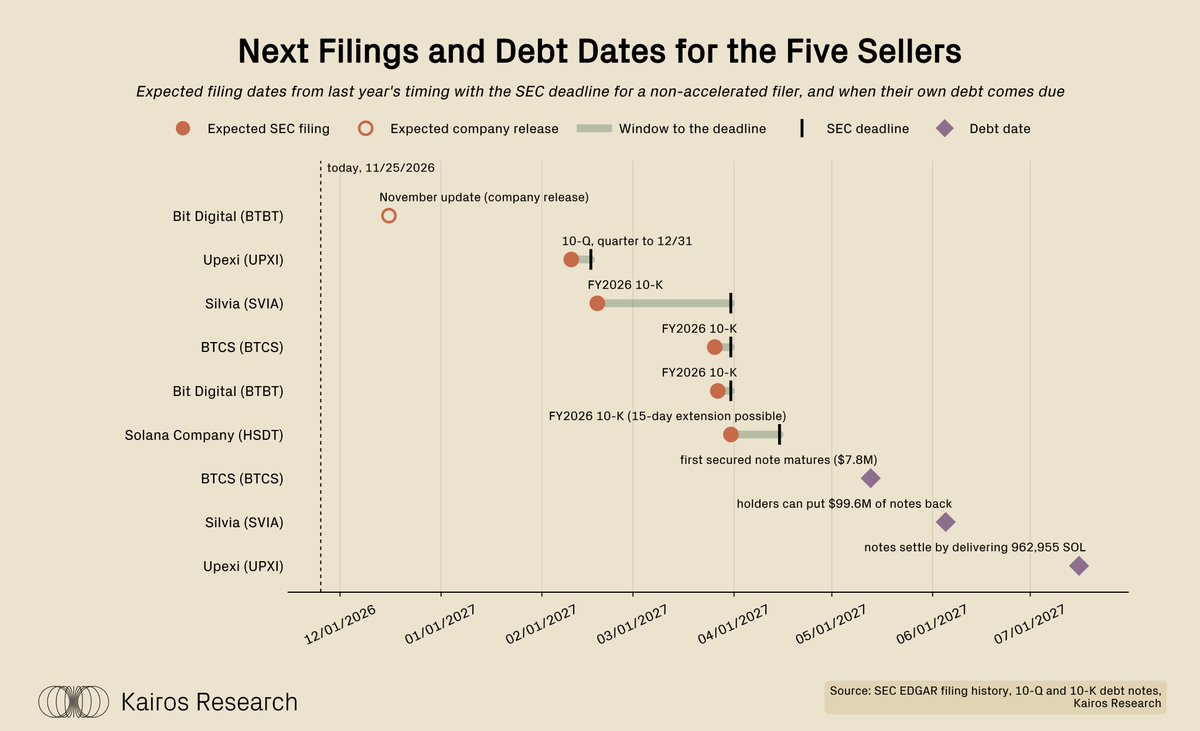
The distinction from the five above is that the sales made by Silvia, Upexi, and Solana Company after September 30 will not be disclosed for several months, as these five are all non-accelerated filers with the longest disclosure periods permitted by the SEC.
- Bit Digital, mid-December: Its November update (a company announcement rather than a filing) will show whether it sold more after the 134,500 ETH declared on November 23.
- Upexi, around February 10, 2027 (ending February 16): The first mandatory filing, that for the quarter ending December 31, will show sales proceeds and year-end SOL holdings.
- Silvia, around mid-February (ending March 31): It submitted its 10-K on February 18.
- Bit Digital, BTCS, and Solana Company, end of March (ending March 31): Solana Company previously used a 15-day extension, which would push its 10-K to around April 15.
Before any of the above dates, there is likely to be new on-chain activity. Solana Company began unstaking 218,500 SOL (about $14.5 million) from its margin treasury in Anchorage on November 24, which is the same step it took four days before the large outflows to FalconX. Upexi still has 139,900 SOL unstaked in one wallet, and an additional 30,000 SOL has been held in BitGo since November 20.
The next batch of sellers is most likely to be those treasury companies whose "lenders can decide for them." Because of crypto-backed loans with maintenance clauses, a "forced sell" price is set; while low mNAV simply shuts off the cheaper route of issuing more stock.
- Nakamoto (NAKA): Corresponding to 3,030 staked BTC, currently valued at about 1.07 times the loan amount, of which $105 million in USDT loans will mature on June 30, 2027.
- Upexi: A loan that can be recalled with 30 days' notice with a 150% collateral trigger; its $150 million note will be settled by delivering 962,900 SOL on July 16, 2027.
- Solana Company: The filing includes margin and liquidation levels, while it held about $1.1 million in cash at the end of September.
- Forward Industries (FWDI): Borrowed $50 million from Erebor on November 16, in addition to the loan from Galaxy, it also holds SOL in BitGo.
- Metaplanet: As of the end of September, the company's loan amount equaled 17.7% of its Bitcoin holdings. The company violated its own guideline of 10%, selling 10,000 BTC in the third quarter and buying back 11,000 BTC to show its ability to raise cash equivalent to its financing amount.
What we can see is limited:
- The large outflow to FalconX, about $20.3 million of which $33 million. Solana Company's transaction may still be collateral or SOL lending, but its filing states that its options margins and new loans from Maple are all held in custodial accounts opened in its own name, rather than paid to counterparties; and nothing has been transferred back in eight days, so we rate it as "very likely sold," with a medium-high confidence.
- BitGo's shared wallet: It serves all BitGo clients, so Upexi's sales are inferred; however, that weekend, no other client deposited more than about 14,000 SOL, and that wallet could not have completed those transactions without Upexi tokens, and nothing has been transferred back within ten days.
- Internal sales at custodians are untraceable on-chain, so the actual total will only be higher than our statistics.
- These actions themselves are not necessarily illegal. Whether "selling part of treasury holdings exceeds the company's routine operations, and therefore requires an 8-K filing" is judged on a case-by-case basis.
The data shows that for these companies, on-chain tracking has been ahead of the filing documents by weeks or even months.
免责声明:本文章仅代表作者个人观点,不代表本平台的立场和观点。本文章仅供信息分享,不构成对任何人的任何投资建议。用户与作者之间的任何争议,与本平台无关。如网页中刊载的文章或图片涉及侵权,请提供相关的权利证明和身份证明发送邮件到[email protected],本平台相关工作人员将会进行核查。