Author: Trend Research
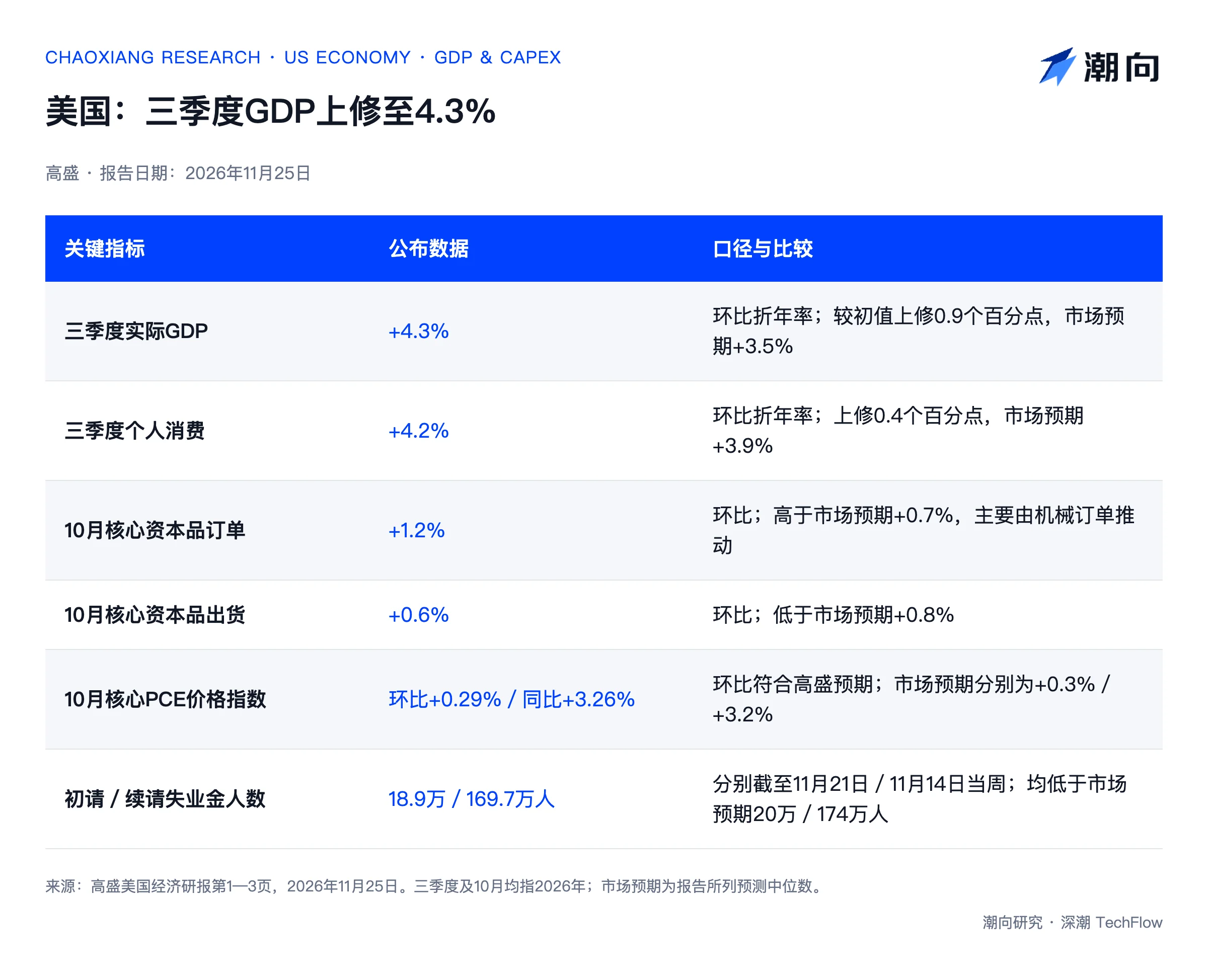
The economic growth momentum of the United States in the third quarter far exceeded initial expectations, with corporate AI capital expenditure becoming the biggest driver. The Goldman Sachs economic research team (Jan Hatzius et al.) noted in a macro data commentary released on November 25, 2026, that the US actual GDP for the third quarter was revised up by 0.9 percentage points to an annualized rate of 4.3%, and core capital goods orders increased by 1.2% month-on-month, significantly surpassing the market expectation of 0.7%. Meanwhile, the core PCE price index in October rose by 0.29% month-on-month in line with expectations, and the number of initial jobless claims fell to 189,000, indicating that the US economy remains resilient at the end of the year.
Business Investment Leads Upgrade, Consumption Shows Strong Resilience
The revised data rewrites the growth backdrop of the US economy in the third quarter.
The US Department of Commerce reported that the revised actual GDP for the third quarter reached an annualized rate of 4.3%, significantly higher than the previous initial estimate of 2.2%, and also above Goldman Sachs’ expectation of 3.7% and the market consensus of 3.5%. Non-residential fixed investment growth was significantly revised up by 3.4 percentage points to 16.1%, with the intellectual property products component contributing the most to this revision.
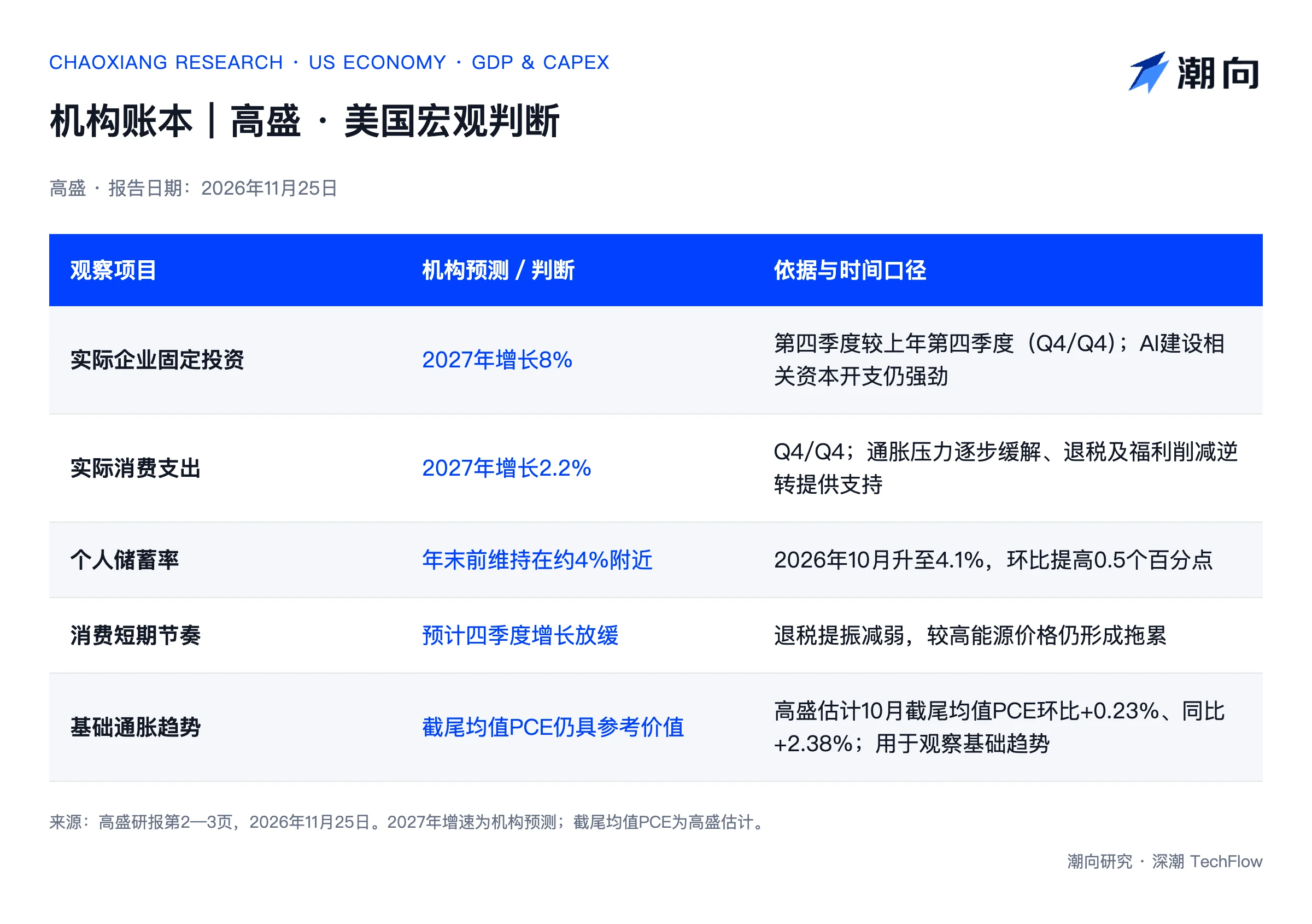
The wave of AI infrastructure remains the core driving force of corporate capital expenditure. Investment in information processing equipment surged by 41.7% in the third quarter, and investment in industrial equipment increased by 20.6%. Goldman Sachs expects that in 2027, the real commercial fixed investment in the US will still maintain a robust year-on-year growth rate of 8%.
Household consumption also surprised. The growth rate of personal consumption expenditures in the third quarter was revised up by 0.4 percentage points to 4.2%, with the demand for goods offsetting a slight downward adjustment in healthcare services spending. Goldman Sachs pointed out that the effect of tax rebates and the wealth effect from the rise in US stocks fully offset the drag caused by high energy prices, and it is expected that personal consumption will maintain a steady growth rate of 2.2% in 2027.
October Consumption Cools Month-on-Month, Core PCE in Line with Expectations
Entering the fourth quarter, the rhythm of household income and expenditure in the United States begins to return to normal.
In October, US personal income rose by 0.7% month-on-month, significantly surpassing the market expectation of 0.4%, mainly driven by a substantial increase of 1.8% in personal dividend income. Nominal disposable income increased by 5.5% year-on-year, and the real year-on-year growth rate reached 1.6%. Personal consumption expenditures rose by 0.3% month-on-month, slightly below the consensus expectation of 0.4%, and inflation-adjusted real personal spending remained flat month-on-month.
The savings rate then began to show signs of recovery. In October, the US personal savings rate rose by 0.5 percentage points to 4.1%, confirming Goldman Sachs' judgment that the savings rate would hover around 4% before the end of the year. Goldman Sachs expects that as the effect of tax rebates fades and high energy prices continue to exert pressure, the consumption growth rate will slow month-on-month in the fourth quarter.
Inflation data overall fell within the market's range. In October, the core PCE price index rose by 0.29% month-on-month and grew by 3.26% year-on-year, almost perfectly aligning with Goldman Sachs' expectations. Goldman Sachs estimates that the Dallas Federal Reserve’s trimmed mean PCE increased by 0.23% month-on-month and rose by 2.38% year-on-year, noting that this indicator excludes one-time disruptions from tariffs, energy shocks, and AI-related statistical distortions, better reflecting underlying inflation trends.
Core Capital Goods Orders Strengthen, Job Market Remains Tight
The forward-looking indicators for manufacturing investment are sending positive signals.
In October, US durable goods orders increased by 0.2% month-on-month, although affected by transportation equipment, it fell short of the market expectation of 0.7%. However, excluding transportation, it showed a steady month-on-month growth of 0.5%. More forward-looking, orders for core capital goods (non-defense capital goods excluding aircraft) surged by 1.2% month-on-month, far exceeding the market expectation of 0.7%, with new orders for machinery and equipment being the main driver.
The AI investment chain has maintained high-speed expansion over the past year. Data shows that in the past 12 months, new orders for computers and electronic products increased by 14.2% year-on-year, and orders for machinery and equipment grew by 16.7%. However, in October, shipments of core capital goods increased by 0.6% month-on-month, slightly below the market expectation of 0.8%, and manufacturing inventories rose by 0.4% month-on-month.
The labor market is also sending robust signals. For the week ending November 21, the number of initial jobless claims in the US fell by 13,000 to 189,000, below the market expectation of 200,000, with the four-week moving average dropping to 196,000. For the week ending November 14, the number of continuing jobless claims decreased significantly by 95,000 to 1.697 million, reversing a previous surge in claims due to the introduction of a new unemployment insurance system in Michigan.
This article is a compilation and interpretation of research reports from third-party brokerage firms by Trend Research. The ratings, target prices, profit forecasts, and related judgments cited in the article are the opinions of analysts from those brokerage firms and represent the positions of their respective institutions, not the views of Trend Research, nor do they constitute any investment advice.
The market has risks; decisions should be made independently. This article should not be the basis for buying or selling any securities.
免责声明:本文章仅代表作者个人观点,不代表本平台的立场和观点。本文章仅供信息分享,不构成对任何人的任何投资建议。用户与作者之间的任何争议,与本平台无关。如网页中刊载的文章或图片涉及侵权,请提供相关的权利证明和身份证明发送邮件到[email protected],本平台相关工作人员将会进行核查。