Author: Lilyann, Geek Park
After years of surfing the internet, you must have had experiences like this: wanting to cancel an auto-renewal but can’t find the way; obviously, the merchant deducted too much money, but applying for a refund requires layers of transfers; explaining to customer service for half an hour over a trivial amount of money, only to hear, "We are very sorry, we can't process this for you at the moment." The amount of money might not be much, but you can't swallow this indignation. What's more frustrating is that you know you are right, but you don't have the time to waste on it. Companies have an entire customer service system, while you might only have a lunch break.
Now, this asymmetrical relationship is finally seeing changes. The emergence of AI, especially Personal AI, allows consumers to hand over these mundane tasks to AI, whether it's email correspondence or complaints on an app, the Agent can handle it with a single click. But new problems arise: the good news is that AI can finally make customer service calls for you; the bad news is that the person on the other end might also be an AI.
On one side is the AI customer service agent sent by the company, on the other side is the AI assistant sent by the consumer. The two tirelessly discuss a billing dispute over a few dollars, while the real consumer has long gone off to do other things, leaving only two AIs politely negotiating. It sounds like a dark humor, but in Silicon Valley in 2026, this has become a serious business issue for startups to explore.
In October, the enterprise customer service AI company Decagon launched the Personal Agent Gateway, aiming to enable the consumer's AI assistant to directly communicate with the enterprise customer service system. They even published an article discussing a previously unheard-of type of customer: the "Customer Who Never Gets Tired."
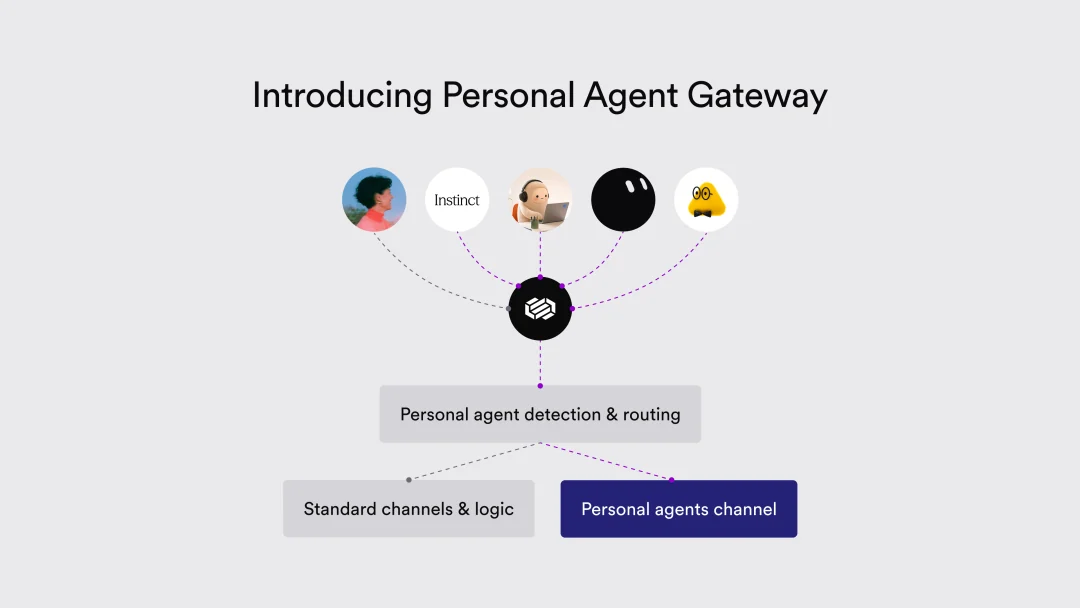
Image: Personal Agent Gateway Framework (Source: Decagon)
A real person may give up after being refused a refund a couple of times. But what about an AI? It can check policies, gather evidence, look for other solutions until it gets the matter resolved or confirms that it's truly impossible.
Recently, a product called Pine Computer has attracted attention in the Silicon Valley tech circle. In October, Pine AI released a cloud computing environment specifically designed for AI, with related posts gaining about 2.4 million views on the day of release; in November, the team launched Pine Phone, allowing AI to make real-world calls while operating web pages and handling documents.
Geek Park chatted with Sun Yurun, co-founder and CTO of Pine AI. Pine was established in June 2024, with the core team coming from the real-time audio and video company Agora, and it has completed a $25 million Series A financing. They started from a seemingly insignificant thing: letting AI make phone calls for ordinary people, negotiate bills, process refunds, and handle those troublesome matters that no one wants to deal with.
It is easy for outsiders to understand it as a battle between AI and AI in customer service. But Sun Yurun doesn’t see it that way: “We are not directly confronting these big companies.” In his view, saving a few dollars on a bill is just the first step to getting users to trust AI. The real goal is to let AI get things done in a complex, inefficient world filled with various rules.
“I called five or six times and couldn't resolve it; How could it succeed just like that for AI?”
When Sun Yurun and his team decided to start their venture in 2024, generative AI had already begun to visibly change how programmers work. Cursor was gradually becoming popular, ChatGPT could write code, generate documents, but for the many ordinary people who do not code, this productivity revolution seemed to still be on someone else’s computer.
Sun Yurun remembers that in 2023 a photo of a construction site went viral on Reddit. A Belgian company hung a giant advertisement on the unfinished building’s exterior: “Hey ChatGPT, finish this building…” Below it was another line: “Your skills are irreplaceable.”

Image: Belgian Construction Site Advertisement (Source: Reddit)
Behind the joke lies a real disconnect: the people creating AI are enjoying the efficiency gains it brings every day, while in the real world, countless tasks still need a human to make phone calls, fill out forms, find departments, and communicate repeatedly. Sun Yurun himself experienced this: he hadn't received a renewal card from HSBC after it was sent out; applying online was difficult, and in the end, he still had to call customer service. If AI can write websites, why is it still so troublesome to recover a credit card? They then decided to let AI jump out of the computer and genuinely do tasks for people.
But soon the team found that getting AI to speak wasn't the hardest part; the challenge was whether it could solve issues ordinary people couldn't solve themselves. Sun Yurun shared a case: a user needed to terminate internet services early due to the company relocating, but the provider insisted on charging for the entire billing cycle. The user called five or six times without resolution. After Pine took over, it first checked the billing policies and historical cases, then contacted the provider with this basis, ultimately saving the user hundreds of dollars.
“At that moment, the user realized that AI can actually be more patient and understand the rules better than I can,” Sun Yurun said. This became the core logic that the team repeatedly verified later: if AI is to handle tasks for ordinary people, it cannot rely solely on linguistic ability; it must also rely on understanding of rules, mastery of processes, and the resilience to maintain communication.
A competent AI assistant cannot ask for instructions from the boss every three minutes
However, getting things done does not mean letting AI operate freely. Many decisions in life often involve real money, personal privacy, and legal responsibilities. If an AI is going to process a refund for you and encounters conditions that require compromise, should it agree on your behalf or stop to ask you? If every step requires asking, the user's energy has not truly been freed; but if it decides everything for you, when a mistake happens, the cost may be much greater than the few dollars saved.
Finding a balance between autonomy and safety has become a design challenge for all Personal AI today. Sun Yurun likens it to a human assistant: a good assistant can neither send messages to the boss for approval every three minutes nor make decisions on their own like signing contracts. The key is to establish a gradient control system based on permissions.
In Pine's design, tasks are broken down into different risk levels. For ordinary information gathering, bill checking, and policy inquiries, the AI can proceed autonomously; but once it involves financial transactions, signing agreements, or giving up rights, the system will trigger a confirmation mechanism to return the final decision-making authority to the human.
More importantly, the AI must clearly communicate its identity to the person it is communicating with. Pine will directly state that it is the user’s AI assistant when making calls and explain the entrusted matters. Sun Yurun believes that masquerading as a human not only involves legal and ethical risks, but also undermines long-term business trust. “For AI to truly enter human society, it must not only be smart enough, but also know its place.”
As businesses use AI to answer calls, consumers are also starting to use AI to make calls
As consumers begin to use AI to make calls, another intriguing change is quietly happening: the customer service on the other end of the line is increasingly being replaced by AI. From Klarna to major banks, global companies have been massively deploying AI customer service over the past two years in an attempt to reduce labor costs. But when AI encounters AI, things start to get complicated.
Traditional enterprise customer service often relies on information asymmetry and consumer fatigue to establish a defensive line. Many seemingly compliant but very difficult cancellation processes, long wait times, objectively discourage many aggrieved parties. But when the consumer also sends out a tireless AI, this balance of offense and defense begins to tip.
The Personal Agent Gateway proposed by Decagon saw this trend. Rather than having two large language models probing each other over the phone using simulated human voices, it would be better to establish a structured Agent-to-Agent communication protocol in the background to directly complete information exchange, authorization verification, and policy matching.
However, this does not mean that all disputes can be resolved instantly. Sun Yurun pointed out that behind enterprise customer service systems often involve complex commercial interests and permission separations. AI can already answer calls on behalf of companies, but it may not have the authority to make decisions for the companies; similarly, a consumer's AI must also operate within the limits of its authorization. The mutual trust agreements and responsibility determinations between the two systems will be a key factor that must be addressed in the infrastructure over the next few years.
Do ordinary people really need an AI assistant?
In Silicon Valley, discussions about the future shape of Agents never cease. Some believe that everyone will possess an omniscient and omnipotent super-brain, managing everything in daily life; others believe that vertically segmented tools in specific scenarios have better survival space.
Facing such grand narratives, Sun Yurun and his team's thinking appears more pragmatic. In their view, ordinary people's demand for AI often does not start from “changing lifestyles,” but begins with a specific, headache-inducing small problem: refunding a missed flight ticket, canceling a gym membership that charges for a year, retrieving an overcharged broadband fee.
These things are of limited value in isolation but quietly consume the energy and happiness of ordinary people. A previous study by Goldman Sachs pointed out that if the time people spend dealing with administrative trivialities and rights disputes during non-working hours were converted into economic value, it would be a huge hidden cost. When technology finally allows this part of the cost to go down, it not only releases efficiency but also the very lives of people.
From phone to computer: What else does an AI assistant need to learn?
Making phone calls is just the first step. In real life, getting things done often requires a “combination of punches”: first checking policies online, filling out forms, uploading receipts, then following up with calls, and finally confirming via email. This has also prompted Pine to move from Voice Agent to Computer Use, and it launched Pine Computer in October this year.
Pine Computer is led by co-founder and chief architect Dylan Wang. Dylan also comes from Agora and has a deep understanding of the importance of infrastructure: In recent years, the industry has been focused on making models smarter, but rarely rethought the computers the models use. Models have to complete tasks through screens, mice, and browsers designed for humans, consuming a lot of reasoning capability in understanding interfaces. Rather than training models to adapt to human computers, it’s better to redesign a cloud computing environment suited for AI use.
However, technology still has a way to go before becoming truly reliable. In Pine's announced SaaS-Bench v1.1 tests in October, the system achieved a checkpoint pass rate of 78.3%, but the complete task completion rate was only 27.4%. This precisely demonstrates the current plight of Agents: they can often accurately perform many steps, but a mistake in the final step can still cause the whole matter to fail. What users care about most is always one thing: Did it get done or not?
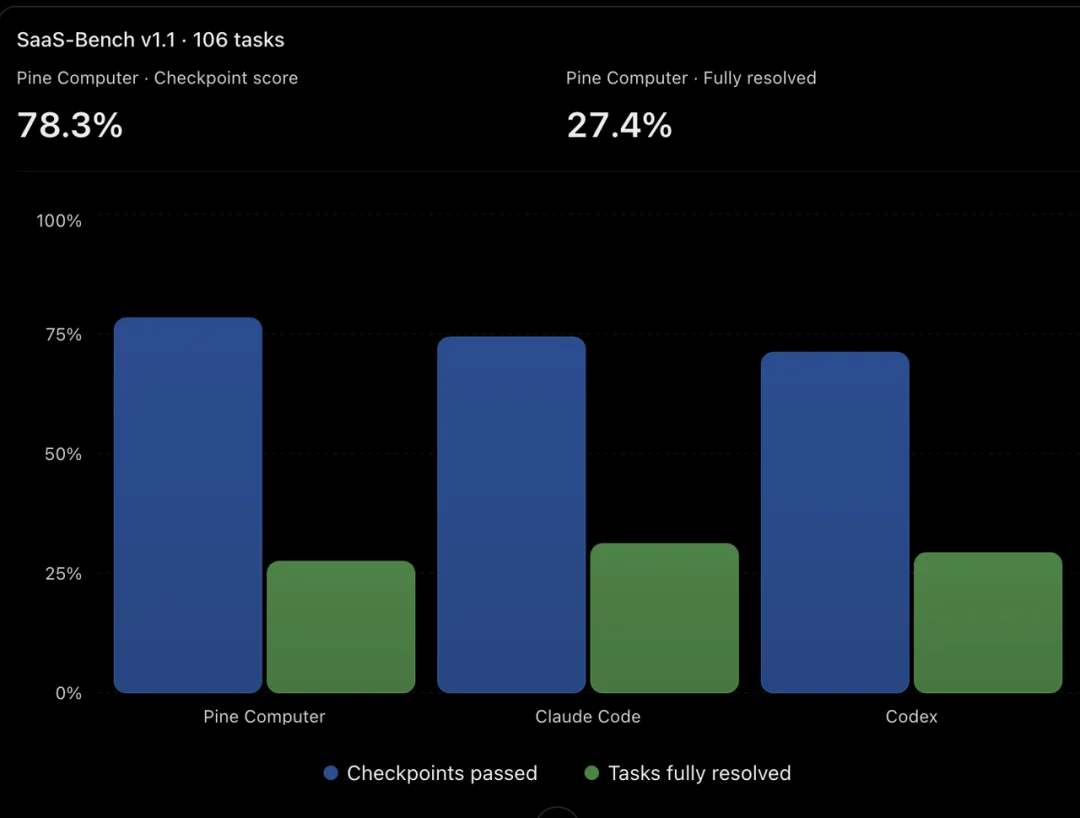
Image: SaaS-Bench v1.1 Test Results
Sun Yurun believes that compared to short-term product forms, what truly needs long-term accumulation is the ability to get things done quickly, cheaply, and reliably. This is also why he is cautious about the societal imagination of a universal Agent freely collaborating: “The habits of this world are very strong; it’s hard to avoid dealing with people.” Humans have spent decades trying to move services online, yet until today, many things still require finding specific individuals to get things done.
For a long time, discussions about the productivity revolution of AI have always focused on how much code it can write and how much content it can generate. But there is another form of productivity that is rarely seriously calculated: the time, knowledge, and emotional costs that ordinary people spend to protect their rights and handle daily trivial matters. In the past, companies had professional teams, complex systems, and large databases, while consumers only had limited patience.
Now AI is starting to reduce these costs. The endpoint of this change may not be to give everyone a more skilled AI to argue with; rather, it may allow those things that were previously abandoned due to being too troublesome to finally be handled thoroughly by someone else. Perhaps one day, we won’t have to personally call lengthy customer service lines for a few dollars; two AIs will exchange authorizations, query policies, communicate in the background, and finally send the results to our phones. The difference is that this time, what was consumed will no longer be your patience.
免责声明:本文章仅代表作者个人观点,不代表本平台的立场和观点。本文章仅供信息分享,不构成对任何人的任何投资建议。用户与作者之间的任何争议,与本平台无关。如网页中刊载的文章或图片涉及侵权,请提供相关的权利证明和身份证明发送邮件到[email protected],本平台相关工作人员将会进行核查。