Author: New Intelligence Source

The technological trend of global large models is rapidly changing, with the battlefield reaching the very foundation of AI architecture. In September, OpenAI unveiled GPT-6 Astra, igniting the AI community with Recurrent Depth technology; on November 23, Zhizhu released GLM-5.4, directly incorporating Loop Transformer into their flagship model. Both leading AI companies have bet on the same technological direction.
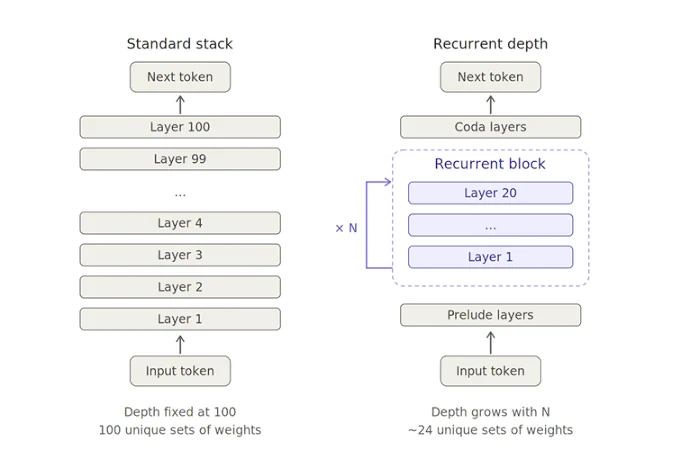
Using only 750 billion parameters, Zhizhu's model can achieve the intelligence level of models with 2 to 3 trillion parameters. Just in the past few days, a technical report titled "General Looped Model" briefly appeared in the public domain before being temporarily retracted. The report comes from a Chinese AI startup: FaceMind.
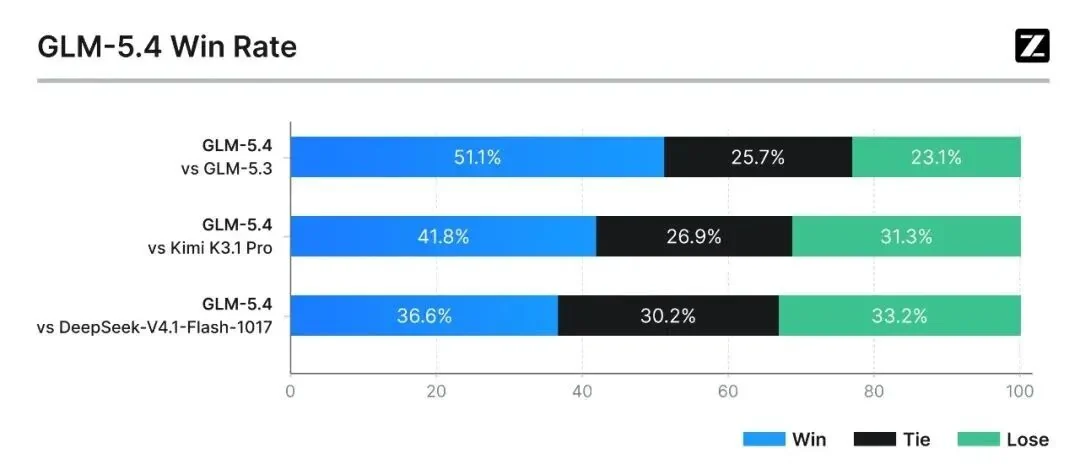
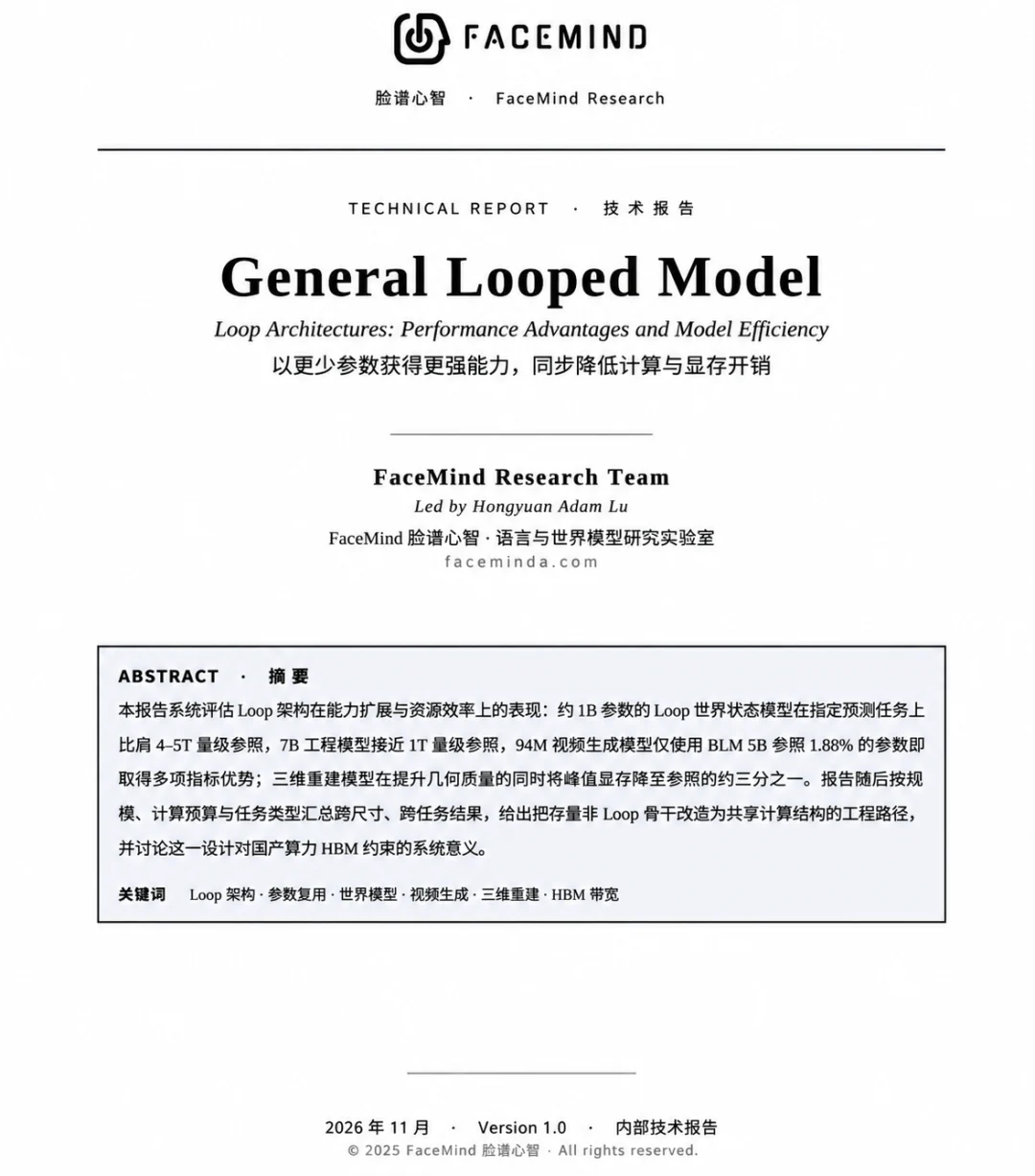
The official reasons for the retraction have not been detailed. However, from the disclosed content, it is evident that the team's ambitions extend far beyond language models: world models, diffusion models, and even 3D reconstruction have all entered their research scope.
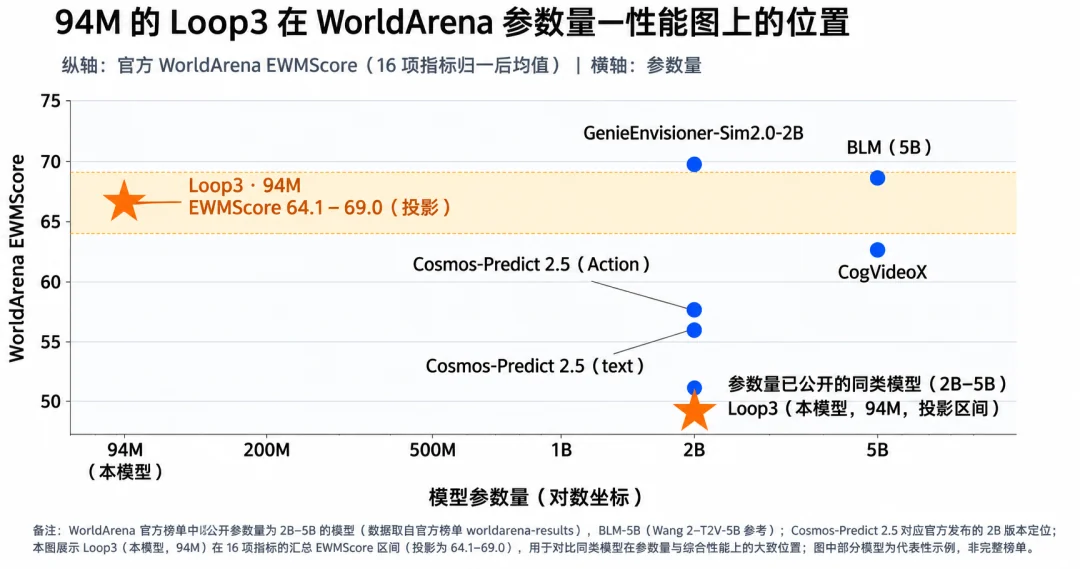
One set of experiments is particularly impressive: the main model has only 94 million parameters yet outperformed an open-source model with 5 billion parameters across seven video generation metrics, a staggering 53 times difference in parameters! Three months before the public report on OpenAI Astra architecture, this Chinese team had already published research on recurrent world models. As industry giants have all placed bets on Loop, a group of researchers who have been in the background for years have finally gotten their chance to shine.
Piling Parameters, Hitting the Ceiling
In the past few years, global AI giants have been engaged in almost the same endeavor: piling parameters, data, and computing power. From 175 billion parameters in GPT-3 to flagship models now exceeding tens of trillions of parameters, the entire industry is caught in an unprecedented arms race. But what if AI's intelligence could grow in another way?
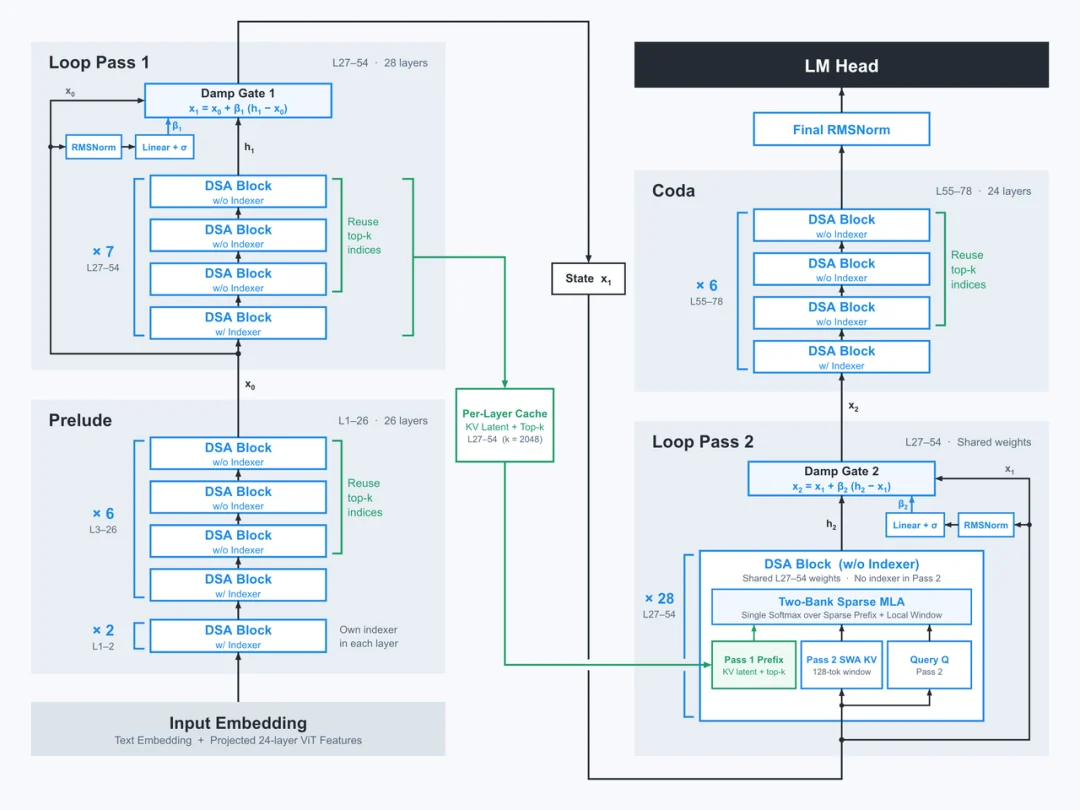
Zhizhu's recently released GLM-5.4 offers a stunning answer: Zhizhu performed two rounds of cycling on the 28 layers of the 750B foundation. In traditional Transformers, each layer typically computes only once and then passes the result to the next layer; in contrast, the Loop allows the model to feed the processed information back to the same set of network layers for continued computation, correction, and inference. No parameters were added, yet the computational depth increased.
In Zhizhu's previous 30B model control experiments, merely increasing the training computation by about 10% resulted in significant improvements in mathematical and scientific reasoning tasks for the cyclic version. Amazingly, the thought chains generated by the model became shorter.
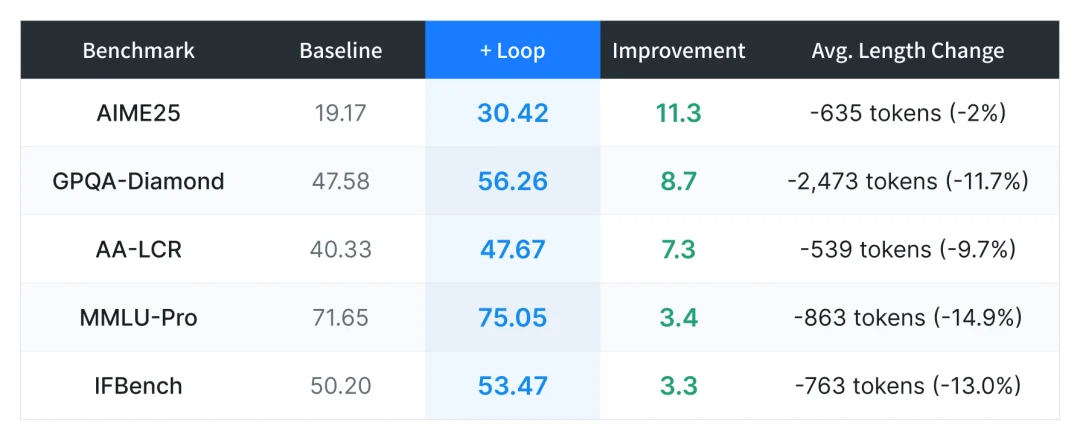
Previously, to make AI think longer, more tokens were often required; now the model can retain more thoughts within its "brain," which is the most exciting aspect of Loop: AI's intelligence growth has the potential to detach itself from close ties with parameter scale.
Of course, Loop did not emerge out of nowhere. As early as 2018, the Universal Transformer had explored a similar cycle computing mechanism, and there have been occasional attempts in academia since then. But today, with OpenAI and Zhizhu bringing cycling computation into flagship models, this once relatively obscure technical route has finally entered the core stage of large model competition. Zhizhu has explicitly stated that it will simultaneously advance model scale and cyclic depth, leaving little time for other AI companies.
Years of Waiting, a Turnaround
One of the most interesting phenomena in the AI community over the past few years is that previously non-consensed technologies have been experiencing a "resurrection." Turing Award winner Yann LeCun has insisted on researching world models for years, and while the world rushes toward large language models, he has always believed that machines need to build an understanding of the world internally and possess capabilities for prediction, planning, and reasoning.
FaceMind identifies with LeCun's technology philosophy but is also exploring a more specific architectural question: can AI repeatedly use the same set of parameters, self-looping in hidden states? World models are a domain where this architecture has significant applicability, and its potential could extend to language reasoning and diffusion generation. According to founder Lu Hongyuan, he began exploring cyclic architectures as early as around 2022, later extending research to spatial intelligence and world models.

At that time, the wave sparked by ChatGPT swept the globe, with few realizing that cyclic architectures would play such an important role in flagship large models in the future. On June 16, 2026, FaceMind submitted the paper "Looped World Models," proposing a cyclic architecture LoopWM aimed at world modeling, soon topping the Hugging Face Papers daily ranking.
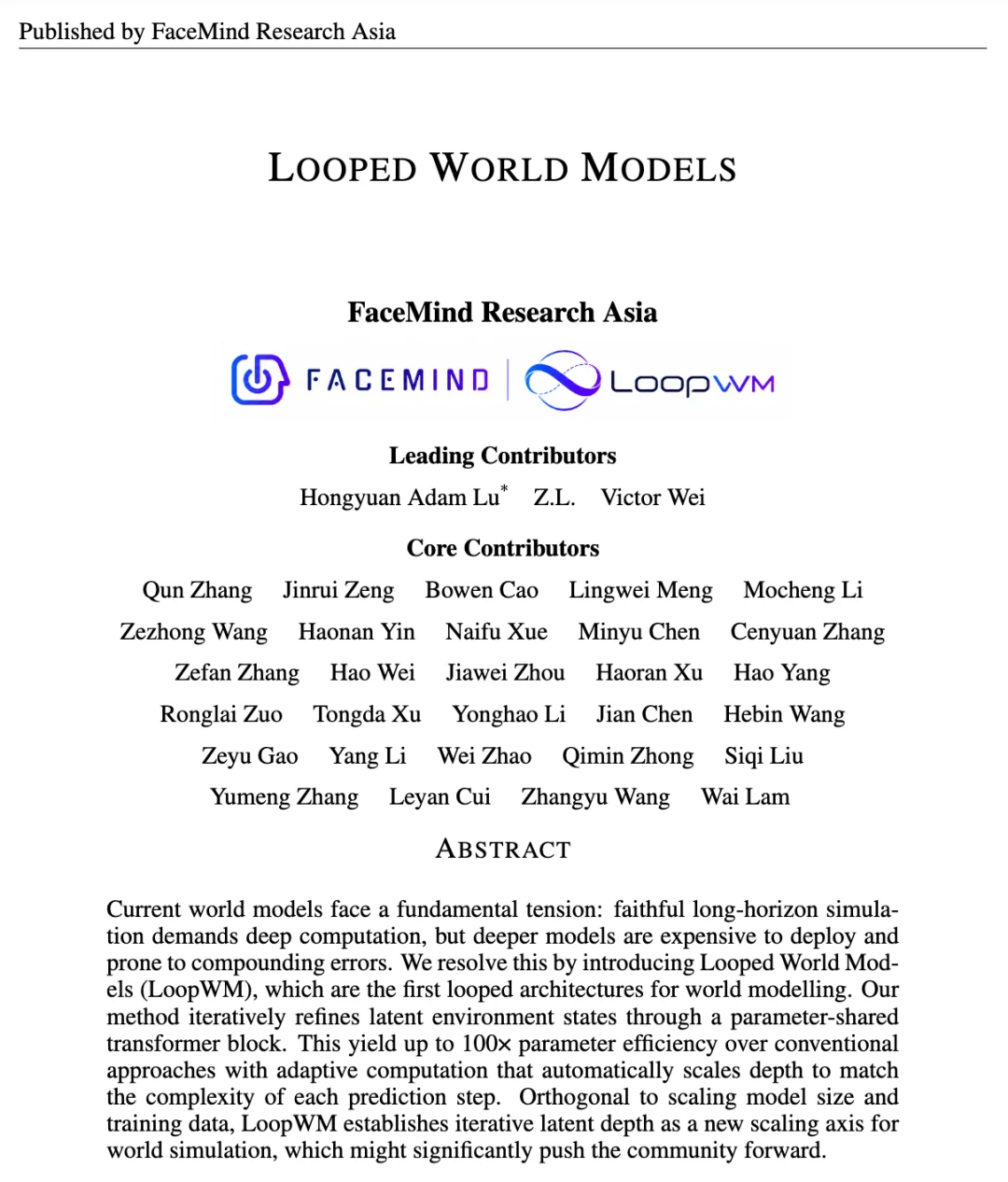
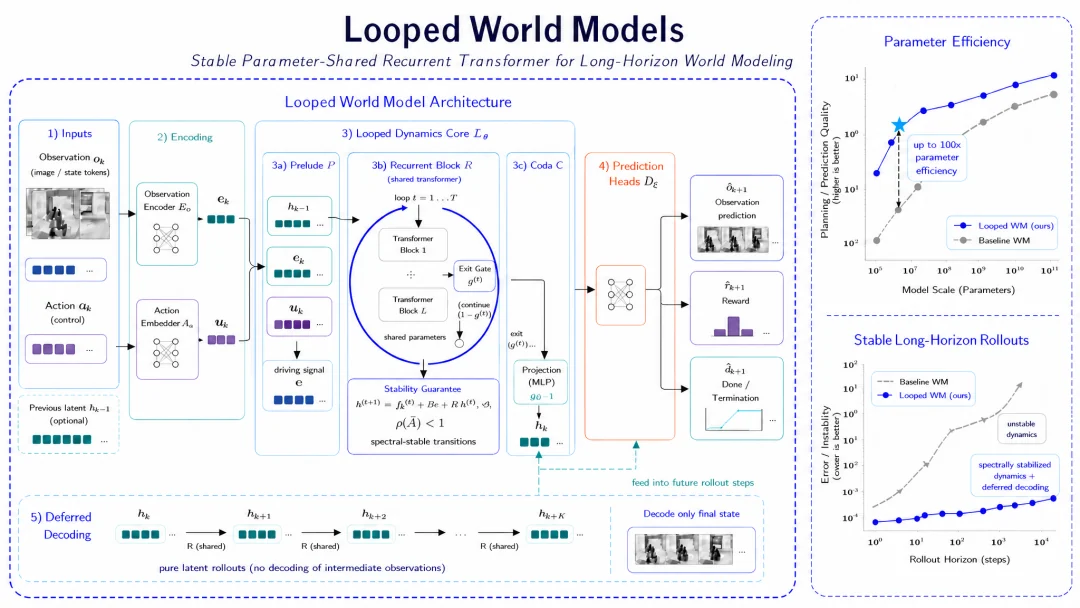
The paper targets one of the trickiest issues in world models: error accumulation. Suppose a robot imagines cleaning a room in advance; if the first prediction deviates, the room in the robot's mind could be completely different after continuing to reason for dozens of steps. FaceMind's solution is to have the model internally reason multiple rounds before each prediction, reducing computations for simple actions and revising when facing complex scenes like collisions and occlusions. The team also added stability constraints, performing continuous reasoning in hidden space and decoding as needed, achieving up to 100 times improvement in parameter efficiency.
This paper was published about three months before the public report on OpenAI Astra architecture and more than five months before Nikke's GLM-5.4 was officially released. Although OpenAI has not publicly adopted LeCun’s advocated world model route in Astra, Loop has already penetrated the core competition of large language models, and FaceMind still holds another card.
94 Million vs. 5 Billion!
If Loop can allow language models to think deeper and world models to reason further, what about diffusion models? In October of this year, FaceMind introduced Loop into video generation models, keeping the main model parameter count unchanged while allocating more computational resources to hidden state cycles. The resulting Loop3 model has only 94 million parameters, while the competitor uses Alibaba Wan2.2-TI2V-5B as a backbone with a main model parameter count of 5 billion.
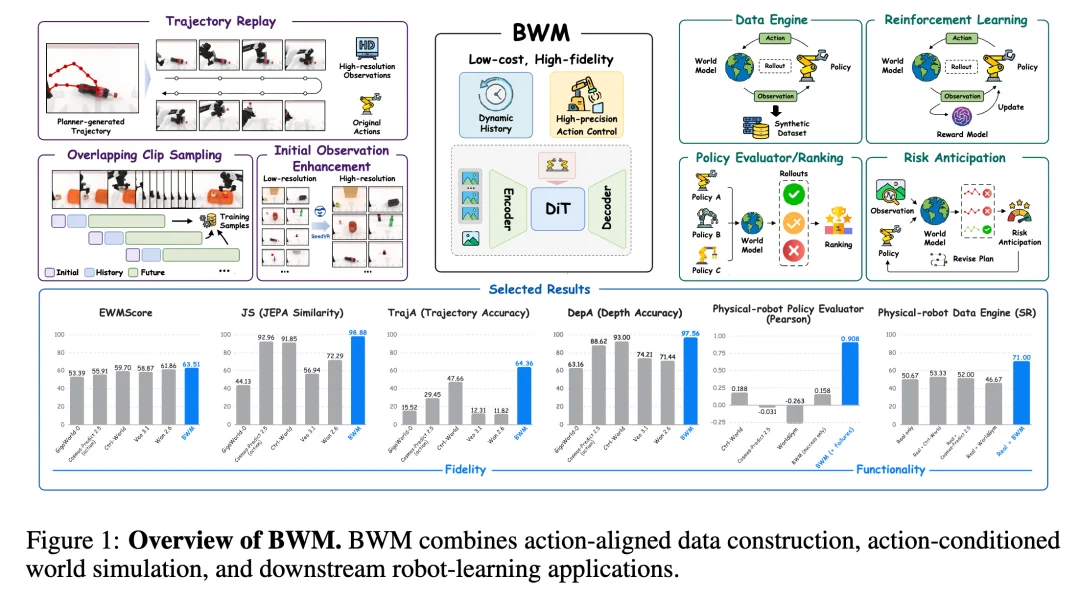
In a unified evaluation pipeline, out of 16 metrics, Loop3 won 7, including core metrics like motion smoothness, trajectory accuracy, depth accuracy, and instruction adherence; it fell slightly short on 3 metrics, lagged on 5, and had 1 without distinguishability. This was a controlled experiment conducted at 128×128 resolution, 57 frames, and FP16 precision.
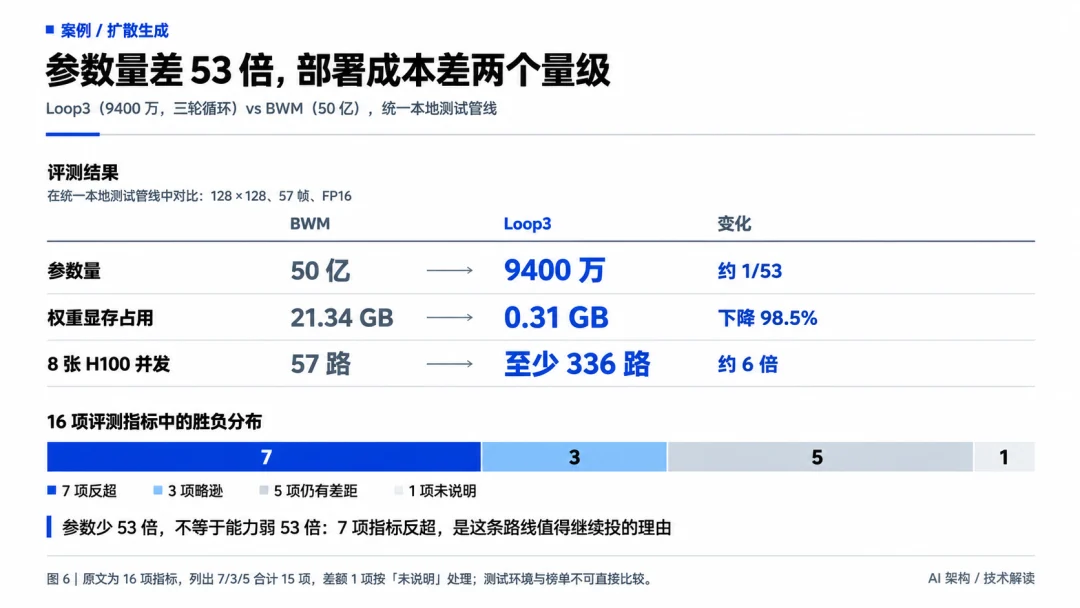
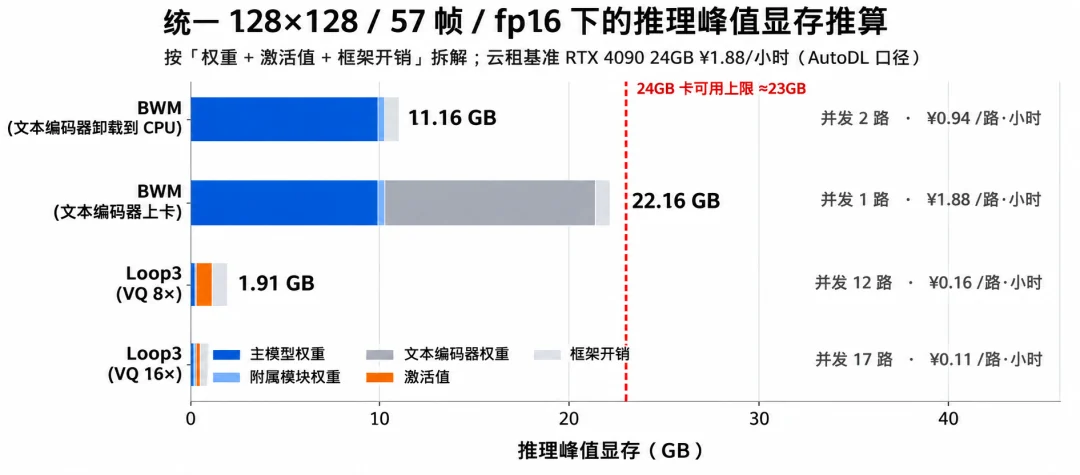
Even more striking is the memory usage: calculated at FP16 precision, the BWM main model weights require 10 GB of memory, while Loop3 needs only 0.188 GB. When accounting for each auxiliary component, the memory weights are 21.34 GB and 0.31 GB respectively. On the same 8-card H100 server, the theoretical concurrent routes can increase from 57 to at least 336, nearly a 6-fold improvement.
The temporarily retracted "General Looped Model" technical report attempts to unify these studies: language, vision, and physical world simulation, using the same underlying computational philosophy: reusing weights, iterating continuously in hidden space, and demanding more intelligence from computational depth. Once generality receives larger-scale validation, its impact will touch the underlying architecture of generative AI.
The Next AI Arms Race
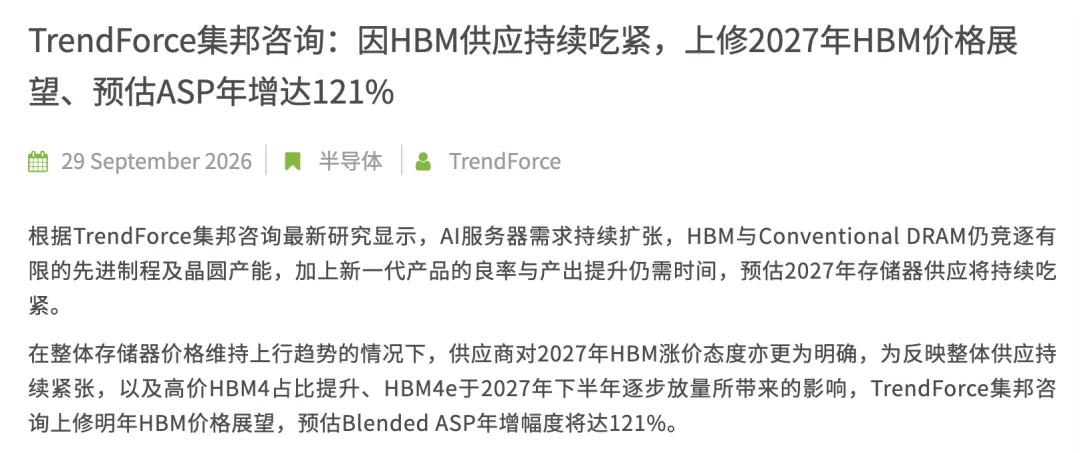
As giants frantically purchase graphics cards, another crisis looms: HBM (High Bandwidth Memory) is becoming increasingly expensive and harder to procure. TrendForce predicts that by 2027, the year-on-year increase in the average selling price of HBM may reach 121%. For AI companies accustomed to piling parameters, once memory cannot accommodate the model, they will have no choice but to increase hardware resources.
However, Loop offers a new solution: as long as the weights can fit into memory, there is a chance for the same set of parameters to participate in computations repeatedly. While cycles present engineering challenges related to training stability, parallel efficiency, and inference latency, once addressed, the competition landscape will undergo significant changes: teams achieving comparable intelligence levels with fewer parameters can allocate remaining computational power to larger-scale training or deeper reasoning, creating a continuously accumulating advantage. This is particularly crucial for Chinese AI teams that are relatively limited in computational resources.
Now, FaceMind, founded by two young PhDs, Lu Hongyuan and Wei Yiran, is attempting to unify multi-domain explorations through the General Looped Model. The birth of the Transformer in 2017 initiated the era of large models; now, the Transformer itself is also reaching an evolutionary tipping point. When both parameter scale and computational depth become drivers of intelligence growth, besides continuing to pile parameters, where else can models scale? This time, whoever finds the answer first will have the opportunity to seize the high ground in the next round of AI competition.
Reference: https://arxiv.org/abs/2606.18208
免责声明:本文章仅代表作者个人观点,不代表本平台的立场和观点。本文章仅供信息分享,不构成对任何人的任何投资建议。用户与作者之间的任何争议,与本平台无关。如网页中刊载的文章或图片涉及侵权,请提供相关的权利证明和身份证明发送邮件到[email protected],本平台相关工作人员将会进行核查。