16.61 billion MON has ended its locking cliff period, and the circulating supply has surged by 1.8 times.
Written by: Ma He, Foresight News
On November 24, Monad, with a glamorous halo of $225 million in financing, celebrated the first anniversary of its mainnet launch. As 16.61 billion MON (valued at approximately $183 million based on the current price of $0.011) ended its locking cliff period and was released en masse, according to Bitget market data, the price of the MON token plunged below the psychological barrier of $0.01, touching a historical low of $0.0091.
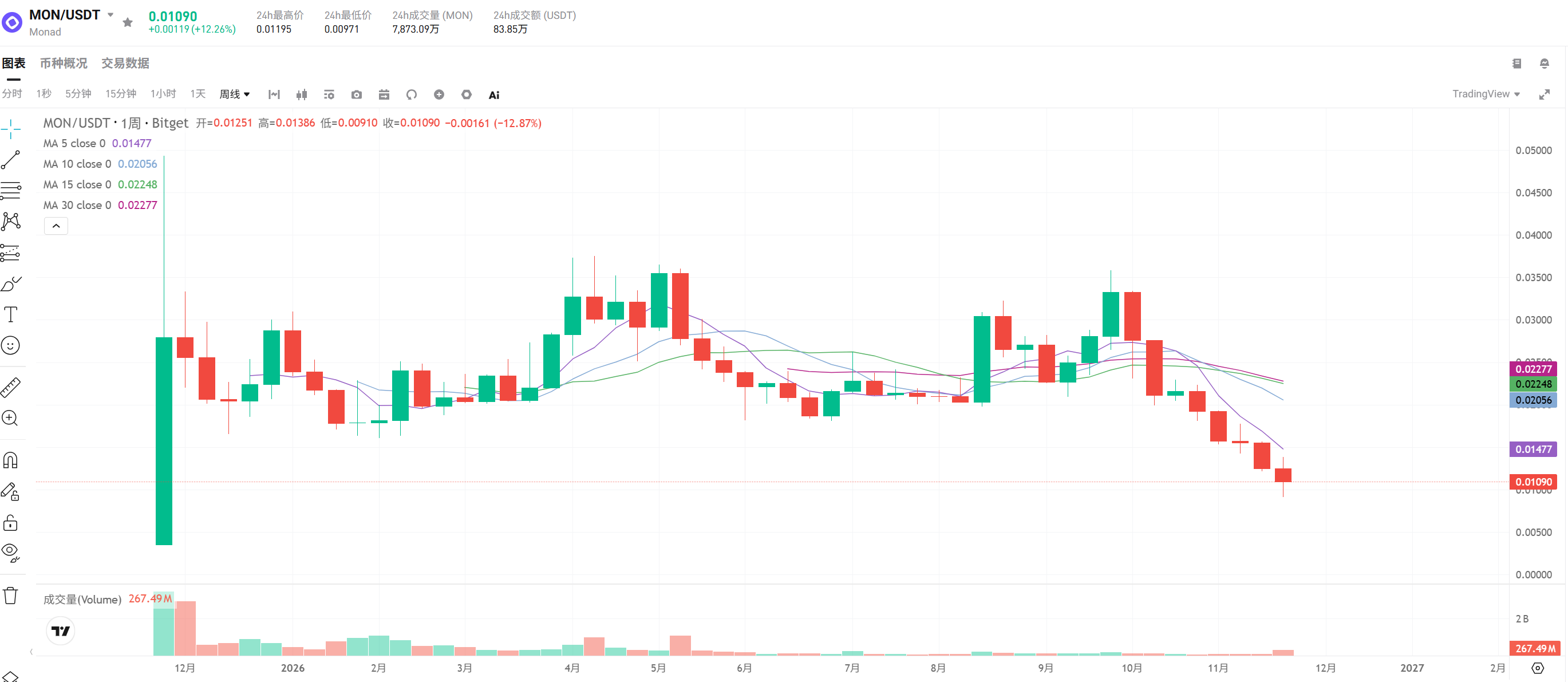
Price trend of the MON token (weekly chart)
As of the time of writing, MON has rebounded to around $0.011, but the current price is still halved from the public sale price of $0.025 (down 55.7%) and has retracted over 77% from a year ago’s historical high of $0.04876.
Has the last public chain Monad entered its "hellish hour"?
Circulating supply surged by 1.8 times
The trigger for this intense volatility comes from an extreme imbalance in supply and demand. According to the token economics announced by the Monad Foundation in November 2025, the initial total supply of MON is 100 billion tokens.
On the day the mainnet launched, approximately 10.8 billion tokens were entered into public circulation through public sale and airdrop, while about 38.5 billion tokens were managed by the foundation for ecological development. The remaining 50.6% (approximately 50.6 billion tokens) were locked up, distributed to the team (approximately 27 billion tokens), investors (approximately 19.7 billion tokens), and the Category Labs treasury (approximately 3.95 billion tokens).
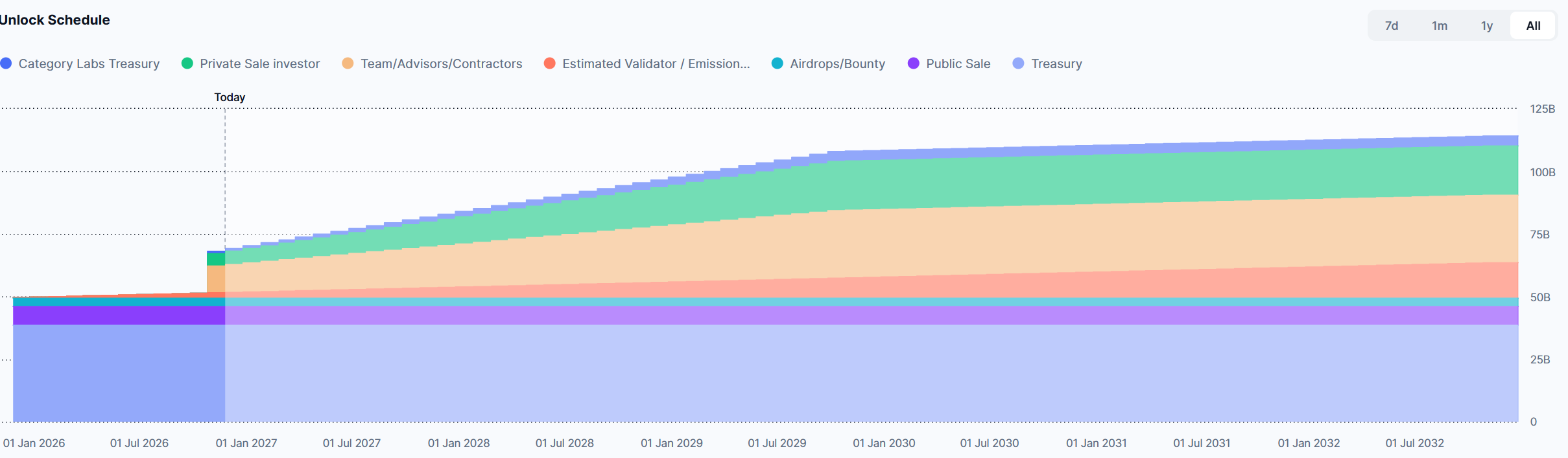
At the one-year unlock event, the team released 10.7% of the initial total supply (approximately 10.7 billion tokens) according to the rules. Investors and the Category Labs treasury, who held a total of 23.65 billion tokens after enduring a one-year cliff period, released 25% (approximately 5.91 billion tokens) at once, leading to a total actual unlock of 16.61 billion tokens in a single day. As a result, the circulating supply of MON skyrocketed from about 9.2 billion tokens before the unlock to 25.81 billion tokens, an increase of about 1.8 times in one day.
According to CoinMarketCap data, the current circulating market value of MON is $286 million, with a fully diluted valuation (FDV) of about $1.26 billion.
Tokens are being withdrawn from staking, with 368 million MON tokens in withdrawal
Beyond short-term speculation, the on-chain ledger has exposed deeper fissures in the distribution of interests. Data from MonadVision shows that the total staking amount across the network is approximately 22.3 billion MON, with a staking rate maintaining around 22% of the current total supply, and an annual percentage rate (APR) of about 7.4%, maintained by active validator nodes such as Backpack, Kraken, Figment, and Alchemy.
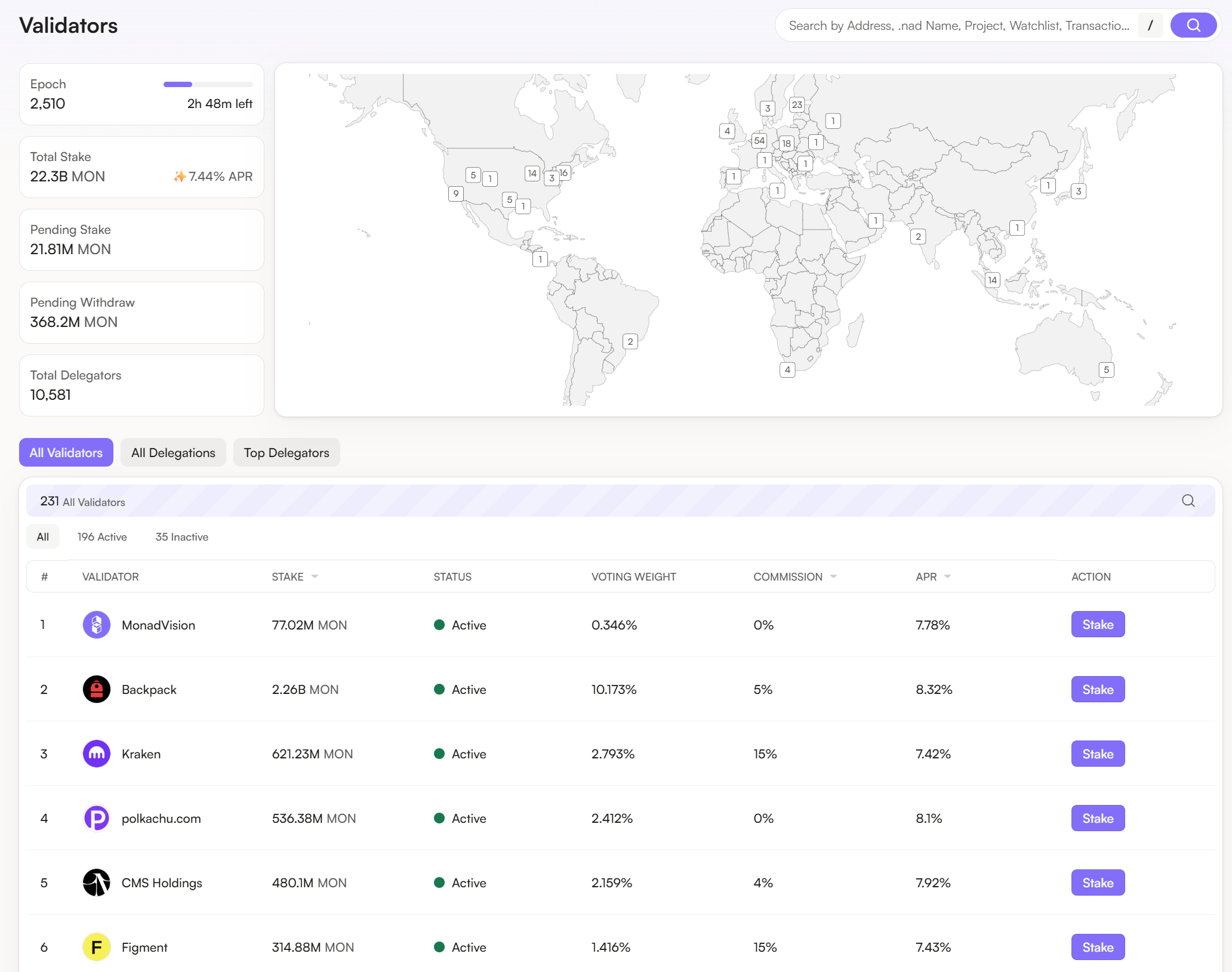
Newly staked 21.81 million tokens, 368 million tokens queued for withdrawal, data from MonadVision
A set of counterintuitive data comparisons is worth noting: prior to the unlock, the circulating supply in the public market was only 9.2 billion tokens, yet the on-chain staking scale had already surpassed 20 billion tokens.
This indicates that over the past year, the vast majority of staking rewards have effectively been pocketed by the Monad Foundation (through the Validator Delegation Program, VDP) — the foundation has profited handsomely from over 7% inflation issuance with nominal 'ecological development' tokens on-chain, while the 16.61 billion tokens just unlocked for teams and institutions now formally qualify for staking.
CoinMarketCap data further confirms this dilution effect: the current total supply of MON has inflated from the initial 100 billion to 101.86 billion, with a maximum supply of 114.16 billion, resulting in an increase of about 1.86 billion (approximately $20.46 million) within a year;
Conversely, the cumulative destruction amount on the mainnet is only about 87.94 million tokens, failing to cover even 5% of the annual inflation issuance. Early large holders have continued to dilute costs by earning interest through locked staking, while secondary market buyers alone swallow the bitter fruit of inflation dilution.
Furthermore, third-party browser MonadVision shows that currently, 368 million MON tokens are queued for withdrawal from staking (approximately $4.05 million), which is nearly 17 times the new staking amount.
Buy only, no burn accounting: why the project side does not destroy tokens?
Amidst ongoing skepticism about inflation, the market had once hoped that the project would launch a "buyback and burn" plan, but Monad's "destruction" and "buyback" are completely disconnected. The roughly 87.94 million MON tokens already burned on-chain have all originated from gas base fees automatically burnt in line with EIP-1559 and are unrelated to the project's financial operations.
As long as there is no improvement in on-chain transaction activity, protocol-level destruction is unlikely to expand significantly.
On the capital side, although Monad's system has launched two bottom support plans this year, both have adopted a "buy only, no burn" strategy: the core development team Category Labs has expanded the authorized purchase amount in the public market to $80 million (effective until the end of this year), but the tokens purchased are directly incorporated into the company's reserves and not sent to a burn address;
The Monad Foundation also allocated up to $60 million in August to initiate a "limited liquidity plan" for early investors, allowing institutions to repurchase locked tokens at a discount, but the tokens repurchased continue to follow the original lockup period, and the nominal total supply and fully diluted valuation (FDV) have not been reduced as a result.
However, the early investor repurchase plan ultimately saw "limited actual participation." For early-stage seed round firms, even though the current price has fallen by more than half from the public sale price of $0.025, they still maintain considerable floating profits, naturally lacking the motivation to exit at a discount.
Meanwhile, despite the foundation stating it will not sell tokens directly through over-the-counter (OTC) transactions, there is still ongoing scrutiny in the market regarding its 38.5 billion ecological tokens and their indirect entry into the market through validator delegation programs (VDP), ecological incentives, and borrowing for market making.
The three-year linear selling pressure has just begun
The fundamental issue that supports overvaluation remains the hollowing out of actual demand on-chain. Monad was once famous for "10,000 TPS parallel EVM," but as the mainnet marks its first anniversary, MonadVision indicates that while the total number of transactions has exceeded 1.25 billion, with approximately 4.5 million total accounts and an average block time maintained at 0.3 seconds, the real-time TPS is only about 98, with a 24-hour peak TPS of only 708.

The even more embarrassing ecological status is hidden in the official documentation.
In the official Monad "Token and Cross-Chain Bridges" list, the actively used assets on-chain are almost entirely external wrapped assets moved through cross-chain bridges such as LayerZero, Chainlink CCIP, Circle CCTP, etc. (covering USDC, USDT0, AUSD, USDe, cbBTC, WBTC, and wstETH, etc.), with only one WMON listed under natively issued assets.
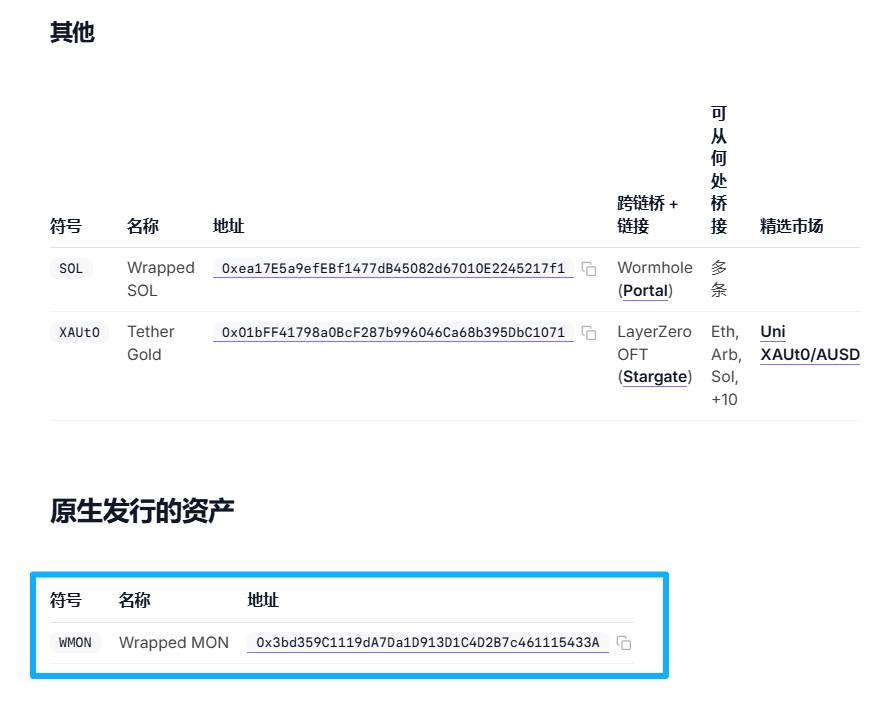
The lack of high-retention native killer applications means that on-chain gas consumption is unlikely to form a scalable moat.
For the secondary market, the intense fluctuations on November 24 are far from the end.
According to the official unlock schedule, investors and the Category Labs treasury will continue to release tokens linearly at a rate of 1/48 per month following the cliff period, adding approximately 400 million to 500 million each month; the remaining team tokens amounting to about $179 million will also be gradually released over the next three years under the dual conditions of circulating unlock and vesting, until the end of Q4 2029 when they are mostly released.
As the real consumption at the application layer lags far behind the rates of inflation and unlock, what awaits this "last public chain" is not just the pain of a single-day plummet, but a liquidity endurance battle lasting three years.
免责声明:本文章仅代表作者个人观点,不代表本平台的立场和观点。本文章仅供信息分享,不构成对任何人的任何投资建议。用户与作者之间的任何争议,与本平台无关。如网页中刊载的文章或图片涉及侵权,请提供相关的权利证明和身份证明发送邮件到[email protected],本平台相关工作人员将会进行核查。