Deep Tide Guide: NVIDIA recently agreed to pay $290 million in cash to resolve an ongoing class action lawsuit that has lasted for eight years, pending court approval.
The core fact of this lawsuit is not complicated: during the Ethereum mining boom from 2017 to 2018, NVIDIA attributed over a billion dollars in revenue from graphics cards that were originally sold to miners to its gaming business, failing to disclose its dependence on the cryptocurrency cycle to the capital market. Subsequently, the mining crash at the end of 2018 led to channel inventory being overstocked, and after NVIDIA downgraded its performance guidance, its stock price plummeted 28.5% in two days. With the U.S. Securities and Exchange Commission's previous penalties and the Supreme Court's dismissal of the appeal, this compensation, primarily covered by commercial insurance, is expected to help this AI chip giant turn the page on its historical reliance on the cryptocurrency cycle.
After dragging on for a full eight years, NVIDIA has finally reached a settlement regarding the lawsuit triggered by profits made from miners.
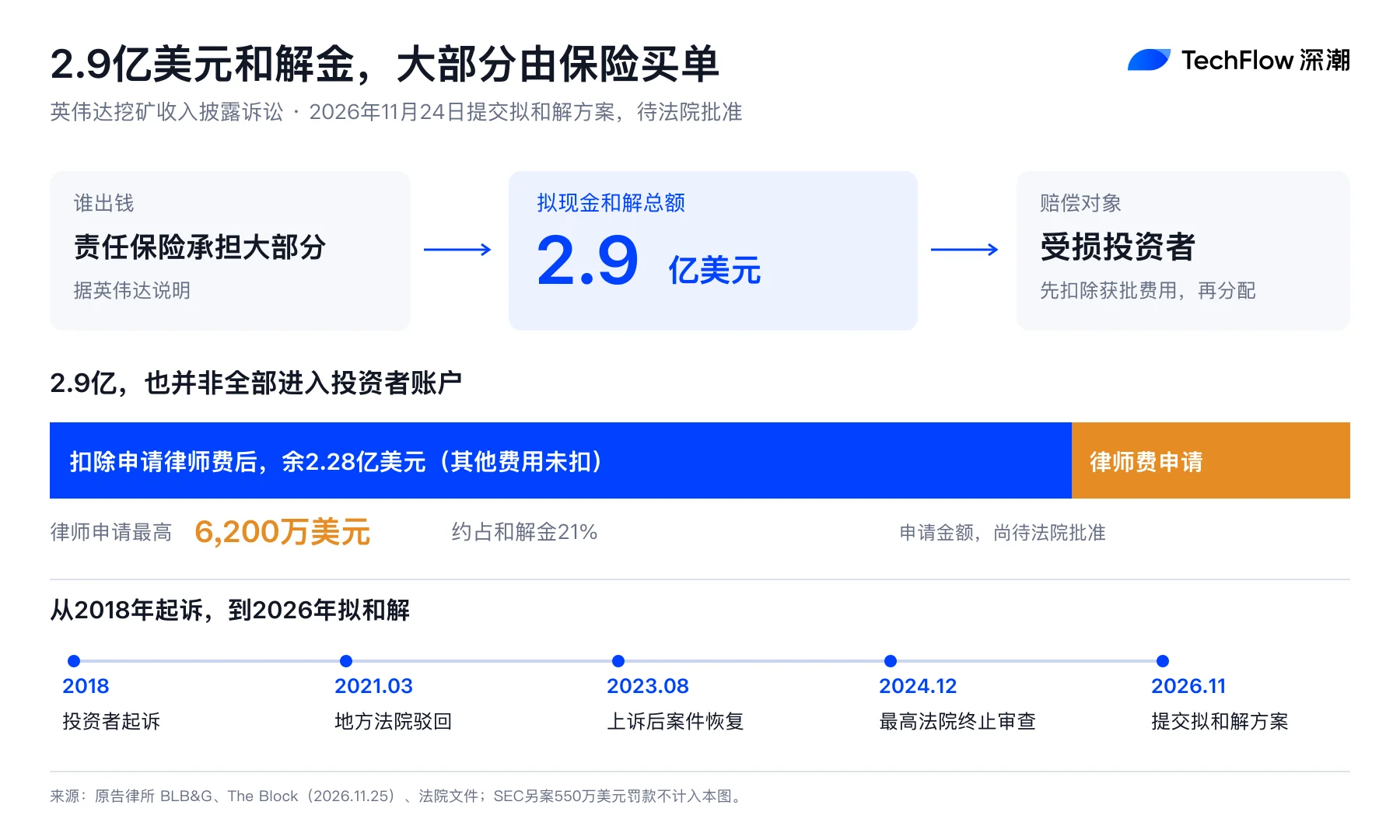
On November 24 local time, the agreement submitted by the plaintiffs to the U.S. District Court for the Northern District of California shows that NVIDIA agreed to pay $290 million in cash to settle with investors who accused it of financial misrepresentation.
This lawsuit originated at the end of 2018 and has been a back-and-forth for eight years, with the core dispute centering on one issue: the graphics cards NVIDIA sold at that time, a significant portion was bought by cryptocurrency miners, but NVIDIA attributed this revenue to gamers in its financial reports.
$1.1 billion underreported and "crypto hangover"
Let's turn back time to the Ethereum graphics card mining frenzy from 2017 to 2018.
Although NVIDIA established a small dedicated mining card business line at that time, miners still bought large quantities of regular GeForce gaming graphics cards to be able to resell them later.
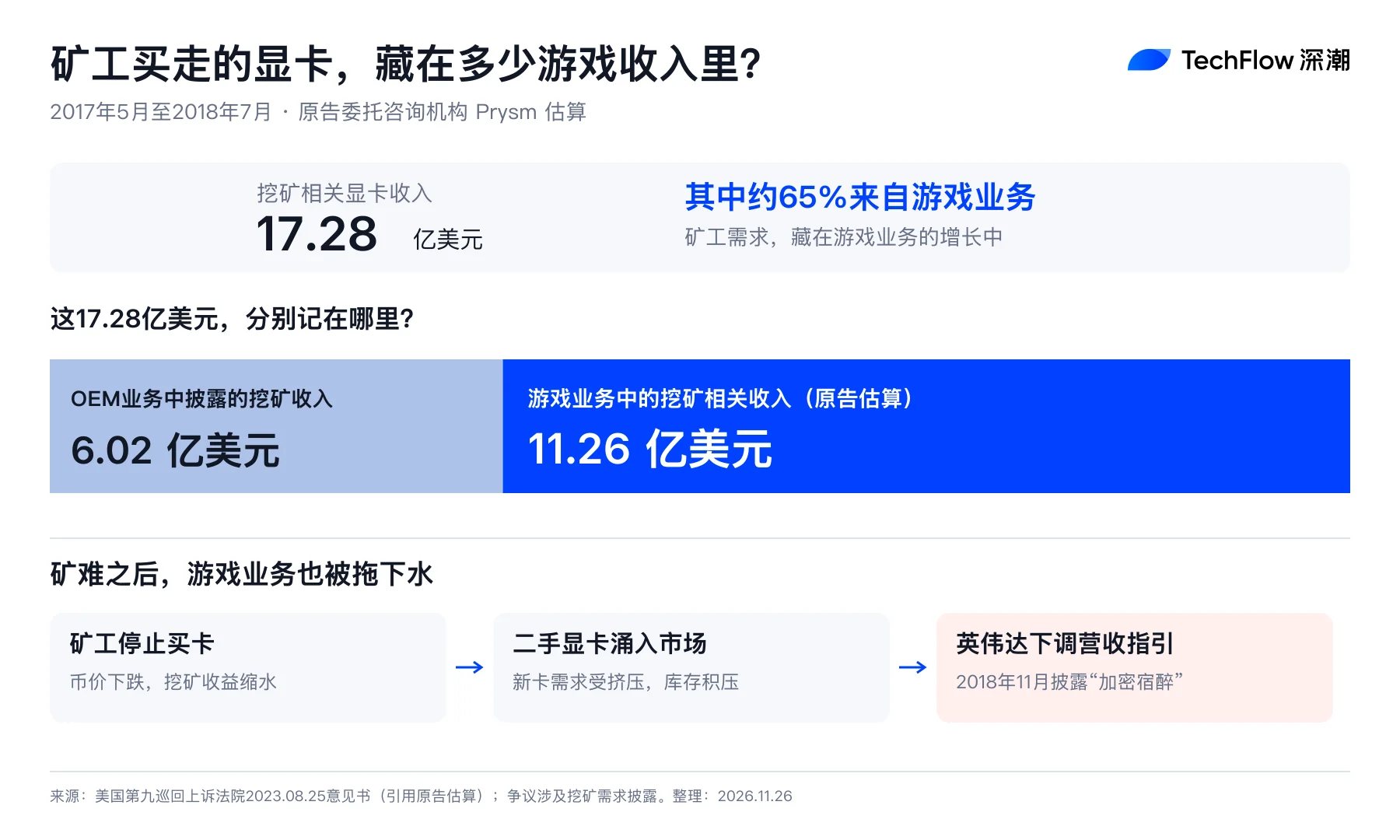
According to data later reverse-engineered by consulting firm Prysm Group and investment bank RBC, based on the overall Ethereum network hash rate growth: between May 2017 and July 2018, NVIDIA sold graphics cards to miners totaling $1.7 billion to $1.8 billion, but the company only reported about $600 million under cryptocurrency business, with the underreported mining-related revenue amounting to $1.126 billion.
However, at that time, the secondary market valued the gaming business far higher than the volatile mining business.
Jensen Huang stated during the earnings call with analysts in August 2017 that the vast majority of miners were buying dedicated mining cards; in media interviews, he downplayed the impact of cryptocurrency business to "probably only around $150 million."
It was not until the second half of 2018 when the cryptocurrency prices collapsed, making mining unprofitable, that miners stopped buying cards and began to sell second-hand cards at low prices, leading to inventory explosion.
On November 15, 2018, NVIDIA finally recognized it had encountered a "crypto hangover" and significantly lowered its fourth-quarter revenue guidance. Within two days after the financial report was published, NVIDIA’s stock price plummeted by 28.5%, triggering a class action lawsuit from harmed shareholders.
The lawsuit lasted eight years, and now spending $290 million to settle
This lawsuit was initially dismissed by a district court in 2021, but was overturned by the Ninth Circuit Court of Appeals in 2023.
The appellate court's ruling was very clear, directly citing the $1.126 billion data gap and stating: "A CEO unaware of the source of $1.126 billion in revenue is almost impossible."
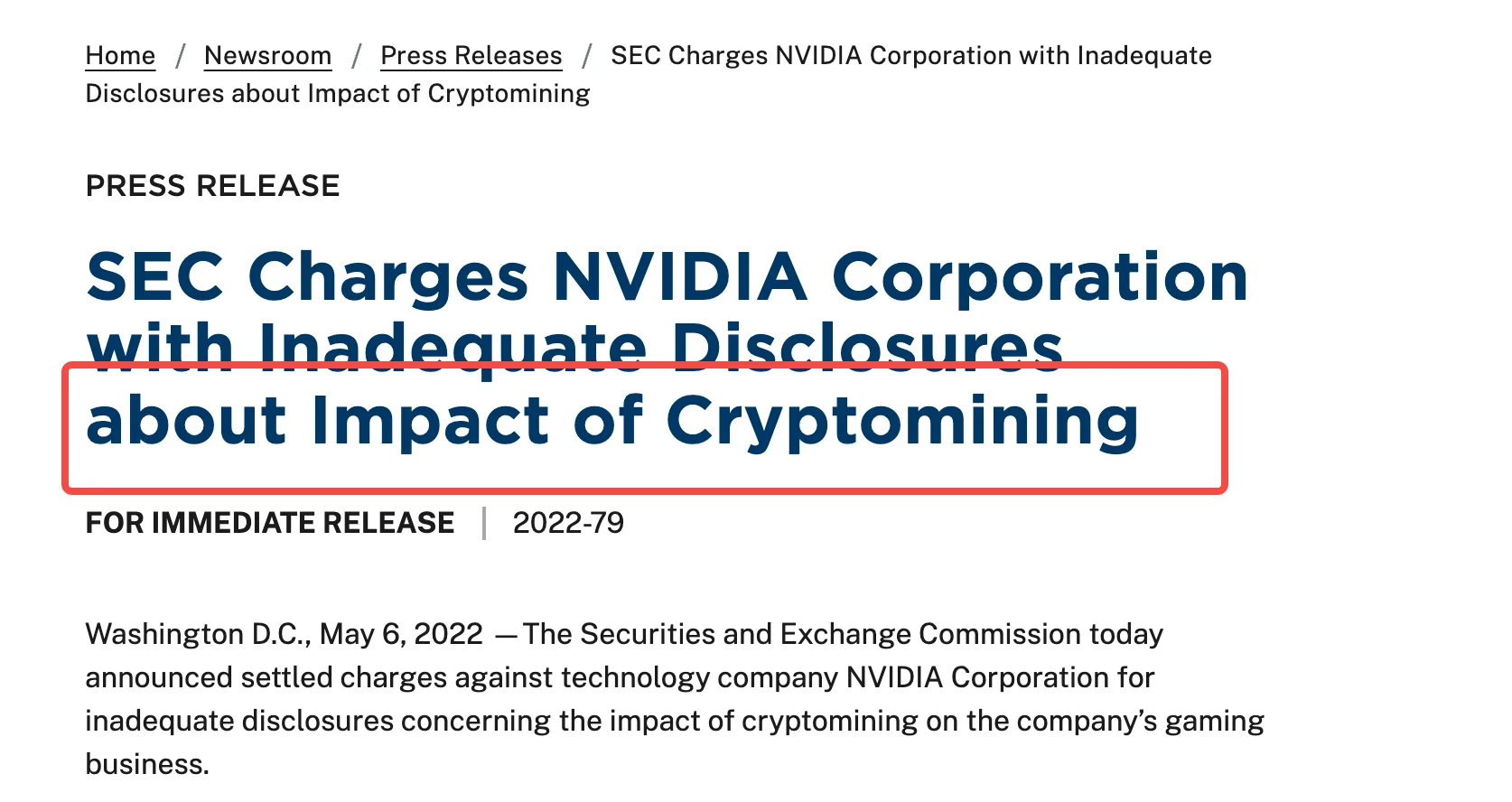
In addition, the U.S. Securities and Exchange Commission (SEC) had already classified this in May 2022, imposing a $5.5 million fine due to NVIDIA’s failure to disclose the severe reliance of gaming business growth on mining in their quarterly reports.
After the U.S. Supreme Court dismissed NVIDIA's appeal in December 2024, the case officially escalated to a class action lawsuit in March of this year, and NVIDIA ultimately chose to settle by paying.
For the plaintiff investors, this $290 million roughly only compensates about 14% of their claimed losses back then, essentially a discounted resolution; for NVIDIA, this expenditure is not only trivial in the face of today’s trillion-dollar market value, but also explicitly mentioned in the statement that most of the compensation will be directly covered by the company's liability insurance provider.
Looking back, this settlement of an eight-year-old case feels like a displaced note of an era.
Before the explosion of AI computing power, it was indeed the cryptocurrency miners who supported NVIDIA's extremely crucial performance growth. And today, this chip giant uses a compensation to settle the insurance, attempting to turn the page on a history that wanted to profit from the cryptocurrency market while not wanting to be tagged as part of it.
免责声明:本文章仅代表作者个人观点,不代表本平台的立场和观点。本文章仅供信息分享,不构成对任何人的任何投资建议。用户与作者之间的任何争议,与本平台无关。如网页中刊载的文章或图片涉及侵权,请提供相关的权利证明和身份证明发送邮件到[email protected],本平台相关工作人员将会进行核查。