If the retreat of AI trading causes further declines in the stock market, it may substitute the Federal Reserve's interest rate hikes, completing the tightening and cooling subsequent rate hike expectations.
Written by: Bo Shuqing, Wall Street Insights
Goldman Sachs estimates that, since the beginning of this year, U.S. financial conditions have tightened by about 100 basis points, equivalent to the tightening effect of four standard rate hikes by the Federal Reserve, with almost all of this occurring after early September. David Mericle, the bank's chief U.S. economist, believes this is not enough to prevent the Fed from raising rates by another 25 basis points in December, which he describes as "virtually certain."
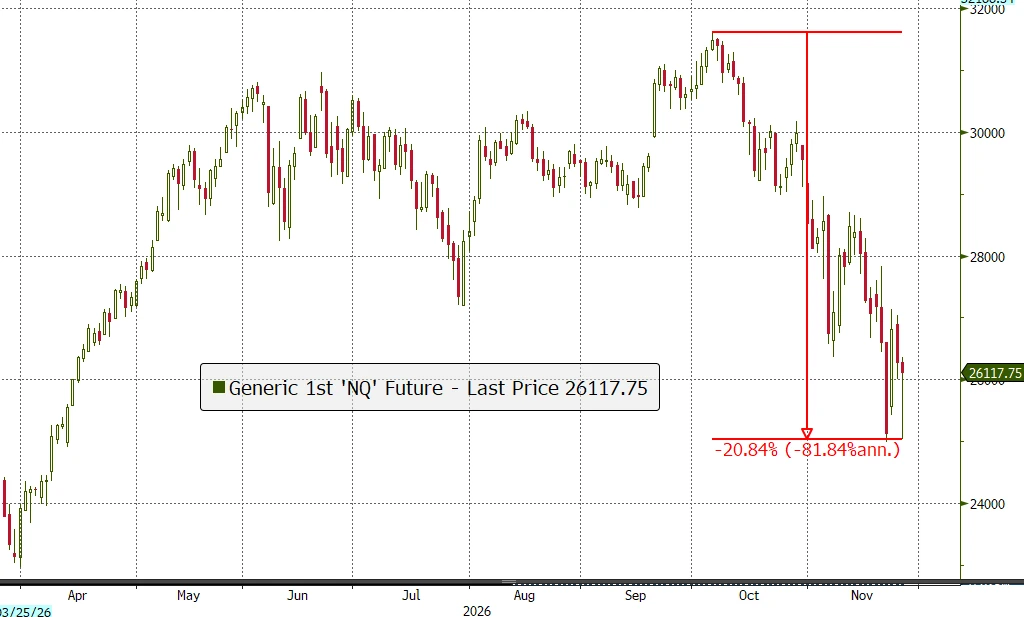
In his latest report titled "What the Tightening of Financial Conditions Means for Growth and the Federal Reserve," Mericle stated that the Financial Conditions Index (FCI) has tightened by a cumulative 104.1 basis points this year, with over 40 basis points contributed just last week. The S&P 500 index fell by 8.4% last week, marking its worst weekly performance since "Liberation Day," while the Nasdaq 100 index is just a step away from a bear market, and Goldman Sachs' fear index has risen to a record high of 9.8.
Although the market has largely completed the tightening on its own, Mericle still expects the Federal Reserve to raise interest rates in December and again in March next year. His reasoning is that the current tightening is exactly what the Fed intended to achieve, and that current inflation is high, with growth slightly above potential levels, contrasting with the circumstances in early 2016 and late 2018 when the Fed paused due to tightening financial conditions.
The money market has now fully priced in the expectation of a 25 basis point rate hike on December 9. Last Friday, when the S&P 500 index briefly fell by 3.5% and the VIX rose to 39, the market temporarily believed that the sell-off had been sufficient for the Fed to halt rate hikes, but as news regarding Nvidia boosted the stock market, rate hike expectations were quickly repriced.
Where the 100 basis points come from
Goldman Sachs broke down the composition of the 104.1 basis points: stocks contributed 50.1 basis points, the 10-year U.S. Treasury yield contributed 33.4 basis points, and the dollar contributed 19.1 basis points. The federal funds rate, which was moved by the Fed's rate hike in September, only contributed 1.1 basis points, while credit spreads contributed 0.3 basis points.
The contribution from stocks is noteworthy. The S&P 500 index was essentially flat until last week this year, but Goldman Sachs' FCI, calculated using the P/E ratio based on a ten-year average profit, shows that this average profit has significantly increased this year. Thus, a flat index means a decline in valuation multiples and tightened financial conditions. Mericle acknowledged that if nominal consumption, which is more directly related to wealth effects, were used as the denominator, the stock contribution would be slightly smaller; the Fed’s own FCI-G only uses price changes, so the effects displayed this year would also be smaller.
The dollar is a key observation point for Morgan Stanley. In the latest "Global Reflections," Nick Savone pointed out that the stock market decline and the strengthening dollar have jointly tightened financial conditions. Morgan Stanley's own index shows that since mid-September, conditions have tightened by about 75 basis points, most of which has been driven by the dollar. On Monday, the Bloomberg Dollar Index reached its highest level since April 2025, then fell back on Tuesday.
The only aspect that has hardly changed is credit. As of the data cutoff on November 19 from Goldman Sachs, credit spreads only contributed 0.3 basis points. However, this portion is beginning to crack: junk bond spreads have widened significantly since, with the credit market continuing to worsen by Tuesday's close.
Growth drag of about half a percentage point
Mericle estimates that if financial conditions remain at current levels, they will impose a drag of 0.5 percentage points on GDP growth in the fourth quarter of 2026, and another 0.5 percentage points on year-on-year growth in the fourth quarter of 2027, adding a few tenths of a percentage point more than Goldman Sachs' 2.4% growth forecast for 2027 implies, and also slightly more than the drag implied by the level of financial conditions at the October FOMC meeting.
This impact is much smaller than the previous tightening cycle in 2022 when the growth impulse was nearly negative 1.6 percentage points. Goldman Sachs believes that this latest round of tightening has been relatively short-lived, and if their strategists' forecasts prove correct, that the stock market rebounds next year and long-term yields fall, then more than half of the tightening will reverse, without additional unexpected drag on forecasts.
In other words, Goldman Sachs' growth forecast is contingent upon the validity of their market forecasts.
Why Walsh still wants to raise rates
Mericle's judgment is straightforward: "A second rate hike of 25 basis points in December is virtually certain." He also expects a third rate hike in March next year, a prediction first made after the October CPI data was hotter than expected. He provided three reasons.
First, this round of tightening is roughly what the Federal Reserve intended to achieve. A 100 basis point tightening in financial conditions is equivalent to the effects typically brought about by a 100 basis point rate hike, and recent statements from FOMC members indicate that most currently envision a total increase of at least 50 basis points, more likely between 75 and 100 basis points.
Second, part of this comes from the expectations of rate hikes themselves. The increase in long-term yields has partly stemmed from market expectations that the FOMC will ultimately hike rates more often, and if the Fed does not deliver, this part could reverse. Mericle refers to this as a reflexive version of the "Walsh put option": stop raising rates, yields will decrease, conditions will loosen, and the reasons for hiking again will return.
Third, this time is different from 2016 or 2018. At that time, inflation was near target, and the Fed could choose to pause; now inflation is high, with growth slightly above potential levels, and committee members are less worried that further rate hikes will be excessive and detrimental. While inflation was also high in the round of tightening in November 2023, the extent of that tightening far exceeded the impact of a single rate hike and was not primarily driven by rate hike expectations.
The FOMC has not indicated a willingness to pause either. The minutes from last Wednesday's meeting showed that almost all committee members believe further rate hikes are necessary. Last Friday, when the S&P 500 index fell by 3.5% and the VIX reported 39, Governor Cook stated that financial conditions are still too loose.
AI is the only escape route
Goldman Sachs does not assert that a rate hike is set in stone. Mericle pointed out that recent tightening may prompt some committee members to lower the forecast for the number of rate hikes in 2027 on the December dot plot. He also provided an escape route.
If further tightening ultimately convinces the FOMC that no more hikes are needed, the premise is that this tightening is driven by a deterioration in risk appetite and is largely independent of rate hike expectations, meaning it could persist even if the Federal Reserve halts. A further sell-off in the stock market triggered by worries about AI spending may particularly reduce the necessity of rate hikes, as AI demand is pushing core PCE inflation higher through both genuine cost spillovers and exaggerated statistical errors. Many FOMC members have already mentioned the role of AI demand, potentially viewing a cooling in spending as a positive signal for the inflation outlook.
This logic implies that the faster the retreat of AI trading, the less Walsh needs to raise rates. This also explains why the minutes from the October meeting were so focused on opaque AI debts.
Michael Hartnett from Bank of America shares a similar view. On Sunday he stated that the quickest way to prevent the Federal Reserve from acting is for the stock market to give back all its gains from 2026. Two weeks ago in "DEM Fatale," he outlined conditions for a reversal in financial conditions: ceasing rate hikes by central banks, 10-year yields below 4.5%, and oil prices below $80. Currently, WTI crude is around $79.5, which is almost within range, but the 10-year yield at 4.89% still has some distance to cover, and rate hikes have not yet stopped.
Reflexivity and the contradiction of the dot plot
The issue with Goldman Sachs' prediction for a rate hike in March is clearly visible in its own data. In the tightening of 104 basis points, the Federal Reserve itself contributed only 1 basis point; the 10-year yield accounted for 33 basis points, which Goldman claims is driven by rate hike expectations and could reverse if the Fed pauses; the remaining approximately 70 basis points came from stocks and the dollar, representing the "risk appetite" type tightening that Goldman mentioned would persist even if the FOMC stops raising rates, and is increasingly driven by AI. The only part that has yet to contribute is credit, which is just beginning to crack.
According to Goldman Sachs' own framework, such a composition supports fewer rate hikes, not more.
ZeroHedge's judgment is that a rate hike in December will happen because the market has priced it in, and the committee has almost committed to it. The March rate hike is most likely to quietly disappear, and the path will probably first be reflected in the December dot plot, aided by AI trading. If Walsh insists, the market will do the work for him, just like Powell raised rates in a declining market on December 19, 2018, only to shift to a "patient" stance by January 4 of the following year. That instance took 165 days, while there are still 14 days until the December FOMC meeting.
免责声明:本文章仅代表作者个人观点,不代表本平台的立场和观点。本文章仅供信息分享,不构成对任何人的任何投资建议。用户与作者之间的任何争议,与本平台无关。如网页中刊载的文章或图片涉及侵权,请提供相关的权利证明和身份证明发送邮件到[email protected],本平台相关工作人员将会进行核查。