For the second time in weeks, a major Bitcoin mining firm has warned that attackers are siphoning mining rewards by hijacking the internet connections between miners and their pools, a sign that a long-dormant weakness in mining’s plumbing is now being exploited at scale.
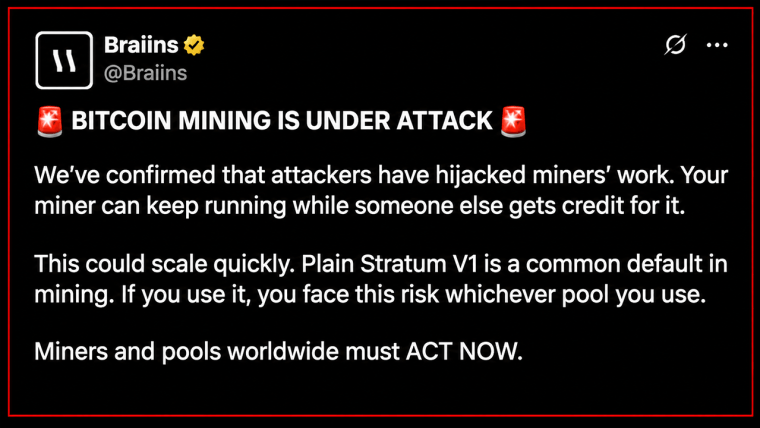
Mining software firm Braiins said Wednesday that an attacker struck more than a thousand mining sites in a single second on Nov. 20, rerouting their connections to an impostor pool.
It follows a similar incident just last week, when mining-services firm Luxor reported that hackers had redirected miner rewards, which it tied to AI-assisted attacks.
You can now act on the news you read: Go long or short Bitcoin with perpetual futures, all from your Decrypt Money Account.
The two firms described somewhat different mechanisms, but the effect was the same: hashrate quietly diverted away from the miners who produced it.
In its security alert, Braiins stressed the attacker didn’t need to break into any miner or into Braiins Pool itself. Instead, they exploited a long-standing flaw in Stratum V1, the unencrypted, plain-text protocol that carries work between miners and pools and offers no way to verify that the server on the other end is the real pool.
By rerouting traffic, the attacker impersonated the pool, fed miners legitimate-looking jobs, and pocketed the resulting shares under their own account at a separate pool.
The scheme hinged on manipulating the Border Gateway Protocol, or BGP, the trust-based system that tells networks where to route internet traffic. The attacker announced a narrower, more specific block of addresses that included a pool’s Stratum endpoint, causing networks that failed to validate the route to funnel miners’ connections to the impostor.
Hijacked machines kept hashing at full power while their pool dashboards showed zero hashrate, making the theft nearly invisible on-site.
Braiins traced episodes starting in early November across Latin America, mostly Brazil and Argentina, before a larger Nov. 20 wave hit mostly European miners, diverting between 0.6 and 1.9 exahashes per second at a time. The firm characterized the short, escalating bursts as the attacker “testing the waters,” noting the diverted hashrate grew more than tenfold in two weeks.
The technique isn’t new. Braiins noted that Dell SecureWorks documented the same routing trick stealing roughly $83,000 in mining rewards back in 2014, and the firm has warned about “hashrate hijacking” since 2020 as a reason to adopt the encrypted Stratum V2 protocol.
For years, the industry treated it as rare enough to tolerate; now, two firms in a matter of weeks have flagged it hitting miners in the wild.
Braiins urged the whole industry to act, recommending miners move to Stratum V2 or Stratum V1 over TLS with certificate verification, strip out plain-text backup connections, and push network operators to validate routes. It also released a free proxy tool for miners that can’t upgrade.
Any miner still on plain Stratum V1, the firm said, “is a target, on any pool.”
免责声明:本文章仅代表作者个人观点,不代表本平台的立场和观点。本文章仅供信息分享,不构成对任何人的任何投资建议。用户与作者之间的任何争议,与本平台无关。如网页中刊载的文章或图片涉及侵权,请提供相关的权利证明和身份证明发送邮件到[email protected],本平台相关工作人员将会进行核查。