Key Takeaways
- Braiins identified four attacks on Nov. 20 affecting between 1,050 and 1,600 mining sites per episode.
- Attackers exploited internet routing vulnerabilities and unencrypted mining connections without compromising mining pool infrastructure.
- Braiins recommends migrating to Stratum V2 or authenticated encrypted connections as the threat remains active.
In an X post and security advisory published Wednesday, Braiins disclosed that an attacker redirected bitcoin miners toward an impersonated mining pool by manipulating internet traffic. The company stressed that neither its mining pool nor the affected mining equipment was directly compromised.
The earliest incidents documented by Braiins occurred between Nov. 7 and Nov. 12, primarily affecting mining operations in Brazil and Argentina. Investigators identified 19 episodes involving between 120 and 400 mining sites per incident, with diverted computational power ranging from 36 to 174 petahash per second (PH/s).
By Nov. 20, the attacks had grown considerably larger and shifted predominantly toward Europe. Braiins identified four episodes lasting between six and 49 minutes, each affecting more than 1,000 mining sites and redirecting between 0.6 and 1.9 EH/s.
“The weakness they used is not newly discovered,” Braiins explained.
Stratum V1, introduced in 2012, facilitates communication between mining equipment and mining pools. Its unencrypted implementation lacks a mechanism for miners to authenticate the server assigning their computational work, leaving mining revenue exposed to malicious network interference.
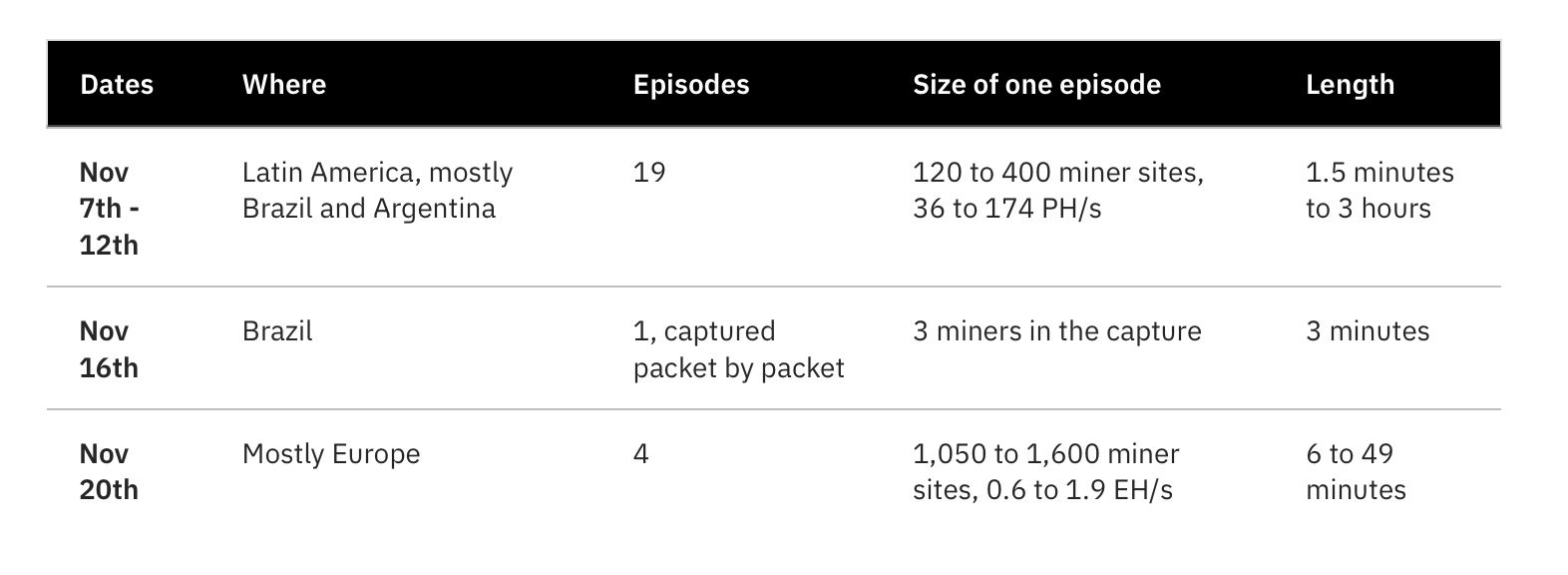
Braiins data shows the escalation of Bitcoin hashrate hijacking attacks throughout November, expanding from Latin America to Europe and reaching 1.9 EH/s across as many as 1,600 mining sites on Nov. 20, 2026. Image source: Braiins.
Braiins traced the European incidents to manipulation of the Border Gateway Protocol (BGP), the system responsible for directing internet traffic between independent networks. Fraudulent routing announcements diverted legitimate mining communications toward unauthorized infrastructure.
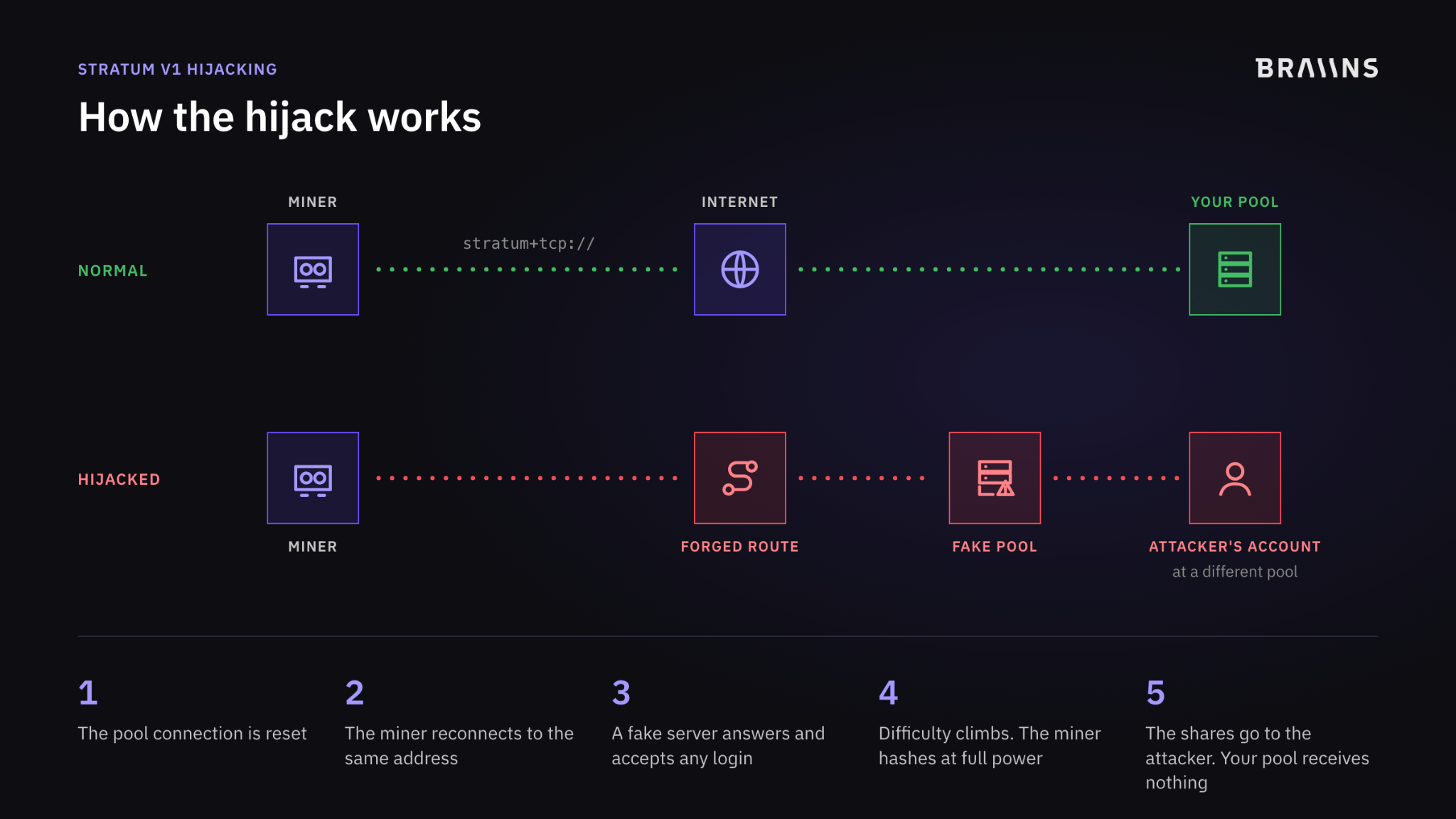
A Braiins diagram illustrates how attackers exploit unencrypted Stratum V1 connections to redirect Bitcoin mining power and claim rewards without compromising mining hardware or pool infrastructure. Image source: Braiins.
The investigation found that affected equipment continued operating at full computational capacity while legitimate pool dashboards recorded disappearing hashrate. Consequently, miners could continue consuming electricity without receiving credit for their work.
The latest security disclosure follows a separate hashrate hijacking incident involving Luxor Technology earlier this month. On Nov. 15, Luxor confirmed that unauthorized modifications to mining pool configurations through its Commander management platform affected just over a dozen customer accounts.
Estimates suggested approximately 13 EH/s had been redirected to the Ocean mining pool, although the figure remains independently unverified. Luxor CEO Nick Hansen attributed the compromise to a “sophisticated AI-enabled vector,” without publicly disclosing its technical mechanics.
Unlike the Luxor incident, which involved unauthorized configuration changes, the attacks documented by Braiins intercepted communications between mining machines and their intended pools. No changes to mining configurations were necessary, and pool account balances and payout settings remained unaffected.
The underlying vulnerability has persisted for more than a decade. In 2014, Dell Secureworks documented a similar internet routing attack that diverted approximately $83,000 in cryptocurrency mining rewards. Braiins subsequently addressed the threat in 2020 while advocating the adoption of Stratum V2.
The company believes November’s escalating incidents may represent preliminary experimentation by the attacker.
Braiins recommends that mining operators adopt Stratum V2, which encrypts communications and authenticates the identity of mining pools. Operators unable to migrate immediately can use Stratum V1 protected by Transport Layer Security (TLS), provided their firmware properly validates security certificates.
The company released Braiins OS 26.11 on Wednesday, introducing TLS certificate and hostname verification alongside protections against automatic transitions to unencrypted connections. Braiins also introduced a free Stratum V2 proxy for equipment that lacks compatible firmware.
Testing conducted across seven firmware implementations on Nov. 20 and Nov. 23 revealed additional security deficiencies. Two widely used implementations accepted invalid certificates despite offering TLS functionality, potentially exposing operators to impersonation even when communications appeared encrypted.
Braiins also urged mining pools, firmware developers and internet providers to strengthen infrastructure security, while recommending that operators monitor discrepancies between locally reported hashrate and computational power credited by their pools.
Authenticated encryption cannot prevent malicious actors from disrupting internet connectivity, but it can prevent mining equipment from performing work for impersonated pools.
November’s incidents expose an uncomfortable reality for an industry operating increasingly sophisticated industrial infrastructure. Expensive mining fleets remain dependent on communication protocols developed during Bitcoin’s formative years. While computational efficiency has advanced considerably, securing the connection through which that computational power generates revenue remains unfinished business.
免责声明:本文章仅代表作者个人观点,不代表本平台的立场和观点。本文章仅供信息分享,不构成对任何人的任何投资建议。用户与作者之间的任何争议,与本平台无关。如网页中刊载的文章或图片涉及侵权,请提供相关的权利证明和身份证明发送邮件到[email protected],本平台相关工作人员将会进行核查。