Organized & Compiled by: Deep Tide TechFlow
Deep Tide Guide: As the capital market celebrates the trillion-dollar AI valuations and wealth-building myths, Ray Dalio, founder of the world's largest hedge fund Bridgewater, provided a calm and penetrating macro warning during an exclusive interview with Sourcery: we must strictly differentiate between "wealth" and "money." Wealth is merely a numerical representation of paper assets; asset bubbles often burst completely when those who hold wealth are forced to sell assets to convert them into money. From the electricity, automobiles, and radios of the 1920s to the internet of 2000, each great technological birth in history has sparked a fever of capital concentration, but very few of these ultimately translate into great investment returns.
In this deep 51-minute interview, Ray Dalio candidly discussed the five macro forces driving historical evolution, the deep-seated wealth divide and public education crisis in America, and detailed the AI decision-making system he is developing by algorithmizing his lifelong investment principles and causal logic. He dissected how Bridgewater's "Dot Collector" mechanism achieves extreme reality and extreme transparency, pointed out that the traditional way of weighing decisions in the human brain is outdated, and explained why outstanding leaders must possess the intellectual humility to "know what they do not know." Faced with the unknowns of a historical grand cycle, he not only reconstructed macro investment logic but also shared ultimate reflections on life's three chapters, peer confrontations, and the meaning of life.
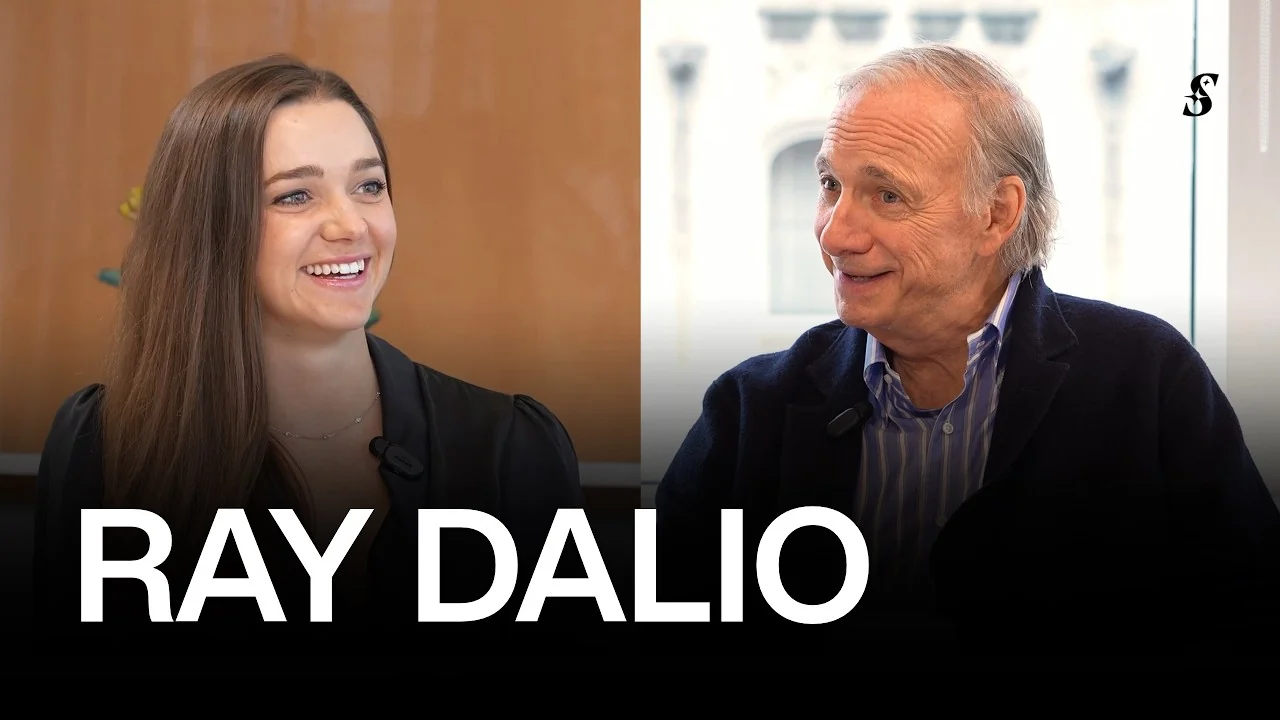
Guest: Ray Dalio (Founder of Bridgewater Associates, Author of "Principles")
Host: Molly O'Shea (Host of the Sourcery Podcast)
Podcast Source: Sourcery with Molly O'Shea ( https://www.youtube.com/watch?v=X5FuYnLtB6k )
Original Title: I Finally Interview Ray Dalio
Release Date: Beijing Time: 2026-11-23 22:00
Key Points Summary
The essential distinction between wealth and money; paper valuations are not liquid cash: Wealth cannot be directly consumed; it must be sold and converted into legal money before it can be spent. It is easy to create paper wealth of $1 billion from a $50 million investment, but bubbles often burst completely when wealth holders encounter liquidity stress, debt pressure, or tax rigidity and are forced to liquidate. There simply isn't enough money and credit in the market for everyone to liquidate at the same time.
Great technology is not synonymous with great investment; beware of the ruthless repetition of historical cycles: In the 1920s, the electrification of the grid, the proliferation of radios, automobiles, and airplanes were far more disruptive technologies than today's AI; yet, the frenzy sparked blind credit expansion that inflated valuations, and when the market faced deleveraging, assets ultimately fell into weak hands. A market that excessively bets on the concentration of a single new technology is extremely fragile, and ultimately 90% of companies will go bankrupt in fierce competition.
The five macro forces driving historical evolution are at the end of a long cycle: The five intertwined forces are the cycles of money and credit debt, internal political order and wealth disparity, international great power geopolitical competition, natural disasters, and technological innovation. The current global order is at the end of the long cycle since 1945, where high debt and social polarization are testing the system's resilience, and history is repeating the classic patterns humanity has experienced countless times.
The wealth divide is not only a gap in wealth but also inequality in access to opportunities and education: Taking Connecticut, which ranks high in per capita income, as an example, it is shocking that up to 22% of high school students are on the brink of dropping out or have gone missing. If the lower strata lose fair access to education and the upward path to cross social classes, the trust foundation of society will collapse, and populist confrontations will become inevitable.
The old decision-making model of the human brain is outdated; build a system for the coexistence of extraordinary human wisdom and AI: 77-year-old Ray Dalio is algorithmizing his lifetime investment principles and causal logic. The world has become too complex; relying solely on the human brain to weigh decisions is no longer sufficient to cope with a variable environment. The future belongs to decision-makers who can algorithmize causal logic and realize the co-evolution of machine and human intelligence.
Mental humility and confronting one's ignorance; arrogance and errors are humanity’s greatest tragedy: True excellence lies not in providing standard answers in traditional education but in "knowing what one does not know." Bridgewater achieves extreme reality and extreme transparency through the "Dot Collector" system; only by embracing thoughtful disagreement can prejudices be penetrated to reach objective truth.
Noteworthy Perspectives
"We must distinguish between wealth (Wealth) and money (Money). You cannot consume wealth directly; it must be sold and converted into money to spend. The bursting of asset bubbles usually occurs when those with wealth urgently need to liquidate it for cash."
"One fatal mistake people often make is mistaking great new technologies for great investments. The electrification of the grid, the emergence of automobiles and airplanes in the 1920s was a more shocking technological breakthrough than today’s AI; however, the blindly inflated assets still faced devastating liquidation."
"The traditional way of making decisions solely by weighing pros and cons in one's mind has become entirely outdated. The future belongs to decision-makers who can code causal logic and realize the co-evolution of extraordinary human wisdom and AI."
"Top universities reward rote memorization and knowing-the-answer students, which is the worst selection mechanism. The profoundest tragedy of humanity is holding on to arrogant biases while being unaware of one’s own errors."
"Finding peers who can engage in thoughtful disagreement is more important than finding mentors. They have different perspectives and can engage in honest intellectual confrontations until we approach true reality."
"If a person spends their entire life focused solely on making money without reflecting on genuine connections between people, meaningful work, and significant relationships, that is the true irrationality."
"所谓的精神性并非宗教,而是换位思考的同理心。认识到自己只是整体的一小部分,用他人的双眼看世界,才能获得真正长久的健康与安宁。"
"You really only need a bed, an apartment, and three meals a day. Besides that, you have complete freedom. Be bold and try, how much real risk do you actually bear?"
The complete dialogue is as follows:
The Origins and Macro Framework: 500-Year Cycle and the Five Forces Driving the World
Molly O'Shea: Ray Dalio, welcome to the Sourcery podcast! You have long been one of my top 100 dream guests for interviews. Our show focuses on venture capital, cutting-edge technology, and macro investing. Before we started, we chatted about our wonderful coincidence: we not only hail from Westport, Connecticut, but we also share the same birthday on August 8. Today, we are recording at Pro Se's office, and we have placed a shark model behind us to pay tribute to your long dedication to ocean exploration. As one of the world's top macro investors, you have always explained the underlying mechanisms of the world to the public. To lay the groundwork for our dialogue, can you first outline the five core forces driving human historical evolution for us?
Ray Dalio: I'm delighted to talk with you and all the listeners. Indeed, Bridgewater was born in Westport, and being able to meet on the same birthday and land is a wonderful thing.
As a global macro investor, my job is to see all the variables that could affect the market and economy, and I must bet real money based on that. Reflecting on my experience, I was a clerk on the floor of the New York Stock Exchange in 1971. One Sunday night, President Nixon suddenly delivered a speech on television announcing that the U.S. would stop allowing the dollar to be exchanged for gold. At that time, gold was the true legal money; this was essentially a form of debt default, even though he did not use the word default. On Monday morning as I walked into the trading floor, I thought this would lead to a catastrophic disaster, and the stock market would certainly crash. However, the opposite happened; the stock market not only did not fall but surged in a huge rally. This left me completely confused, unable to understand the mechanism behind it.
This drove me to systematically study history. I found that in March 1933, President Roosevelt did the same thing. This led me to a complete understanding of the mechanical transmission mechanism of currency devaluation and liquidity injection. I deeply reviewed the Great Depression and the historical period from 1930 to 1945, and that research helped me accurately predict the global financial tsunami of 2008 decades later. I then conducted cross-cycle research on the past 500 years of human history and found that similar things keep repeating, mainly driven by five core forces.
These five forces are backed by strict physical mechanical logic: first is the operating mechanism of money, credit, and debt markets; second is internal political order, specifically how we interact with each other, the wealth gap, value gap, and whether the existing system can or cannot resolve these disputes; third is the geopolitical order on the international level, where we used to rely on so-called multilateral mechanisms to resolve disputes, such as the United Nations, World Trade Organization, and even the International Court, but that was a naive assumption. As the power of major countries waxes and wanes, these multilateral constraints have become obsolete, and we have entered a classic power confrontation pattern; fourth are natural forces—droughts, floods, pandemics, and other disasters that take lives and reshape the world structure—far larger than humans ever imagine and absolutely cannot be overlooked; fifth are science and technology, specifically humanity’s ability to enhance productivity and change living conditions through learning and innovation, but the key is whether the technology is used for warfare and destruction, or to enhance human welfare.
These five forces intertwine and usually form a long cycle that equates to a person’s lifetime. 1945 marks the starting point of the current world order; as emerging powers rise to challenge existing powers and global debt continually accumulates, turmoil follows. History always cycles between disorder leading to prosperity, rebuilding order before descending into severe division, major conflict, and re-entering disorder. The interplay of these five forces forms the underlying framework for all discussions today.
Political Turning Points and Deep Divisions in America: The Rise of Moderates, the Historical Destiny of Extremism, and the Deadlock of Debt
Molly O'Shea: Speaking of the most timely topics, the U.S. election has just concluded, which relates to the second force you mentioned. Can you break down the underlying mechanisms for us, and what will happen next as the U.S. regime transitions? What might be the most unexpected outcome in this game?
Ray Dalio: I believe we must first recognize a core reality: we just changed the people dealing with issues, but the issues themselves remain unchanged. These problems still exist objectively. We still face a heavy debt crisis, a significant wealth gap and value gap between the right and left wings, and serious challenges such as climate change and geopolitical confrontation. The only thing that has changed is the specific decision-makers at the table addressing these challenges.
History has repeatedly demonstrated that for a democratic system to operate smoothly, there is often only one successful path. On the political spectrum, there are left, right, and they sit on a continuous spectrum: extreme left, moderate left, moderate right, and extreme right. Within this spectrum, there is not only a confrontation between the left and right, but also intense infighting within the winning party between moderates and extremists after one side wins. We will soon see how they respond to real dilemmas, for example, the debt ceiling issue will soon come to the forefront. Around December 11, the relevant discussions will erupt in full, and the political battles during this transitional phase will be extremely intense. For instance, Elizabeth Warren is likely to chair the Senate Banking Committee, and differing views will escalate sharply.
If the most unexpected yet hopeful outcome is that we will truly see a moderate force that can collaborate across party lines emerging, it is fascinating when I observe the swing state candidates who turned the tide in this election: although they are nominally labeled democrats, they do not resemble the radical socialists of the extreme left at all and their governance style is almost indistinguishable from moderate republicans, leaning more towards rational, pragmatic centrism. In fact, America today essentially has four parties. The only effective way to resolve these conflicts is for moderate democrats and moderate republicans to work together across party lines to suppress the impulses of extremists. Because the vast majority of the general public actually resides in a moderate space.
The biggest political deadlock behind this is that no one in either party is willing to bear the political cost of raising taxes, nor are they willing to voluntarily cut public spending in the face of unsustainable trillion-dollar debts.
Molly O'Shea: Do extremists typically revert to the mean? Is extremism merely a political tactic to win elections, or will it continue to solidify?
Ray Dalio: Generally speaking, when divisions exceed the reconcilable limits, that is, when the interests of each faction override the respect and adherence to the political system, the entire system falls into extreme danger. This is often followed by some form of civil war or intense confrontation until one side completely overcomes the other, imposing its will on society. In the game comprising four political factions, once one side achieves superficial victory, there will inevitably be a brutal struggle within the victorious camp between moderates and extremists for dominance, which is the historical stage we are currently in.
The Invisible Ulcer Beneath Prosperity: 22% of High School Students in Connecticut Missing and the Social Crisis of Opportunity Inequality
Molly O'Shea: I'd like to continue discussing the first force. In our recent interviews, societal class division and wealth gaps have become glaringly obvious. For instance, a previous proposal regarding a wealth tax in California sparked massive debate, and socialist ideas have clearly been on the rise across the U.S. I previously interviewed David Friedberg, and you've discussed with him K-shaped economic divergence and its trajectory. What is the core root of the wealth gap? How will such enormous debt ultimately resolve?
Ray Dalio: The core root of all of this lies in the severe lack of widespread productivity in society. When you look through history, for a country to maintain long-term prosperity, it must achieve three to four fundamental things: first, all citizens must receive quality basic education so that the vast majority have the skills to create productivity and maintain basic civility in interpersonal interactions; second, can people efficiently collaborate and create productivity within the framework of laws and rules, because the standard of living in a nation is entirely determined by productivity; third, can we stay away from the destruction of wars, whether internal civil wars or external military conflicts? Throughout human history, as long as these three things can be accomplished, a prosperous and strong society can be achieved.
However, over the past few decades, this educational foundation has largely failed. For example, shockingly, nearly 60% of American adults have reading comprehension skills below the sixth-grade level. I have a very direct experience because I have long lived in Connecticut, and my wife has been dedicated to helping low-income groups. In Connecticut, which ranks first or second in per capita income in the U.S., a striking 22% of public high school students are either completely dropping out or on the brink of academic failure due to absenteeism exceeding 25%! This means a significantly large portion of our society is unable to acquire the skills necessary for productivity creation or to establish the civil qualities that uphold rule-following.
Right-wing capitalists often emphasize that everyone must earn value through hard work, and self-interest is the greatest motivator. But history shows that this single logic taken to the extreme inevitably leads to uncontrollable wealth disparity. The Industrial Revolution gave birth to the Gilded Age, creating robber barons that led to financial bubbles and the Panic of 1907, ultimately sliding into World War I. The left, on the other hand, will complain that they can’t even access basic education funding, that there are vast budget disparities between different districts, and that the proliferation of drugs and crime continues to degrade lower-income communities. The poorest among us profoundly feel that the current system does not serve them. When they see the wealthy flaunting their $1,200 brand-name bags while they can barely afford even basic tuition and lunch for their children, the animosity and conflict between classes become an unavoidable outcome.
The Physical Essence of Wealth and Money: Why Asset Bubbles Always Burst When They Need to Liquidate?
Molly O'Shea: Following this topic, there is no doubt that the wealth-building myths of tech giants are further widening this wealth gap. For instance, the valuation of SpaceX is surging towards $2 trillion, and there are reports of Anthropic potentially reaching $1 to $2 trillion in valuation as well. More notably, Anthropic has registered as a Public Benefit Corporation for this purpose. Do you think this is a defensive remedy? Are they trying to guard against external moral judgment, attempting to prove to the public, "We are actually benefiting humanity"? What is the essence of this approach?
Ray Dalio: We must strictly distinguish between wealth (Wealth) and money (Money) on a physical mechanism level. You cannot directly consume wealth; you must sell it in the market and convert it into legal money before you can actually spend it.
In capital markets, creating paper wealth is relatively easy. For instance, if you use a round of $50 million of marginal financing to raise a company's overall valuation to $1 billion, you instantly create $1 billion in paper wealth, and you become a paper billionaire as a result. However, before you actually sell these shares in the public market and convert them into cash, this so-called wealth has no practical use.
The reason asset bubbles burst is due to the physical mechanical mechanism: those who book substantial riches on paper are forced to convert their assets into cash due to debt pressure, liquidity exhaustion, or mandatory tax burdens at a certain moment. This situation often arises because they initially borrowed significant credit leverage to create these assets. Returning to the public benefit corporation you just mentioned, they do indeed book significant wealth on paper, but can this book valuation smoothly translate into real cash? Because spending requires real cash. Engaging in public welfare and giving back to society is indeed a commendable act, but paper valuations will never automatically become liquid money. Ultimately, we will have to confront the core question: where do the liquid cash needed to facilitate these conversions truly come from?
Great Technology is Not Great Investment: From the 1920s Automotive Electrification Frenzy to Today's AI Bubble
Molly O'Shea: Many people believe we are currently in some degree of an AI asset bubble. How is a bubble essentially formed? What stage might we be in within this cycle?
Ray Dalio: Many people have a huge misunderstanding of asset bubbles, thinking that as long as asset prices exceed the reasonable range of discounted future cash flows, it's called a bubble. This is not the essence of a bubble because no one can accurately predict the long-term cash flows over the next few decades. Historically, even industries that eventually produced significant cash flow experienced horrific bubble bursts. For example, the industrial bubble of the 1920s and the subsequent Great Depression; even the technologies that ultimately changed the world decades later could not escape the fate of bursting bubbles at that time.
The core mechanism of a bubble is that people often mistakenly equate a "great new technology" with a "great investment." Reflect back to the 1920s: that was the first time in human history when the electrical grid connected countless households; every home began to have light bulbs and refrigerators; films, commercial broadcasts, assembly line cars, and civil aviation erupted. The impact and disruption of that technological revolution on ordinary people's lives were even more immediate and grand than what we see today with AI. During that time, everyone in society firmly believed in these new technologies; they crazily leveraged up to buy related stocks and assets, and the fervent demand created astounding paper wealth.
However, you still need cash to repay those loans. Once interest rates rise, repayment costs soar, or the government begins to impose capital gains taxes, everyone simultaneously needs cash. Where does cash come from? Your only option is to sell stocks. At this point, asset ownership has already shifted to the most vulnerable speculators. Just as we see today, the entire capital market's and macroeconomy's hopes overly bet on the single narrative of AI. This excessive concentration makes the assets extremely fragile and highly volatile. Once a slight disturbance occurs, the positive cycle can instantly reverse into a panic sell-off, triggering a deleveraging stampede, wherein the market rapidly slides from one extreme of blind confidence to another extreme of despair.
The Decision-Making of the Human Brain is Outdated: Algorithmizing Principles to Create a Human-Machine Coexistence Decision-Making System
Molly O'Shea: How have you personally engaged deeply in the AI field? You’ve stated "The era of humans relying on their brains to make decisions is over"; does this imply a fundamental shift in human decision-making paradigms? Will excessive reliance on AI harm critical thinking?
Ray Dalio: I am incredibly excited about the development of AI. From the day I founded Bridgewater in 1975, my core working method has been to deeply reflect on my decision standards for investments, systematize this thinking, and convert it into computer code. Since the Dartmouth Conference in 1956 first proposed the concept of artificial intelligence, while the technological forms have undergone many changes, its core essence has remained unchanged: to code the deep logic of human thought, allowing computers to execute it at speeds and objectivity surpassing human physical limits.
I am now 77 years old and have completely stepped away from hands-on management at Bridgewater. My current passion is to algorithmize the decision standards and principles I have accumulated over my life to create a decision-making machine that can empower the masses. I believe the traditional way of making decisions—that of merely weighing pros and cons in one's mind—is now completely outdated. The world is too complex; in the face of the unknown and volatility, the cognitive capacity of the individual brain is extremely limited.
Human beings and machines must form deep cooperation. You must deeply refine the decision principles you have in investing or life, then put those principles into a hundred years of historical data for extreme back-testing, observing whether they remain robust in all kinds of extreme environments such as inflation, deflation, prosperity, or crisis. A human brain alone cannot accomplish such cross-dimensional validation. We are entering an entirely new era where the top-level wisdom of skilled professionals deeply integrates with the best artificial intelligence.
As for whether it will weaken critical thinking, it entirely depends on the specific individuals using it. I anticipate that a significant portion of the population will completely stop thinking actively; they will habitually say "just tell me the answer," completely giving up on exploring the underlying causal mechanisms and the operating logic behind the machines; but simultaneously, there will also be another group of excellent individuals who will leverage AI to greatly elevate their cognitive dimensions and explore how this super machine of the real world operates. AI acts as an amplifier, making truth-seekers extraordinarily powerful while causing passive recipients to become increasingly mediocre.
Molly O'Shea: You are clearly a scholar deeply engaged in history and extremely curious. Do you think that the most important question in facing a complex world is to ask "why"?
Ray Dalio: Always ask "why"! It is essential to explore the underlying causal relationships. Because the operation of everything in the world resembles a finely tuned machine; every occurrence has pre-existing causes driving it, and causes always precede results. Only those who perceive the law of causality deeply can truly possess a competitive advantage in the changing circumstances of the future.
Bridgewater's Dot Collector and Extreme Transparency: How to Achieve an Idea Meritocracy Through Objective Data?
Molly O'Shea: You established the renowned "Dot Collector" system at Bridgewater. How does this mechanism help the team transcend individual subjective biases and see the real world? What has been the most challenging assessment you experienced at Bridgewater?
Ray Dalio: My core belief is that through extreme truth-seeking and extreme transparency, meaningful work and relationships can be achieved. In a traditional meeting, usually, only one person can speak, and what everyone else is thinking is completely unknown; traditional top-down evaluations are also extremely subjective—a simple "I think you didn't perform well" will only invite dissent and internal strife.
So, I designed the Dot Collector. When everyone meets, each person can use a tablet in real-time to rate the clarity of the speaker’s logic, depth of analysis, open-mindedness, or leadership qualities. This data is systematically aggregated to sketch out each individual’s long-term strengths and weaknesses, forming an objective personal "Baseball Card." Through this approach, we have turned interpersonal assessments into objective, data-driven evaluations, establishing a true idea meritocracy.
I have experienced much rigorous criticism. I remember after one client meeting, a team member directly told me, "Ray, you performed poorly today. You were babbling without paying attention to the client's core issues." For anyone, facing their weaknesses and being criticized face-to-face is extremely challenging, but whether one can overcome their emotional instincts and view criticism as a gift for refining cognition is a watershed moment for personal evolution. Bridgewater has extremely high selection standards; we pursue exceptional talent and a pure culture. But to be frank, throughout the long trials, many people ultimately could not persist.
Honest Confrontation and Interview Anecdotes: The Blind Spot of Exam Takers from Prestigious Schools and “Knowing What You Don’t Know”
Molly O'Shea: In fact, I was one of those who couldn't persist! That was one of my earliest interviews after graduating college. At that time, I was working at a growth equity investment firm, eagerly hoping to enter a top hedge fund, and thus attended an interview at Bridgewater. During the interview, I overly intellectualized the entire interaction, desperately trying to guess what standard answer the interviewer wanted to hear, attempting to prove how smart I was. As a result, by the end of the interview, I was utterly exhausted because I didn’t show my true self at all.
Ray Dalio: In reality, there are no rights or wrongs, only objective facts. Hearing about your experiences from back then, I feel genuine regret for our selection system; it indeed was a missed opportunity for Bridgewater. You really didn’t need to be so nervous; you just needed to maintain inner calm and sincerely tell us how you think. However, we are sitting together today, and I sincerely congratulate you on the wonderful achievements you've made in your podcast and venture capital career!
Molly O'Shea: Thank you, Ray. What core qualities do you value most when selecting outstanding leaders and core team members?
Ray Dalio: Everyone has their own nature, which determines their strengths and weaknesses. Some are good at strategic oversight, while others excel in meticulous execution. The essence of life is to continuously experiment and collide to find the best fit between one’s nature and objective reality.
When selecting talent, I pay the most attention to character and capability, and among these, the most critical is the humility to confront ignorance and to know what one does not know (The power of knowing what you don't know). In the traditional exam-oriented education system, prestigious schools often reward those who rely on rote memorization and can provide standard answers. But this is the worst selection mechanism; it instills a false sense of arrogance, making someone mistaken in believing that answering questions correctly implies omniscience. The deepest tragedy of humanity is to cling to arrogant biases while being completely unaware of one’s own errors. I seek companions who possess extreme curiosity, open-mindedness, and self-reflection, constantly assessing themselves: Am I right or wrong? Only by shedding arrogance and embracing external challenges can we truly transcend the limitations of the personal mind and progress shoulder to shoulder within the idea meritocracy.
The Three Major Chapters of Life and the Power of Companions: Seeking Fellow Travelers Who Dare to Engage in Thoughtful Disagreement
Molly O'Shea: In Bridgewater's past interviews, there was a classic open-ended question: "Do you think social media is good or bad?" What was the intent behind designing such open-ended questions? Additionally, you frequently discuss that life consists of different chapters; could you dive deeper into the evolutionary logic of this life grand cycle? How can contemporary young people break through their feelings of confusion and powerlessness?
Ray Dalio: The core of designing these questions lies in assessing character and capability. The key is determining whether the candidate can work efficiently with others in an idea meritocratic environment without presumption, and whether they can achieve meaningful work and relationships through extreme truth-seeking and extreme transparency for a shared mission.
As for life cycles, a person's life can roughly be divided into three major chapters: the first third of life is essentially a stage of learning, dependent on others. You receive education in school and operate under established directives; you have not yet truly and fully lived your own life autonomously.
Once you graduate from school and enter society, you formally transition into the second stage of life. In this stage, others begin to rely on you. You become an independent decision-maker, free to choose where to settle and what kind of work to undertake. In this phase, you must confront the real challenges of balancing work and life, which constitutes a core learning and evolution process. This stage usually starts around ages 23 to 25 and continues until about 40. At this point, you begin to gain profound insight into how this machine of the world operates, and your leadership and influence over the external world increasingly intensify. The most important task during this stage is to achieve a smooth transition and empower the young to thrive, thus transcending personal limitations and passing on the knowledge acquired over a lifetime.
Then, you step into the third stage of life. In this ultimate phase, you have accumulated a wealth of wisdom and cognition while maintaining health, enabling you to freely pursue what you love most. But as time passes, health will inevitably decline, and you must ultimately face the end of life with equanimity. Whether you can effectively address the corresponding core issues at each stage will determine what kind of life you will lead.
Many young people feel the so-called powerlessness in the first or second stage, to a large extent, exists only in their minds. You must bravely step outside and experiment to verify the possibilities of reality. The worst condition one can be in is being trapped in a job they despise, paralyzed by fear, complaining while compromising. Reflecting carefully, what do you physically need? You only need a bed you can sleep in, a roof over your head, and three meals a day. These are the baseline needs for survival. Beyond that, you have absolute freedom to pursue your truly loved careers and partners. Go boldly pursue your desires; even if you consider all things, what real risk do you actually bear?
Molly O'Shea: Many believe that you will ultimately become the sum of the five people you spend the most time with. In your long investment and management career, who has had the most profound impact on you?
Ray Dalio: It completely depends on your choices and actions. Today, young people can travel anywhere in the world and meet wonderful people from various backgrounds. The only barriers are the ones you construct in your mind.
Throughout my life, two main categories of individuals have profoundly influenced me: the first category consists of mentors who can guide you and provide direction; but compared to the one-sided guidance of mentors, the second category of individuals is far more valuable: those companions who can engage with me in thoughtful disagreement (Thoughtful Disagreement). They possess completely different perspectives, are equally intelligent, and dare to have honest logical confrontations with me until we jointly approach the objective reality of truth.
In the early stages of my life, my parents and teachers undoubtedly shaped my foundational character. And in my later career, many wise individuals with deep philosophies of life or those in centers of power have inspired me, such as Deepak Chopra or Bill Gates. When you explore the meaning of life or face complex choices, engaging with these exceptional minds invariably leads to significant enrichment.
Cognitive Biases in Global Relations, Ultimate Empathy, and the Essence of Life
Molly O'Shea: You have built extremely deep trusting relationships around the globe. Reflecting on your decades of deep engagement with China and Asia, what do you think is the biggest misunderstanding and cognitive bias the West has toward other countries? The legendary figure who manages the world's largest hedge fund in passionate discussions about empathy—don’t you think this seems incredibly unbelievable in many people's eyes?
Ray Dalio: The biggest misconception is that people habitually judge the world entirely from their perspectives and are never willing to empathize or see reality from the viewpoints of others. Narrow arrogance and biases create the most profound cognitive obstacles. If you can completely let go of inherent prejudices and preaching, and come with pure curiosity, attempting to penetrate another person's history and situation to understand their thoughts, you will discover an entirely different world. But if you always approach moral judgments with a sense of superiority, communication will forever be futile. In the end, it all returns to curiosity and ultimate empathy (Empathy).
所谓的精神性并非狭隘的宗教教条,而是指跨越文明的共情能力。所有伟大文明的底层智慧都是相通的:你必须意识到自己只是浩瀚整体中极其微小的一部分。当你理解整体的运作并与周围建立起和谐真诚的连接时,你才能获得真正的身心健康。换位思考、用他人的双眼看世界,是一件具有无穷力量的伟大修行。
I do not think it's unbelievable to discuss empathy. On the contrary, what I find amazing is: why are there so many people who never think about how to interact sincerely with one another? They never consider how to pursue meaningful work and relationships? There exists a common bias in the world that financial investors should only be ruthlessly focused on making money. From my perspective, if someone spends their entire life fixated only on earning money while never caring about the people around them, or even thinking about how the money earned can transform into societal meaning, that state of existence seems truly irrational and utterly bizarre to me.
Molly O'Shea: At the end of the interview, what are you most looking forward to in the coming 12 months? Additionally, I have a personal curiosity: how should I celebrate my birthday next year?
Ray Dalio: A few important things: first, I still deeply love the process of engaging in the game. For me, the evolution of the global macro economy and financial markets is like an extremely fascinating gigantic game; regardless of whether the environment favors or opposes, my mission and joy lie in immersing myself in it; second, I am extremely eager to share the knowledge and tools I have accumulated to empower more young people who wish to participate in this game; third, of course, is my family. I am lucky to have an incredibly excellent wife and 9.5 grandchildren. That 0.5 represents an upcoming grandson, who is about to be born. Spending time with family and maintaining deep relationships with my cherished friends are always the most valuable things in my life.
As for how to celebrate my birthday, I know you are intentionally directing me because I previously celebrated my birthday dancing in a nightclub in Ibiza, Spain, and that video went viral online, and I truly had an incredible time. So my suggestion is simple: go be with those you love most, those who bring you joy, and fully enjoy the pleasures of life and friendship, no matter where in the world you are.
Molly O'Shea: Awesome! Ray Dalio, thank you so much for today; this conversation is truly unforgettable!
Ray Dalio: Thank you very much for having me.
免责声明:本文章仅代表作者个人观点,不代表本平台的立场和观点。本文章仅供信息分享,不构成对任何人的任何投资建议。用户与作者之间的任何争议,与本平台无关。如网页中刊载的文章或图片涉及侵权,请提供相关的权利证明和身份证明发送邮件到[email protected],本平台相关工作人员将会进行核查。