Author: SeaLaunch (@sealaunch_)
Compilation: Shen Chao TechFlow
Shen Chao Guide: Over the past six months, tokenized US stocks have led the entire RWA sector with a net inflow of +$2.4 billion, while US Treasuries experienced a net outflow of $1.4 billion. However, bringing stocks on-chain is just the first step; the core of on-chain finance lies in how to integrate them as collateral into the lending market, thus retaining exposure to US stocks while unlocking liquidity.
On-chain data think tank SeaLaunch thoroughly analyzes the Hub & Spoke dedicated lending instance built by Coinbase in collaboration with Aave V4, examining how three major strategy management institutions utilize 22 vaults to construct US stock arbitrage trading, revealing the underlying mechanics of tokenized assets transitioning from mere holding to efficient capital circulation across the network.

US Stocks Become the New King of RWA Net Inflows: From Simple Holding to Collateralized Lending
In the past six months, tokenized stocks have led all segments of real-world assets (RWA) with a staggering +$2.4 billion in net inflows. During the same period, the once-popular tokenized US Treasuries faced a net outflow of $1.4 billion.
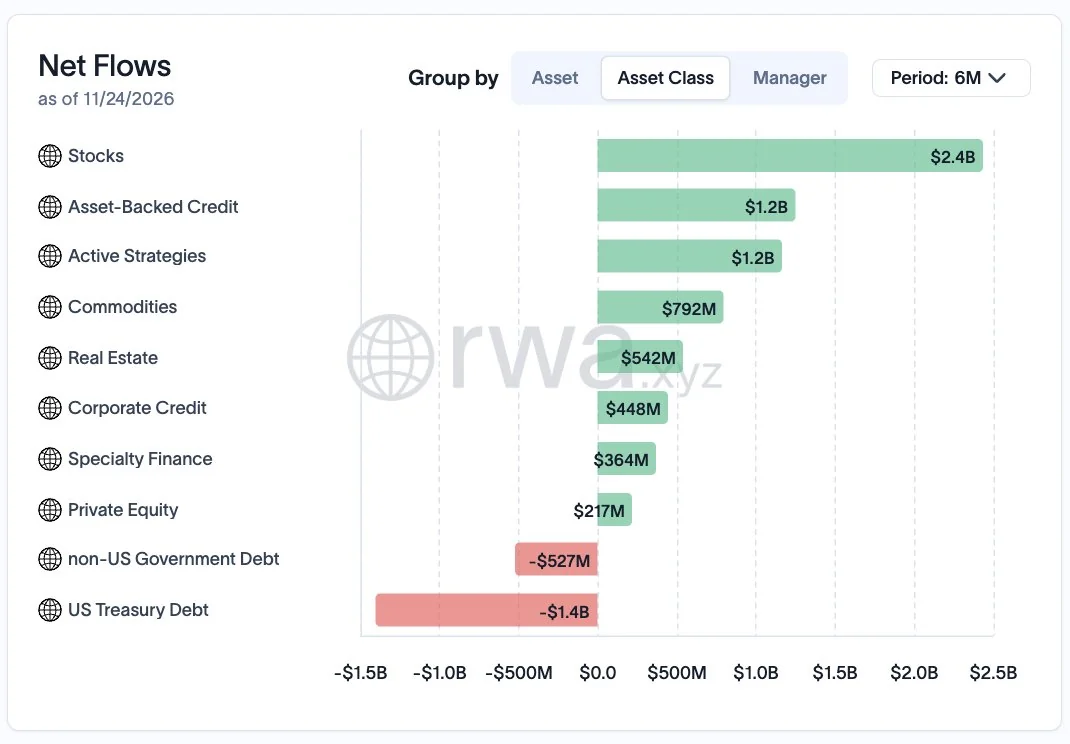
Chart: Comparison of net inflows of various categories of RWA over the past six months (tokenized stocks +$2.4 billion vs US Treasuries -$1.4 billion, source: rwa.xyz)
Holding stocks on-chain provides investors with two inherent advantages: 24/7 instant settlement and irreplaceable self-custody of asset control.
However, the ultimate goal for on-chain stocks extends beyond this; it is about integrating them as qualified collateral into the on-chain lending market. This way, investors can maintain long-term price appreciation exposure to the underlying stocks while borrowing stablecoins against their collateral to unlock immediate liquidity, significantly enhancing overall capital efficiency.
In this wave of financial infrastructure innovation, Coinbase has become one of the early pioneers. It has rolled out a dedicated Aave V4 lending instance tailored for tokenized US stocks on the Ethereum Layer 2 network Base, officially supporting users to borrow USDC using tokenized stocks as collateral.
Coinbase Tokenized US Stocks: $45 Million Raised in 3 Months
In August this year, Coinbase officially launched its tokenized stock product on the Base chain. Each on-chain stock token corresponds to a legal beneficial claim of actual US stock shares, stored on a 1:1 basis in a custody entity that is strictly separated from Coinbase's operational assets, insulated from bankruptcy, and heavily regulated. After the tokens are issued on Base, users can seamlessly access the vast DeFi ecosystem from their self-custody wallets.
Within just three months of launch, the total on-chain scale of this product has surged to $45 million, covering nearly 400 mainstream US stocks and ETFs, with individual holders exceeding 97,000. The four largest stock tokens by market value are:
• NVDAc (Nvidia): $10.9 million
• GOOGLc (Google): $10.4 million
• METAc (Meta): $5.4 million
• SPCXc (SpaceX concept): $4.2 million
Aave V4 Architecture Decoding: How Hub & Spoke Breaks the Liquidity Divide?
At the end of September, Coinbase customized and launched a dedicated Hub & Spoke lending architecture on Aave V4, which quickly became the core lending venue for Coinbase's tokenized stocks and is currently the fastest-growing tokenized US stock lending platform across the network.
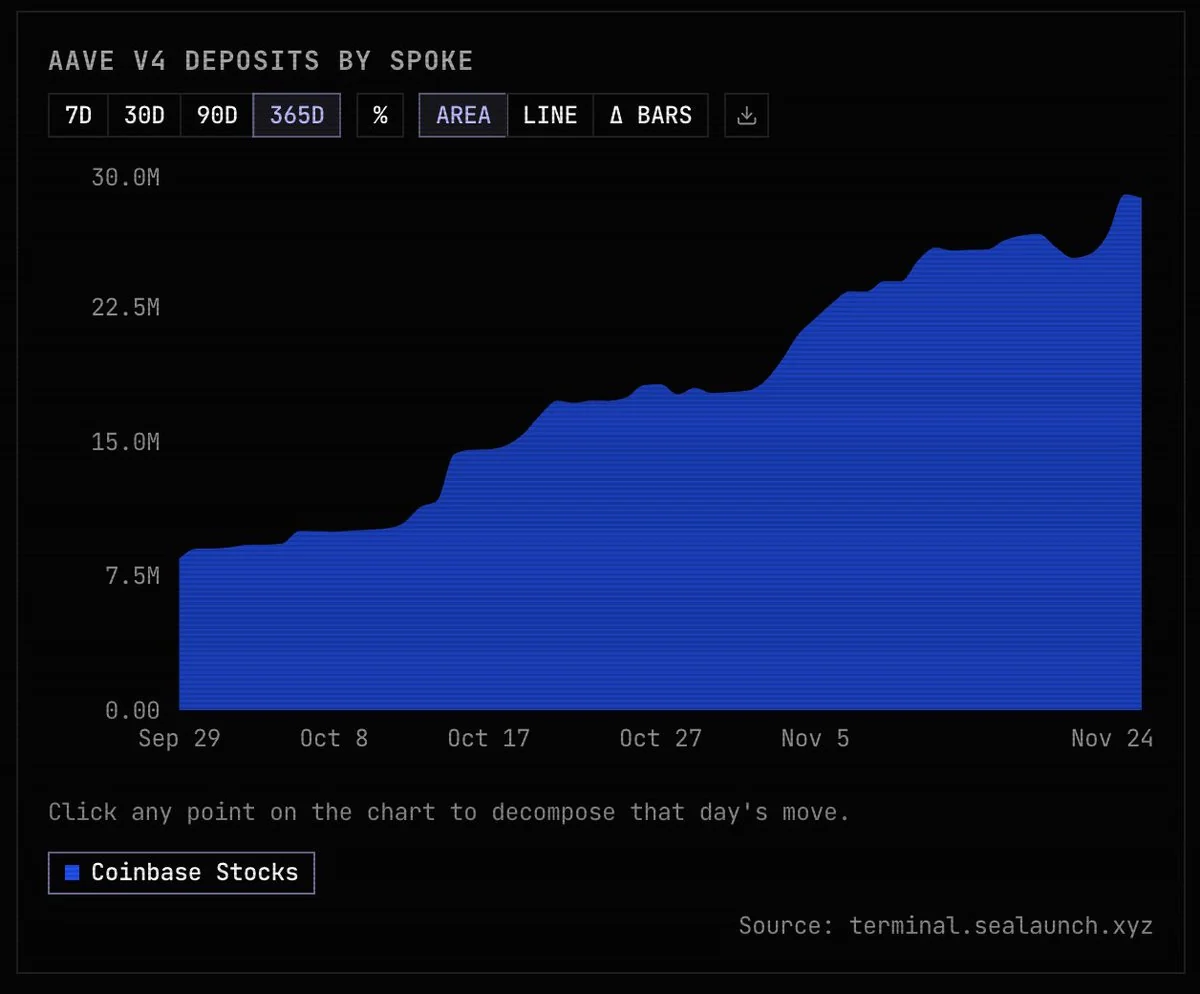
Chart: Operational principles of the dedicated Aave V4 lending instance Hub & Spoke for Coinbase tokenized stocks
Its business model is very straightforward: users deposit tokenized stocks as collateral and borrow USDC at a dynamic collateralization ratio. There is no fixed term for the loans; borrowers need only maintain a healthy loan-to-value ratio (LTV) to repay as needed.
The brilliance of its underlying mechanism design lies in the decoupling of the roles of Hub and Spoke:
The Hub (central liquidity pool) encompasses all USDC reserves and serves as the single source for all borrowing expenses; the Spoke (peripheral risk control spokes) independently carries the risk parameter configurations for each individual stock, including collateral factors, deposit caps, and liquidation thresholds.
In practice, a unified USDC liquidity pool simultaneously provides funding for collateralized borrowing of eight mainstream US stocks, while the risk management for each stock remains completely independent. This means that whenever the platform lists a new tokenized stock, it requires only to set the corresponding risk control parameters on the Spoke to seamlessly integrate, without having to create separate isolated lending pools or seek out exclusive lending sources for new tokens.
This design is critically significant for a long-tail asset matrix covering nearly 400 stocks. If a traditional isolated market model were used, each stock would require bringing in an independent set of USDC lenders, and the vast majority of long-tail stocks would face inadequate liquidity pools due to shallow depths, rendering borrowing impractical; however, under the shared Hub model, USDC lenders provide funding support for all stocks within a single pool, and as the number of listed stocks increases, the liquidity of the entire system not only remains undiluted but becomes increasingly robust.
Currently, this instance has locked approximately $19 million in tokenized stock collateral, accounting for about 40% of the circulating total of Coinbase's tokenized US stocks, and has cumulatively lent out $8.3 million in USDC. Among them, GOOGLc ($6 million), NVDAc ($5.1 million), and METAc ($3.7 million) constitute the majority of the collateral. In terms of utilization rates, NVDAc has reached 73% of its deposit hard cap, GOOGLc has reached 54%, while other targets remain below a safe level of 30%.
Strategy Vaults Become the Lending Main Force: Completing US Stock On-Chain Arbitrage in Three Steps
Specialized strategy vaults are the primary engine driving the surge in borrowing scale for this lending instance. Each vault consolidates the stocks it manages as collateral and borrows USDC in bulk, creating a continuous stream of stable interest returns for depositors providing USDC. The vault layer abstracts and encapsulates complex on-chain execution and risk management for ordinary investors, enabling the lending market to welcome large-scale institutional borrowing demand rather than fragmented small loans.
Currently, three core asset management institutions oversee around $10 million across 22 tokenized stock vaults, collectively providing nearly one-third of the total collateral for all Hub stocks.
These three institutions demonstrate a high degree of consistency in strategic logic, with a standardized execution chain divided into four clear steps:
1. Hold the target tokenized US stock spot assets;
2. Deposit them as qualified collateral into Aave V4;
3. Borrow USDC stablecoins at a specific leverage ratio;
4. Inject the borrowed USDC into high-yield stablecoin investment strategies externally.
In the actual yield structure, vault contributors not only fully retain the long-term capital appreciation of the underlying US stocks but also capture the net interest spread (Spread) between the external USDC investment returns and Aave lending costs. This arbitrage structure (Carry Trade), which has primarily thrived between interest-bearing stablecoins, has now successfully been replicated onto real US stock equity assets.
Analysis of Three Major Strategy Institutions: IPOR, Dialectic, and Superform
Currently, the three major strategy institutions deeply involved in this lending ecosystem exhibit clear differentiated allocation characteristics:
1. 628 Labs (IPOR): Scale $4.8 million
Primarily focused on the Google GOOGL and Nvidia NVDA vaults. In asset allocation, 65% is stored as collateral in Aave V4, while 30% of the funds are injected into the USDC lending optimizer under IPOR to obtain refined dynamic rate alpha.
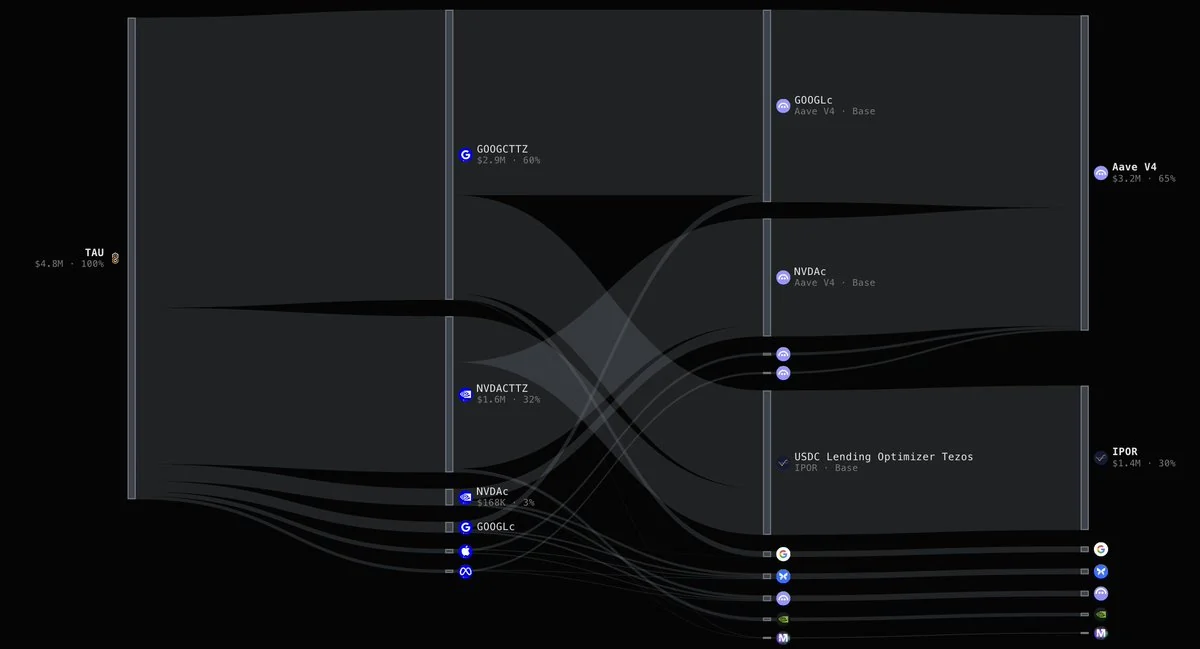
Chart: Flow of funds and collateral allocation for 628 Labs (IPOR) tokenized stock vaults
2. Dialectic Group: Scale $3.1 million
Spanning 8 dedicated vaults, with the leading yGOOGLc vault reaching $1.5 million. In fund allocation, 64% is staked in Aave V4, while the remaining 36% flows to Makina Finance for multi-strategy yield aggregation.
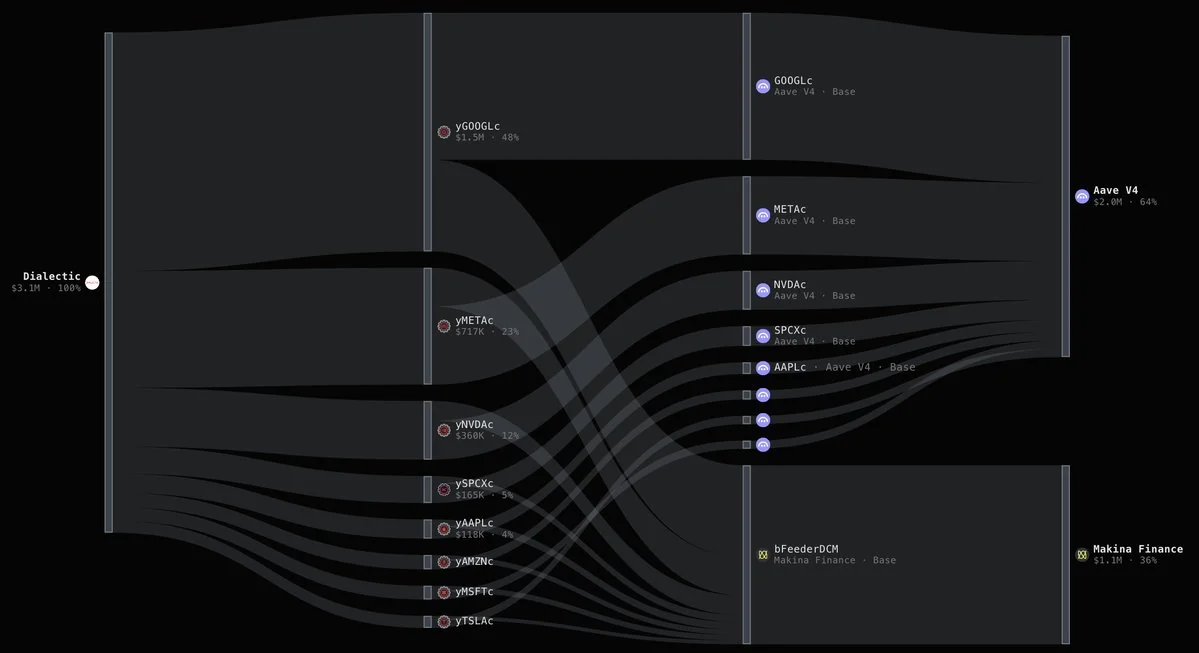
Chart: Asset composition structure of 8 major US stock vaults managed by Dialectic Group
3. Superform: Scale $2.2 million
Also managing eight specialized vaults, with superNVDA leading at $680,000. In fund allocation, 60% is locked in Aave V4 collateral lending, while 28% is injected into the Clearstar high-yield USDC vault on the Morpho platform.
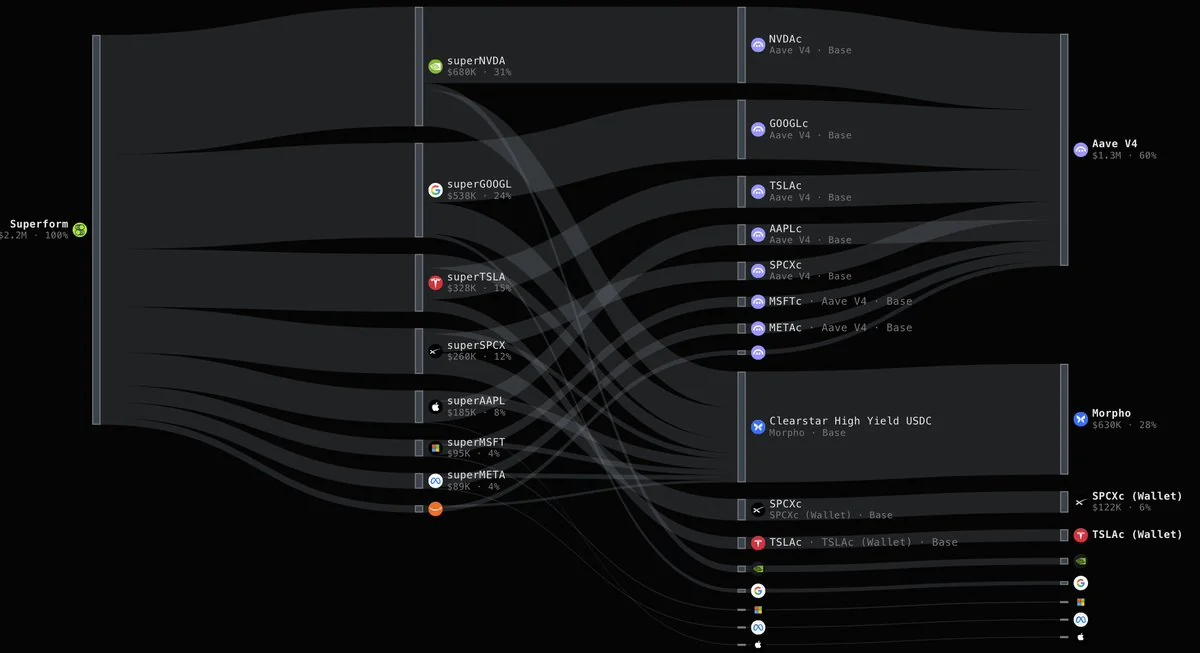
Chart: Strategy vaults such as Superform's superNVDA and Morpho lending structure
Derivative Strategy Evolution: Basis Hedging Index and Hyperliquid Linkage
With the consolidation of lending infrastructure, more complex on-chain derivative financial products are rapidly emerging, grounded in tokenized stocks.
A representative example is the stock basis index being jointly built by the decentralized compliance protocol Keyring and Bitget along with its RWA platform Reality.
This strategy leverages a permissioned DeFi lending market to leverage stake tokenized US stock spots issued by Reality while going short equivalent-sized stock contracts on the decentralized perpetual contract giant Hyperliquid. As the long spot and short contract perfectly hedge each other on price fluctuations, the assets remain protected from systemic impacts of the underlying stock price volatility, while the index continuously collects the funding rates paid by long contract traders. In this closed loop, USDC lenders acquire stable interest from over-collateralized lending, while index holders earn high certainty net returns after deducting funding costs.
Far-Reaching Insights for Issuers, Brokerage Exchanges, and Fund Managers
The on-chain practices of Coinbase and Aave V4 are bringing about a disruptive commercial paradigm shift for different participants across the RWA sector:
• Asset Issuers: Tokenized stocks that can be deposited into lending markets as qualified collateral hold practical value and market liquidity far exceeding that of static assets that can only be passively held. Only those asset issuers who successfully access lending venues with high liquidity and are widely absorbed by institutional-grade vaults can truly complete the critical leap from issuance volume to real usage.
• Brokerage Platforms and Exchanges: Platforms whose users hold tokenized US stocks alongside crypto assets inherently possess significant deposit accumulation and diverse collateral types. Enabling stock collateral lending functionality for users can now be activated with a direct connection to the existing Aave V4 Hub, without the platform itself needing to undertake the enormous engineering and risk management costs of operating a complex lending market.
• Strategy Asset Managers: US stock assets provide a new category of collateral for on-chain carry trade and basis hedging strategies, and the liquidity channels have been fully interconnected. More importantly, it offers vital diversification hedges for current portfolios that are overly bet on stablecoins, ETH, and BTC, allowing strategies to capture independent alphas driven by the supply-demand and funding rates of traditional stock markets, breaking free from sole reliance on the native crypto bull and bear cycles.
免责声明:本文章仅代表作者个人观点,不代表本平台的立场和观点。本文章仅供信息分享,不构成对任何人的任何投资建议。用户与作者之间的任何争议,与本平台无关。如网页中刊载的文章或图片涉及侵权,请提供相关的权利证明和身份证明发送邮件到[email protected],本平台相关工作人员将会进行核查。