Author: Zhou, ChainCatcher
Since November, Bitcoin has cumulatively dropped over 20%, approaching $55,000 and setting a new low since September 2024.
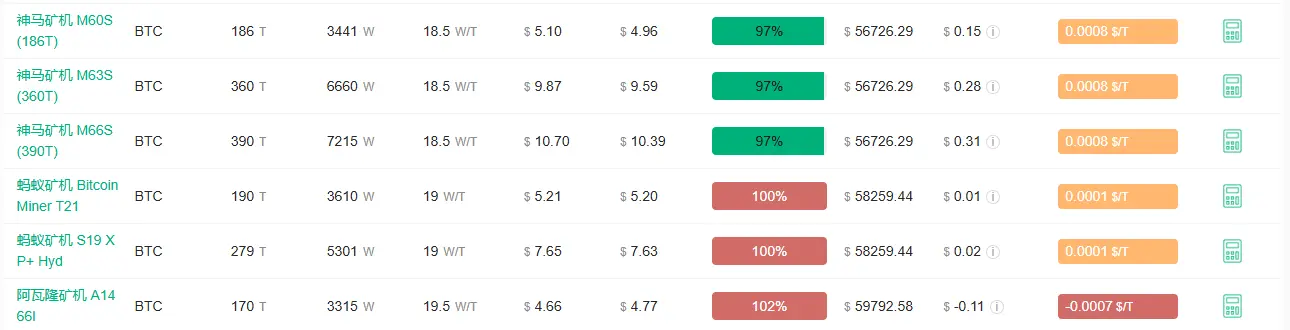
Mining profits have shrunk accordingly. According to Antpool data, with an electricity price of $0.06 per kWh, the electricity costs for newer models like Antminer T21 and Shendi M60S series account for over 97% of revenue, leaving nearly only breakeven, while Avalon A1466I has already fallen below the shutdown price.
In the past year, listed mining companies have responded to the bear market almost identically, selling their bitcoins while transferring electricity and venues to AI companies. The mass retreat of mining companies and the transition to more profitable AI endeavors has become a consensus in the market.
However, entering November, the AI sector also experienced violent fluctuations. During the two weeks when NVIDIA CEO Jensen Huang resigned and then returned, the stock prices of mining companies that had transitioned also fluctuated significantly. This means that the AI business originally used by mining companies to hedge against cryptocurrency prices has become a new source of risk.
1. Mining machines are still running, but mining is no longer profitable
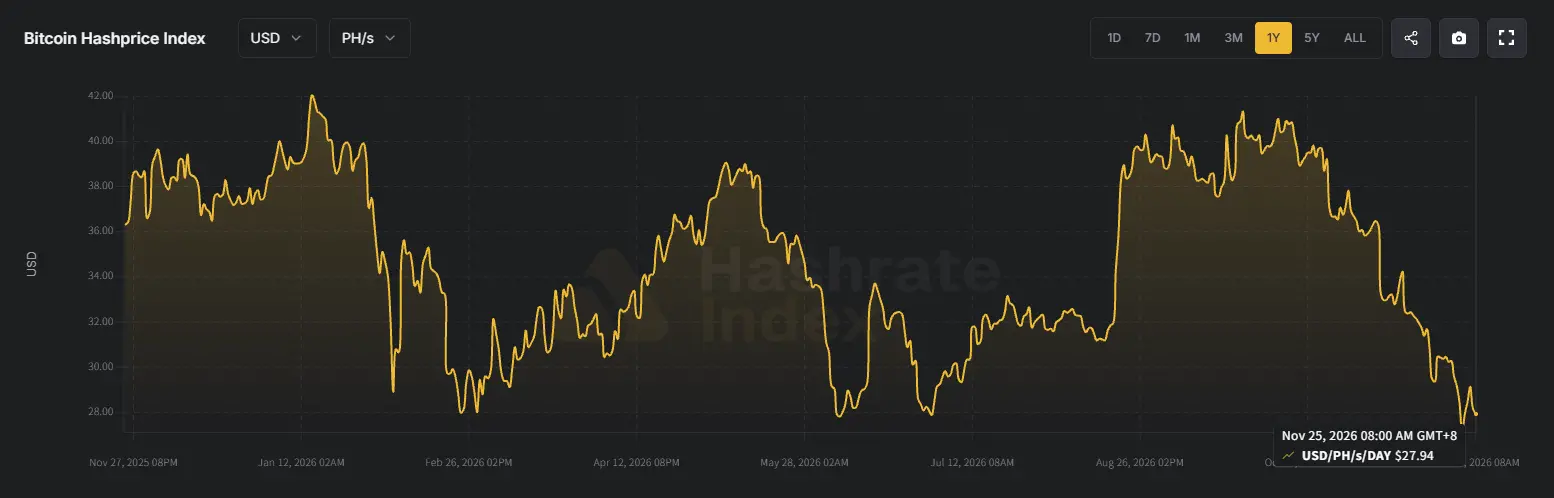
According to Hashrate Index data, as of November 25, the price of Bitcoin hashing power has dropped to $27.74 per PH per day, at a near-year low. However, the 7-day average hashing power across the network is still 1048.8 EH/s, and there has not yet been a large-scale shutdown of mining machines. Hashrate Index predicts that the difficulty adjustment on November 27 will increase by about 8.6%.
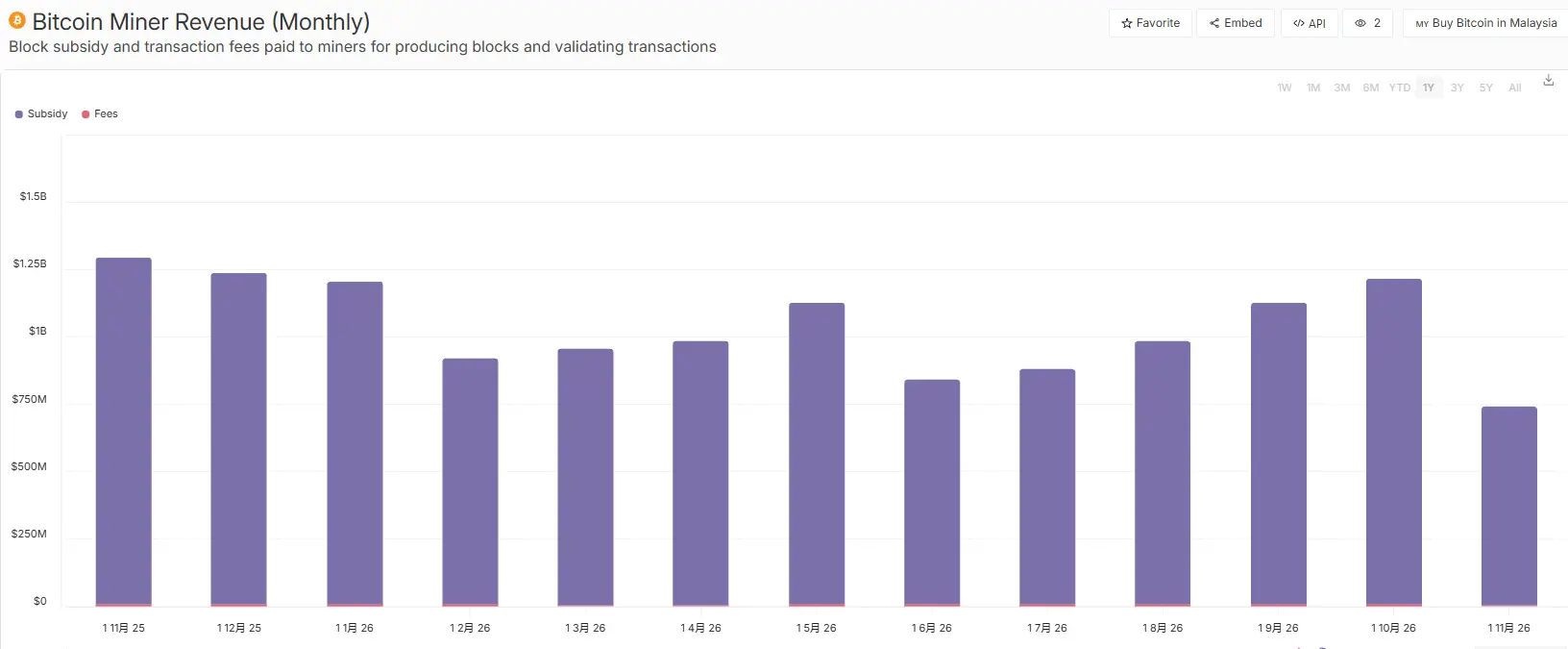
In terms of miner income, according to Newhedge data, the total revenue of miners in October was approximately $1.215 billion, the highest in 11 months. Entering November, the revenue so far is only about $740 million, which, if this pace continues, will clearly be lower than October's total revenue.
The cost pressure on listed mining companies has already become evident. CoinShares’ second-quarter mining report shows that the weighted average cash cost to mine one Bitcoin for listed mining companies is about $75,500, while the Bitcoin price at the end of that quarter was only $58,400, leading the industry overall to fall below the cash break-even line. Now the Bitcoin price has returned to this level.
Twenty One Capital CEO Rapha Zagury previously stated that Bitcoin is experiencing its first-ever hashing power bear market, and the number of listed mining companies capable of maintaining large-scale mining is decreasing.
2. Who is selling Bitcoin?
With mining no longer profitable, mining companies have started to sell coins.
According to Lookonchain statistics, as of November 10, 14 listed companies have collectively sold 108,247 Bitcoins this year, worth about $8.08 billion, the majority of which are mining companies. MARA and Riot have sold 40,581 and 20,264 Bitcoins, respectively, together accounting for over half.
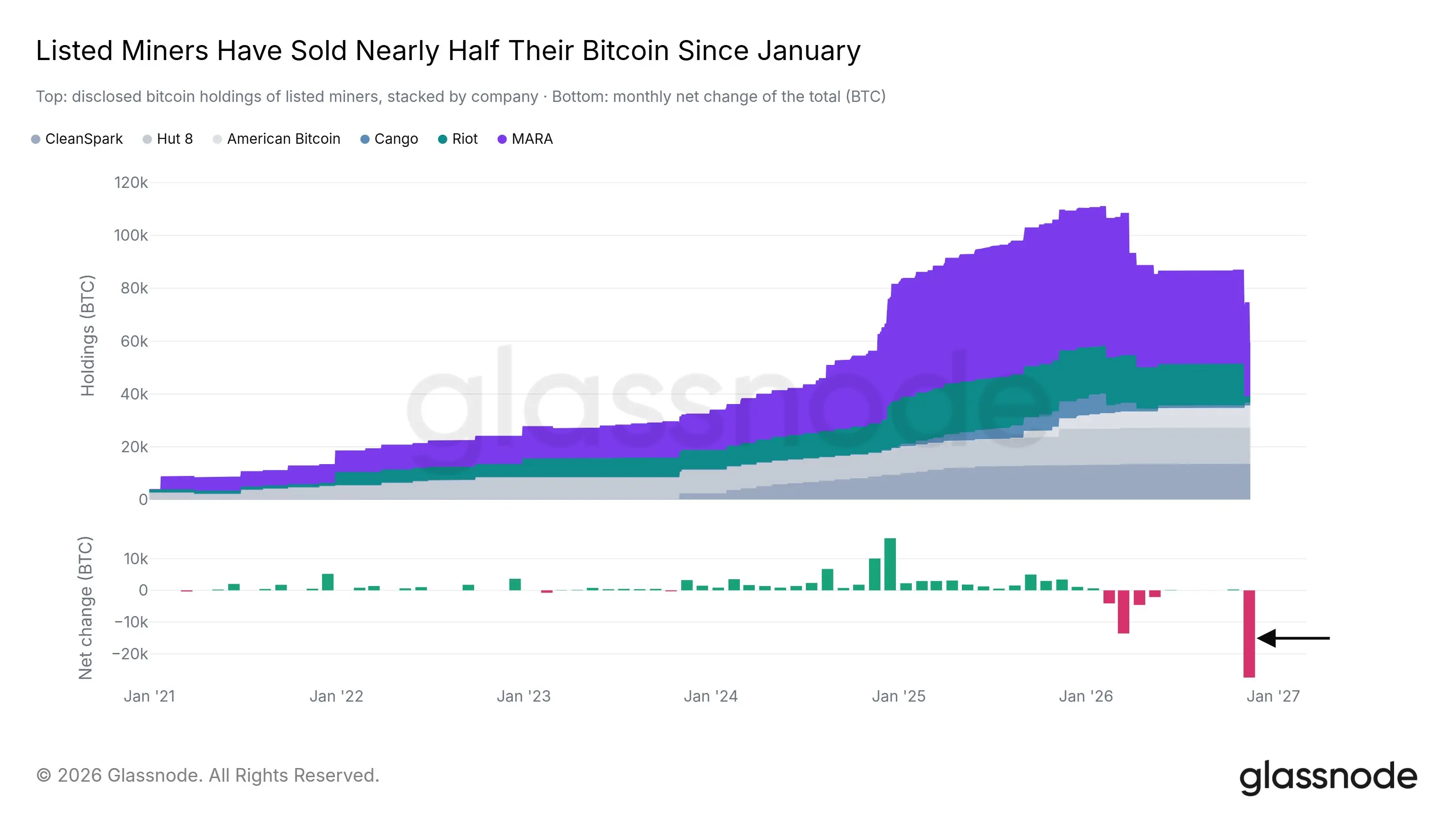
Glassnode pointed out on November 18 that for many years, listed mining companies have continually held onto the Bitcoins they mined and some even made additional purchases, but since January of this year, they have sold nearly half of their reserves, and these Bitcoins are now being used to fund the transition to AI data centers. According to the graphs from Glassnode, the net decrease for November alone is approximately 27,000 Bitcoins, the largest decrease on record.
However, speaking of selling coins, the purposes among different companies vary.
MARA disclosed in its third-quarter shareholder letter that, after the quarter ended, it sold 13,597 Bitcoins at an average price of about $81,039, cashing out approximately $1.1 billion, of which $750 million was used to repay Bitcoin collateralized loans.
Previously, MARA had sold coins to repurchase about $1 billion in convertible bonds, reducing debt by a total of $1.4 billion in the first three quarters, a reduction of 37%. This means that MARA primarily sells coins to repay the leverage left over from the last round of expansion.
Riot, on the other hand, directed its coin sales towards data center construction. According to its third-quarter report, Riot sold 20,264 Bitcoins in the first three quarters of this year, cashing out approximately $1.5 billion, primarily for data center construction, without conducting equity financing throughout the year.
3. Betting on AI: Where is the money from selling coins going?
Mining companies’ betting on AI stems from a very direct accounting. CoinShares estimates that AI computing power can yield about $1.5 million in profits per megawatt annually, whereas Bitcoin mining only yields about $500,000. The capital market is also willing to pay a premium for this; CoinShares’ French managing director Benoît Pellevoizin stated that mining companies with signed AI capacity agreements trade at an average of 12.9 times forward sales, while those without agreements only trade at 3.7 times.
The narrative of transformation peaked in September, when Grayscale renamed its Bitcoin mining company ETF to AI computing power ETF, changing the code from MNRS to GCPU and the tracking index to the Indxx High-Performance Computing Index.
However, the other side of this calculation involves huge investments. CoinShares estimates that converting a mining site into an AI facility costs between $8 million to $15 million per megawatt, more than ten times the cost of building a mining site. According to BlocksBridge Consulting, in the first half of this year, nine listed mining companies had capital expenditures of $5.11 billion, while AI and high-performance computing revenue during the same period was only $341 million, making the investment 15 times the revenue.
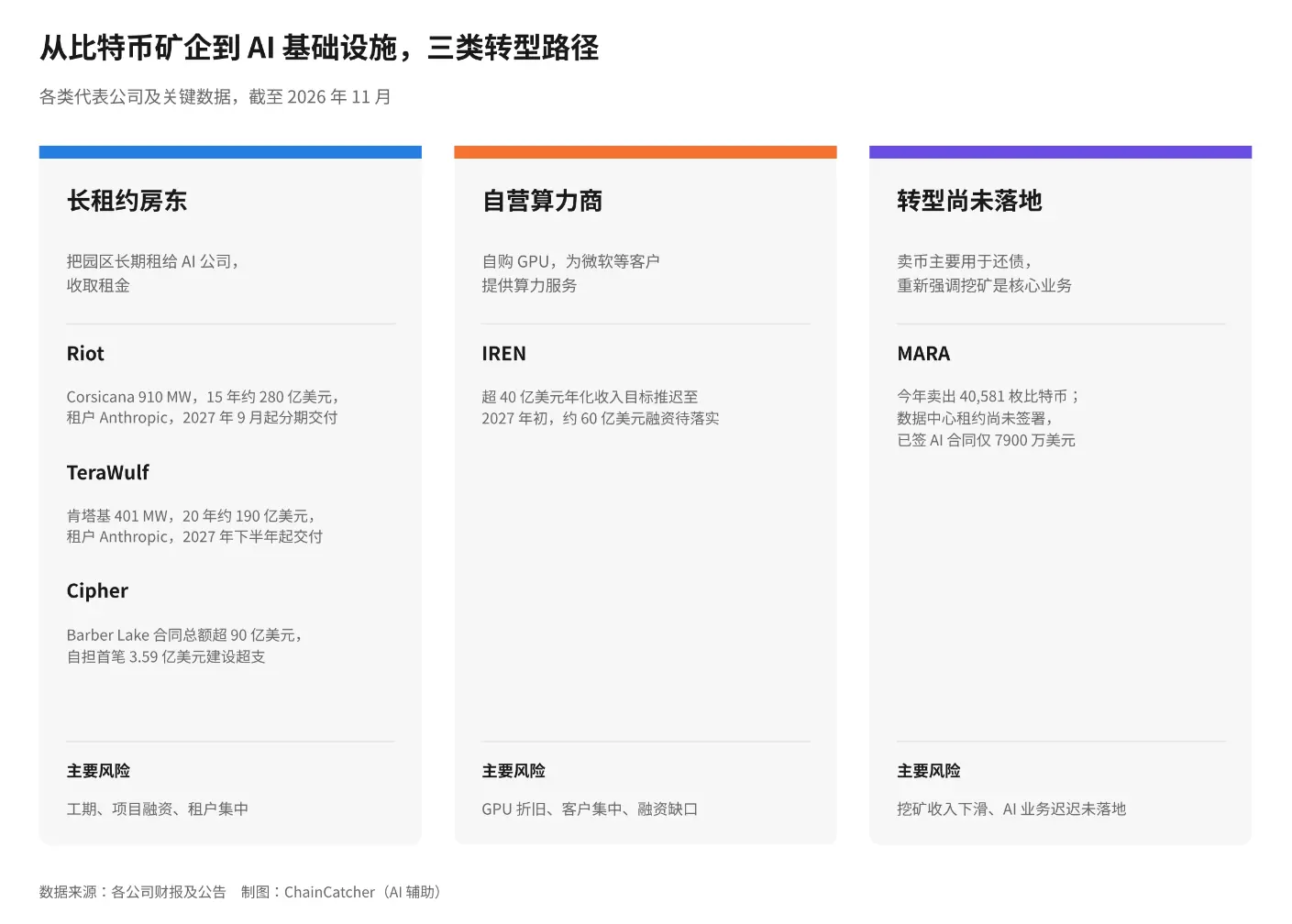
From a transformational perspective, mining companies can be roughly categorized into three types.
The first type is long-term lease landlords, represented by Riot, TeraWulf, and Cipher. Riot has fully leased the Corsicana facility for 15 years, with a contract value of about $28 billion, and its 10-Q document shows Anthropic is the tenant. TeraWulf has signed a 20-year lease with Anthropic worth approximately $19 billion. It is worth mentioning that most of these leases will only start renting after the second half of 2027, and the long-term income of many mining companies is heavily reliant on the same AI company.
The second type is self-operated hashrate service providers, represented by IREN. It purchases GPUs itself to provide computing power services for clients like Microsoft, offering greater revenue flexibility, but it also has to bear the risks of GPU depreciation and client concentration.
The third type consists of mining companies whose transformations have yet to materialize, with MARA being a typical example. It has sold the most coins this year, but its shareholder letter shows that it has yet to sign any data center lease, and the only AI contract signed is a four-year GPU service contract worth $79 million with its subsidiary Exaion. In November, when AI stocks fluctuated sharply, MARA emphasized again in its shareholder letter that Bitcoin mining remains the company’s core business.
4. Dual failure, the market starts classifying mining companies
In November, the violent fluctuations in the AI sector disrupted this path.
According to Bloomberg on November 5, Microsoft tightened its oversight of neocloud projects such as Nebius, IREN, and Nscale, exiting projects it deemed risky and internally discussing whether to continue signing new neocloud contracts.
On the same day, IREN postponed its annual revenue target of over $4 billion from the end of 2026 to January 2027, potentially extending it to February, citing customers' requested design changes and vendor delays.
Then, NVIDIA CEO Jensen Huang resigned on November 12 and was reinstated by the board on the 23rd, causing the stock prices of transforming mining companies to fluctuate sharply.
Based on Nasdaq closing prices, from November 13 to 20, IREN dropped 34.9%, MARA dropped 27.2%, while Bitcoin fell about 15% in the same period. On the day Huang returned, mining stocks collectively rebounded, with IREN spiking over 20%, and then falling back 11.54% the next day.
From the trend, the stock prices of these companies have increasingly followed AI sentiment, while Bitcoin has taken a back seat.
The deeper issue lies in financing. The Bitcoin buffer has been sold off, while most AI leases won’t start until after 2027. The construction funds during this period can only rely on external financing, while the financing environment is tightening.
IREN disclosed that about $6 billion of the remaining capital expenditure for the 2027 fiscal year has yet to be secured, depending on market conditions. Cipher agreed to bear the first payment of $359.3 million exceeding the original budget for the Barber Lake project.
Riot management mentioned in its third-quarter conference call that with rising interest rates and widening credit spreads, lenders are now scrutinizing tenants' credit, power supply, and delivery records much more strictly. The project financing for the Corsicana project won’t start until 2027, and if loans cannot be obtained under market conditions, tenants will need to advance about $3.6 billion in construction costs, which will then be deducted from the rent at an implied annual interest rate of about 12%.
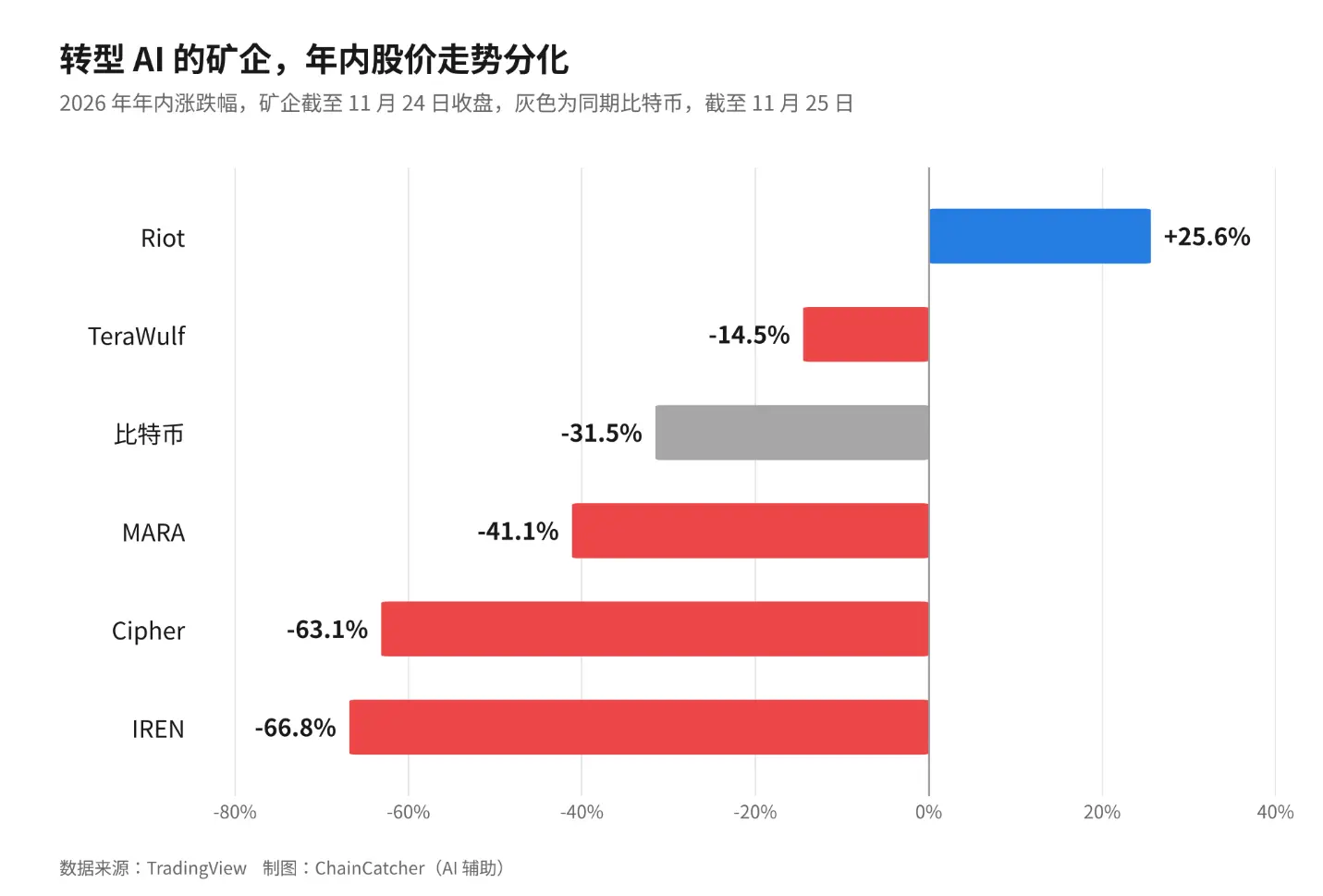
The market is also starting to reprice mining companies accordingly. As of the close on November 24, Riot has risen 25.6% year-to-date, while IREN and Cipher have dropped 66.8% and 63.1%, respectively. MARA has dropped 41.1%, TeraWulf 14.5%, while Bitcoin's year-to-date drop is 31.5%.
Riot, which has secured top tenants and temporarily does not require equity financing, has become one of the few exceptions, while IREN, which has self-purchased GPUs and still has financing gaps, has the steepest decline.
Of course, based on public disclosures, there are currently no signed leases that have been canceled. Mining companies are currently under pressure mainly from valuation, financing, and delivery.
5. Conclusion
Overall, it has become very difficult for mining companies to return to their original path. According to Hashrate Index estimates, the next halving is expected to occur around April 2028, at which point block rewards will also be halved. CoinShares analyst Luke Nolan also believes that even if Bitcoin prices rise, it will be hard to reverse the transformation of mining companies towards AI.
This raises a larger question. Listed mining companies were once the main force in Bitcoin hashing power, but now they are transferring electricity and venues to AI companies; who will take over the remaining hashing power?
VanEck proposed in May this year that as U.S.-listed mining companies transfer electricity to AI mega-scale customers, government-controlled idle hydropower and natural gas resources will become the natural successors of Bitcoin mining.
If this judgment holds, the security budget of the Bitcoin network will increasingly be borne by sovereign entities and low-cost energy providers, while Wall Street capital-supported listed mining companies will gradually turn into electricity landlords of the AI era.
For Bitcoin, this may mean another shift in the power structure, with the successors being a more decentralized and unpredictable group of participants.
免责声明:本文章仅代表作者个人观点,不代表本平台的立场和观点。本文章仅供信息分享,不构成对任何人的任何投资建议。用户与作者之间的任何争议,与本平台无关。如网页中刊载的文章或图片涉及侵权,请提供相关的权利证明和身份证明发送邮件到[email protected],本平台相关工作人员将会进行核查。