Author: Rejamong, Four Pillars
Translation: Shen Chao TechFlow
Shen Chao Introduction: In the current situation where the cryptocurrency market is experiencing significant pullbacks, many holders are trapped in the dilemma of "extremely bullish on the market but lacking liquidity to increase their positions." As the largest and most liquid asset, the vast majority of Bitcoin lies dormant in cold wallets and traditional institutional vaults, with cross-chain wrapping and lending penetration rates still at extremely low levels.
This article systematically dissects the four core custody architectures that connect Bitcoin to the smart contract ecosystem, providing a panoramic overview of the interest rates, liquidation thresholds, and liquidity distribution of mainstream lending protocols. With the entry of spot ETFs and traditional financial giants, Bitcoin's characteristic as high-quality collateral is undergoing a qualitative transformation, but the divergence between on-chain and off-chain will continue to intensify.

All the assets I hold are continuously depreciating. At this price level, I am eager to continue buying and increasing my position, but the reality is my cash is already tight. It was then that I remembered the Bitcoin stored in a hardware cold wallet long ago, almost forgotten. These Bitcoins are undoubtedly excellent collateral. Here is the complete path of how I use them for collateralized lending on-chain to obtain liquidity.
Who is safeguarding my "real" Bitcoins?
The Bitcoin network does not natively support generalized smart contracts. Strictly speaking, DeFi protocols cannot directly seize the native BTC on the Bitcoin mainnet as collateral for lending. Each protocol has its own unique approach to handling custody, but their underlying mechanisms are fundamentally similar: they lock native BTC on the Bitcoin mainnet and mint tokens representing that amount of asset (Wrapped Token) on the target chain that supports smart contracts. Before I truly use my BTC for collateralized lending, I need to clarify who will safeguard my hard-earned assets and how the cross-chain wrapped tokens are issued.
Fixed-rate lending has yet to form a mature and efficient market on-chain, and with significant market fluctuations, floating lending rates can experience dramatic swings in a very short period. Before comparing the lending rates across major protocols, I first need to make a choice: which custody mechanism do I want to trust?
Currently, there are four main mainstream custody models in the market:
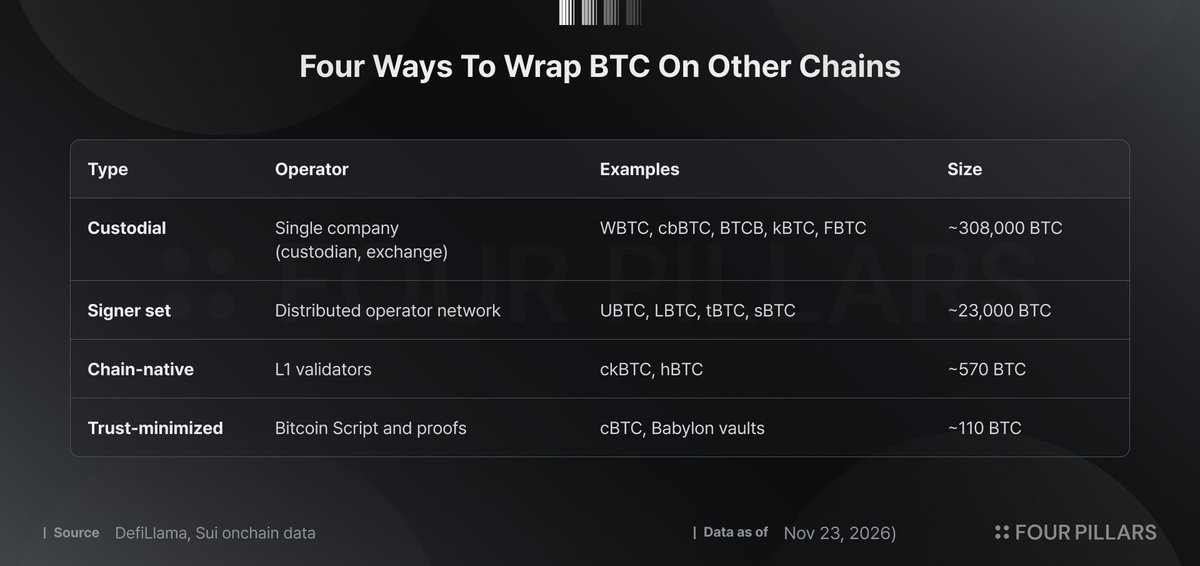
Figure: Comparison of the four core custody models for cross-chain wrapped Bitcoin (Source: Four Pillars)
Centralized Institutional Custodied Tokens
The centralized custody model is the one with the lowest entry barrier and is the easiest to understand. A single commercial entity (such as a licensed custody institution or centralized exchange) safeguards native BTC on the Bitcoin mainnet and issues a 1:1 mapped token on the smart contract platform. WBTC, launched in 2019, is a typical representative of this camp; Coinbase launched cbBTC in September 2024; and Circle officially launched cirBTC on Ethereum on June 8, 2026.
Centralized custodied tokens account for about 85% of the total circulating BTC on other public chains. In the Morpho cbBTC market solely on the Base chain, the locked collateral is valued at approximately $2.5 billion, with borrowers having withdrawn about $1.4 billion in USDC stablecoin liquidity.
The core drawback of this model is that asset holders must unconditionally trust a single centralized entity to safeguard their Bitcoins. However, many long-term Bitcoin hoarders are advocates of self-custody in cold wallets. Their motto is, "Not your keys, not your coins." For this group of people, centralized custodied tokens are hard to be attractive.
Multi-Signature Collective Custody
In the multi-signature collective model, multiple signers jointly control the private key access to the BTC vault on the Bitcoin mainnet. In the tBTC architecture, transferring BTC within the vault requires collecting 51 valid signatures from 100 randomly selected node operators; in the sBTC plan, the signing group of the Stacks network jointly manages the private keys. This is undoubtedly a significant improvement over relying on a single centralized custodian, as any unauthorized fund transfer would require multiple independent signers to conspire maliciously or be simultaneously compromised. Currently, the multi-signature collective custody model safeguards approximately 23,000 BTC, accounting for about 6% of the total cross-chain BTC on other public chains.
The signature group sizes set by different projects vary significantly. In Hyperliquid's UBTC mechanism, 2 out of 3 guardians can authorize asset transfers; Lombard's LBTC is jointly controlled by an alliance of about 15 industry institutions; in the sBTC system, transferring the underlying BTC requires agreement from a majority of over 70% of the approximately 10 selected signers.
Native Validator Node Custody on Public Chains
If I choose to borrow in a DeFi protocol on a specific public chain, it means I have already fully trusted the underlying validator node network of that public chain. Therefore, entrusting my BTC to these same validator nodes does not introduce any unnecessary third parties into the trust chain. This is actually a special evolutionary form of multi-signature collective custody: the entity responsible for managing the multi-signature is precisely the validator nodes of the Layer 1 blockchain where the tokens circulate. Internet Computer (ICP) first explored this path with ckBTC in 2023; Hashi, which officially launched on Sui on November 19, 2026, also adopted this architecture.
Trust-Minimized Cross-Chain Bridges and Vaults
In this model, the Bitcoin mainnet locks BTC using native Bitcoin Script, and funds are only allowed to be released after specific events occur on the target chain and valid cryptographic proof is submitted. This design, based on the BitVM concept, assumes that as long as there is at least one honest participant in the entire network, it is enough to safeguard the vault's security. Citrea’s Clementine cross-chain bridge, which went live with the mainnet on January 27, is a typical representative; another significant player is Babylon's self-custody vaults. On November 9, 2026, Aave DAO officially voted to support including the BTC locked in Babylon's vaults as core collateral for Aave V4.
However, the major flaw in such schemes is the lengthy withdrawal period and limited initial liquidity. Under the current structure of Babylon, redeeming BTC from the vault requires a long fraud challenge period, often taking several days. On November 23, 2026, a research team led by Babylon co-founder David Tse publicly demonstrated a new witness encryption technology, which could release BTC with just a one-way withdrawal proof. By completely eliminating the fraudulent challenge gaming phase, this approach is expected to significantly shorten or even eliminate the withdrawal waiting time.
Many protocols often advertise the above architectures with the marketing label of "native Bitcoin (Native BTC)." However, here, "native" usually just means that there is no single centralized commercial entity issuing the wrapped tokens. In all four models, the real BTC always lies dormant in the Bitcoin mainnet vault; what DeFi lending protocols receive and pledge are, without exception, on-chain certificate tokens representing their shares.
Which DeFi lending protocol should I choose?
Once I have确定 and hold a certain wrapped token, the subsequent lending decision path quickly narrows. Each wrapped token is only issued on a specific public chain, and the lending protocols with deep liquidity behind each token are distinctly different. Currently, the total value of various BTC wrapped tokens deposited in the DeFi lending market is approximately $11 billion. Among them, Aave alone accounts for about $4.7 billion, and Morpho occupies about $3.8 billion, with the two protocols collectively monopolizing 77% of the entire market.
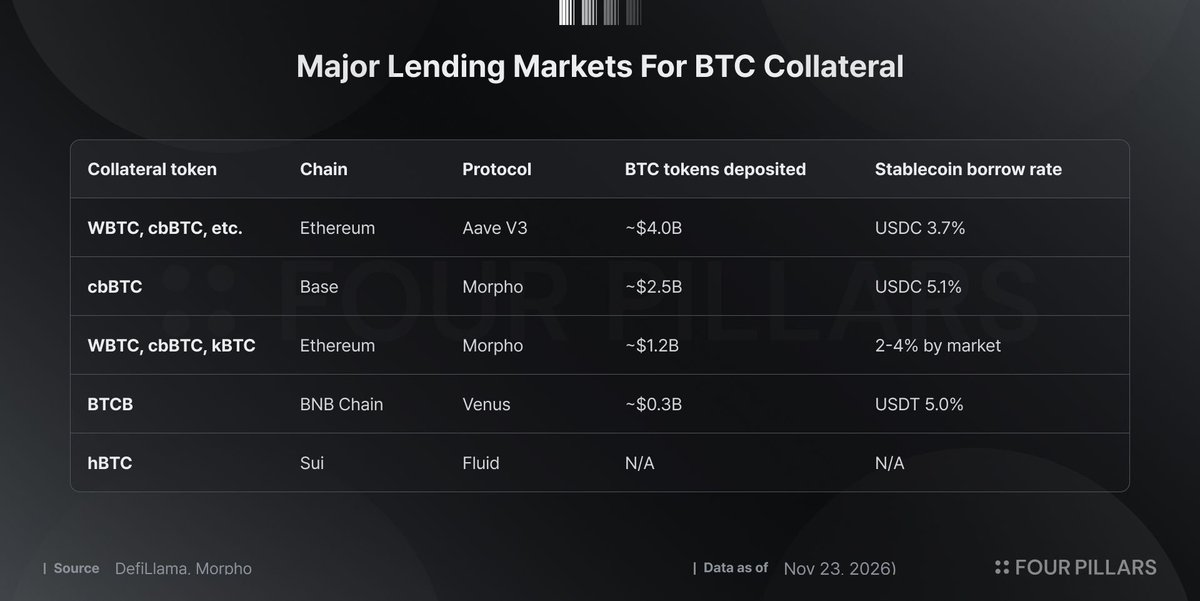
Figure: Mainstream Bitcoin collateral lending market and core parameter distribution (Source: Four Pillars)
For users holding WBTC or cbBTC on the Ethereum mainnet, Aave is undoubtedly the most natural choice. All depositors share a unified large fund pool, making the capital depth here the most abundant. Its USDC annual lending rate is relatively competitive, only at 3.7%. Borrowers can borrow up to 81% of the collateral value in stablecoins (maximum LTV); when the loan-to-value ratio (LTV) hits the liquidation threshold of 85%, the position will trigger forced liquidation.
If my native BTC is already held in a Coinbase account, I will most likely choose to borrow through Morpho. The Bitcoin collateral loan feature provided in the official Coinbase mobile app is directly connected to this market. Morpho has built independent isolated lending markets for each pair of collateral and lending assets, which means even if other asset pools face bad debt risks, it will not spread to other markets. In the cbBTC lending pool on the Base chain, the liquidation threshold is set at 86%.
On the BNB Chain, borrowers can deposit BTCB into Venus as collateral to borrow stablecoins; on the Sui chain, users can use the Fluid protocol launched synchronously with Hashi to pledge hBTC, although the current total supply of hBTC is only about 276 BTC. In the future, Aave V4 is expected to fully support Babylon's trust-minimized vaults, but this integration has not yet been officially deployed on the mainnet.
How many Bitcoins are truly active on-chain?
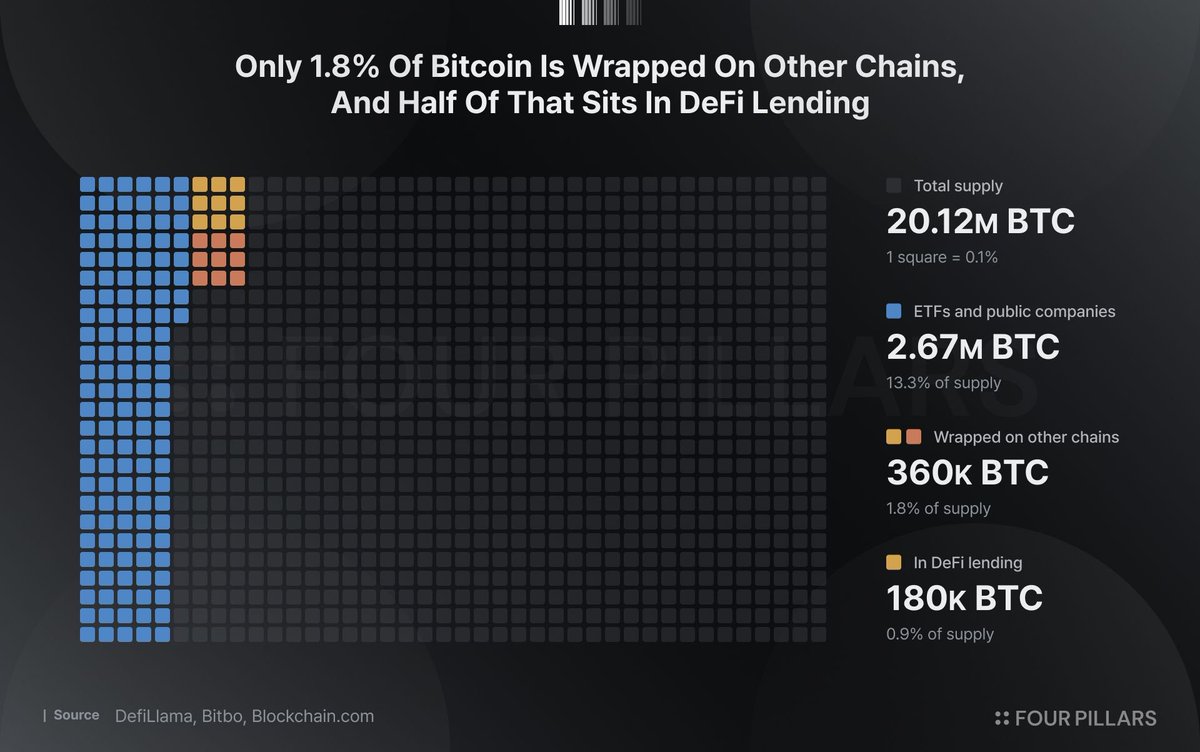
Figure: Distribution of Bitcoin holdings across the network and the proportion of on-chain DeFi lending (Source: Four Pillars)
As of November 23, 2026, approximately 20.12 million BTC have been mined across the network. However, the total amount of wrapped tokens mapped to smart contract public chains is only about 360,000 BTC, accounting for just 1.8% of the total circulating supply.
Even in this insignificant 1.8% share, centralized custodied tokens still占据 an absolute dominant position. The five major tokens WBTC, cbBTC, BTCB, kBTC, and FBTC together account for 85% of the 360,000 cross-chain BTC. Among these, only about 180,000 BTC are actually deposited as collateral in various DeFi lending markets. This number is only half of the total amount of cross-chain tokens and represents as low as 0.9% of the total Bitcoin supply across the network. Ethereum and Base chains collectively absorbed 82% of these lending deposits; by protocol, the vast majority of funds are stagnantly held within the two giants Aave and Morpho.
In stark contrast, global Bitcoin spot ETFs currently hold approximately 1.44 million BTC, and publicly traded companies have reserved about 1.23 million BTC. The combined total of 2.67 million BTC held by both accounts for 13.3% of the total network supply, which is more than seven times the total of all cross-chain wrapped BTC.
Despite the continuous emergence of new use cases to empower Bitcoin, the total scale of funds cross-chain to other ecosystems has almost stagnated. The circulating supply of WBTC once reached a historic peak of about 285,000 in May 2022, and then fell sharply to the current approximately 116,000. A portion of the lost share has shifted to cbBTC, launched in September 2024 (its current scale has increased to about 103,000). However, even when combining the volumes of WBTC and cbBTC (approximately 219,000 in total), it still falls far short of the peak scale of WBTC as a single variety in 2022. Bitcoin, as a globally recognized cornerstone of value storage and native currency of the internet, remains one of the most dormant assets in actual operations, rarely moved.
Will more holders awaken dormant Bitcoins?
But I still believe that a significant amount of dormant Bitcoins are very likely to be activated and flow in the future, as the power structure of the holder community is undergoing fundamental changes. Prior to this, native Bitcoin hoarders have always harbored strong vigilance and distrust toward other public chains outside of Bitcoin. However, institutional ETFs and public companies are becoming the main forces that absorb hoarded Bitcoins. Even if these institutions are inclined to hold long-term, they still face rigid demands for everyday liquidity expenses and financial motivations to pursue yield on capital. Even if only a small portion of institutions choose to pledge their Bitcoins, the size of the entire market will experience a breakthrough.
Numerous astute projects have already begun actively reaching out to these institutions. Circle aggressively promotes its compliant regulated issuer's brand during institutional roadshows; Sui has invested significant effort in paving the institutional access path for Hashi, which is not inferior to its technical development of allowing validator nodes to take over BTC: federally regulated institutional custodian Anchorage Digital has supported direct access to Hashi via its institutional wallet; a tripartite clearing and settlement structure expected to be implemented in early 2027 will allow institutions to conduct BTC pledge collateral while fully retaining the underlying custody rights for assets; in addition, Hashi has also received authoritative legal opinions from top law firm Fenwick, confirming that under the current framework of U.S. tax law, deposit and withdrawal activities into Hashi do not incur taxable income. Meanwhile, Aave is closely collaborating with Babylon to advance the direct acceptance of BTC vault collateral in V4 without relying on any centralized custodians.
With the widespread adoption of crypto assets, I expect Bitcoin’s legitimate status as collateral will quickly be established within the traditional financial (TradFi) system. As early as December 2025, the U.S. Commodity Futures Trading Commission (CFTC) launched a pioneering pilot program that formally permits market participants to use BTC, ETH, and USDC as collateral for derivatives trading; other reports indicate that Wall Street investment banking giant JPMorgan is also actively planning to allow its institutional clients to borrow fiat capital using their held BTC and ETH as credit collateral.
However, once Bitcoin is widely accepted as qualified collateral in the traditional financial world, the demand for cross-chain wrapped BTC could be further diminished and diverted. Those hardcore geeks who have always viewed Bitcoin as the opposite of fiat currency and are fundamentally resistant to handing over private key control to anyone will never transfer their tokens out of cold wallets; while institutions with urgent borrowing needs might find that the capacity of borrowing funds through traditional financial institutions will far exceed the growth of native on-chain lending markets.
Summary and Reflection: On-Chain Lending is Not the Endpoint
When people talk about "going all in" on an investment opportunity, they often mention using severance compensation or even mortgaging property to secure loans. Bitcoin's unique appeal as the ultimate safe haven and last-resort collateral only underscores its nearly perfect asset qualities in the financial collateral inventory. Previously, the paths available for borrowers were extremely narrow and often difficult to build trust with service providers; but today, we have multiple collateralized lending paths with different trust assumptions.
Yet I remain skeptical about whether the vast majority of such lending needs will ultimately remain on-chain. Lending institutions can easily accept Bitcoin as high-quality collateral without moving the loans onto the blockchain. On-chain, anyone can lend without permission 24/7, all positions are transparently visible across the network, and all liquidations are rigidly executed by underlying code. However, from the perspective of large traditional institutions, these native crypto "virtues" become fatal vulnerabilities: they cannot identify counterparty risks, their own positions are fully exposed in public view, and once faced with a margin call crisis, there is no room for any manual negotiation buffer. Furthermore, a significant portion of the funds borrowed against pledged BTC will end up being spent outside the crypto space: listed companies need dollars for daily operational expenses or to repay existing debt; ordinary individuals may need it to purchase real estate or pay taxes. For these practical needs, borrowing directly from traditional financial institutions and directly depositing dollars into bank accounts is clearly a more convenient and smooth path.
At present, I believe that on-chain mortgage lending based on Bitcoin mainly attracts people like me: we are eager to use borrowed funds to accumulate more crypto assets at market lows. At least through this approach, I do not need to wager my home to apply for a mortgage loan at a bank.
免责声明:本文章仅代表作者个人观点,不代表本平台的立场和观点。本文章仅供信息分享,不构成对任何人的任何投资建议。用户与作者之间的任何争议,与本平台无关。如网页中刊载的文章或图片涉及侵权,请提供相关的权利证明和身份证明发送邮件到[email protected],本平台相关工作人员将会进行核查。