OKXICE 113 only tokenized assets were launched on the first day with only 6 initially available; according to CNBC's review of the public notice, initially 56 out of 62 companies had objections (about 90%), with a total of 67 companies raising objections—"who records ownership" is more decisive than "who goes on-chain".
Written by: EX.IO Research
Introduction
On November 23, OKX and the International Exchange Group (ICE, parent company of the New York Stock Exchange) launched OKXICE, a venue for 24/7 trading of tokenized US securities: planning to gradually launch 113 assets, with 6 available on the first day—Coinbase, Circle, Robinhood, Strategy, Securitize, BitGo (Cointelegraph).
However, what is truly noteworthy is not this number, but another set of numbers: According to a CNBC report on November 23, of the 62 companies originally planned for listing on OKXICE, 56 raised objections regarding their tokenized versions, or about 90%—this statistic is based on public documents reviewed by CNBC, not an official count. According to OKXICE's own public notice, the cumulative "Notice of Issuer Objection" totals 67 companies (both versions of the list are consistent, verified item by item in this article), including Apple, Microsoft, Alphabet, Amazon, Meta, Tesla, Nvidia, JPMorgan, Goldman Sachs, Walmart, Coca-Cola, McDonald's, and others.
To grasp the significance of this matter, there is a more authoritative footnote: when the SEC approved this exemption, it included "roster risk" and "AMM pricing deviation" in its rationale (91 FR 60168, the original text is quoted in Section 3 below).
1. The fact sheet for the first day: 113 assets, 6 available, 30 basis points
First, let's clarify the verifiable parts to avoid being misled by marketing narratives (based on SEC orders, OKXICE's two versions of the public notice, and official website organization; the platform's statements have not been independently verified):
- Scale and pace: Planning to launch 113 assets, including individual stocks, ETFs, and other exchange-traded products, in batches; 113 is the number of assets, not the number of companies—at the individual stock level, the initial proposed listing only involved 62 companies. On the first day, 6 assets were actually opened: Coinbase, Circle, Robinhood, Strategy, Securitize, BitGo, all companies in this industry chain. The list of participating institutions also includes Fidelity, Direxion, eToro, Strive, Vida Global, but they were added after November 11 and are not included in the initial list of 6.
- Fee structure: The official website fee schedule shows a total trading fee of 30 bps (0.30%), broken down into 0.2% liquidity pool fee (buying incurs USDC, selling incurs tokenized stock) and 0.1% OKXICE service fee (OKXICE TSV page).
- Technical stack: Trading is completed via the X Layer (OKX's Ethereum layer two) on the Uniswap v4 AMM liquidity pool, utilizing "soulbound tokens (SBT)" for the whitelist—only wallets holding valid SBTs can trade or provide liquidity; there are no order books, nor off-chain matching.
- Access scope: Limited to qualified OKX customers within the United States, requiring identity verification, activation of a self-custody wallet (CeDeFi wallet), and opening an OKXICE account.
- Regulatory basis: The SEC's temporary conditional exemption (TSV Exemption, 91 FR 60168) published on September 17, 2026, and published in the Federal Register on September 22, allows venues for tokenized national market system (NMS) stocks to be exempted from the definition of "exchange" under §3(a)(1) and to not register as a national securities exchange; the order also specifies that such venues are not subject to the fair access requirement and discusses how the trade-through rules (Rule 611) and quotation rules (Rule 602) of Regulation NMS apply under the AMM structure. "Temporary" is only nominal: the order specifies that the exemption is effective from September 17, 2026, until September 17, 2031, providing a five-year window.
- Quota restrictions: The exemption sets hard limits on tradable targets—stocks eligible under LULD Tier 1 are capped at 75 codes, with trading volume not exceeding 0.25% of the average daily volume (ADV) from the previous month; Tier 2 allows for 250 codes, 2.5% (according to the notice from November 20). This is the system constraint for understanding why "113 assets must be launched in batches", not just commercial scheduling.
In short: this is not "selling stocks on a DEX", but a venue exempted from registration, functioning under a framework with AMM for matching and whitelisting for access control. Understanding this is essential for grasping the subsequent controversies.
2. The real structure of a 90% objection rate: it's not anti-technology, but against being "represented"
The objection list itself illustrates the issue. According to the public notice on November 5 (the November 20 updated version has not changed), the 67 issuers who raised objections span:
- Large technology and semiconductor companies: Apple, Microsoft, Alphabet, Amazon, Meta, Nvidia, Broadcom, AMD, Intel, Micron, Qualcomm, Oracle, Adobe, Cisco, IBM, Arm, Applied Materials, Lam Research, KLA, Marvell, Western Digital, Sandisk, Super Micro, Dell, HPE;
- Payment, banking, and financial institutions: JPMorgan, Goldman Sachs, Wells Fargo, S&P Global, SoFi;
- Consumer and healthcare: Walmart, Costco, Home Depot, Nike, Coca-Cola, McDonald's, Carnival, Eli Lilly, UnitedHealth, Cigna, Moderna;
- Energy and new economy targets: Tesla, Rocket Lab, CoreWeave, Cerebras, Applied Digital, IREN, Bloom Energy, IonQ, Palantir, Reddit, Nebius, USA Rare Earth, SpaceX (SPCX), Boeing, CrowdStrike.
> Note: SpaceX (SPCX) is quoted directly from the original public notice; the exemption applies to NMS stocks, this article does not judge their securities status.
It is necessary to clarify the relationship between the two sets of numbers to avoid confusion:
- 56 / 62 ≈ 90% (CNBC basis): Here, the denominator is the 62 companies "originally planned for listing" by OKXICE, and the numerator is the 56 that raised objections; the source is CNBC's review of public notices from October 4 to November 5, which is media statistics.
- 67 companies (concluded from the first-hand notice checked in this article): Cumulative item count of the "Notice of Issuer Objection" in OKXICE's public notice; both the November 5 first version and the November 20 updated version are consistent, both being 67 companies. Since 67 is greater than 56, it indicates that there are objection parties not in that initial list of 62 (CNBC also pointed this out).
- Therefore, a more rigorous statement is: Among the initially planned 62, about 90% raised objections; according to the platform’s own published objection list, the total has reached 67. "90%" refers to the initial list and does not extrapolate to all 113 assets.
Why oppose? Each party's explanation possesses some legitimacy, yet none provide complete evidence:
- Platform side's explanation (OKXICE co-chair, former New York governor Andrew Cuomo, at a press conference on November 23): Competing platforms encourage companies to raise objections, with the intention of "making companies wait for them to build the system"; he also acknowledged that some issuers simply need more time to understand the technology and mentioned that he has received calls from companies saying "we will exit for now but are willing to continue learning". Cuomo did not name any competitors and did not present evidence; CNBC's concurrent report also did not mention this allegation (Cointelegraph).
- Corporate concerns (according to a CNBC report from involved communications sources): A 30-day objection window is too short for "understanding technology + legal and board evaluations + making decisions". CNBC further cited three named statements: Franklin Templeton's Chief Investment Officer for crypto, Seth Ginns, stated that the high refusal rate is due to the "30-day window"; issuers are not against tokenization, just unwilling to be rushed; MassPay's CEO Ran Grushkowsky recounted client concerns, emphasizing that the issue isn't the concept but how 24/7 trading affects stock prices and investor relations (especially during corporate announcements); CEO of Securitize, an OKXICE tokenization partner, Carlos Domingo, noted that even among departing issuers, some internal digital asset leaders were unclear about who made the decision to refuse and pointed out that some regulated trading venues could operate without issuer consent.
- The mechanism itself: Under the SEC's temporary exemption, the platform must first notify issuers, and trading cannot begin until 30 calendar days after the issuer receives the notice; if issuers raise objections in writing during that period, they cannot be listed. "Silence from the issuer does not constitute endorsement" is my interpretation of this mechanism, not the original terms of the order.
Displaying these three points side by side leads to a stark conclusion: The nature of the objections is not "against going on-chain," but "against being represented by a third party establishing a parallel ownership record in their name." If it were merely a change in trading methods, companies would have no motive to intensively send letters during the 30-day window; the intensity arises because this structure touches on the control over shareholder registers, corporate actions (dividends, voting, splits, mergers), and information disclosure.
3. Five structural differences: "1:1 backing" does not equal "registered"
OKXICE's description is clear: each token is backed 1:1 by underlying shares held in custody by a broker-dealer, with holders enjoying the same dividend, voting rights, and rights to distribution of residual assets as the underlying stock. This statement holds true in terms of economic rights. However, the public notice simultaneously clarified five differences, which determine whether this set of assets "resembles a stock" (based on OKXICE's November 20 public notice, not independently verified):
- Recording authority lies with the tokenization party, not with the issuer. The notice states that the ownership of holders is "a right claimed on the books and records of the tokenization party (Tokenizer)", with on-chain records accounted for and reconciled with the tokenization party's ledger; corporate actions (such as record snapshots on ex-dividend dates, dividend distributions, distribution of proxy materials, voting collection, splits, and mergers) are handled by the tokenization party, not OKXICE. In other words, there is a third party between the issuer's register and the on-chain holders.
- Pricing is determined by the pool, not the NMS market. The notice makes clear: prices come from the ratio of two assets within the AMM pool, not referencing the underlying stock market; during market closures, low pool liquidity, suspensions, or corporate actions, prices may significantly deviate from the underlying stock. This is a hard constraint for institutions wishing to hedge or make markets within the "same price continuum".
- There is no central counterparty, nor net settlement. Each transaction is settled on-chain atomically, without clearinghouses, CCPs, netting, or partial fills; all trades must be fully backed, with no support for margin or lending. Structurally, this is closer to "spot fully paid transfer", not a brokerage account system.
- Liquidity providers do not need to be registered market makers. The notice explicitly states: liquidity providers do not need to be registered broker-dealers and may rely on a dealer registration exemption, thus not constrained by the capital requirements of registered market makers, and also have no obligation to continuously provide liquidity; they can withdraw at any time before or after periods of volatility or suspensions.
- Operational and code-level authority is centralized, with some risks being "disclosed but not eliminated". Key functions (upgrading contracts, creating pools, withdrawing LP liquidity) require multi-signatures; routine functions (pausing pools, adding or removing from the whitelist, submitting daily trading volume) are executed by a single management private key, with changes having no time-lock, meaning participants may not receive upgrade notifications beforehand; MEV risks are explicitly acknowledged as "can only be significantly mitigated, not eliminated". Concerning external audits, a time point must be noted: the November 5 first version of the notice only stated "internal audit, Hook contracts intended for external audit before deployment", while the November 20 updated version changed to "audited internally by OKX Technology and externally by Certified Kernel Tech LLC"—the audit reduces but does not eliminate code risks, while upgrades and changes remain solely via internal audits. Furthermore, whether tokenized stocks in self-custody wallets can be considered customer property and whether they are protected by SIPC during broker-dealer bankruptcies is stated in the notice as "uncertain".
Combined, these five points form a directly quotable statement: "1:1 backing" addresses value endorsement, while "being registered on the issuer's register" addresses rights ownership and enforceability; the two are not the same thing. This is also the biggest point of divergence between this article and mainstream reports—most reports stop at "113 assets launched, issuer objections", without unpacking this layer.
Moreover, it is important to note: this judgment is not an invention of this article, but rather what regulatory agencies wrote when establishing rules. The SEC, when explaining "why issuers need objection rights," explicitly mentioned the first two reasons that align with this article: issuers "may be concerned about the risk of maintaining its shareholder register related to on-chain transfers," and "the potential price dislocation or adverse effects on the price of the underlying NMS stock, particularly given that prices disseminated by an AMM Liquidity Pool are most likely based only on the ratio of the quantities of assets in that liquidity pool" (91 FR 60168, order text). In other words, "roster risk" and "AMM pricing deviation" are the two variables explicitly named under the exemption framework, rather than post-facto attributions from industry commentary.
4. Diverging paths: transfer agents, trading venues under pressure, and Hong Kong registers
If this matter is interpreted only as "opposition between exchanges and companies," more significant concurrent actions would be overlooked.
Firstly, the transfer agent itself has become an acquisition target. According to CNBC, Bullish is acquiring the transfer agent Equiniti for about $4 billion, becoming an example of "issuer-sponsored + integrating into existing regulated infrastructure". Transfer agents are the statutory maintainers of shareholder registers—by tokenizing, it puts "the register" and "the token" under the same roof, which is a completely different governance structure than "venues finding tokenizers themselves, then notifying issuers". This also explains why this acquisition, seemingly unrelated to crypto, is actually the most critical infrastructure buy within the tokenized equity track.
Secondly, trading venues are changing lanes themselves. The same CNBC report's title indicates "As NYSE and Nasdaq pivot for this new market." However, the paths for the two are not the same: according to CNBC, Nasdaq is adopting an "issuer-centric" model and is collaborating with Payward, the parent company of Kraken, planning to launch in the second quarter of 2027; NYSE's specific plans have not been fully disclosed. This detail is crucial—Nasdaq's choice effectively proves that "issuer's approval" has become a prerequisite for this business, not an optional step. Public information does not confirm whether "issuer objections are organized by exchanges" (Cuomo did not name names or present evidence); even if the wave of objections partly stems from competitors' lobbying, it reinforces the idea that competition for this market has shifted from technological validation to channel and roster stages (this is my judgment).
Aligning these two with OKXICE, the track can be split into three layers (with internal differentiation within the third layer, hence listed across two lines):
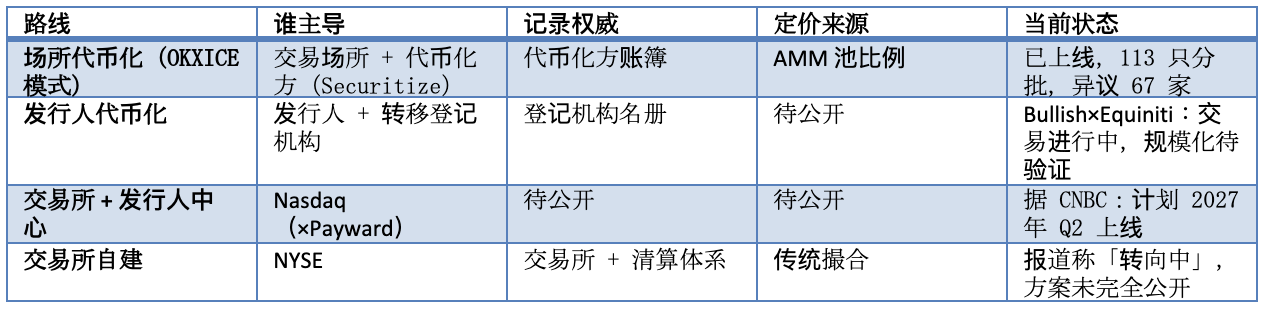
> Note: The table above is organized by this article based on public notices and media reports, not an official count; the latter two lines have limited public information, hence marked "to be disclosed".
Thirdly, Hong Kong is addressing the "register", not "trading"— In the same week, another piece of relatively unnoticed news emerged from Hong Kong: On November 24, the Hong Kong Securities and Futures Commission (SFC) released a speech by Chairman Kelvin Wong, marking the occasion of the inaugural listing under the New Uncertificated Securities Market (USM) regime (SFC 26PR198). The SFC press release summary also pointed out the institutional goal of the USM: "USM empowers direct shareholder rights," simplifying the communication processes between issuers and shareholders.
A critical separation must be made here, to avoid misreading as "Hong Kong is building a tokenized stock track": The USM is a non-certificated centralized electronic registry system replacing paper stock certificates, not DLT, nor tokenization; and HKMA's EnsembleTX serves interbank wholesale settlement infrastructure. Neither equates to Hong Kong opening retail tokenized stock trading, nor does it represent SFC's stance on tokenized stock trading. To gauge the SFC's public positioning more accurately, a better reference is SFC CEO Julia Leung's quoted statement in the HKMA news release dated November 2—focusing on "secondary trading of tokenized funds on licensed platforms", which refers to the secondary trading of tokenized funds on licensed platforms, not retail tokenized stocks.
Adding HKMA's November 2 announcement on EnsembleTX: supporting 24/7 interbank settlement of tokenized deposits with tokenized central bank money (tokenized CeBM), involving 12 participating banks and 20 industry pioneers (HKMA press release). The comparison between the two regions can be succinctly captured in one sentence: The US is contending whether "the trading route should bypass the register," while Hong Kong is making "register + central bank money settlement" the default route (this is my judgment).
This represents two ends of the same axis of contention:
- The debate in the US revolves around "who has the authority to create and maintain a parallel holding record to the issuer's register"—third-party venues wish to establish it, while issuers oppose;
- Hong Kong is pursuing "to modernize the official register first, and then to facilitate trading and settlement based on that register"—the register is the starting point, not an object to be bypassed.
It should be noted that Hong Kong's pathway serves regulated securities and institutional settlement scenarios, not 24/7 retail tokenized US stocks; the two differ in terms of investor scope, pricing mechanisms, and clearing structures, and one cannot infer which is more "advanced" based on this.
5. EX.IO Research Perspective
Judgment one: The key variable in this round is not "the number of listings," but "the marginal speed of objections." The first day managed to list only 6 assets, focusing on companies related to the industry chain, while also constrained by LULD quota limits, indicating the platform is scheduling under dual constraints of "regulatory limits + issuer attitudes". If new objections continue to rise over the next two weeks (exceeding the public list of 67), then the batch plan for 113 assets will effectively degrade into a "24/7 trading channel for a select few crypto and fintech assets"; if objections cease, and companies like Cuomo mentioned "exit first, then come back", it would signal the mechanism being accepted by the market for the first time.
Judgment two: AMM pricing decoupled from NMS price discovery is a hard constraint on the path to institutionalization, not an optimizable detail. A structure that allows for 24/7 trading but does not reference the underlying market, with liquidity providers under no market-making obligation and lacking a CCP and netting, finds it difficult to be accepted in scenarios where even a one-thousandth price deviation is significant (for example, index tracking, collateral valuation, fund net asset value calculations). A more realistic mid-term scenario may be: tokenized securities are treated as "collateral and settlement tools", rather than "price discovery venues," which aligns with the evolution direction of tokenized sovereign bonds in recent years. (Further reading: EX.IO Research "The Last Mile of Tokenization: Not On-Chain But In The Risk Ledger".)
Judgment three: The divergence between issuer-led tokenization and venue-led tokenization is more noteworthy than "on-chain vs off-chain" tracking. The involvement of transfer agents in issuer-led tokenization merges "register authority" and "tokens"; should this path scale, third-party venues' negotiation leverage will shift from "leading with technology" to "requiring issuer endorsement". For institutions providing registration, custody, settlement, and compliance interfaces, the institutional value of this path outweighs its trading side (this is my view).
Three verifiable observation signals (for future tracking, not forming any suggestions):
- Whether the list of objections in subsequent OKXICE public notices continues to grow, and the actual transaction and liquidity depth of the first batch of 6 assets (the officials committed to publicize transaction data down to individual trades within 30 days).
- Whether the specific plans of NYSE and Nasdaq are realized (according to CNBC, Nasdaq adopts an issuer-centric model, collaborates with Payward, and plans to launch in Q2 2027), and whether "issuer's explicit agreement" is treated as a prerequisite for listings.
- Whether issuer-led tokenization (the transfer agent path) produces a verifiable first batch of issuers and scale; and whether the Hong Kong USM register sees its second and third listings.
🔗 Sources
- OKXICE TSV, *Public Notice of OKXICE TSV*, 2026-11-05 (first version) and 2026-11-20 (updated version)—including full issuer objection list (67 companies), AMM structure, LULD quota limits, auditing, and risk disclosures. 11-05: https://www.okx.com/cdn/assets/okfe/web3-activities/okxicetsv/notices/OKXICE_Tokenized_Securities_Venue_Public_Notice_26.11.05.pdf | 11-20: https://www.okx.com/cdn/assets/okfe/web3-activities/okxicetsv/notices/OKXICE_Tokenized_Securities_Venue_Public_Notice_26.11.20.pdf
- Cointelegraph, *OKX, ICE launch 113 tokenized assets despite issuer objections*, 2026-11-23 — https://cointelegraph.com/news/okxice-launch-113-tokenized-assets-objections
- Cointelegraph, *Cuomo says rivals urged companies to opt out of OKXICE tokenized stocks*, 2026-11-23 — https://cointelegraph.com/news/cuomo-rivals-urged-companies-reject-okx-ice-tokenized-stocks
- CNBC, *Tokenized stocks face pushback as NYSE, Nasdaq pivot for a new market*, 2026-11-23 (the 90% reference originates from the introduction and text of this article: 56 objections out of 62 in the initial list, based on a review of public notices from 10-04 to 11-05)— https://www.cnbc.com/2026/11/23/tokenized-stocks-face-pushback-as-nyse-nasdaq-pivot-for-a-new-market-.html
- U.S. SEC, *Order Granting Temporary Conditional Exemptive Relief … for the Use of Certain Distributed Ledger Trading Venues for Tokenized NMS Stocks*, 91 FR 60168 (published on 2026-09-22; exemption period from 2026-09-17 to 2031-09-17)— https://www.govinfo.gov/content/pkg/FR-2026-09-22/pdf/2026-19388.pdf
- OKXICE TSV official page (access conditions, fee 30bps, technical stack description)— https://www.okx.com/okxicetsv
- SFC, *Remarks at Listing Ceremony of the First Company under the New Uncertificated Securities Market Regime* (26PR198), 2026-11-24 — https://apps.sfc.hk/edistributionWeb/gateway/EN/news-and-announcements/news/doc?refNo=26PR198
- HKMA, *EnsembleTX press release* (tokenized central bank money 24/7 interbank settlement), 2026-11-02 — https://www.hkma.gov.hk/eng/news-and-media/press-releases/2026/11/20261102-5/
免责声明:本文章仅代表作者个人观点,不代表本平台的立场和观点。本文章仅供信息分享,不构成对任何人的任何投资建议。用户与作者之间的任何争议,与本平台无关。如网页中刊载的文章或图片涉及侵权,请提供相关的权利证明和身份证明发送邮件到[email protected],本平台相关工作人员将会进行核查。