
Citi raised Nvidia's target price from $225 to $240, with earnings forecasts unchanged. The entire adjustment comes from the valuation multiple increasing from about 14 times to about 15 times.
On November 23, 2026, the team of Citi analyst Atif Malik released a report. The bank maintains a "Buy" rating for Nvidia (NVDA.US). Citi is betting that after Jensen Huang's return, the management risk that depressed Nvidia's valuation will dissipate.
Jensen Huang's Return, the Biggest Uncertainty is Resolved
According to Nvidia's announcement on November 23, 2026, the board unanimously voted to restore Jensen Huang's positions as president, chief executive officer, and director, effective immediately. The 8-K filing submitted by Nvidia shows that the board's decision was made on November 22.
This is about two weeks after he resigned. According to CFO Dive, Huang resigned on November 12, 2026. Colette Kress, who served as interim CEO during Huang's resignation, has returned to her position as chief financial officer.
The announcement also mentioned that the board took into account opinions from senior U.S. government officials during the decision-making process and is confident that Huang's return does not pose a national security risk. The board has established a committee on national security and export controls and has begun recruiting a chief compliance officer.
Citi believes that Huang's return alleviates the largest pressure brought by CEO changes. Nvidia's product roadmap, customer relationships, and supplier collaborations can continue.
The bank wrote that the previous leadership risk was one of the reasons for the compression of Nvidia's valuation multiple. With Huang's return, this risk diminishes.
The pricing date of the report is November 20, when Nvidia's closing price was $125.53. The front page of the report states that, based on this price, Nvidia's market capitalization is approximately $3.03 trillion.
This price is prior to the announcement of the return. According to CNBC's report on November 23, 2026, on the day the return news was announced, Nvidia's stock price rose by 31%.
Target Price Increase All Comes from Valuation Multiple
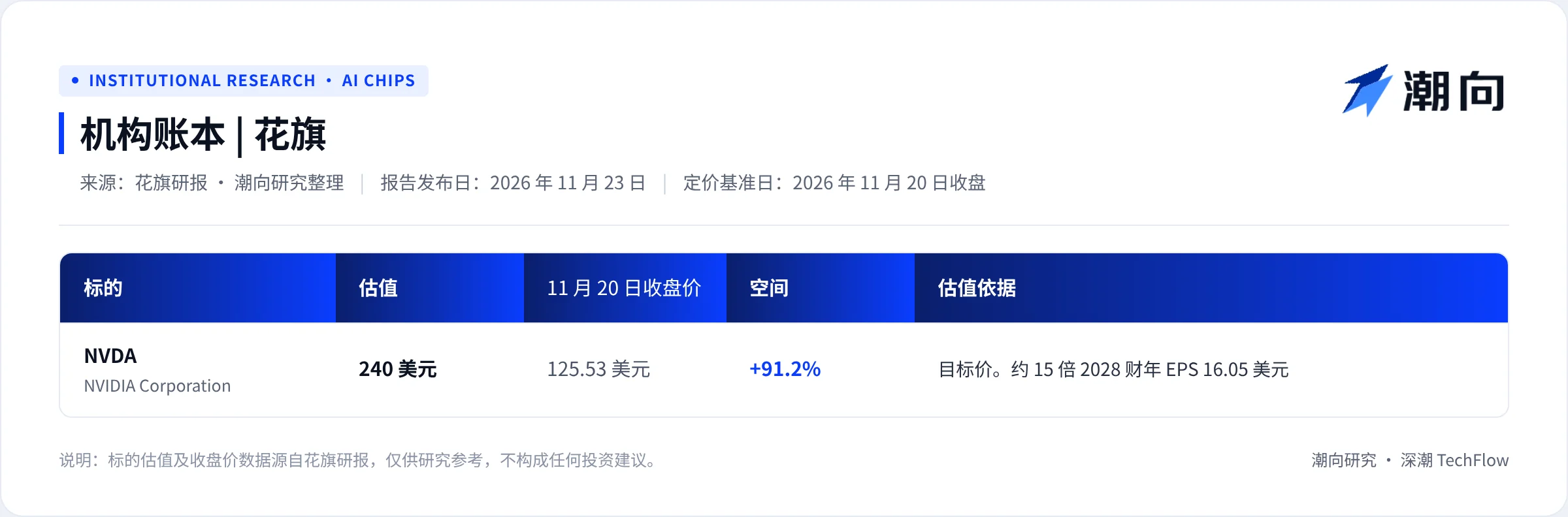
The calculation for the target price of $240 is written in the report: about a 15 times price-to-earnings ratio, multiplied by the earnings capacity for the natural year of 2027.
Nvidia's fiscal year ends on January 31 each year, with the 2028 fiscal year roughly corresponding to the natural year of 2027. Citi's forecast for earnings per share (EPS) for the 2028 fiscal year is $16.05, which multiplied by 15 times is about $240.
Citi emphasizes that the target price earnings ratio of 15 times is about 14% lower than Nvidia's average level over the past year. The discount reflects the ongoing investigation and uncertainties brought about by the Chinese market and export controls.
The earnings forecast itself has not changed. The EPS forecasts for fiscal years 2027 to 2029 are completely consistent with Citi's previous version.
Citi expects Nvidia's EPS for the 2027 fiscal year to be $9.60, more than double the actual value of $4.49 for the 2026 fiscal year.
The quarterly trend can also reflect this rhythm. In the first quarter of the 2026 fiscal year, Nvidia's EPS was $0.75, and it rose to $1.55 in the fourth quarter. Citi expects it to reach $2.84 in the fourth quarter of the 2027 fiscal year.
Citi's forecasts are also slightly lower than the market consensus. The table below lists Citi's forecasts compared to the consensus from two data providers:
| Fiscal Year | Citi EPS Forecast | First Call Consensus | Visible Alpha Consensus |
|---|---|---|---|
| 2027 Fiscal Year | $9.60 | $9.65 | $9.63 |
| 2028 Fiscal Year | $16.05 | $16.78 | $16.68 |
| 2029 Fiscal Year | $20.47 | $21.78 | $21.77 |
For the 2028 fiscal year, Citi's EPS forecast is about 3.8% lower than the Visible Alpha consensus. By the 2029 fiscal year, the gap widens to about 6.0%.
In other words, this adjustment did not rely on more optimistic profit assumptions; the change only occurred in the valuation multiple.
Based on the closing price on November 20, Nvidia's price-to-earnings ratio for the 2028 fiscal year is only 7.8 times. This is the figure in the report's valuation table.
Citi Expects Nearly Doubling of Revenue in a Year
Nvidia's revenue for the 2026 fiscal year is approximately $215.9 billion, and Citi expects it to rise to about $423.8 billion in the 2027 fiscal year, nearly doubling.
For the 2028 fiscal year, Citi expects revenue to reach about $739.7 billion, an increase of about 75% over the 2027 fiscal year. For the 2029 fiscal year, revenue is expected to be around $987.7 billion.
According to CNBC's report on November 23, 2026, Kress chaired the first earnings call after Huang's resignation. During the call, she raised the 2028 fiscal year's revenue growth expectation from about 70% to about 75%. Citi's approximate growth rate of 75% aligns with this guidance.
Gross margins are expected to remain above 70%. Citi forecasts gross margins for the fiscal years 2027 to 2029 to be 73.9%, 71.9%, and 71.5% respectively.
Profits and cash flow are expected to expand. Citi expects a net profit of about $387.4 billion and free cash flow attributable to shareholders of about $293.4 billion for the 2028 fiscal year.
Net margins are projected to retreat somewhat. Citi expects a net margin of 59.4% for the 2027 fiscal year and to drop to 52.4% for the 2028 fiscal year.
The corresponding free cash flow yield for this set of figures in the 2028 fiscal year is 9.7%. In other words, based on the market capitalization as of November 20, the free cash flow generated by Nvidia in a year accounts for about 10% of its market value.
Three Scenarios: Even in the Worst Case, There is a 19% Upside Potential
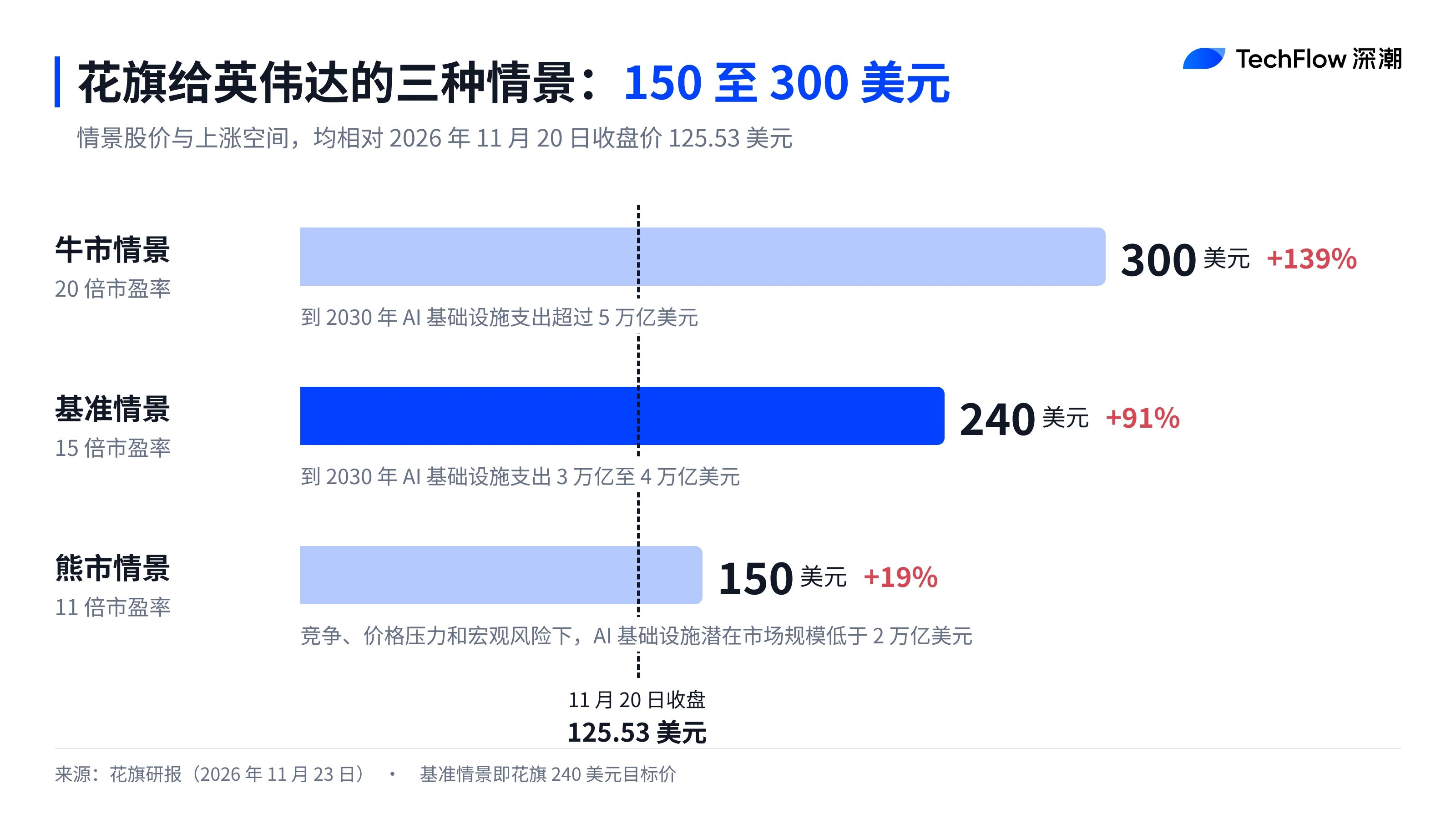
The report provides three scenarios: bullish, baseline, and bearish. The differences among them lie in the valuation multiples and the assumptions regarding AI infrastructure spending by 2030.
The baseline scenario is the target price of $240. It assumes a 15 times price-to-earnings ratio and AI infrastructure spending of $3 trillion to $4 trillion by 2030.
In the bullish scenario, the stock price could reach $300, provided that there is a 20 times price-to-earnings ratio and AI infrastructure spending exceeding $5 trillion by 2030.
In the bearish scenario, the stock price would be $150, corresponding to an 11 times price-to-earnings ratio. Citi assumes that competition, price pressures, and macro risks will depress the potential market size of AI infrastructure below $2 trillion.
Even in the bearish scenario, $150 is still about 19% higher than the closing price on November 20. The difference between the bullish and bearish scenarios is 119 percentage points.
These potentials are calculated based on the closing price on November 20 and do not reflect stock price changes following the announcement of the return on November 23. The comparison of the three scenarios is shown in the figure below:
Investigations and Export Controls Remain Variables
Citi also listed unresolved issues. The investigation into Huang's connections with a suspected Chinese intelligence officer is still ongoing.
The export investigation related to Megaspeed has not concluded either. Huang is also set to face a closed-door inquiry from the U.S. House committee, and Nvidia's 10-Q quarterly report is still delayed.
Citi's view is that if these issues are resolved completely, they could become the next catalyst for the stock price.
According to the uncertainties listed in the report, readers can refer to three key points. They are when the 10-Q will be submitted, the progress of the House's closed-door inquiry, and the conclusion of the board's independent committee investigation. Nvidia has stated that this investigation will proceed to the end.
The report also listed six downside risks. The top concern is competition in data centers. The proprietary chips (ASICs) developed by cloud vendors and AI labs may undermine Nvidia's market share and pricing power.
The popularity of new platforms such as Vera Rubin may take longer than expected. The supply of HBM, CoWoS, and substrates may also be restricted. Both factors could drag down data center sales and profit margins. Rising storage costs that cannot be fully passed on to customers will compress gross margins.
Further tightening of export controls could shrink Nvidia's addressable demand. Scenarios mentioned in the report include broader restrictions in China and Southeast Asia, remote access rules, and possible countermeasures from China.
If ongoing investigations result unfavorably, they could lead to fines or reputational damage. The last item is financing. If the financing environment for emerging cloud vendors and AI labs tightens, it will weaken demand. Nvidia’s related guarantees and commitments may also form or have liabilities.
Institutional Accounts
Fixed note regarding the contents of the research report (brokerage viewpoint, not Chao Xiang Research's viewpoint)
This article is an organization and interpretation of third-party brokerage research reports by Chao Xiang Research. The ratings, target prices, earnings forecasts, and related judgments quoted in the text are solely the views of the brokerage analysts, representing the positions of their respective institutions, and do not represent the views of Chao Xiang Research, nor do they constitute any investment advice.
The market has risks, and decisions should be independent. This article should not be used as the basis for buying or selling any securities.
免责声明:本文章仅代表作者个人观点,不代表本平台的立场和观点。本文章仅供信息分享,不构成对任何人的任何投资建议。用户与作者之间的任何争议,与本平台无关。如网页中刊载的文章或图片涉及侵权,请提供相关的权利证明和身份证明发送邮件到[email protected],本平台相关工作人员将会进行核查。