Author: AiPlot Research Institute
Focus: RWA / Digital Assets / In-depth Analysis of Financial Infrastructure
Website: https://aiplot.com/?utm_source=aicoin
From "Reality Assets on Chain" to On-chain Financial Infrastructure
Many people understand RWA as one sentence: putting real-world assets on the blockchain.
This understanding is not wrong, but it is not accurate enough. Because "on-chain" is merely a technical action, it does not equal the asset becoming valuable, nor does it mean that investors genuinely acquire rights to the underlying assets.
A more complete understanding is:
RWA maps real-world assets, rights to revenues, or financial instruments into on-chain records that are digital rights that can be recorded, transferred, settled, and composed, according to legal and regulatory requirements.
The focus here is not on "is there a token," but rather on whether there are real assets, clear rights, reliable custody, verifiable valuations, and actual usable trading and financial scenarios behind that token.
1. The Essence of RWA: It is Not About Asset Tokenization, But Asset Rights Tokenization
The Bank for International Settlements and the Committee on Payments and Market Infrastructures define asset tokenization as: generating and recording digital representations of traditional assets on programmable platforms.
This definition includes three critical components.
First, on-chain tokens must correspond to some traditional assets or asset rights. This can be U.S. Treasury bonds, money market funds, corporate bonds, stocks, gold, or even rights to real estate revenues, private credit, carbon credits, etc.
Second, tokens are not ordinary images or database identifiers, but digital rights that can embed transfer rules, holder qualifications, dividend mechanisms, and redemption conditions.
Third, assets must be able to be issued, transferred, traded, or settled within programmable systems. In the future, they may also be used for lending, repurchase, collateral, and fund management.
Thus, RWA consists of at least four structural layers:
- Underlying assets: What are the assets themselves, do they genuinely exist;
- Legal rights: Do token holders possess ownership, beneficial rights, creditor rights, or merely have price exposure;
- Issuance and custody: Who issues the token, who preserves the underlying assets, are the assets isolated;
- On-chain applications: Can the token be traded, redeemed, settled, and can it enter lending or other financial agreements.
If only the "token issuance" of the fourth layer is completed without fulfilling the first three layers, it resembles a cryptocurrency token with a narrative based on real assets, rather than a mature RWA product.
2. Why is "Having Real Asset" Not Enough?
An important judgment: Not everything with a price in the real world automatically becomes a high-quality investment-type RWA.
For instance, an asset may indeed exist but lacks a stable valuation system; there may be market prices but no clear ownership; it may be tokenizable, yet investors have no reliable exit channels; there might be revenues, but the issuer and custodian cannot prove that the asset has not been re-pledged or misappropriated.
Hence, to assess whether an RWA possesses financial value, at least five critical questions must be asked:
- Do the underlying assets genuinely exist, and can they be independently verified?
- What rights do token holders actually acquire?
- Are the assets isolated and preserved by a qualified custodian?
- How are price, net value, and yield calculated?
- How can investors subscribe, redeem, transfer, or exit?
This underscores the importance of compliance. Compliance is not merely a promotional label for projects but establishes an enforceable institutional foundation for asset rights, investor qualifications, transfer restrictions, information disclosure, and dispute resolution.
3. What are the Differences Between RWA, STO, Stablecoins, and Synthetic Assets?
RWA, STO, stablecoins, and synthetic assets are often discussed together, but they are not completely identical concepts.
RWA vs. STO
STO typically emphasizes the issuance of security-type tokens, focusing on whether the issued financial instruments qualify as securities and whether the issuance complies with securities regulations. RWA has a broader scope, encompassing not only securities but also gold, fund shares, trade receivables, and other rights to real assets.
The two may overlap. For instance, a tokenized corporate bond can be seen as both RWA and STO. However, "RWA" emphasizes the source of assets and their on-chain representation, while "STO" places more emphasis on the securities characteristics and issuance regulations.
RWA vs. Stablecoins
Stablecoins typically represent a stable value claim against a particular currency or reserve asset. Their core aim is payment and settlement stability.
Tokenized Treasury funds may represent fund shares, where holders earn revenues from the underlying Treasury bonds or cash management assets through the fund structure. It can serve as a reserve asset for stablecoins, but their legal structures, revenue distribution methods, and redemption rules differ.
RWA vs. Synthetic Assets
Synthetic assets may merely replicate price performance through collateral, derivatives, or smart contracts and may not hold corresponding underlying assets.
For instance, a token may track the price of a stock, but the issuer does not truly hold that stock. In this case, investors receive price exposure rather than ownership or beneficial rights to the stock itself.
This distinction is crucial. One of the core risks of RWA is the market conflating "supported by underlying assets" with "merely simulating the price of underlying assets."
4. The Value of RWA is Not Just About Lowering Investment Barriers
Several common values of RWA include improving liquidity, increasing transparency, promoting financial innovation, and connecting traditional finance with DeFi.
These values can be further broken down into four tangible changes.
1. Making Asset Issuance and Transfer More Programmable
Issuance, registration, custody, trading, and settlement of traditional financial products are typically carried out by multiple separate institutions. After tokenization, some rules can be embedded in smart contracts. For example, only addresses that complete KYC can hold tokens; transfers can only occur within specific time windows; yields can be automatically calculated based on holdings.
This does not mean that smart contracts can replace legal and financial institutions. They can only automatically execute rules that have been clearly expressed; they cannot independently verify the actual existence of the underlying assets.
2. Shortening Transaction and Settlement Chains
Tokenization platforms have the potential to reduce coordination friction between different systems and integrate functions like issuance, trading, and settlement into a tighter programmable environment.
Traditional asset transactions often require waiting for transaction confirmations, custody deliveries, and fund arrivals. On-chain settlement can reduce some waiting times, especially suitable for cross-border fund management, inter-institutional trading, and round-the-clock markets.
3. Enhancing Asset Composability
When tokenized assets have standardized interfaces, they can be recognized by wallets, trading platforms, lending protocols, and asset management tools.
For instance, tokenized stocks can be traded and also used as collateral to borrow USDC; tokenized money market funds can be utilized for cash management and may become low-volatility assets for on-chain trading; tokenized funds can be combined with tokenized deposits to create more automated subscription, settlement, and redemption processes.
4. Improving Data Tracking, but Not Automatically Eliminating Risks
Blockchain can record the issuance, transfer, and holding changes of tokens, thereby aiding in the analysis of asset circulation and fund flows.
However, on-chain transparency only addresses "what happened to the tokens" and does not necessarily solve "what happened to the underlying assets." If issuers disclose insufficient information, on-chain addresses cannot independently substantiate that the corresponding amounts of Treasury bonds, gold, or stocks genuinely exist in the custody accounts.
Therefore, the transparency of RWA requires the joint contribution of on-chain data, issuer disclosures, custodian proofs, and independent audits.
5. The First Change in the Recent RWA Market: Funds Begin to Clearly Differentiate
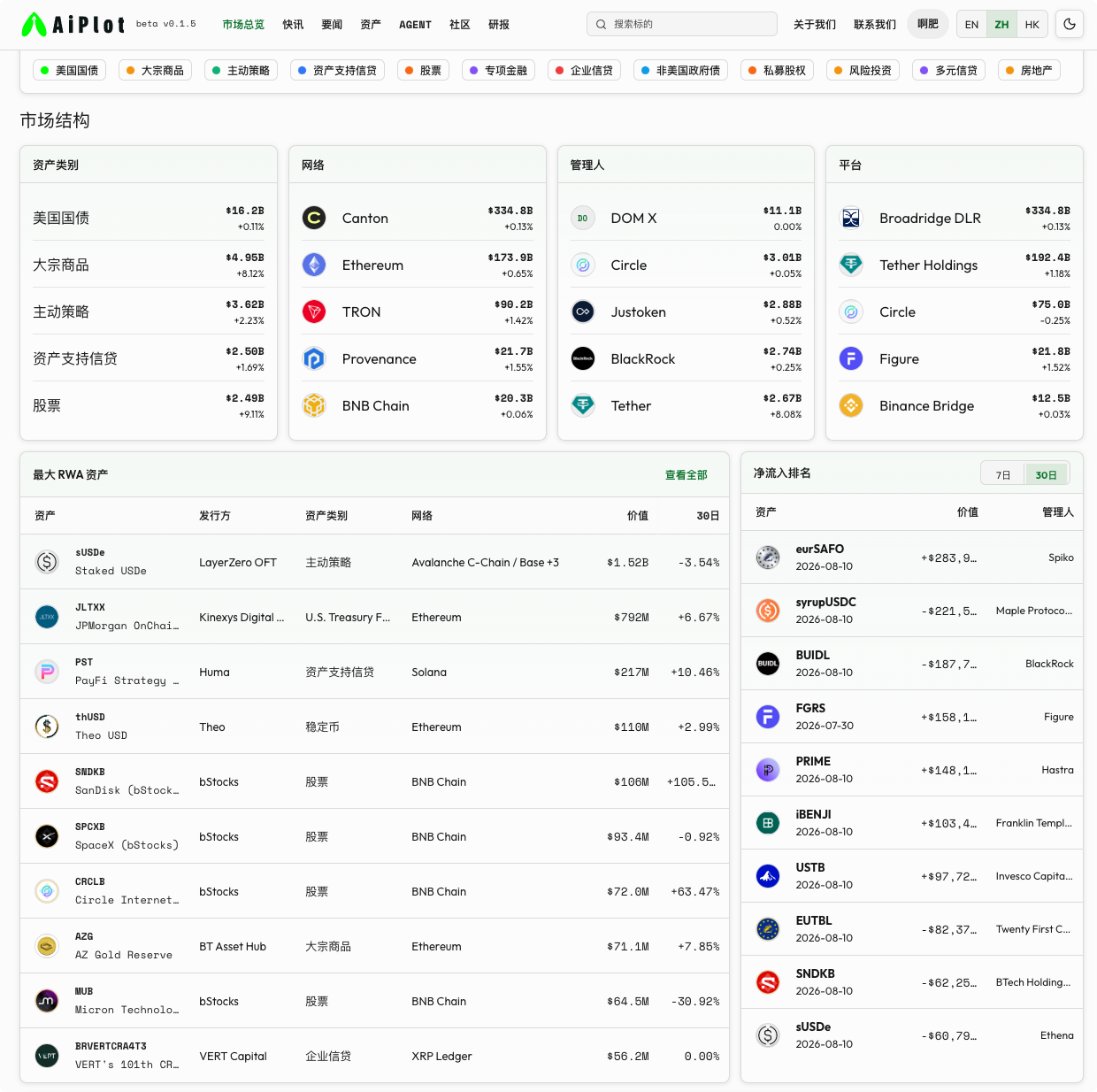
On November 24, 2026, AiPlot displayed significant product differentiation in the 7-day net flow data.
Franklin Templeton's BENJI had a net inflow of approximately $399 million, Amundi's eurSAFO had a net inflow of about $109 million, and Direxion's SOXLB had a net inflow of around $43.19 million. Meanwhile, BlackRock's BUIDL had a net outflow of about $249 million, Circle's USYC had a net outflow of approximately $143 million, and Anemoy's JTRSY had a net outflow of about $50.6 million.
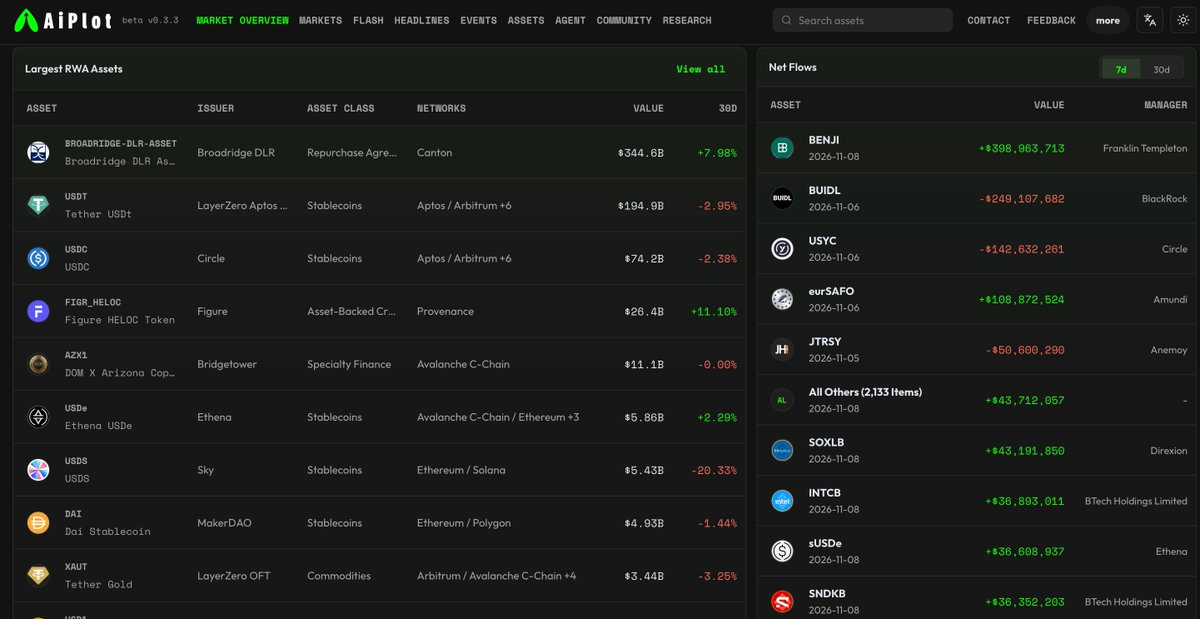
This set of data illustrates that RWA does not experience simultaneous growth across all products. Institutional funds have begun to choose between different issuers, revenue structures, redemption mechanisms, on-chain networks, and liquidity conditions.
However, net inflows and outflows cannot be directly equated with subscriptions and redemptions, nor can conclusions like "funds are shifting from BlackRock to Franklin" be drawn solely from this data. Changes in issuance volume, product migration, changes in holders, and the coverage of statistics may all influence the final data.
This is also the value of AiPlot's data tracking: not only looking at the total scale of individual assets, but also analyzing net flow alongside the number of holders, APY, NAV, network deployment, transfer volume, and redemption conditions.
It is important not to simply add the two figures together, nor to directly interpret Represented Asset Value as the scale of assets already circulating on-chain. When researching RWA, it is crucial to confirm whether the data refers to distributed, represented, market cap, or total asset value.
6. The Second Change in the Recent RWA Market: Transitioning from Issuing Products to Building Financial Infrastructure
The early narrative of RWA primarily revolved around "moving bonds, funds, and gold onto the blockchain." The recent shift indicates that assets are starting to be integrated into more complete trading, settlement, and financing processes.
Official documentation from Aave shows that seven Coinbase tokenized U.S. tech stocks can now be used as collateral to borrow USDC on Aave V4 on Base. This means that tokenized stocks are no longer just trading objects but have become collateral assets within an on-chain credit system.
Hong Kong's Project Ensemble also reflects a similar direction. In November 2025, the Hong Kong Monetary Authority launched the Ensemble TX pilot, supporting real value trading between tokenized deposits and digital assets, initially focused on tokenized money market fund trading and corporate liquidity and fund management.
By November 2026, the Hong Kong Monetary Authority announced that Ensemble TX had entered the 24/7 settlement phase for tokenized central bank currencies. The number of participating banks increased to 12, with industry pioneers rising to 20, and began to support corporate fund management, tokenized money market fund trading, and secondary trading of tokenized funds on licensed platforms.
The significance of this progress is not merely "the blockchain is running longer." It indicates that Hong Kong is testing a combination closer to real financial markets:
- Tokenized funds as trading assets;
- Tokenized deposits as settlement funds;
- Tokenized central bank currencies as interbank settlement assets;
- Regulated platforms as trading and distribution venues.
When RWA begins to combine with payment, settlement, collateral, and fund management, it transitions from a single product narrative to a financial market infrastructure.
7. The Most Common Application Scenarios for RWA
Tokenized Treasury Bonds and Money Market Funds
This is currently one of the most mature types of RWA. The underlying assets usually have a public market, clear NAV, and relatively mature custody systems. BENJI, BUIDL, USYC, and USDY are all representative products in this direction.
They can provide on-chain investors with USD-denominated returns and can also become cash management tools for trading platforms and DeFi protocols. It is important to note that the investment barriers, investor qualifications, transfer restrictions, and redemption mechanisms for these products vary.
Tokenized Stocks
Tokenized stocks provide economic exposure to stocks, and some products may also reflect total returns through token supply adjustments, dividend reinvestments, and corporate action handling.
The focus of these assets is not only whether they can be traded 24/7 but also whether they can access the lending market, whether they possess reliable oracles, whether there is sufficient clearing liquidity, and what legal rights token holders actually have.
Tokenized Gold and Commodities
Gold tokens are typically supported by custodial physical gold or corresponding beneficial rights. Investors need to pay attention to the storage location of gold bars, audit frequency, redemption conditions, custodians, and the correlation between on-chain tokens and physical inventories.
Real Estate and Private Credit
Real estate, receivables, and private credit have relatively high asset scales but more complex valuation and exit mechanisms. They may yield higher returns but commonly lack continuous and transparent market prices like Treasury bonds and large stocks.
Therefore, these types of RWA rely more on issuer disclosures, independent valuations, legal documents, and mechanisms for professional investors. Tokenization does not automatically create liquidity but provides a new technical basis for future transfers and segmentation.
Green Finance and Carbon Assets
Carbon trading may become a long-term direction for RWA.
Carbon assets have potential for cross-regional trading and standardized pricing, but currently face issues regarding the quality of carbon credits, certification standards, double counting, and cross-market mutual recognition. Whether carbon assets are suitable for large-scale tokenization hinges not on the ability to issue tokens but on whether the underlying emission reduction effects can be independently verified.
8. What Should You Look for When Evaluating an RWA Project?
Beginners do not need to study complex smart contract code first but must understand the asset and rights structure clearly first.
First, look at the assets. Are the underlying assets Treasury bonds, fund shares, stocks, gold, or a private debt lacking continuous valuation? The quality of the assets determines the starting point for returns and risks.
Second, look at the rights. Does the token represent ownership, beneficial rights, creditor rights, or just provide price exposure? This determines whether investors can achieve relief in the event of issuer default or bankruptcy.
Third, look at custody. Who is preserving the underlying assets? Are they isolated? Is there auditing, reserve proof, or independent supervision?
Fourth, look at valuation. Are prices derived from trading markets, fund NAV, issuer quotes, or oracle models? Different valuation methods correspond to different liquidity and settlement risks.
Fifth, look at exit. Can investors redeem? How long is the redemption cycle? Are transfers only allowed to whitelisted addresses? Is there a secondary market?
Sixth, look at use cases. Whether the token can be traded is just the starting point. Whether it can be used for collateral, settlement, or fund management further indicates whether it has entered on-chain financial activities.
Conclusion: The Endpoint of RWA is Not "Asset on Chain," But "Asset Usable"
RWA is not merely about adding a blockchain label to real assets, nor do all tokens with real asset narratives possess investment value.
High-quality RWA must at least concurrently meet several criteria: underlying assets must genuinely exist, legal rights must be clear, custody and valuation must be credible, investors must be able to subscribe or exit according to the rules, and assets must be capable of entering real trading, settlement, or financing processes.
Recent developments indicate that RWA is undergoing two changes. Market funds are beginning to differentiate among various products, while financial centers like Hong Kong are starting to link tokenized assets with tokenized deposits, central bank currency settlements, and secondary trading.
For more data and analysis, please follow Aiplot:
https://aiplot.com/?utm_source=aicoin
📖 Community Communication:
Telegram:
https://t.me/+IIYMcJigBAo4Mjg1
The content of this article represents only the author's personal views and does not reflect the stance of this platform. The views, conclusions, and suggestions contained in the article are for the reference of investors only and do not constitute any investment advice related to this platform. The market has risks, and investments need to be cautious.
免责声明:本文章仅代表作者个人观点,不代表本平台的立场和观点。本文章仅供信息分享,不构成对任何人的任何投资建议。用户与作者之间的任何争议,与本平台无关。如网页中刊载的文章或图片涉及侵权,请提供相关的权利证明和身份证明发送邮件到[email protected],本平台相关工作人员将会进行核查。