Author: Four Pillars Research Team
Editor: Gu Yu, ChainCatcher
Abstract
The year 2026 is a contradictory year for digital assets. Prices are struggling, market attention is shifting towards AI, yet the crypto industry is more deeply embedded in the financial system than ever before. Institutions are entering on-chain markets, regulators are creating clearer pathways for digital assets, and stablecoins, tokenized securities, and crypto-native market infrastructure are increasingly connected to traditional finance. Crypto may have lost the spotlight, but it has gained something more enduring: a place within the system.
This shift has also made the market more selective. Growth is concentrated in areas with clear demand, whether speculative markets like perpetual contracts and prediction markets, or financial infrastructure like stablecoins, RWA, payments, and institutional on-chain products. Meanwhile, weaker protocols are shutting down, venture capital activity is slowing, token valuations are becoming more sensitive to revenue and value capture, and companies in the industry are converging on fewer, more validated opportunities. The market is no longer simply rewarding participation but increasingly questioning: what truly works, who is using it, and where does the value ultimately flow?
Through this lens, "State of Digital Assets 2026" looks forward to 2027. The next phase will no longer be about putting more assets, products, and users on-chain for the sake of being on-chain but transforming the infrastructure built over the past few years into true utility, sustainable economic models, and broader distribution. From institutional finance and tokenized assets to new trading markets and agentic payments, the core question is becoming consistent: as the crypto industry enters the system, once inside, what value can it prove?
Market Summary
A review of the overall crypto market in 2026 through market capitalization, trading volume, and active wallets.
Difficult Start to 2026, Clear Winners and Losers
DefiLlama, CoinGecko, CoinMarketCap, RWA.xyz · As of October 30, 2026
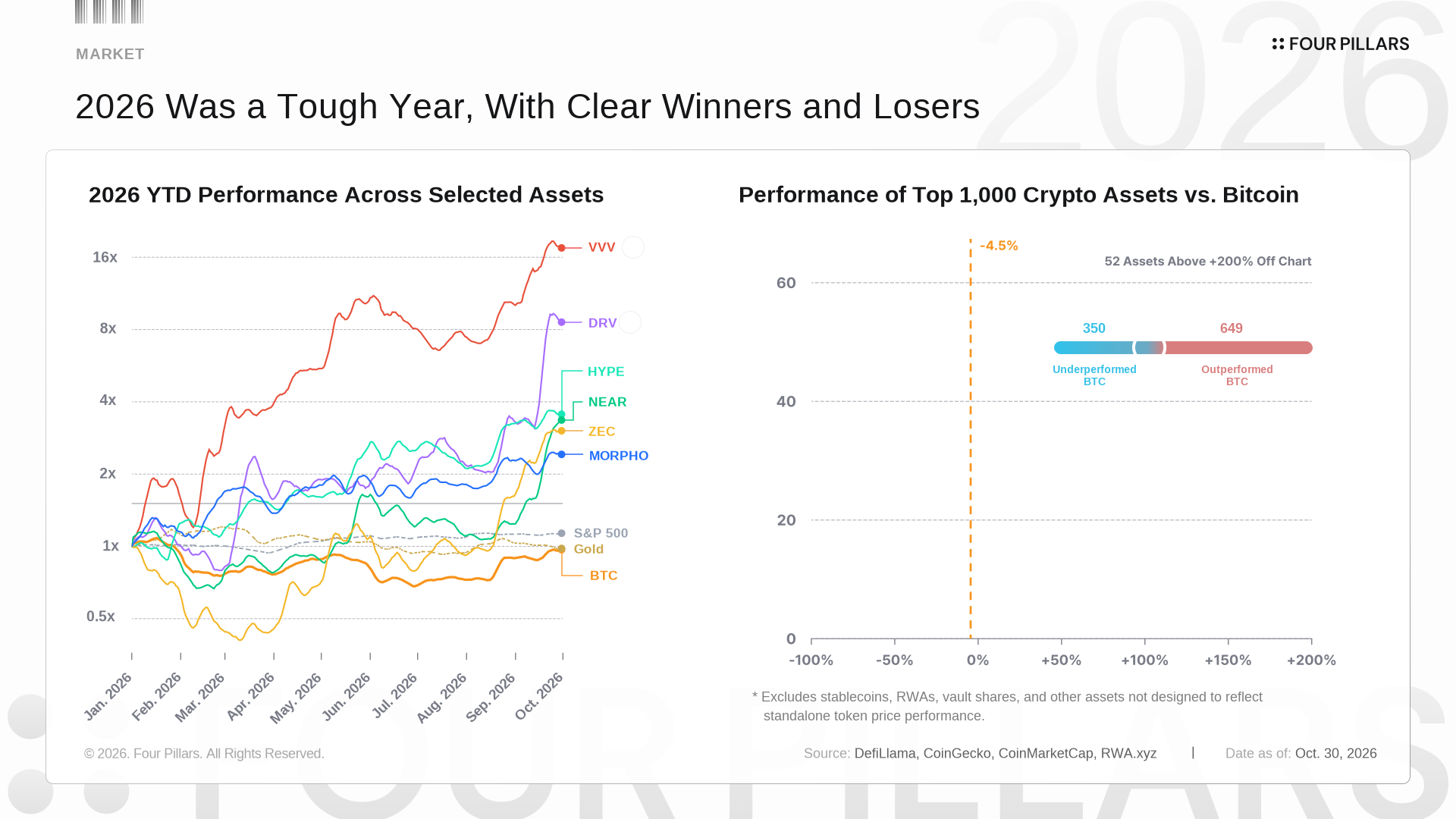
2026 has been a tough year for the crypto industry as a whole. The market experienced a prolonged downturn in the first half of the year, and even after a strong rebound in the third quarter, the total market capitalization of crypto remains below that at the beginning of the year. As of late October, Bitcoin is still in negative return territory. More importantly, this weakness is widespread. Among the top 1000 crypto assets shown in the chart, 649 have underperformed Bitcoin, while only 350 have outperformed it. Meanwhile, a few tokens like HYPE, NEAR, MORPHO, and ZEC have achieved outsized gains. Consequently, instances of widespread market rallies are rare, with returns concentrated among relatively few winners.
2026 Crypto ETF Flows Basically Flat
Farside Investors, CoinGecko · As of October 15, 2026
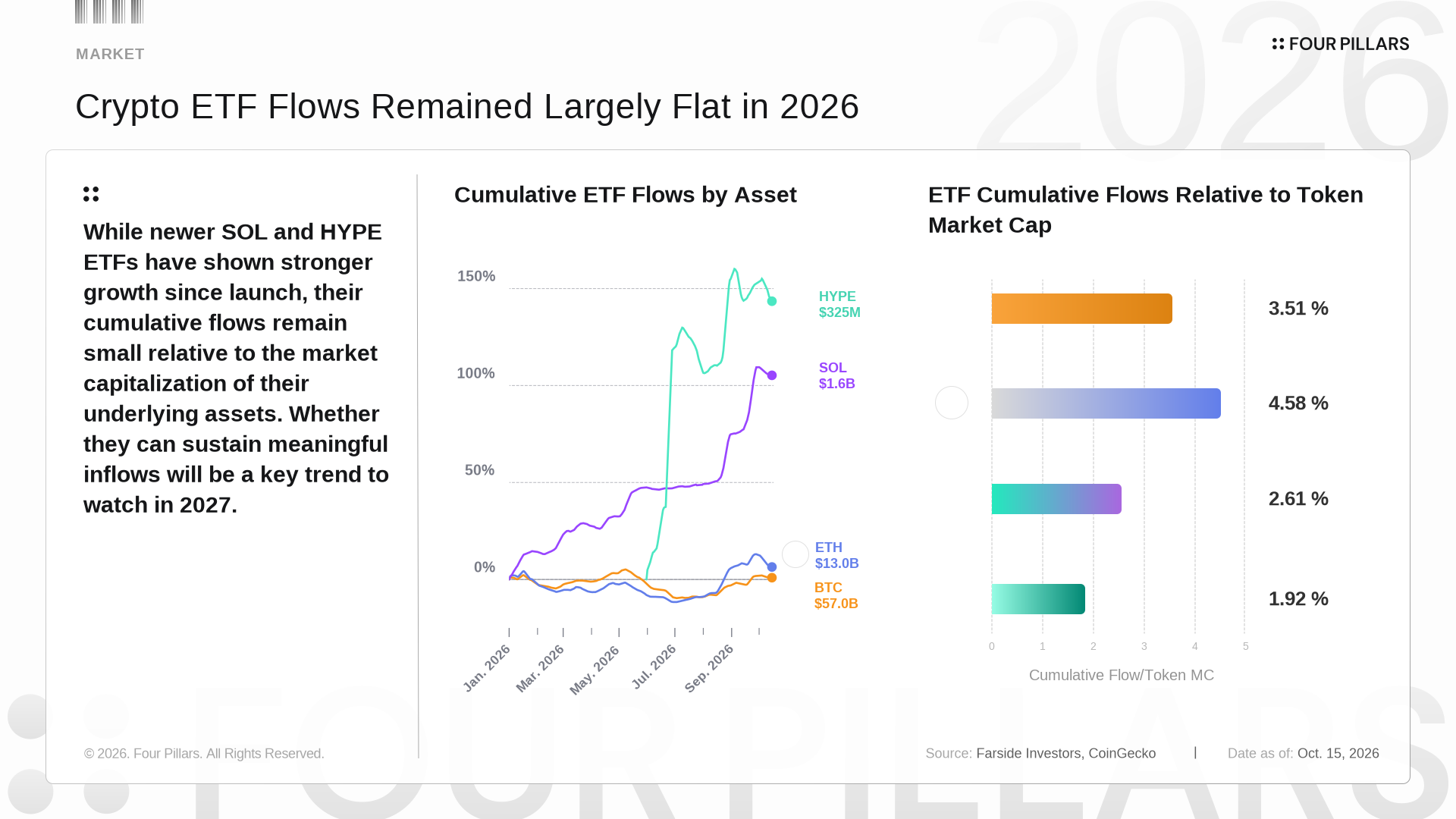
The inflows for crypto ETFs in 2026 have basically stagnated. By the end of this period, cumulative inflows for BTC and ETH were approximately $57 billion and $13 billion, respectively, with both remaining largely range-bound for much of the year rather than maintaining the strong inflow trend that began post-launch.
DAT Trading at a Discount, Momentum Weakens
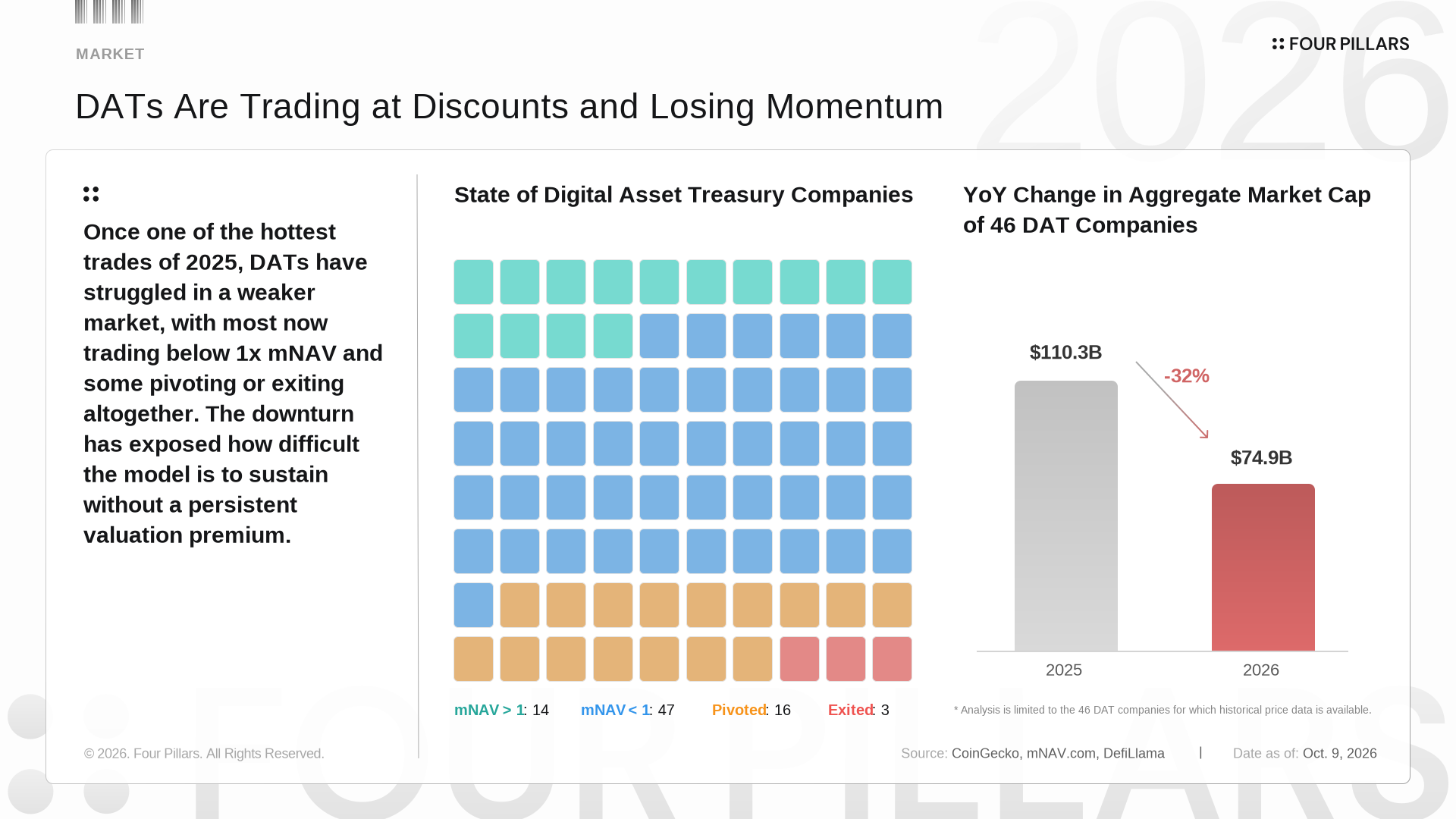
Coingecko, mNAV.com, DefiLlama · As of October 9, 2026
DAT (Digital Asset Treasury Company) was one of the hottest trading themes in 2025, but as the 2026 crypto market weakened, this model has come under significant pressure. Among the companies shown in the chart, only 14 continue to trade above 1x mNAV, while 47 are below 1x. The total market capitalization of the 46 DAT companies with historical price data has also decreased by 32%, from $110.3 billion in 2025 to $74.9 billion in 2026. The problem lies at a structural level. When DAT trades above its net asset value (NAV), it can issue shares at a premium, using the proceeds to purchase more crypto assets, thus reinforcing the flywheel effect. Once mNAV falls below 1x, new share issuances will dilute existing shareholders, causing this mechanism to fail. This shift to discount trading raises questions about the sustainability of the model. For companies unable to maintain the flywheel, the outcomes are increasingly polarized. The charts show that 16 companies have adjusted their strategies, with 3 exiting entirely. In other words, 2026 turned DAT trading from a broad market narrative into a test of which companies could truly navigate a weak cycle based on their own capital structures.
Bitcoin May Be Approaching a Cycle Bottom
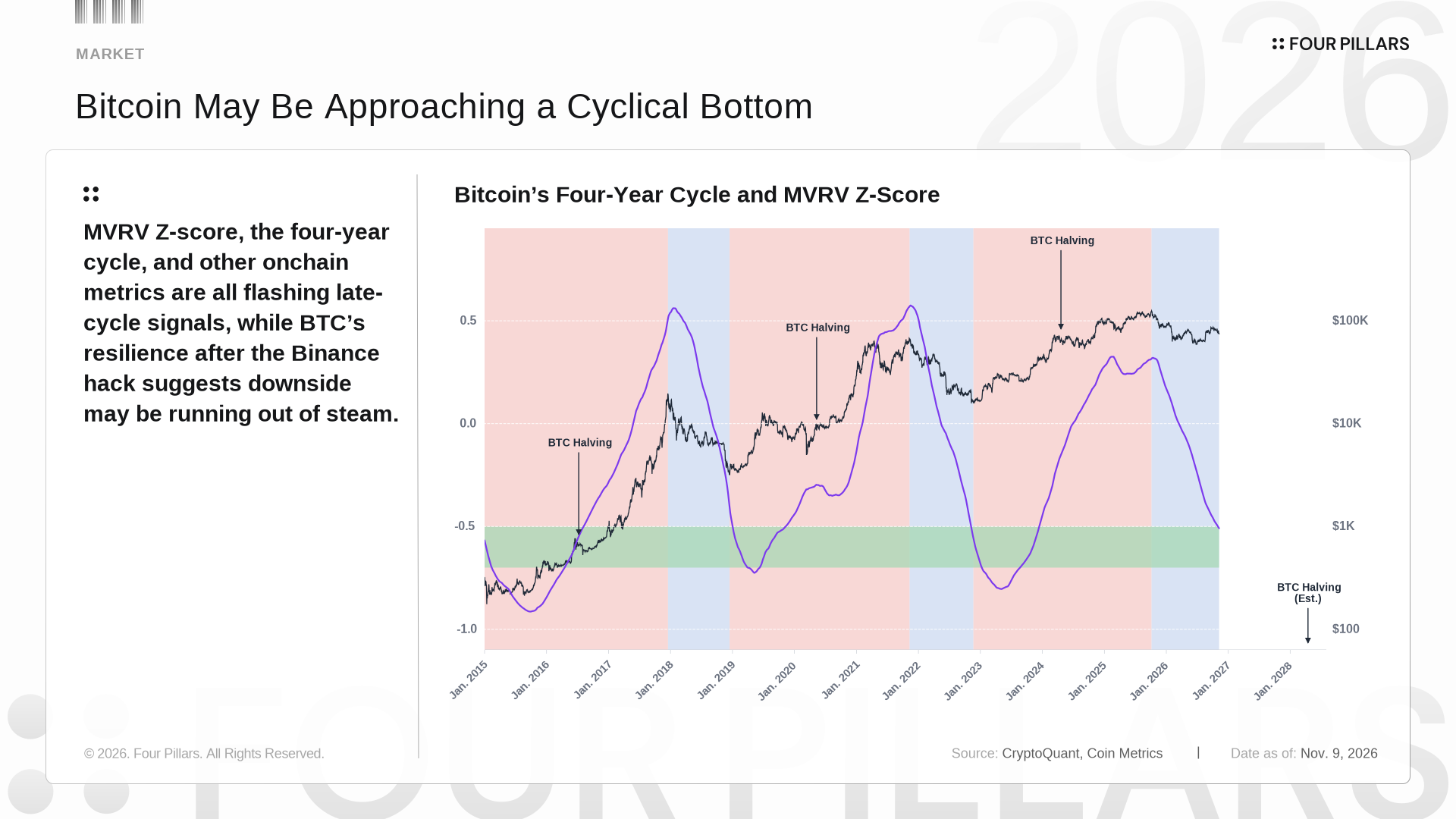
Bitcoin’s four-year cycle has historically corresponded quite accurately with important market turning points. If this framework still holds, the current pattern suggests that Bitcoin may be approaching the late stage of its downward cycle and gradually nearing a cyclical bottom. The MVRV Z-score points in a similar direction. This indicator compares Bitcoin’s market capitalization with its realized value (i.e., the aggregate cost basis of holders on-chain) and standardizes the gap between the two using historical volatility. Historically, lower readings usually correspond to an undervalued, late-stage bear market, while higher readings often occur during periods of market overheating. Therefore, the current decline in the MVRV Z-score suggests that a significant reset in Bitcoin’s valuation may have already occurred. If the four-year cycle theory continues to hold, Bitcoin may be close to the bottom region. The question now is simple: can it start to rise from here?
The On-Chain Ecosystem is Showing a Increasingly Barbell Structure
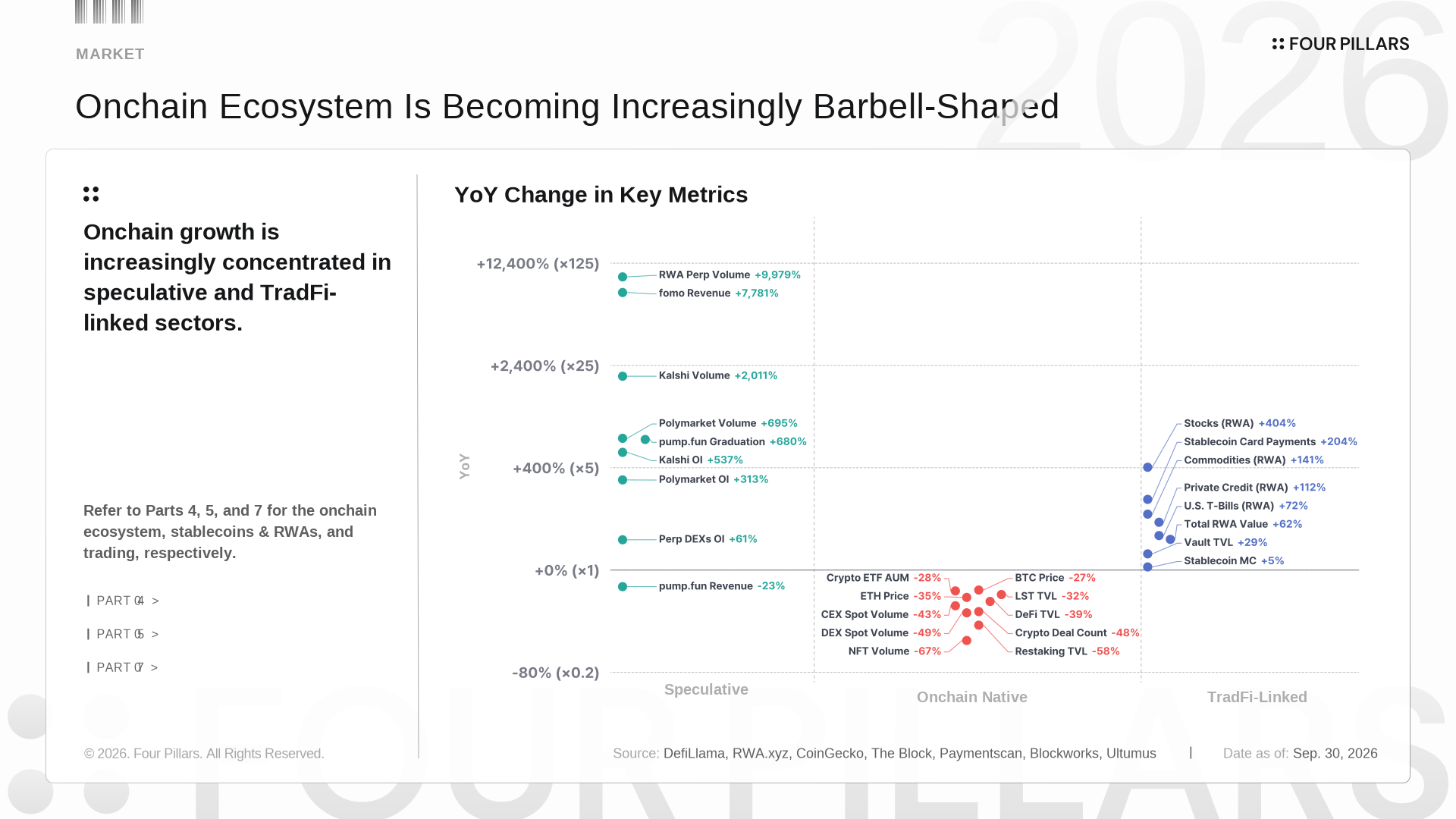
DefiLlama, RWA.xyz, CoinGecko, The Block, Paymentscan, Blockworks, Ultumus · As of September 30, 2026
In 2026, the on-chain market is increasingly taking on a barbell structure. Despite the broader crypto market being weak, growth at both ends of the ecosystem remains exceptionally strong. On the speculative side, Kalshi saw trading volume grow by 2011% year on year, Polymarket by 695%, and the open interest in perpetual contract DEXs grew by 61%. On the traditional finance-linked side, tokenized stocks grew by 404%, stablecoin card payments by 204%, and private credit by 112%. For in-depth analysis about the on-chain ecosystem, stablecoins, RWA, and trading, please refer to sections 4, 5, and 7 respectively.
The Crypto Industry is Losing Venture Capital Attention
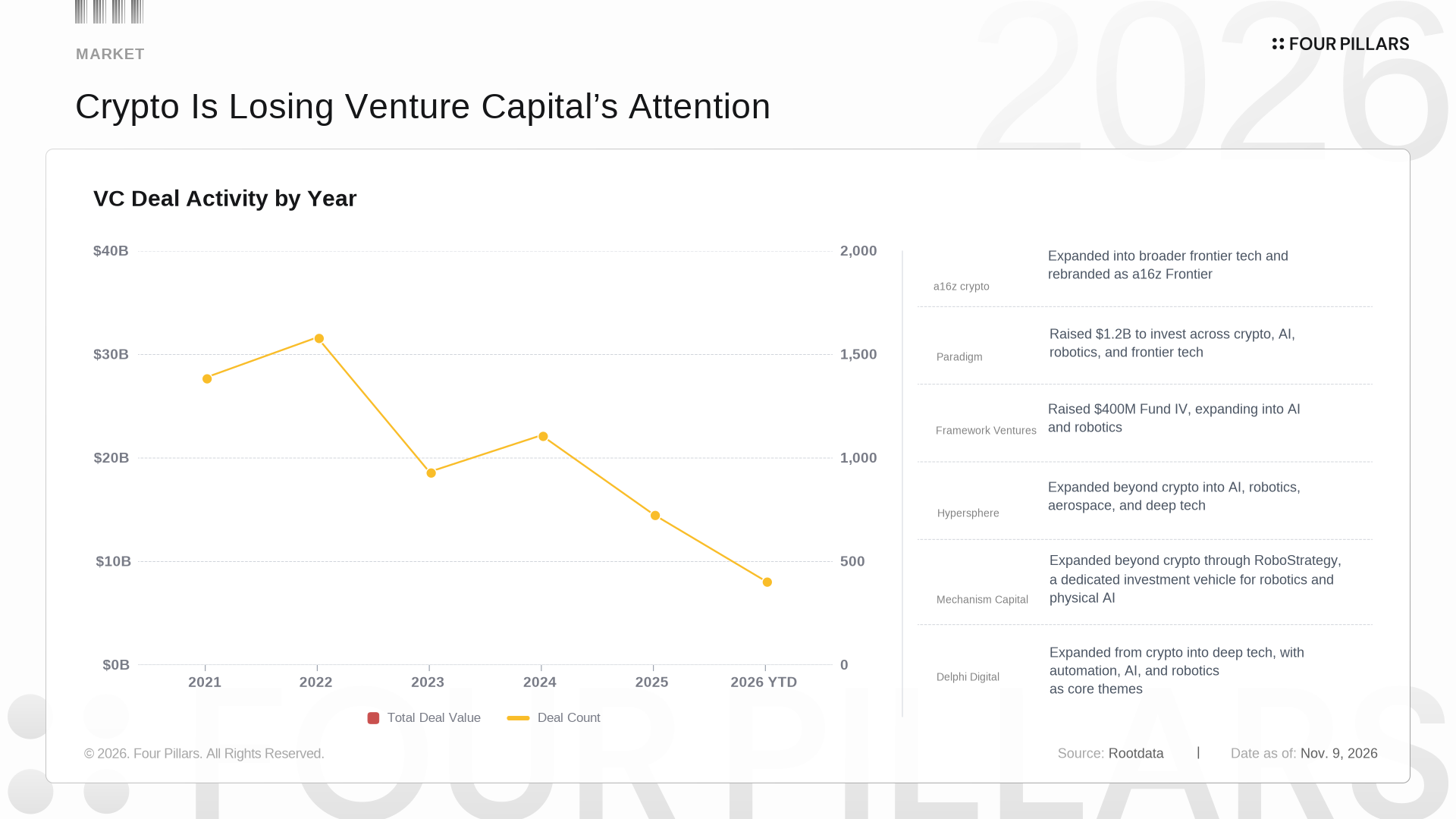
As of November 9, 2026
Venture capital activity in the crypto space has significantly declined from the peak of the last cycle. The chart shows that the number of deals fell from over 1500 in 2022 to less than 500 year to date in 2026, with total deal size also far below the peaks of 2021 and 2022. This shift is also visible in venture capital firms that were previously mainly associated with crypto. Companies that once primarily focused on crypto are increasingly branching out into AI, robotics, physical AI, aerospace, and other leading-edge technology fields. a16z crypto has expanded into a broader a16z Frontier platform, while Paradigm, Framework, Hypersphere, Mechanism Capital, and Delphi have all extended their investment mandates beyond crypto. The message is increasingly clear: the crypto industry is no longer just competing for capital within its own space but contending for attention with some of the fastest-growing tech sectors.
Mergers and Acquisitions Remain Active as the Industry Matures
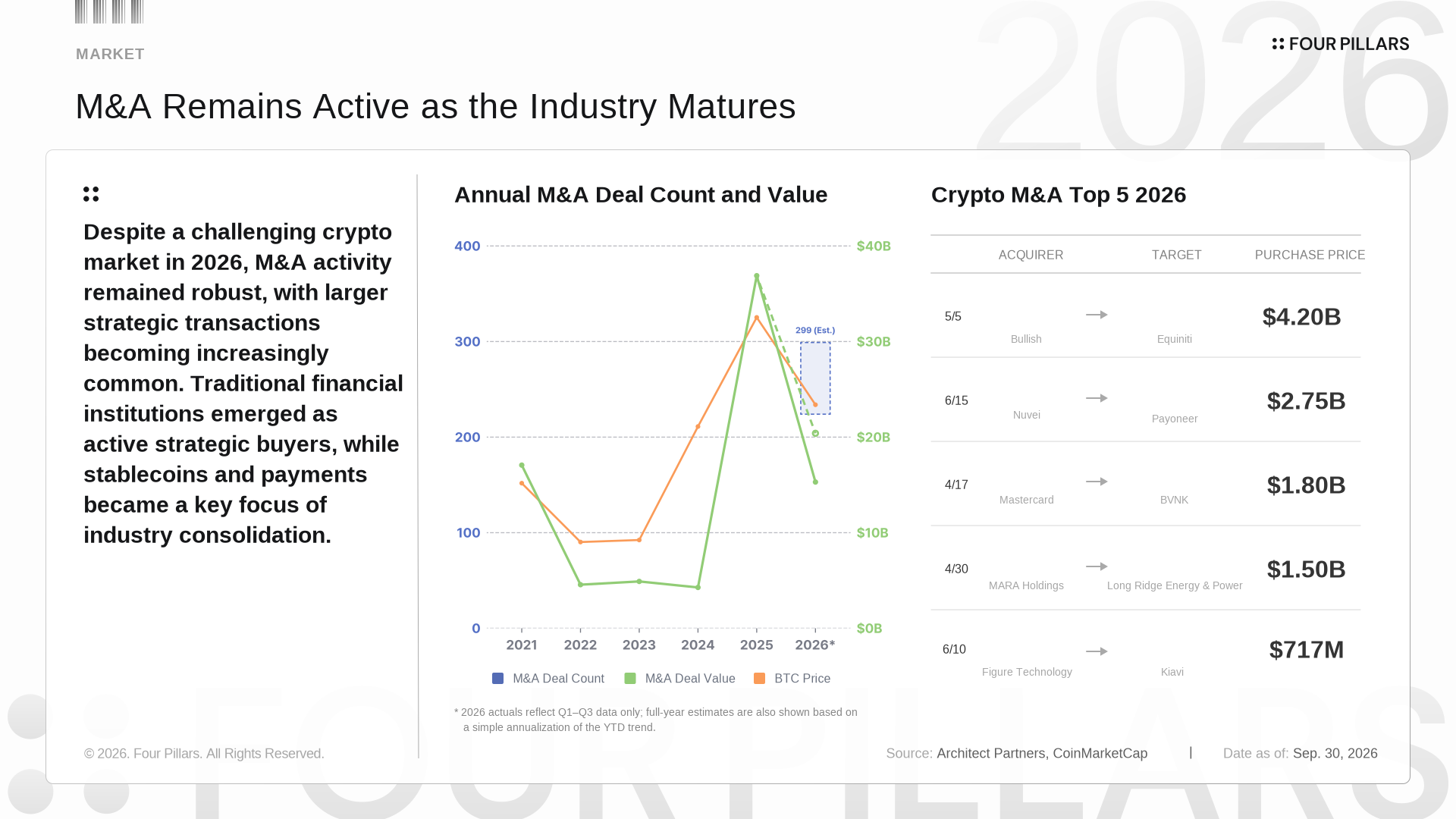
Architect Partners, CoinMarketCap · As of September 30, 2026
While crypto venture capital has weakened in 2026, mergers and acquisitions have risen against the trend. The chart indicates that about 300 deals are projected for 2026, with estimated annual deal volume still staying above $20 billion. More importantly, the largest transactions have become significantly larger, including Bullish’s $4.2 billion acquisition of Equiniti, Nuvei’s $2.75 billion acquisition of Payoneer, and Mastercard’s $1.8 billion acquisition of BVNK.
Fundamentals Start to Matter
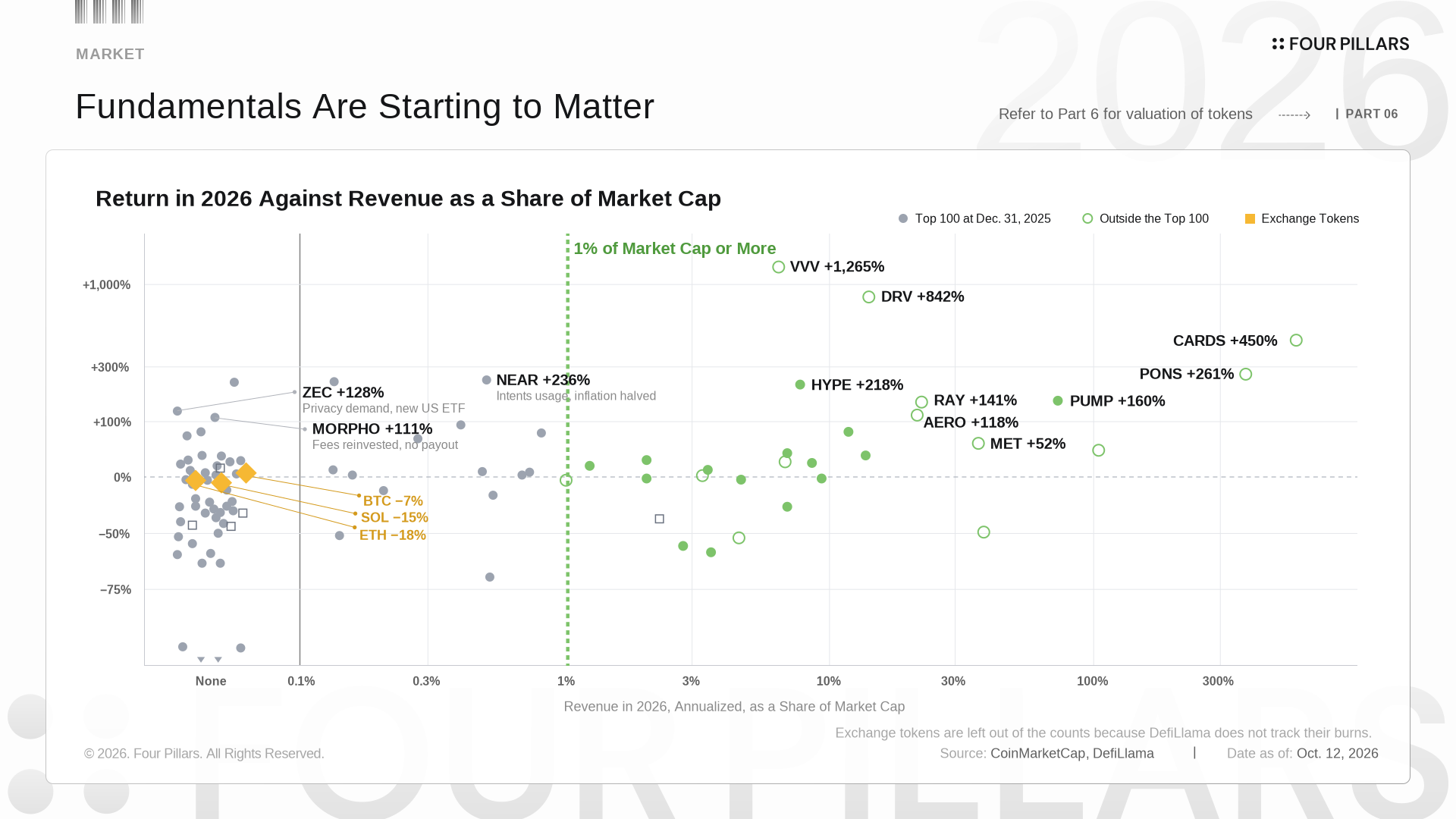
CoinMarketCap, DefiLlama · As of October 12, 2026
Unlike previous cycles, the link between token performance and fundamentals is clearer in 2026. The chart indicates that protocols generating significant revenue relative to their market capitalization tend to perform better, while many tokens with little to no revenue remain concentrated in negative return territory. The strongest performing tokens, including VVV, DRV, HYPE, RAY, and PUMP, also sit well above the 1% revenue-to-market cap threshold shown in the chart. This suggests that the market is becoming more selective about whom it rewards. Revenue itself does not determine token performance, but the increasingly strong relationship between operational economics, value capture, and price indicates that the crypto industry is beginning to take fundamentals pricing more seriously.
Tokenized Stocks Make Strides in 2026
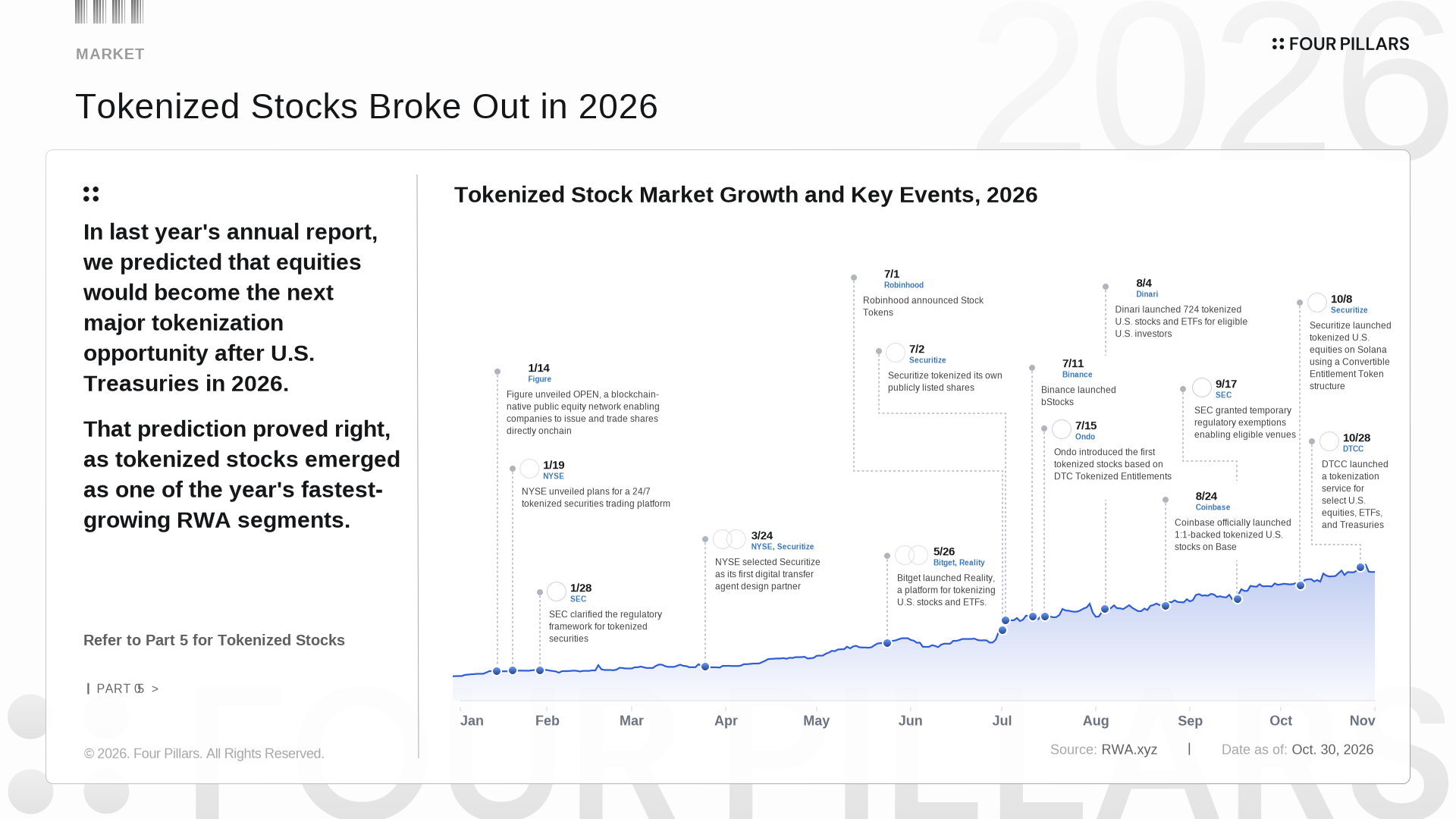
As of October 30, 2026
2026 has been a breakthrough year for tokenized stocks, as the market rapidly expanded both in scale and depth. The chart shows that with new platforms and products entering the market and distribution channels widening, the market capitalization accelerated growth throughout the year, especially from mid-2026 onwards. This growth is also reflected in quality. Companies like Robinhood, Dinari, Binance, Ondo, Coinbase, Securitize, and DTCC have launched or expanded tokenized stock offerings, while U.S. regulators have begun providing clearer frameworks for the issuance and trading of tokenized securities. In September, the SEC granted temporary conditional exemptions for on-chain trading of certain tokenized NMS stocks, marking a meaningful step toward regulated adoption. Altogether, the combination of platform expansion, institutional participation, and regulatory progress suggests that tokenized stocks are likely to continue being one of the fastest-growing RWA categories in 2027.
Institutional Adoption and Stablecoins Defined Asia in 2026
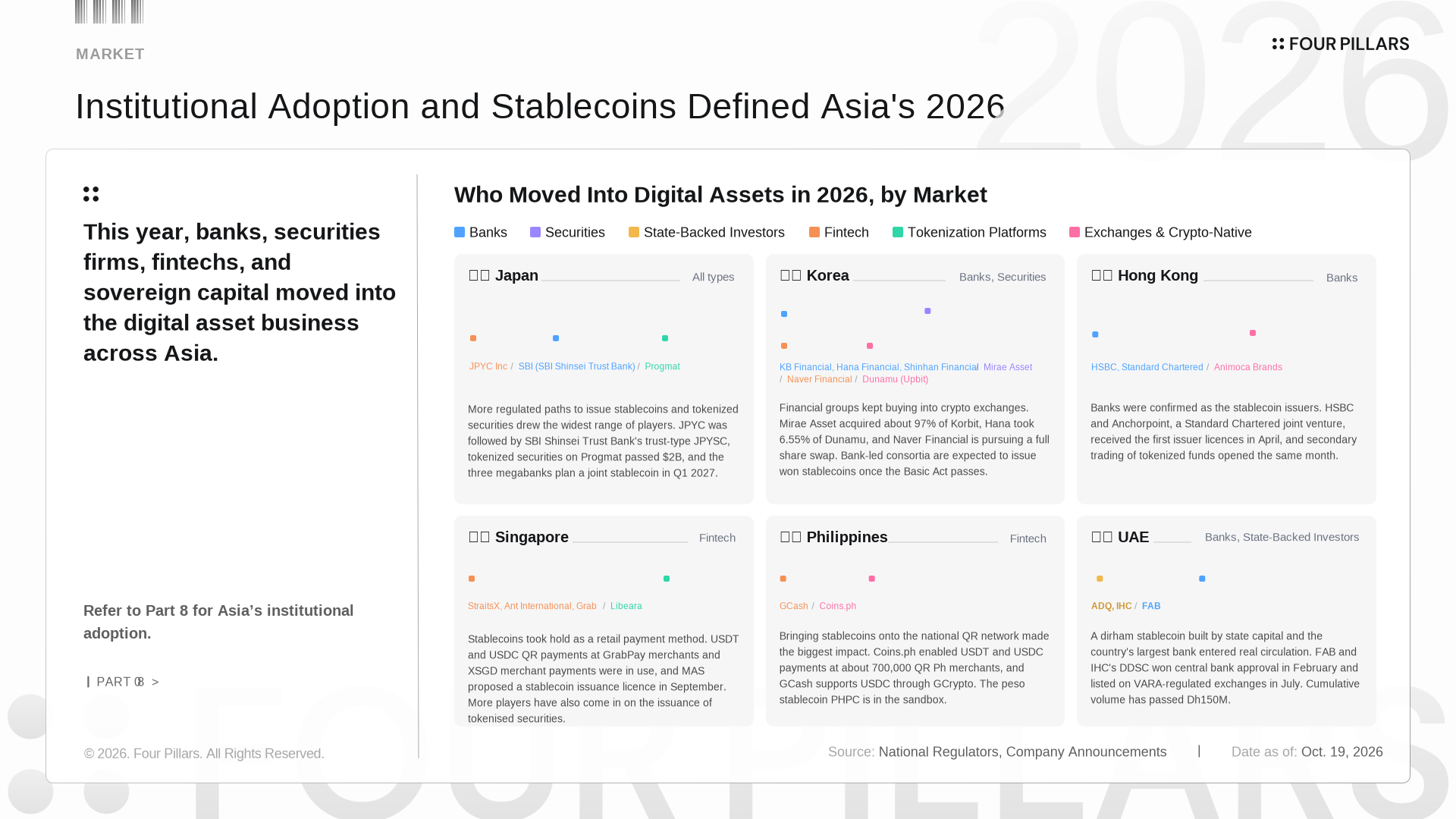
National Regulators, Company Announcements · As of October 19, 2026
Institutional adoption is one of the clearest themes in Asia in 2026. Banks, brokerage firms, fintech companies, exchanges, and sovereign-backed entities have entered the digital asset space more deeply, but the form of adoption varies by market. Japan has advanced regulated stablecoins and tokenized securities, South Korean financial groups have increased exposure to crypto exchanges, Hong Kong has allowed banks to participate in stablecoin issuance, while Singapore and the Philippines continue to push for payment and fintech-led adoption. The common thread is that digital assets are increasingly entering existing financial institutions rather than developing as a separate industry. Meanwhile, Asia remains highly fragmented, with each jurisdiction following its own regulatory and business path. For an in-depth analysis of institutional adoption in Asia, see section 8.
Agentic Payments Still Have a Long Way to Go for Mainstream Adoption
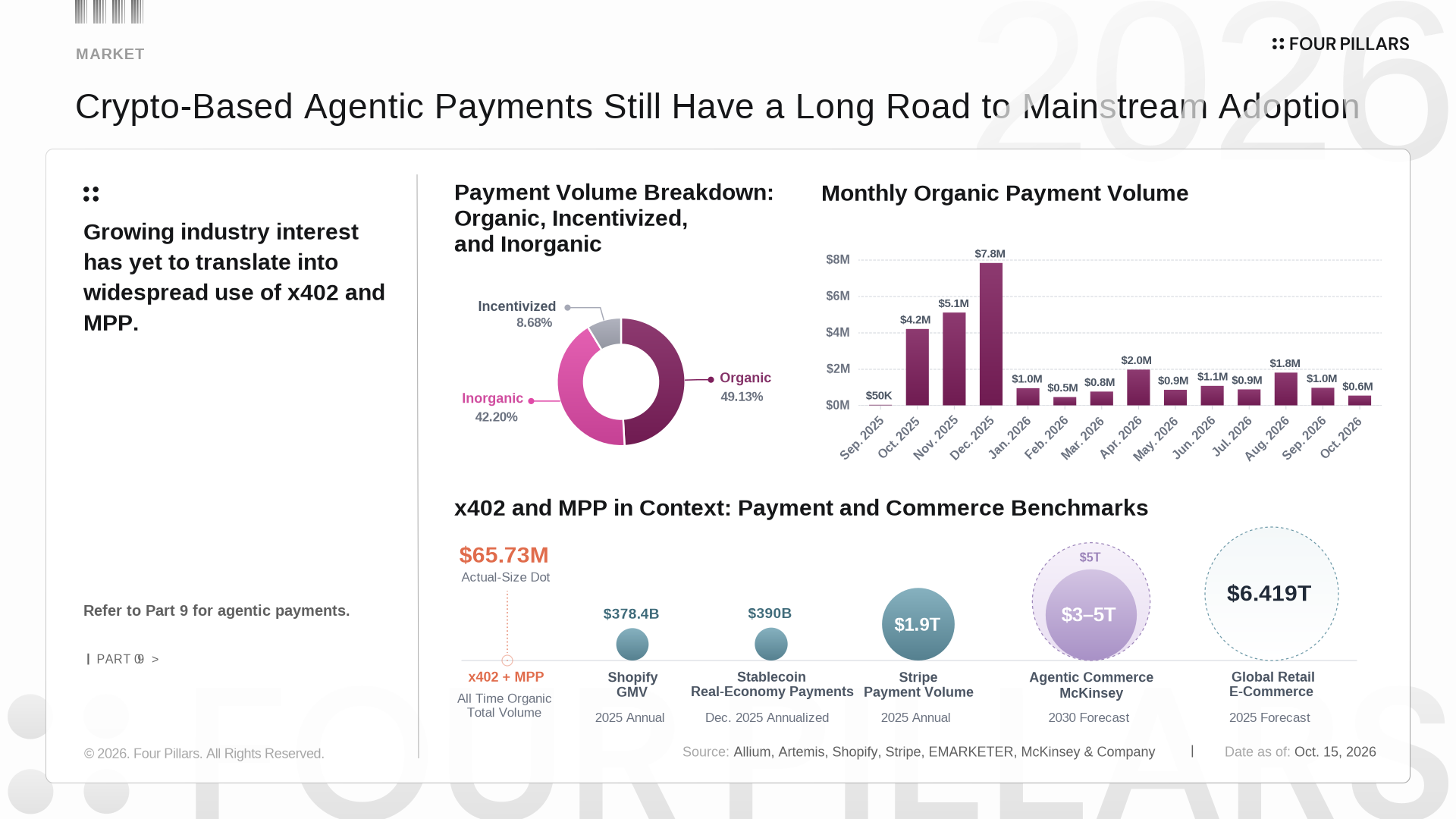
Allium, Artemis, Shopify, Stripe, EMARKETER, McKinsey & Company · As of October 15, 2026
Agentic payments have become one of the most discussed new use cases for crypto in 2026, but actual adoption remains in a very early stage. On x402 and MPP, the total historical natural payment volume amounts to only $65.73 million, with almost half of the observed activity classified as non-natural activity and another 8.7% categorized as incentive-driven. Monthly natural payment volume peaked at $7.8 million at the end of 2025, but has remained mostly between $500,000 and $2 million per month throughout 2026. The gap is more pronounced compared to the existing payments and commerce market. In contrast to Shopify's total GMV of $378 billion, $390 billion in stablecoin real economy payments, and Stripe's annual payment volume of $1.9 trillion, the agentic payment volume is still negligible, not to mention the projected multi-trillion dollar market for agentic commerce by 2030. Infrastructure and concepts are beginning to take shape, but meaningful mainstream use has yet to arrive. For in-depth analysis on agentic payments, see section 9.
Bitcoin at a Crossroads
Focusing on Bitcoin itself: spot ETPs, corporate holdings, and mining economics.
Has Bitcoin Found the Cycle Bottom?
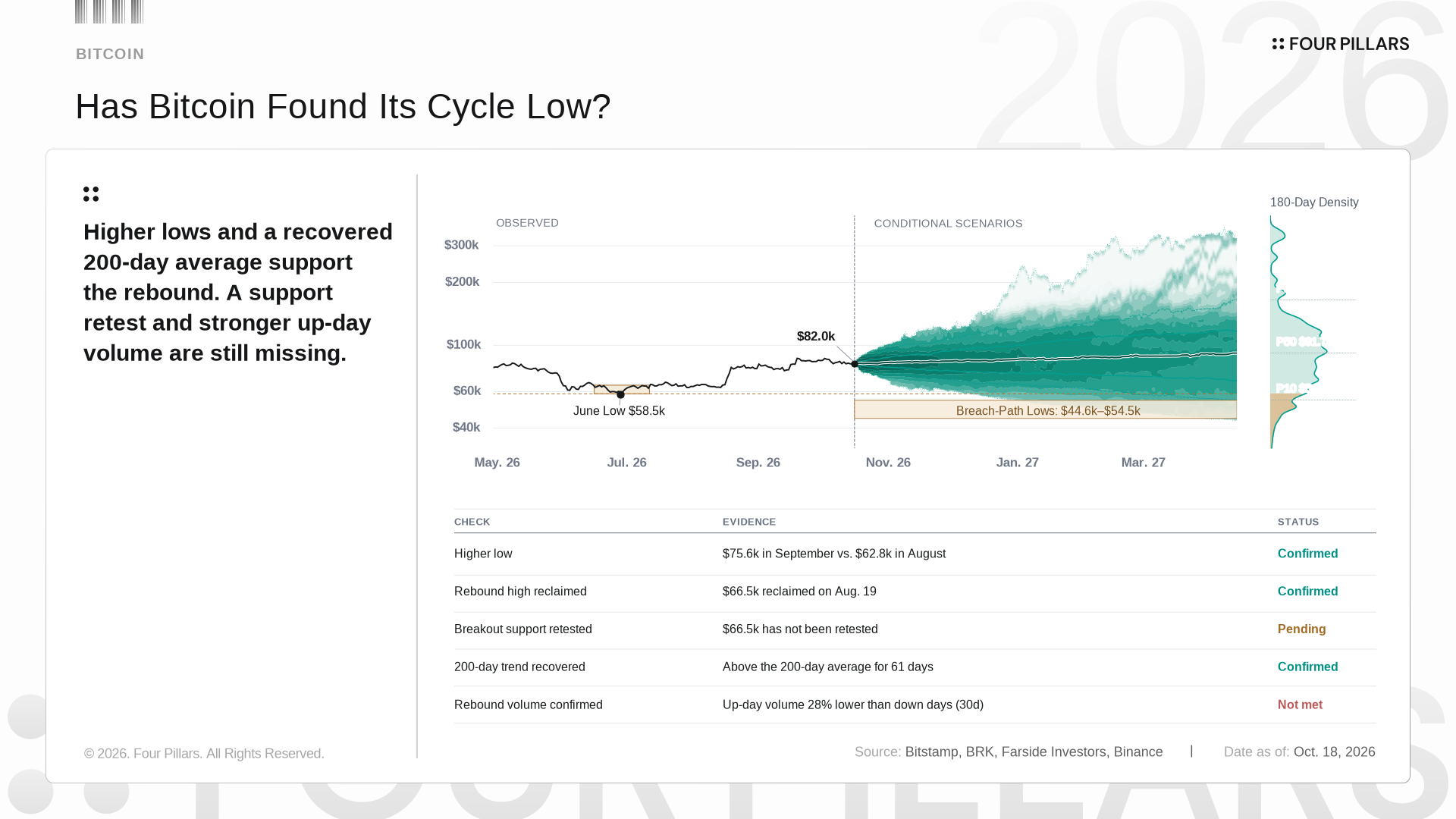
Bitstamp, BRK, Farside Investors, Binance · As of October 18, 2026
As of October 18, 2026, Bitcoin has rebounded to about $82,000, approximately 40% higher than the low of $58,526 in June. The price has reclaimed the 200-day moving average and the short-term holder cost basis. However, the 30-day short-term holder SOPR is only 1.003, which indicates that realized profits are just above breakeven. These indicators support the recovery since the June low, but recent buyers do not seem to have enough profit buffer to withstand further declines.
Bitcoin's Price Correlation with the S&P 500 is Strengthening
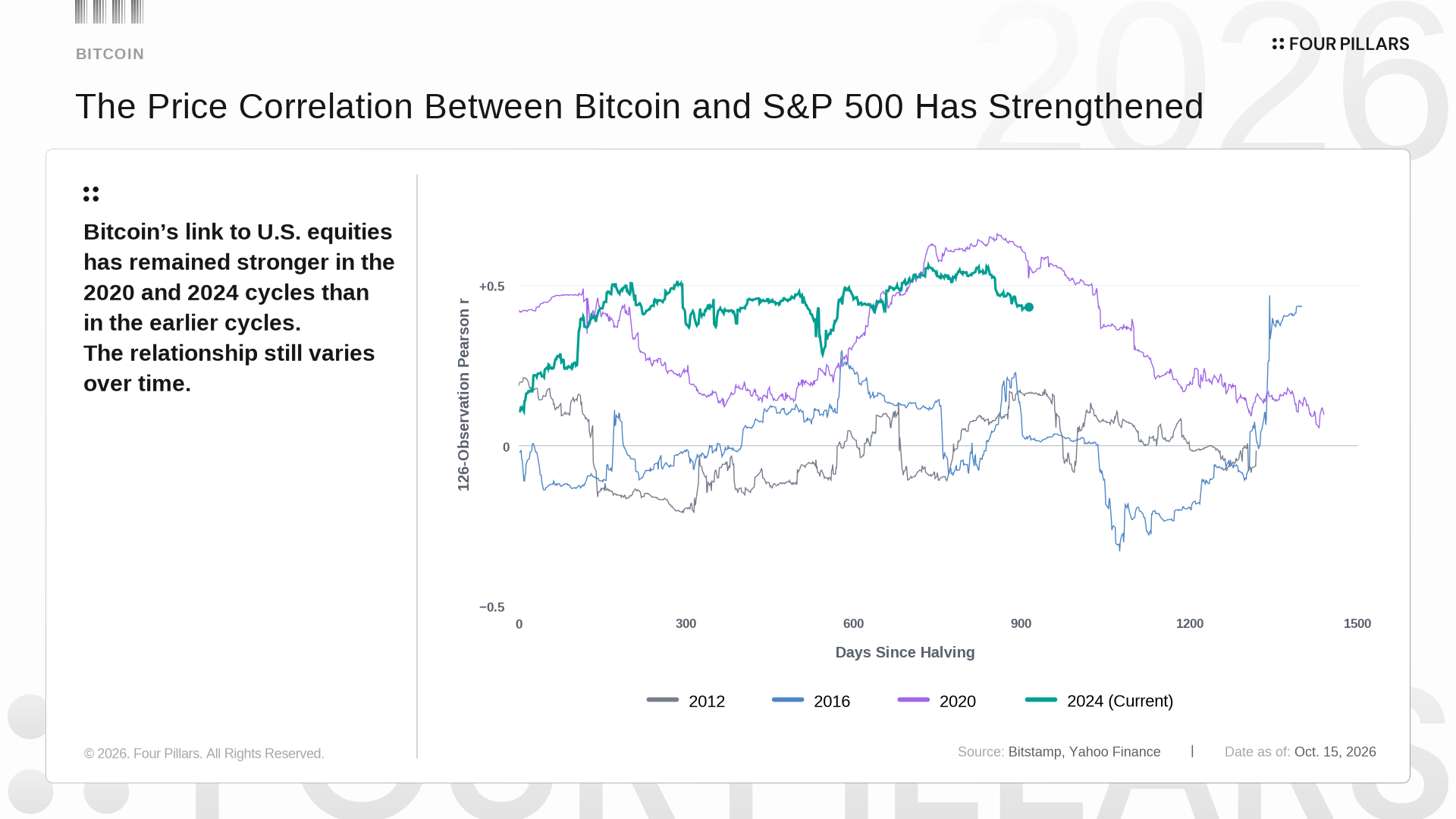
Bitstamp, Yahoo Finance · As of October 15, 2026
Comparing the returns of each halving period over the first 908 days, Bitcoin's correlation with the S&P 500 index was -0.06 in 2012, 0.07 in 2016, 0.39 in 2020, and is currently 0.43 in this cycle. The first two corresponding cycles had weak stock market correlation, but the tendency for both assets to move in the same direction became more apparent in the 2020 cycle. This relationship has continued into the current cycle. From the beginning of 2026 to October 15, the correlation is 0.494, indicating a significant positive relationship with the stock market. The bond yield relationship is less stable. In each cycle's first 908 days, the yield changes on U.S. Treasury bonds were close to zero in correlation with Bitcoin returns. However, in the last 126 common observations from April 16 to October 15, 2026, the correlation with the 2-year and 10-year U.S. Treasury bond yield changes was -0.22 and -0.20, respectively, suggesting a weak negative correlation. Over the entire period available in 2026, these correlations are much closer to zero, at -0.079 and -0.087, respectively.
Quote: Ki Young Ju, CEO of CryptoQuant
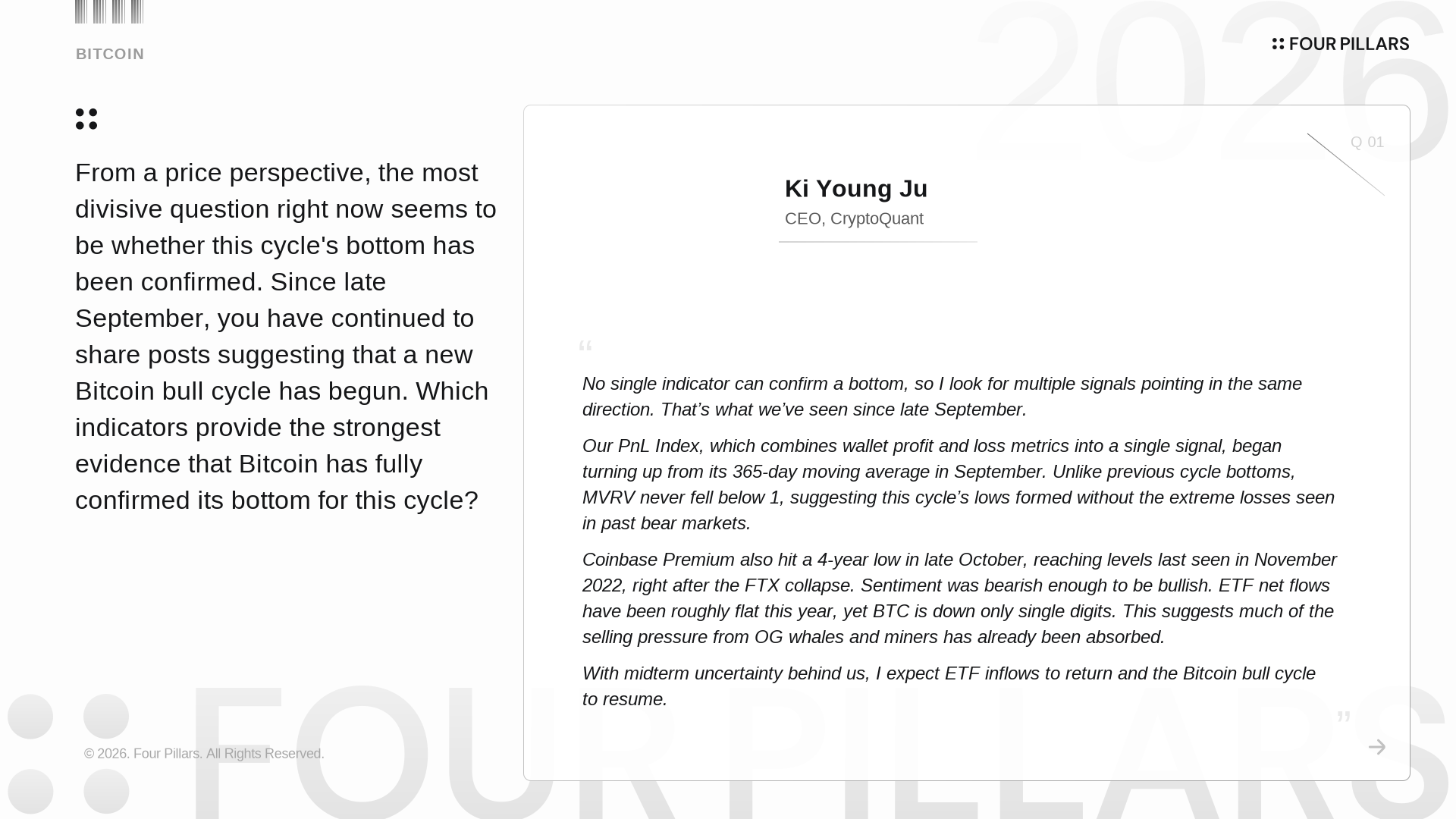
Interview: Ki Young Ju
From a price perspective, the most controversial question now seems to be whether the current cycle bottom has been confirmed. Since late September, you have been consistently hinting that a new round of the Bitcoin bull market has started. What indicators most strongly support the confirmation of Bitcoin’s current cycle bottom? No single indicator can confirm a bottom, so I would look for multiple signals pointing in the same direction. This is precisely what we have been observing since late September. Our PnL Index integrates the profitability indicators of wallets into a single signal, which began to move upward from its 365-day moving average in September. Unlike previous cycle bottoms, the MVRV has never dropped below 1, indicating that the formation of this cycle's low has not been accompanied by the extreme losses of past bear markets. The Coinbase Premium also hit a four-year low in late October, reaching levels not seen since the fallout from the FTX collapse in November 2022. Market sentiment is pessimistic enough to be a bullish signal. This year, ETF net inflows have been roughly flat, yet BTC has only dropped by single digits. This suggests that much of the selling pressure from seasoned whales and miners has been absorbed. As midterm uncertainties settle, I expect ETF inflows to return, and the Bitcoin bull market cycle to resume. —— Ki Young Ju, CEO of CryptoQuant
IBIT Leads Net Inflows for Bitcoin ETFs
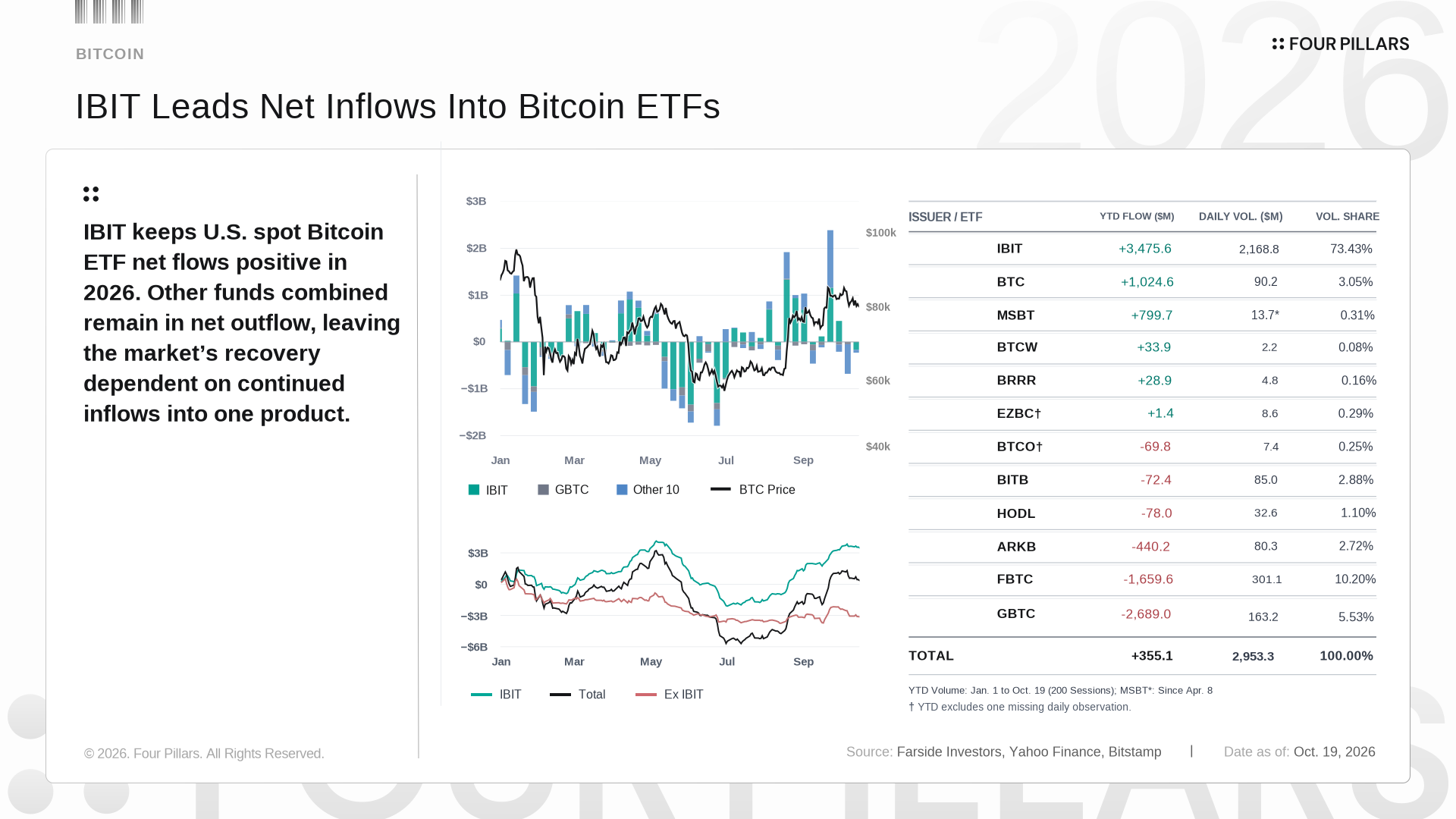
Farside Investors, Yahoo Finance, Bitstamp · As of October 19, 2026
In 2026, BlackRock’s IBIT has continued to attract net inflows for the U.S. spot Bitcoin ETF. As of October 16, IBIT attracted approximately $3.48 billion, while the rest of the funds recorded about $3.12 billion in net outflows. GBTC and FBTC faced approximately $2.69 billion and $1.66 billion in large redemptions, respectively. Although IBIT has seen inflows, the total net inflow year-to-date is still only about $355 million. Thus, a significant portion of this year’s ETF demand has been offset by withdrawals from existing investors.
ETF Inflows Weakly Associated with Subsequent BTC Returns
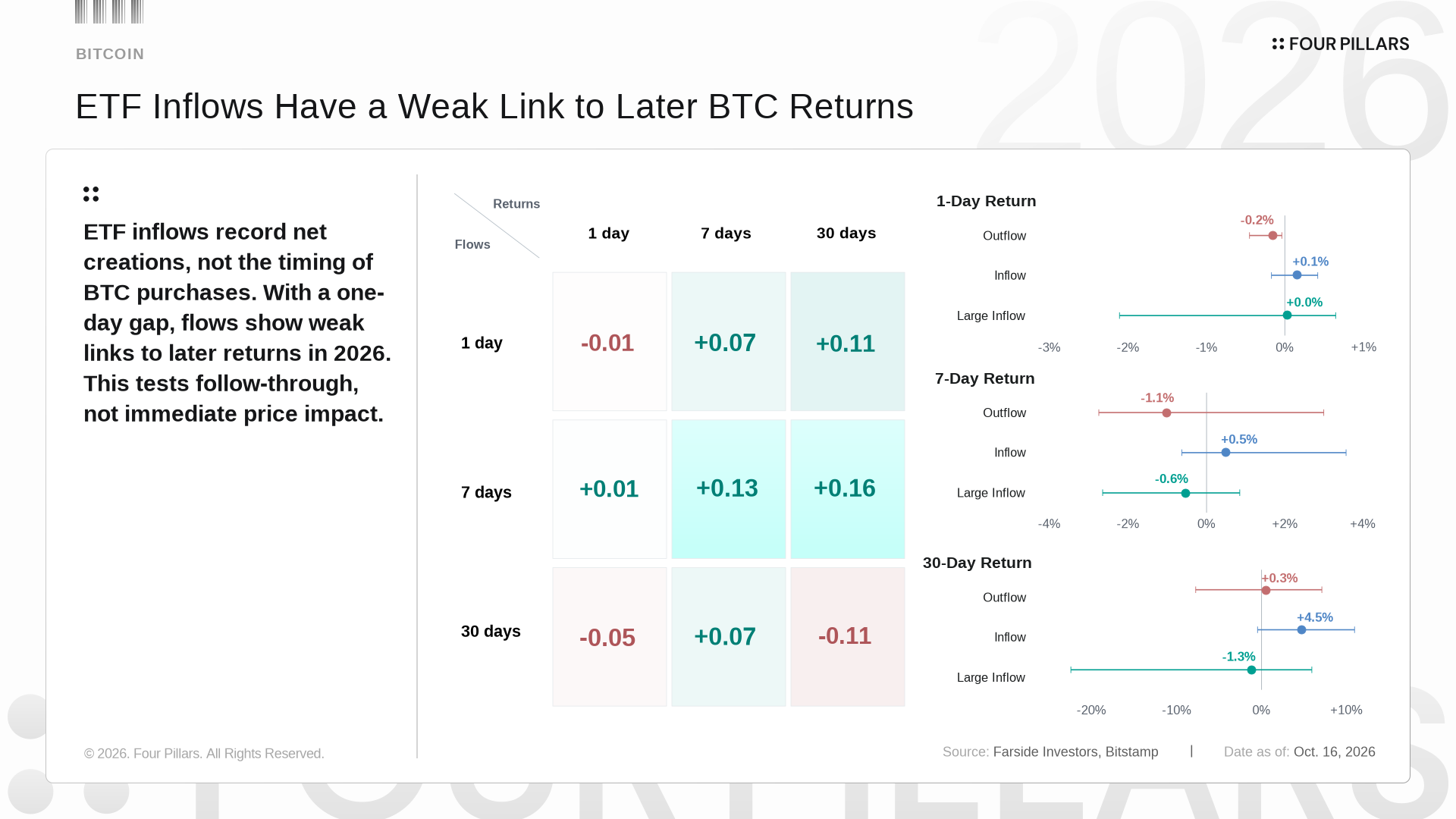
Farside Investors, Bitstamp · As of October 16, 2026
During the sample period of 2026, the relationship between ETF fund flows and subsequent Bitcoin returns was weak across daily, weekly, and monthly timeframes. Daily net inflows had correlations with subsequent 1-day, 7-day, and 30-day returns of -0.01, 0.07, and 0.11, respectively. For rolling 7-day net inflows, the corresponding correlations were 0.01, 0.13, and 0.16, while rolling 30-day fund flows had a correlation of -0.11 with subsequent 30-day returns. To adequately separate fund flow measurements from return windows, returns were calculated starting from the closing prices on the day following the ETF fund flow dates. The 95% confidence intervals for all nine combinations included zero, with little evidence of a consistent leading relationship.
Quote: Corbin Fraser, CEO of Bitcoin.com
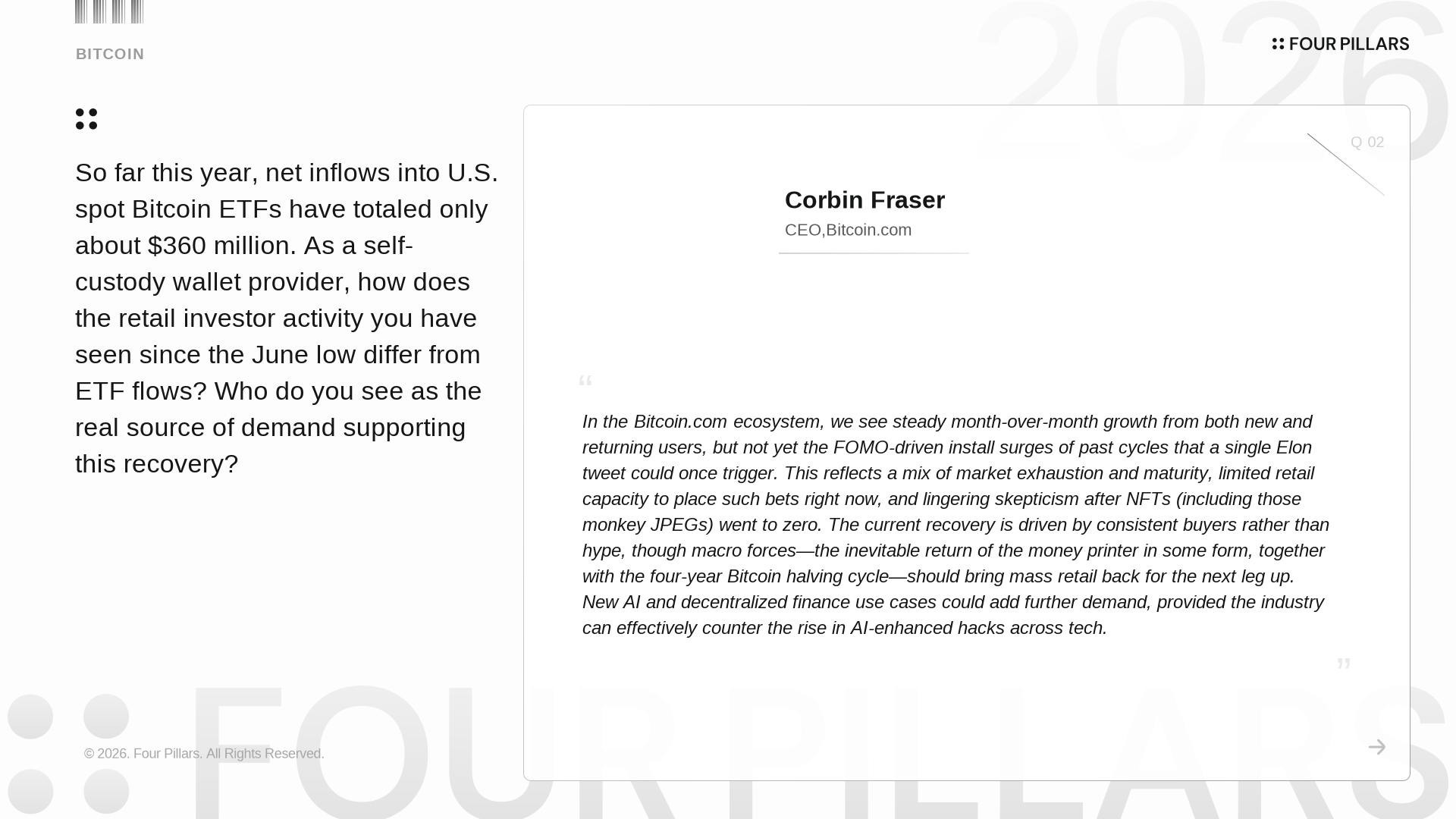
Interview: Corbin Fraser
So far this year, the total net inflows for U.S. spot Bitcoin ETFs are only about $360 million. As a self-custody wallet provider, how does the retail investor activity you have seen since the June low differ from ETF fund flows? Who do you think the real demand driving this recovery comes from? In the ecosystem, we have seen steady growth in new and old users, but we haven't seen the kind of FOMO-driven spikes in installs that past cycles experienced due to a single Elon tweet. This reflects a fusion of market fatigue and maturation, coupled with the limited capacity of current retail participants to make such bets, and the lingering skepticism after NFTs — with even those monkey JPEGs hitting zero. The current recovery is driven by persistent buyers rather than speculation; although macro forces—there is an inevitable return of the money printer in some form, combined with Bitcoin's four-year halving cycle—should bring retail participants back to drive the next leg up. New AI and decentralized finance use cases could also bring further demand, provided the industry can effectively navigate the increasing onslaught of AI-enhanced attacks. —— Corbin Fraser, CEO of Bitcoin.com
MSTR's Bigger Treasury Actually Dilutes Shareholder Value
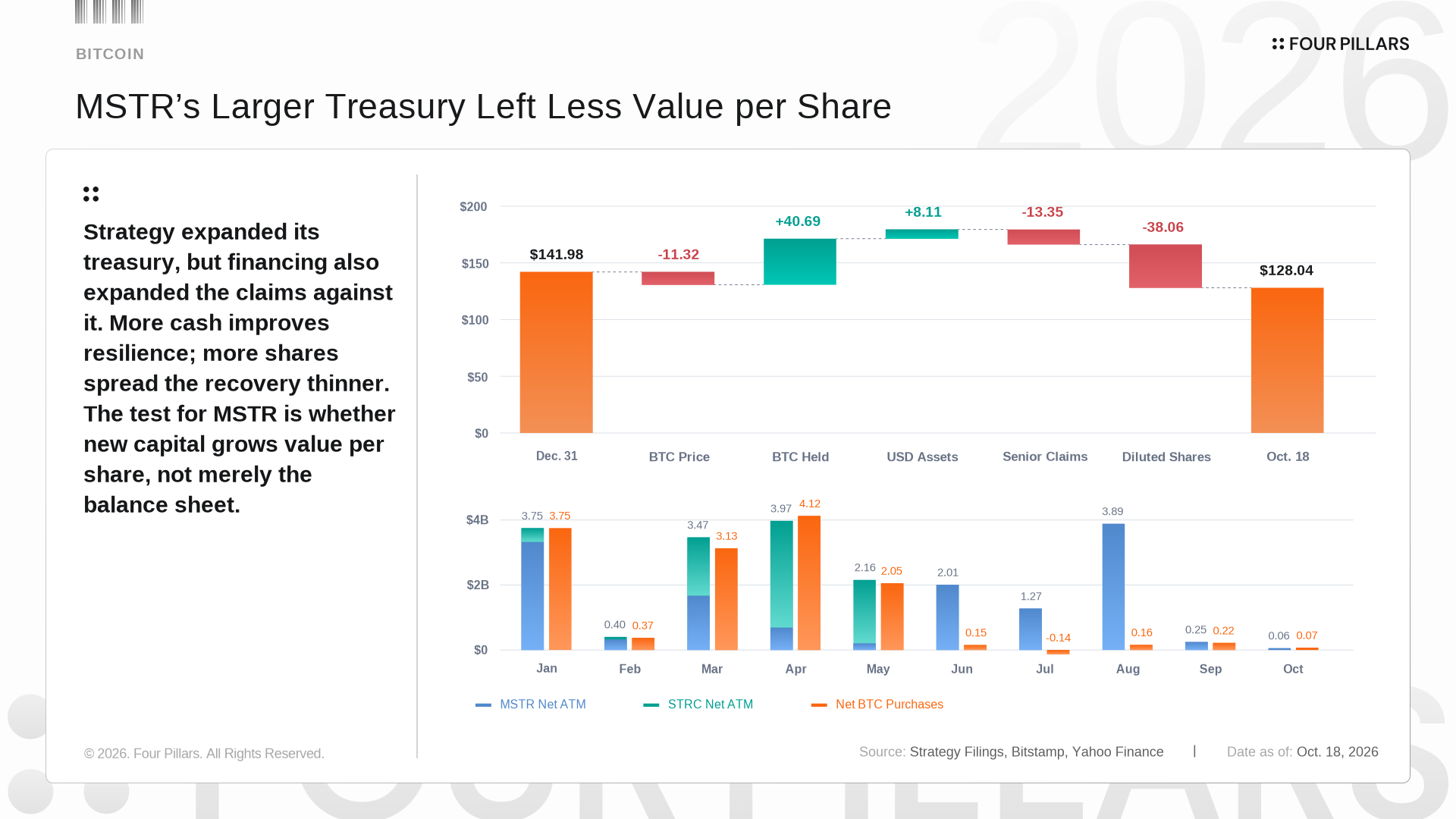
Strategy Filings, Bitstamp, Yahoo Finance · As of October 18, 2026
In 2026, the Bitcoin holdings of Strategy increased by 26.2%, but when accounting for all convertible securities, the value per share actually declined by 4.6%. The number of shares entitled to participate in these holdings grew faster than the company’s Bitcoin purchases.
Strategy Places Confidence in BTC Purchases Over STRC
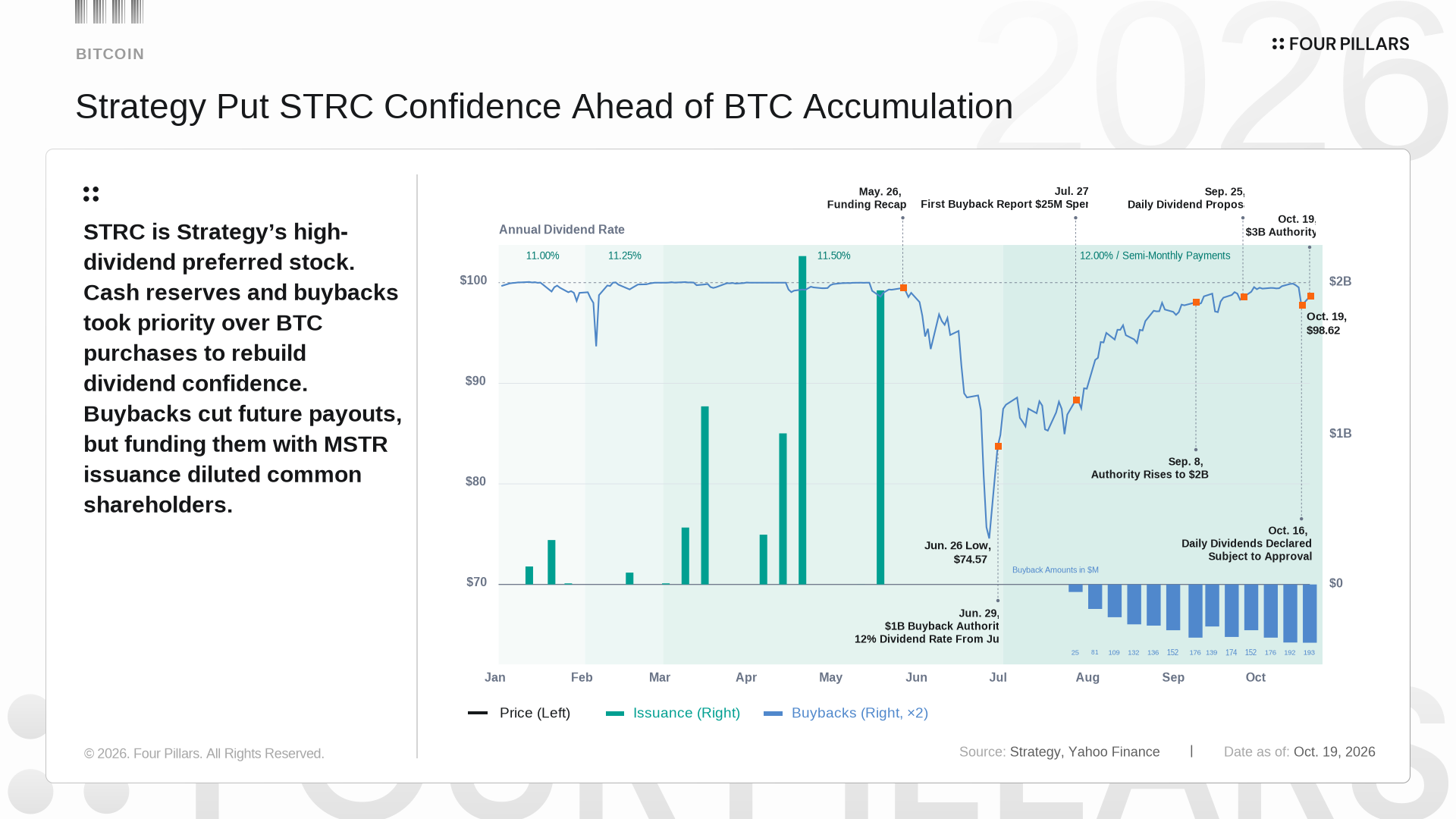
Strategy, Yahoo Finance · As of October 19, 2026
STRC is a preferred stock issued by Strategy to raise funds for purchasing BTC. Investors do not directly participate in the rise of BTC’s price but receive high cash dividends. At the beginning of the year, the dividend yield was 11% per $100 reference amount, raised to 12% in July. Through adjustments to the dividend yield and other measures, Strategy guides STRC to trade near $100, but the product does not allow investors to redeem $100 at any time, nor does it have an expiration date. Therefore, the value of STRC depends not only on the high dividend yield itself but also on how long the company can sustain the payments.
Bitcoin Still Drives Revenue, Miners Shift Towards AI
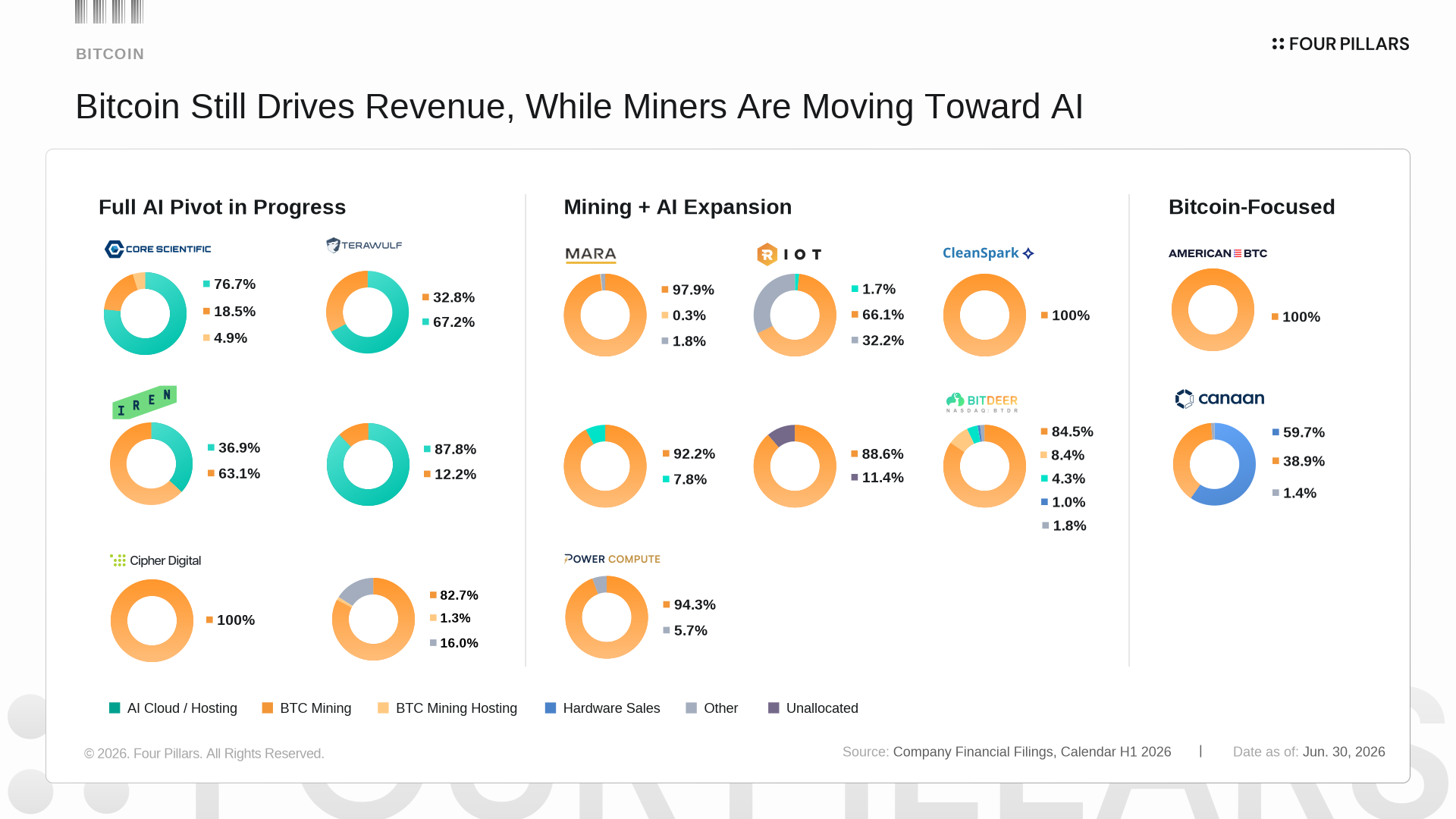
Company Financial Filings, Calendar H1 2026 · As of June 30, 2026
Bitcoin miners are expanding into AI, but their revenues are transitioning at a decidedly different pace. In the first half of 2026, Ionic Digital, Core Scientific, and TeraWulf saw over half of their revenues coming from AI and computing infrastructure. Meanwhile, Cipher Digital and Keel Infrastructure continued to derive revenue from mining during the same period, even as they advanced their AI-centric transformations/power sales. While these companies may share the same strategic direction, they are at different stages: some are already earning revenue from new businesses, while others are still building.
Miner Sell-off Reduced, but Didn’t Prevent Bitcoin’s Q2 Decline
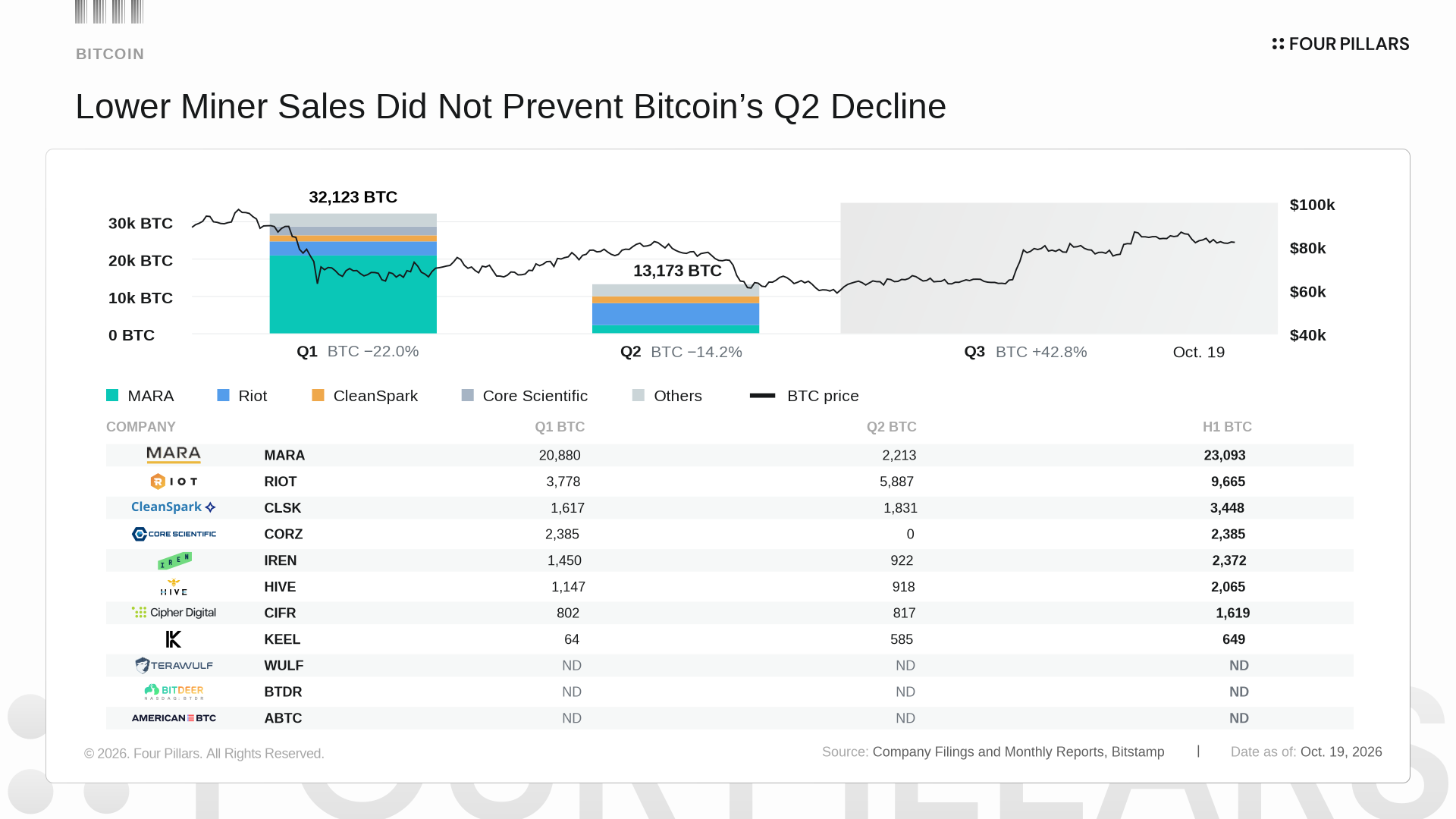
Company Filings and Monthly Reports, Bitstamp · As of October 19, 2026
The volume of Bitcoin sold by eight major public miners dropped by 59%, from about 32,123 BTC in the first quarter of 2026 to 13,173 BTC in the second quarter, with MARA accounting for most of the decline. Meanwhile, Riot increased its sales from 3,778 BTC to 5,887 BTC.
Transaction Volume Rises, but Miner Revenue Declines with Price
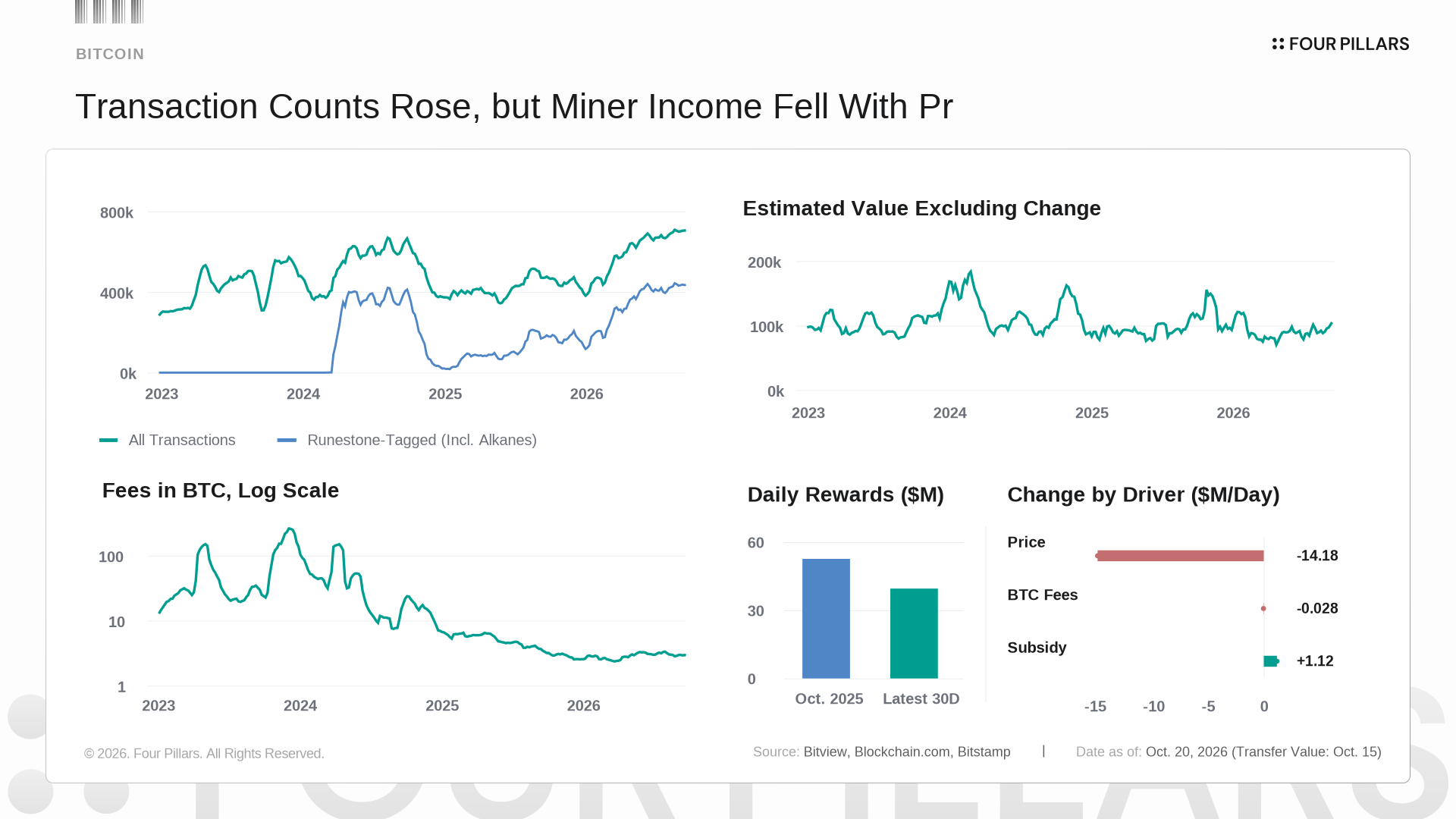
Bitview, Blockchain.com, Bitstamp · As of October 20, 2026 (Transaction values: as of October 15)
Unlike Bitcoin's price, on-chain activity measured by transaction volume has steadily risen since 2025. In the 30 days leading up to October 20, the average daily transaction volume was around 706,000 transactions, a 50% increase compared to October 2025 and nearing this cycle's peak. This growth has been driven by token-related activities using the Runestone format, including Runes, Alkanes, and DIESEL.
Quote: Muneeb Ali, CEO and Founder of Stacks Labs
Interview: Muneeb Ali
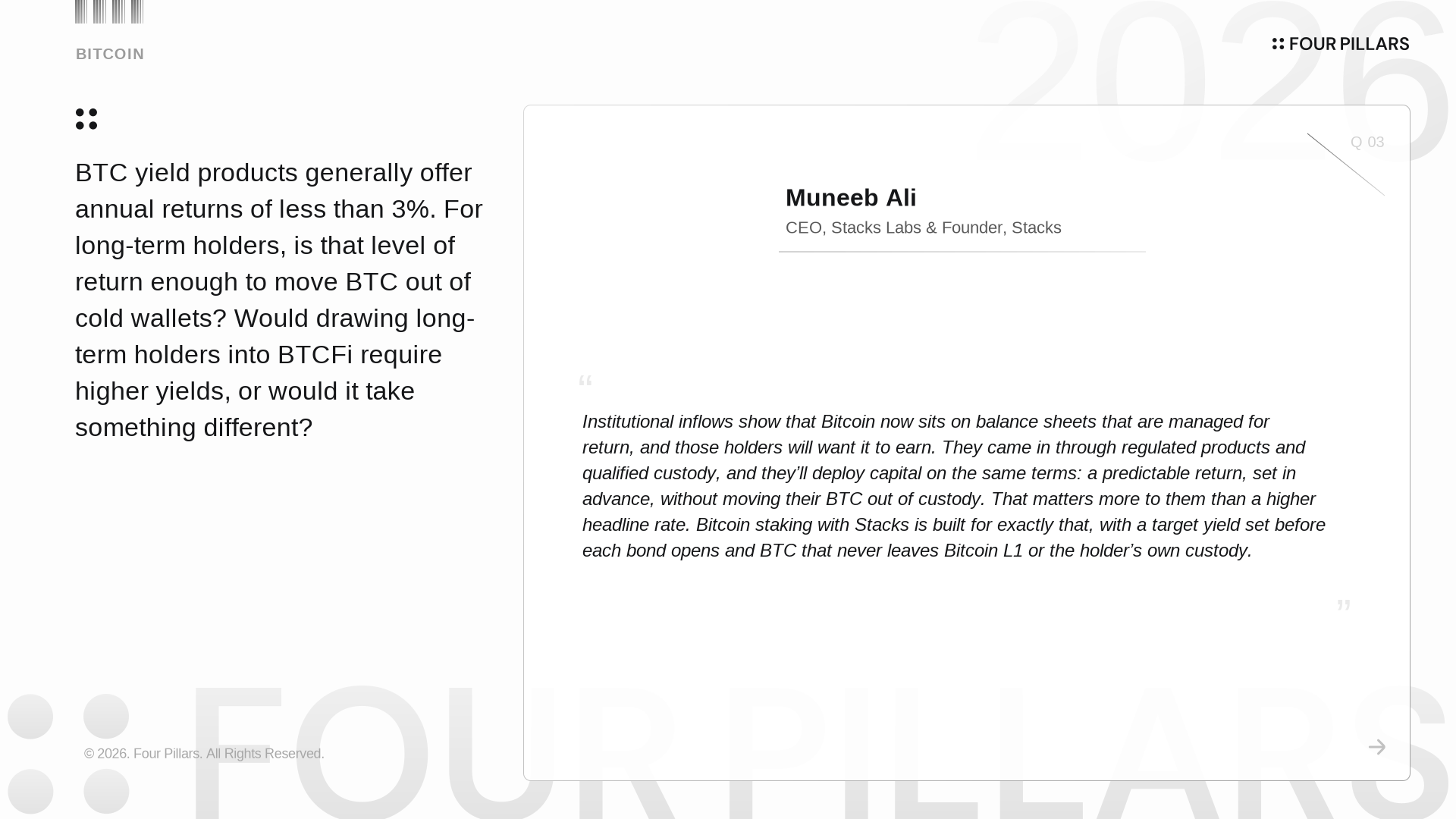
BTC yield products typically offer annualized returns of less than 3%. For long-term holders, is this level of return enough to justify moving BTC out of cold storage? Do you think higher yields are needed to attract long-term holders into BTCFi, or is something else required? Institutional flows indicate that Bitcoin is now on balance sheets managed for returns, and these holders will want it to generate yield. They enter the market through regulated products and qualified custodians, deploying funds under the same conditions: preset predictable returns without having to move BTC out of custody. This matters more to them than higher nominal interest rates. Stacks' Bitcoin staking is built for this, establishing target yields before each bond issuance, where BTC never leaves Bitcoin L1 or the holder’s own custody. —— Muneeb Ali, CEO and Founder of Stacks Labs
Active Developers Down, Core Development Participation Broader
Electric Capital, Bitcoin Core Git history · As of September 30, 2026
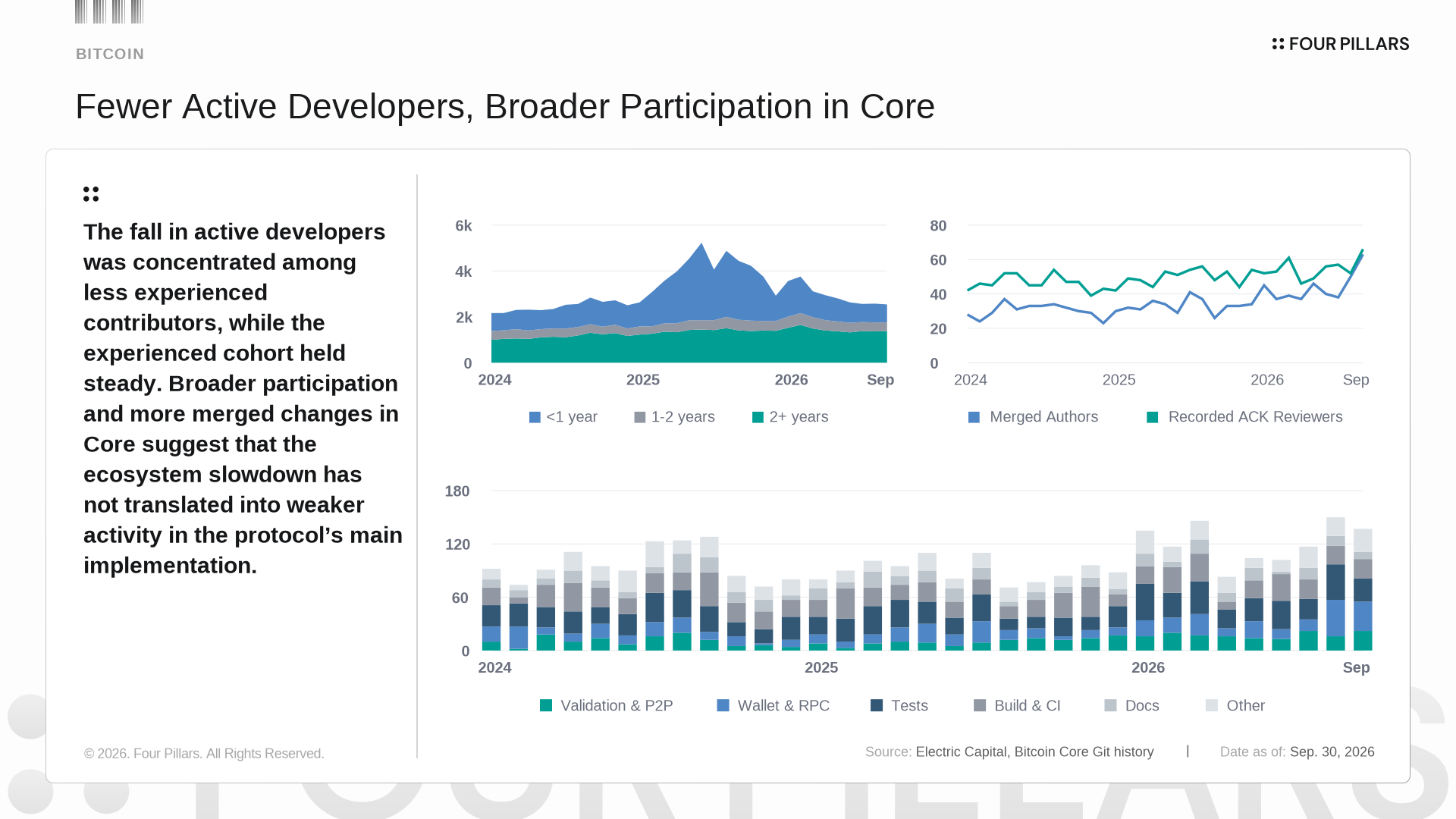
Over the past year, the number of active developers in the Bitcoin ecosystem has decreased, but this has not translated into a widespread weakening of the development base. As of September 2026, monthly active developers were down about 43% compared to the same month last year, while the group with more than two years of crypto development experience only decreased by around 3%. The decline has been concentrated among developers with shorter resumes, indicating that while some gains made from expanded participation in 2025 have been reversed, the pool of experienced developers has largely stayed stable.
BIP-110 Fails to Gain Widespread Mining Support
Coin Dance, Alkanes scanner, Bitcoin Forks, Bitcoin Core / BIPs / Knots · As of October 20, 2026
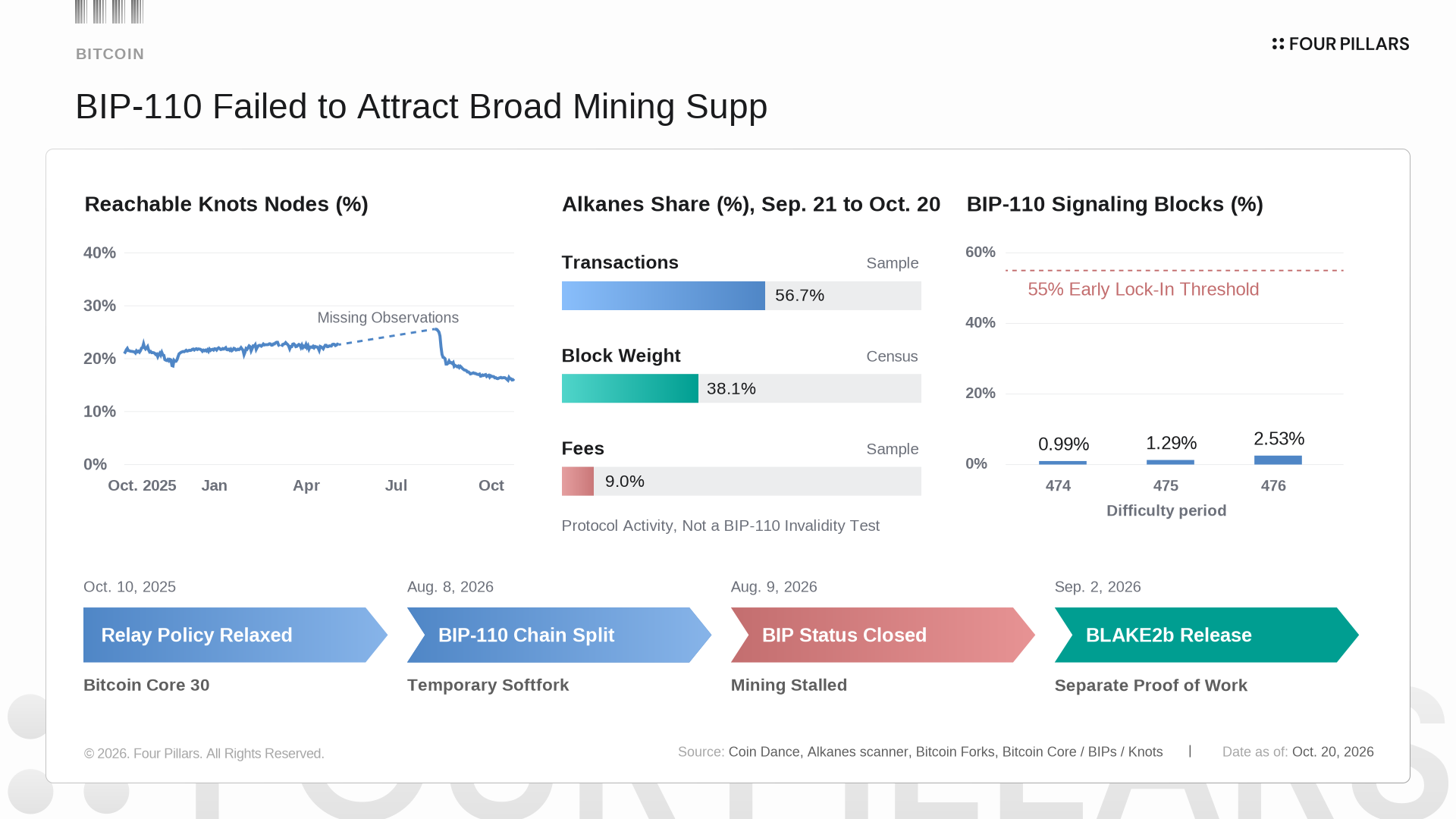
One of the biggest debates in the Bitcoin community this year has involved how much Bitcoin should be allowed to be used to record data unrelated to payments, and whether the issue should be left up to the relaying strategies of each node or restricted through shared network rules. This debate gained substance in October 2025 when the OP_RETURN changes introduced in Bitcoin Core 30 relaxed the data relay restrictions. In response, BIP-110 was proposed to temporarily cap the size and format of transaction-carrying data as consensus rules through a soft fork. Some node operators support the proposal and have adopted the Knots client to implement these policies.
Quantum Risk Exposure Concentrated in Large Balances
ChainQuery · As of October 21, 2026
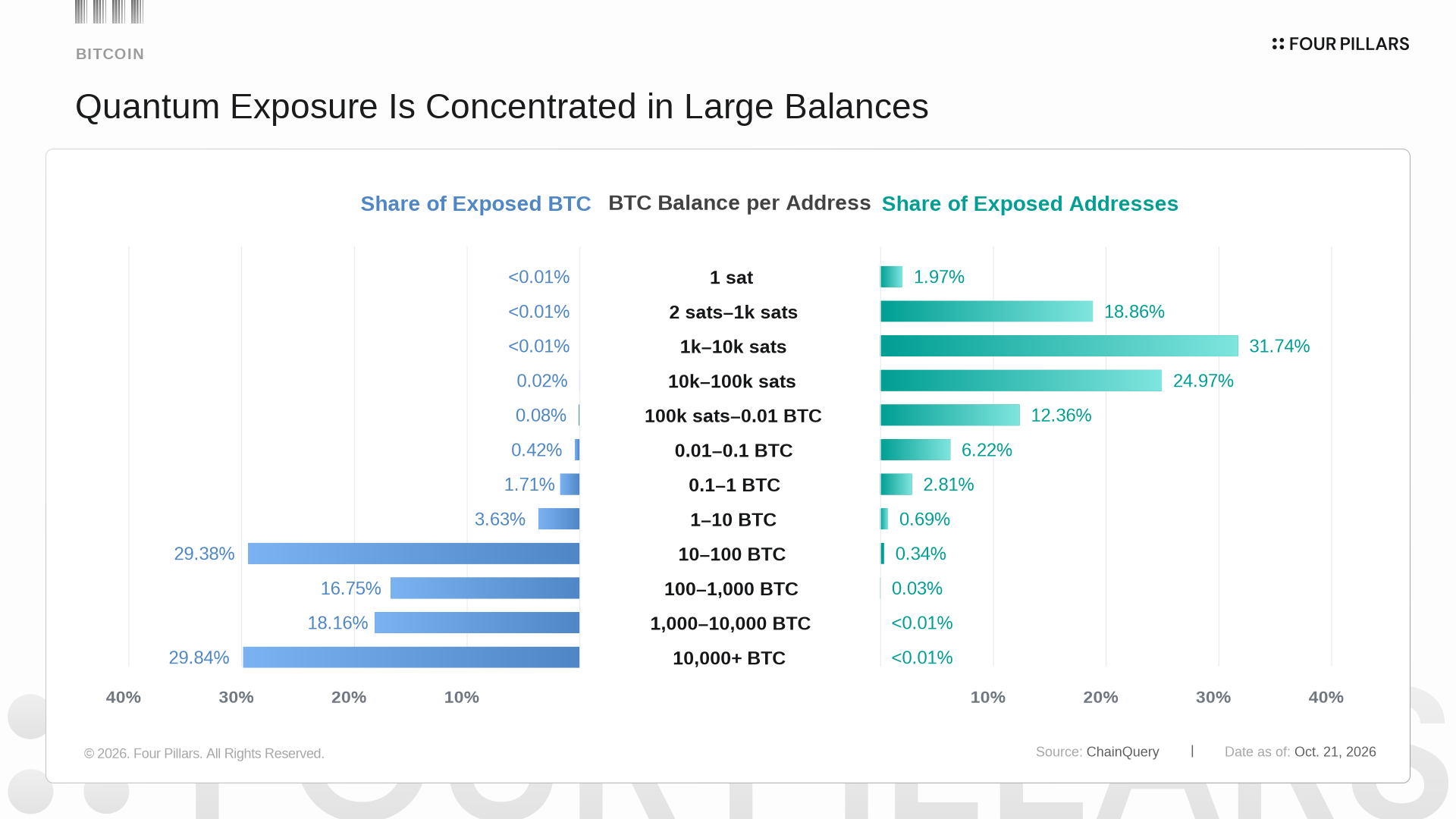
The ongoing debate about whether Bitcoin can adequately counter the threats posed by quantum computing has been a topic of concern. A sufficiently powerful quantum computer could derive private keys from public keys, enabling it to spend tokens without the owner’s consent. The vulnerability lies in the digital signatures that authorize transactions. Certain Bitcoin address formats keep the public key hidden before the token is spent but leave a balance protected by the already revealed key if the address is reused after spending. In comparison, early Bitcoin uses the P2PK format and the current Taproot format, which inherently expose the public keys. Once a quantum computer is constructed that can break existing signatures, these holdings could become attractive targets for attack.
Ethereum Outperforms $ETH
A year of Ethereum from fees, staking, and L2 settlement.
ETH Experiences Shallowest Drop in History, But with Strongest Correlation to BTC
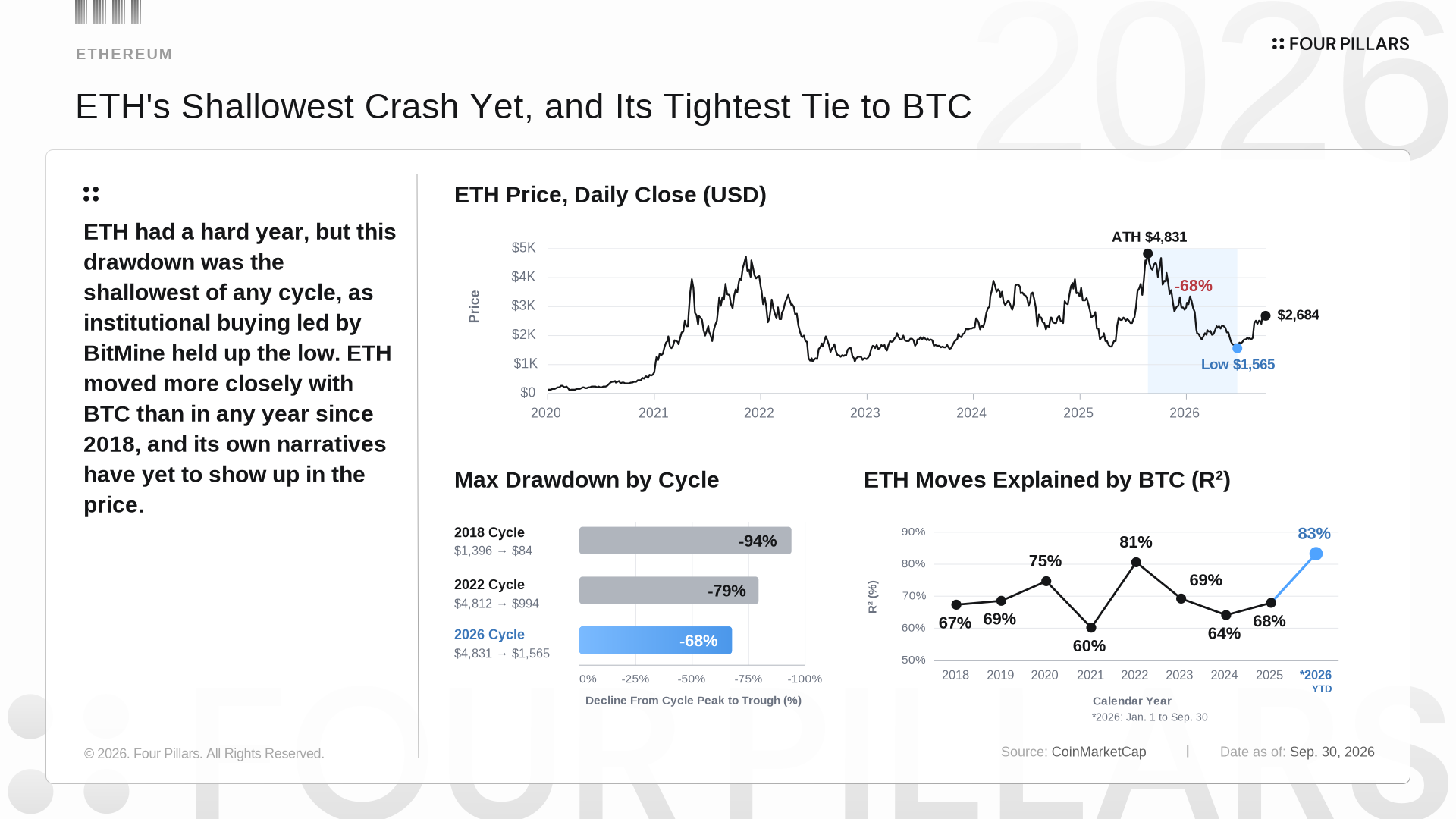
CoinMarketCap · As of September 30, 2026
ETH fell 68% from its peak in August 2025. It has been a tough year, but the pullback has been shrinking by cycle. The previous cycles saw declines of 94% in 2018 and 79% in 2022. During this downturn, institutions absorbed the selling pressure. The DAT company BitMine bought about 1.89 million ETH from January to September. Most of the ETH sold by the Ethereum Foundation also flowed to BitMine via OTC (over-the-counter) transactions. While the crypto industry struggles, other assets like the Nasdaq and South Korea’s KOSPI have risen significantly. Only the crypto industry remains in a bear market. Ethereum’s performance this year relative to BTC has also resembled a high-beta asset. In 2026, 83% of ETH's intraday volatility can be explained by BTC, marking the closest correlation between the two since 2018. This means ETH is following the overall trend of the crypto market led by BTC, rather than seeing an independent trend. Ethereum's own narrative has yet to reflect in ETH's price.
Despite Falling Prices, Network Usage Hits New Highs
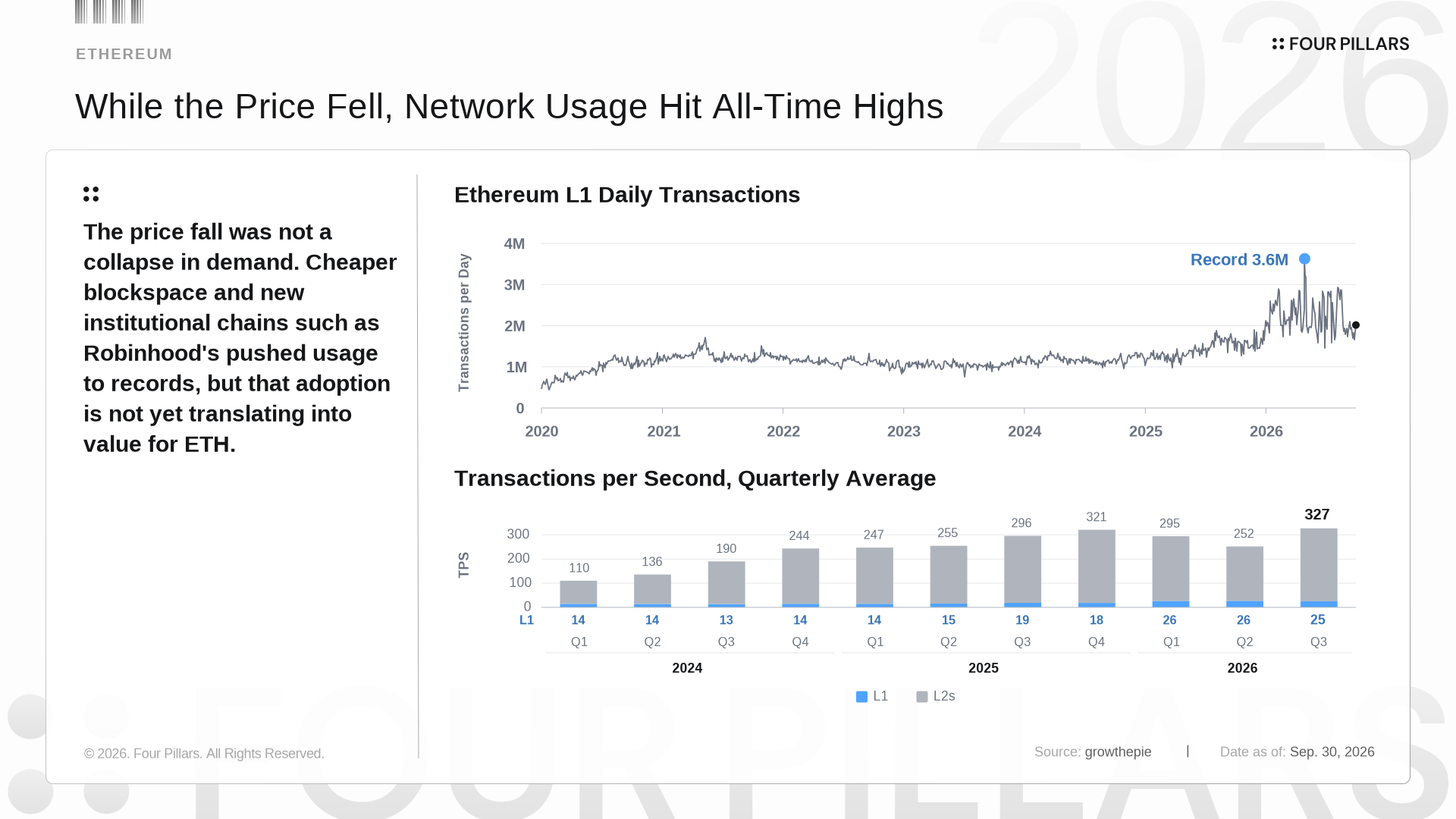
growthepie · As of September 30, 2026
Despite the price drop, the network usage has hit a historic high. On April 28, Ethereum L1’s daily transaction volume reached a peak of 3.63 million, the highest since its launch. The previous year’s peak was 2.23 million transactions on December 29, thus marking an increase of over 60% in daily records within four months. When L2 is included, throughput averages 327 transactions per second in the third quarter, the highest in history, which is 13 times the volume handled solely by L1. The lower fees are the reason behind the increase in usage. In late November 2025, before the Fusaka upgrade, the gas limit was raised to 60 million, which considerably lowered L1 fees. Payment for the data and settlement published on L1 from L2 dropped from 228 ETH in the third quarter of 2025 to 79 ETH in the third quarter of 2026, a decrease of 65%. The blob (the dedicated space for L2 data) now has such ample idle capacity that its fees are approaching zero. There is no basis to interpret the decline in ETH prices as a collapse in demand. The remaining challenge is how to convert the new demand into value for ETH.
BitMine Continues to Accumulate ETH, While Smaller Treasury Companies Sell
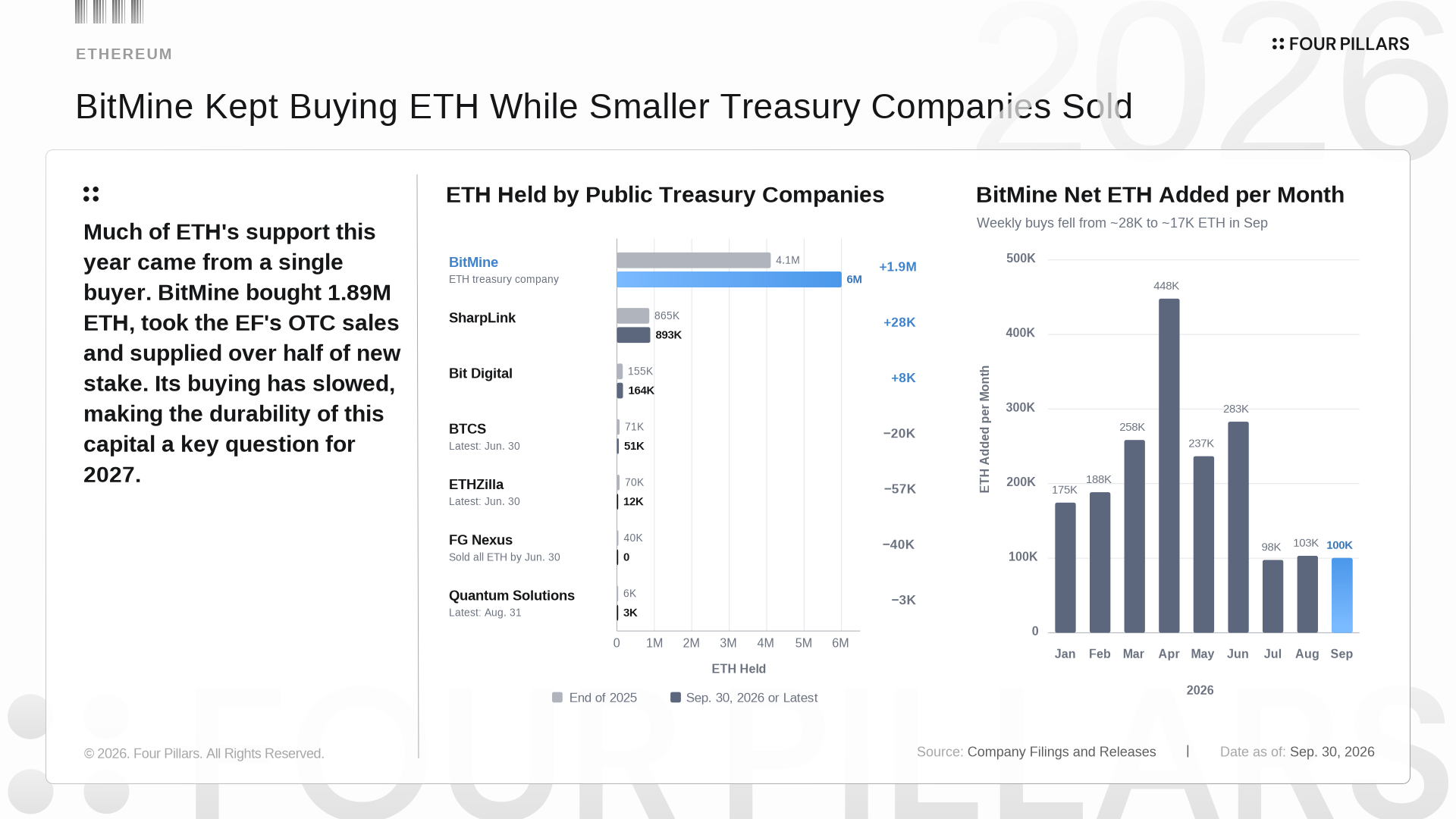
Company filings and announcements · As of September 30, 2026
BitMine increased its ETH holdings from 4.11 million at the end of 2025 to 6 million by the end of September 2026. It bought 1.89 million ETH just this year, currently holding about 4.9% of the total supply. On the other hand, SharpLink and Bit Digital only slightly increased their ETH holdings in 2026. BTCS and ETHZilla instead reduced their positions. FG Nexus liquidated all ETH. As a result, BitMine's share of the total ETH held by the seven listed DAT companies rose from 77% to 84%. The company is nearing its 5% target of total supply held. The primary purchaser supporting ETH has slowed this year, thus the core question for the supply-demand balance of ETH is: who will fill this role in 2027?
Record Staking, with BitMine Providing Over Half of New Staking
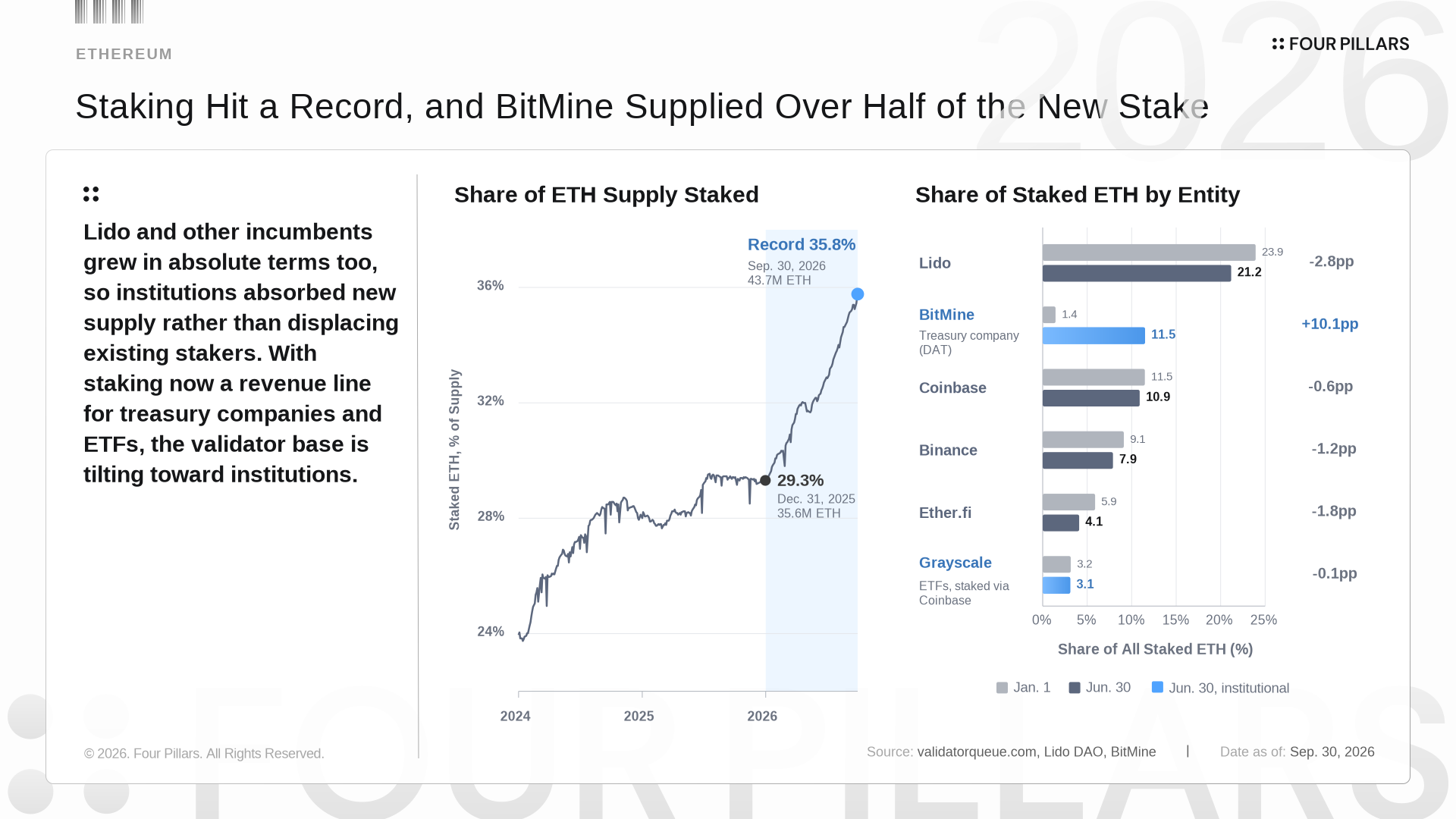
validatorqueue.com, Lido DAO, BitMine · As of September 30, 2026
In 2026, Ethereum staking has continued to set records. As of September 30, a total of 43.66 million ETH has been staked, accounting for 35.8% of the total supply. This number was 35.57 million ETH (29.3%) at the end of 2025, indicating an increase of 8.1 million ETH over nine months. The staking supply ratio hovered around 28% to 29% throughout the year 2025, but has surged sharply this year. Currently, over one-third of ETH has been staked.
Quote: Samuel Chong, Head of Asia Pacific Institutional Relations at Lido Ecosystem Foundation
Interview: Samuel Chong
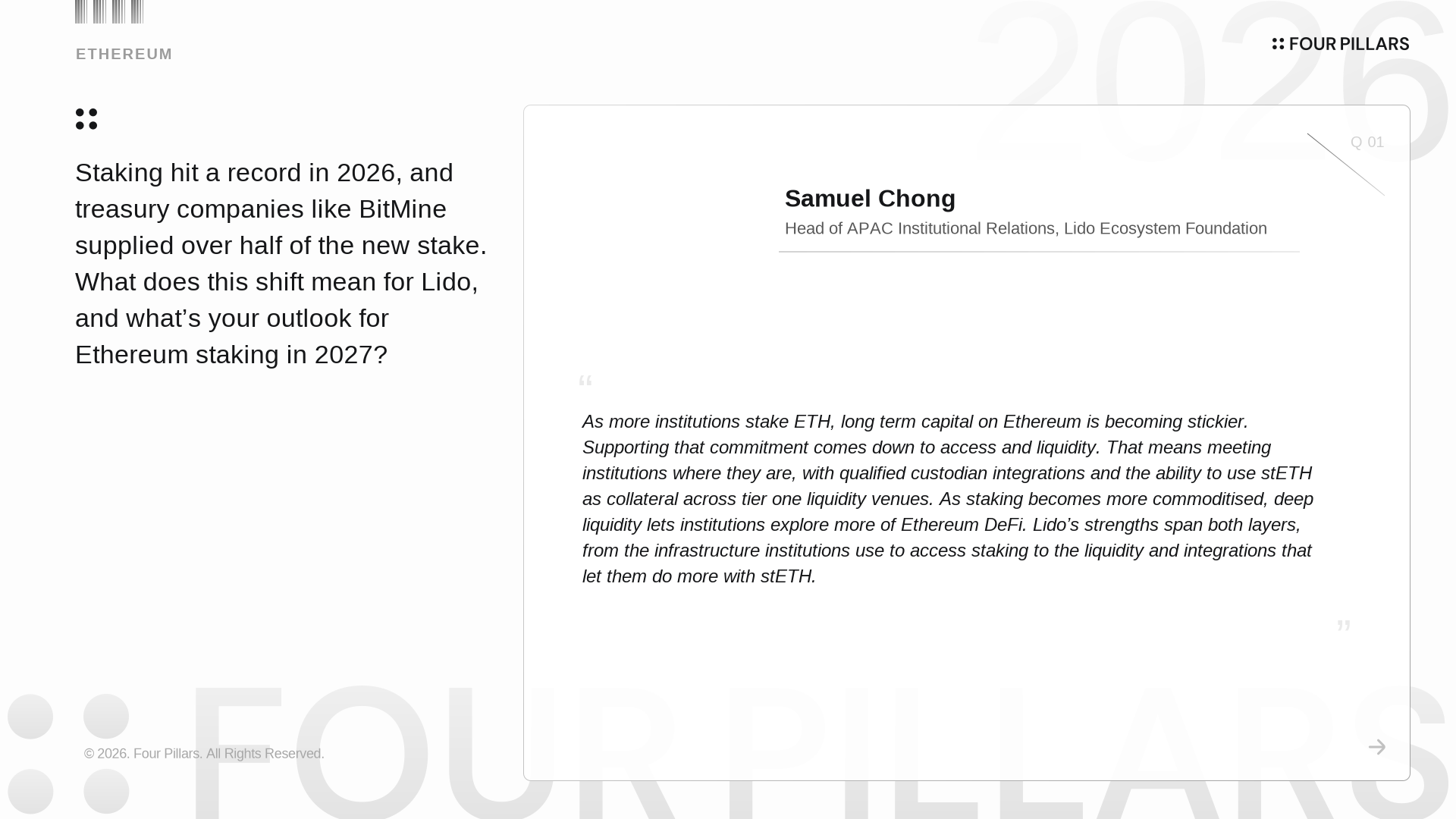
The record set for staking in 2026 means that treasury companies like BitMine have provided more than half of the new staking. What does this mean for Lido? What are your outlooks on Ethereum staking in 2027? With more institutions staking ETH, long-term capital on Ethereum is becoming stickier. The key to supporting this commitment lies in access and liquidity. This means meeting the demands where the institutions are, providing integration with qualified custodians, and the ability to use stETH as collateral in frontline liquidity venues. As staking becomes increasingly commoditized, deep liquidity allows institutions to explore more Ethereum DeFi. Lido’s advantages span two levels, from the infrastructure that institutions use to access staking to the liquidity and integration that enables them to do more with stETH. —— Samuel Chong, Head of Asia Pacific Institutional Relations at Lido Ecosystem Foundation
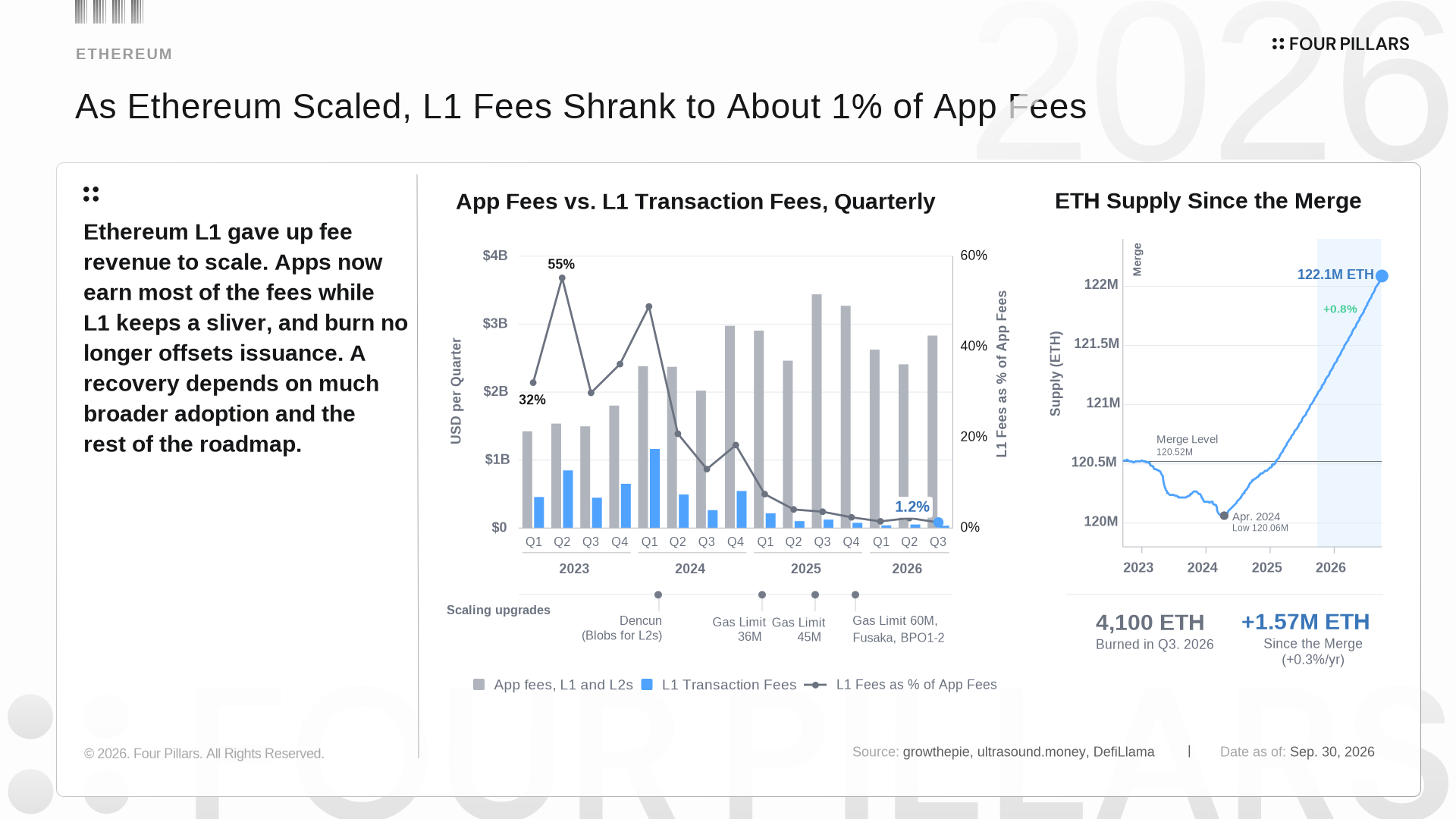
With Ethereum’s Scalability, L1 Fees Shrink to About 1% of Application Fees
growthepie, ultrasound.money, DefiLlama · As of September 30, 2026
Usage continues to grow, but L1 revenue has declined. In the third quarter, applications on Ethereum earned $2.83 billion in fees, while Ethereum only charged $35.1 million in transaction fees, just 1.2% of application fees. In 2023, this figure was 38%. This decline stems from choice rather than failure. The Dencun upgrade in March 2024 added blobs (dedicated spaces for L2 data). Subsequently, the 2025 gas limit doubled from 30 million to 60 million. The Fusaka upgrade in December 2025 and two subsequent BPOs (which only adjusted blob parameters) further increased blob capacity. Ethereum chose to lower network usage costs and enhance throughput. As a result, the amount of ETH burned correspondingly decreased. In the third quarter, the burn amount was only about 4,100 ETH, while the overall supply of ETH increased by 990,000 over the past year, or 0.8%. Since the merger, the net increase in supply has been 1.57 million ETH. The roadmap aims to further enhance Ethereum's throughput. To convert this additional throughput into value for ETH, adoption scale must far exceed current levels.
Quote: Artem Sinyakin, CEO of OAK Research
Interview: Artem Sinyakin
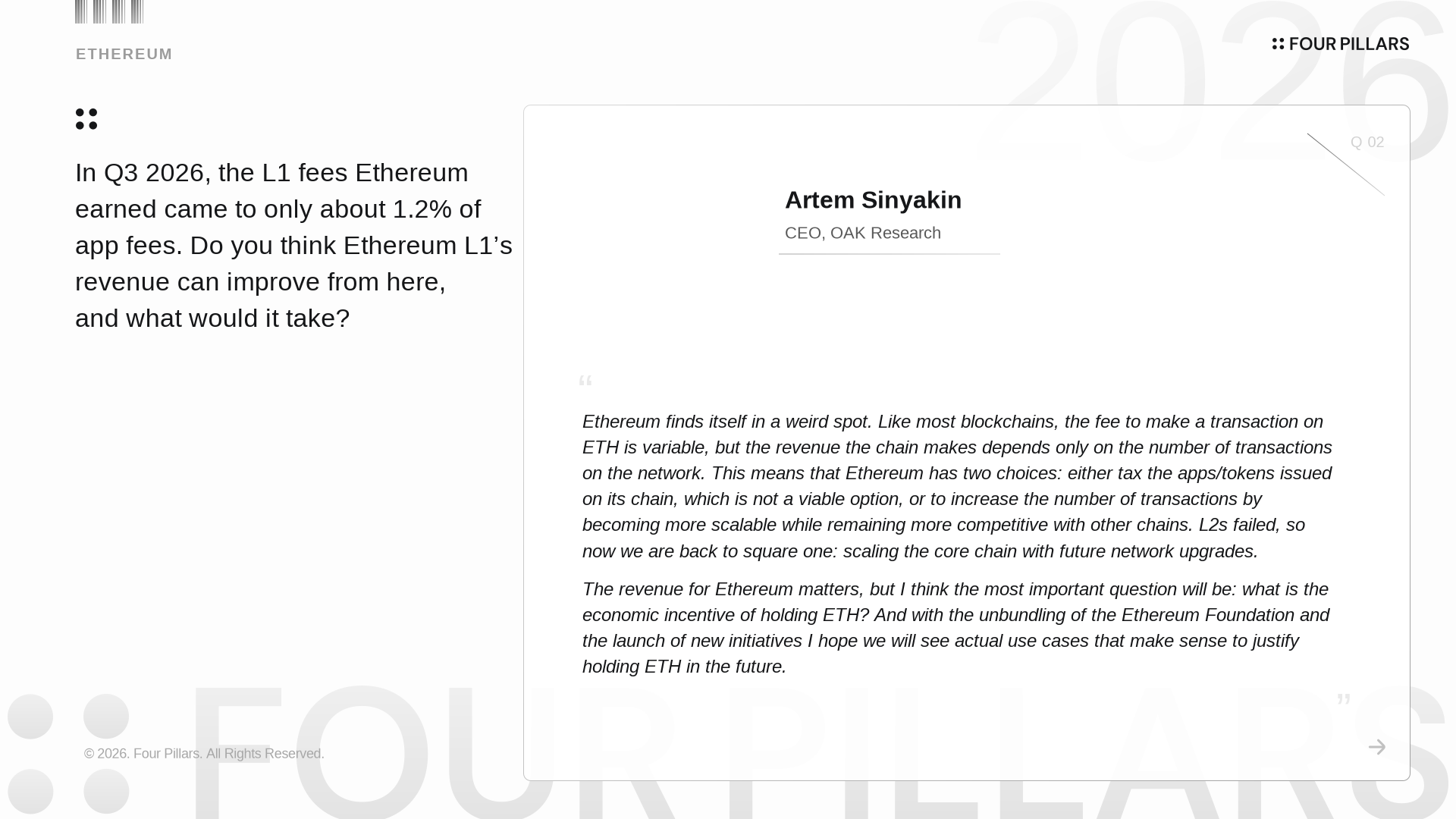
In the third quarter of 2026, Ethereum earned just 1.2% of application fees in L1 revenue. Do you think there is room for improvement in Ethereum L1’s revenues from here? What conditions are necessary? Ethereum finds itself in a delicate position. Like most blockchains, the costs of conducting transactions on ETH are variable, but the chain's revenue is solely dependent on the number of transactions on the network. This means Ethereum has two choices: tax the applications/tokens issued on its chain, which is not a feasible option, or become more scalable while remaining competitive against other chains to increase the number of transactions. L2 has not delivered as expected, so we are back to square one: scaling the core chain through future network upgrades. While Ethereum’s revenue is undoubtedly important, I think the more pressing question is: what are the economic incentives for holding ETH? With the splitting of the Ethereum Foundation and the introduction of new initiatives, I hope to see truly meaningful use cases in the future that prove the rationale for holding ETH. —— Artem Sinyakin, CEO of OAK Research
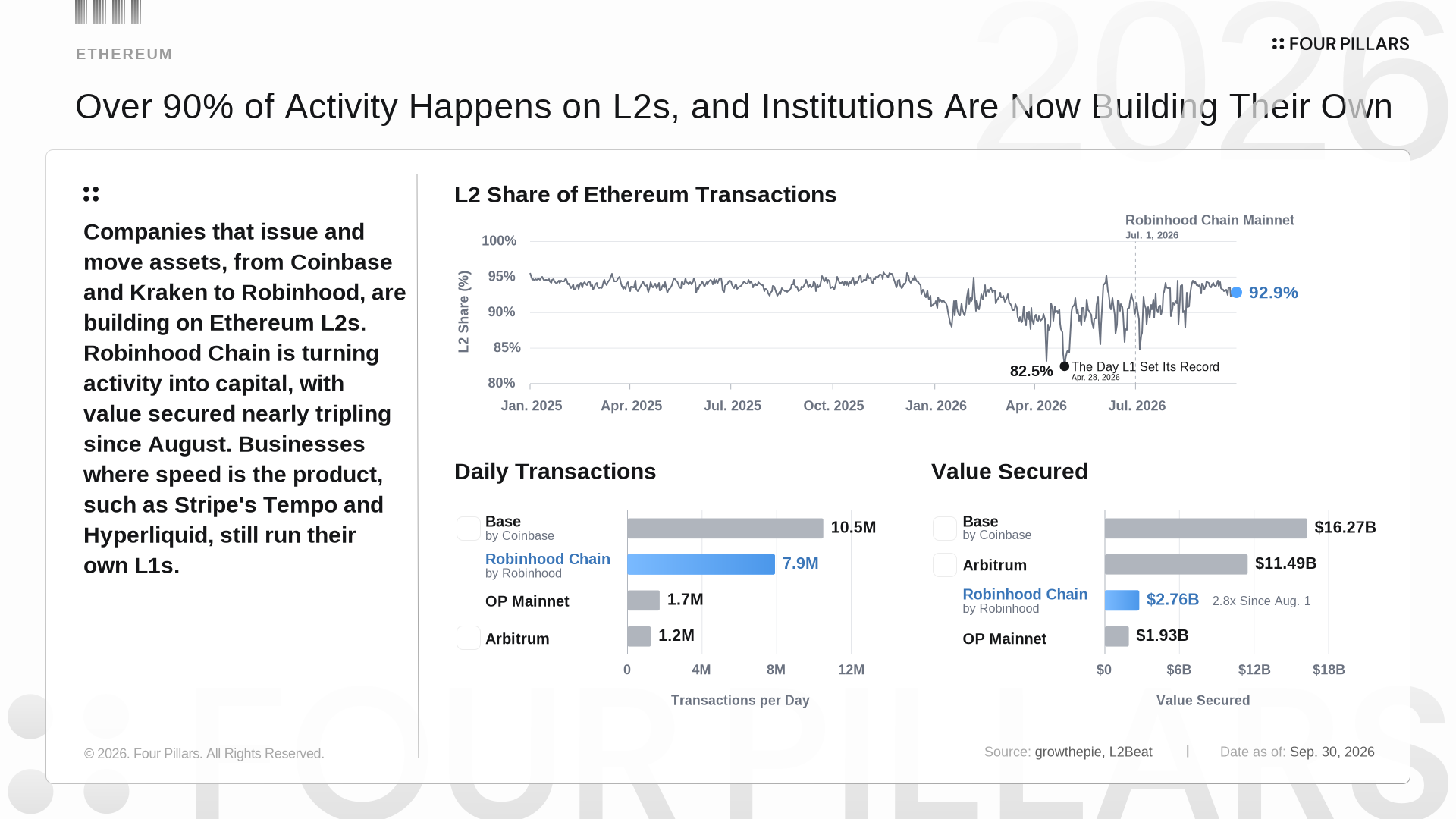
More than 90% of Activity Occurs on L2, with Institutions Now Building Their Own L2s
growthepie, L2Beat · As of September 30, 2026
Most Ethereum activity occurs on L2. As of September 30, L2 accounted for 92.9% of all Ethereum transactions. Companies building these L2s have performed well. On that day, Coinbase’s Base led with 10.5 million transactions, followed by Robinhood Chain with 7.91 million transactions. Alongside Kraken’s Ink, they show a clear trend: companies that issue and transfer assets are launching their own L2 chains on Ethereum. Some companies have opted for their own L1, like Tempo, supported by Stripe and Paradigm. However, in places where trust in assets and liquidity is crucial, companies are choosing Ethereum L2.
Applications Run on L2, Funds Settle on Ethereum L1
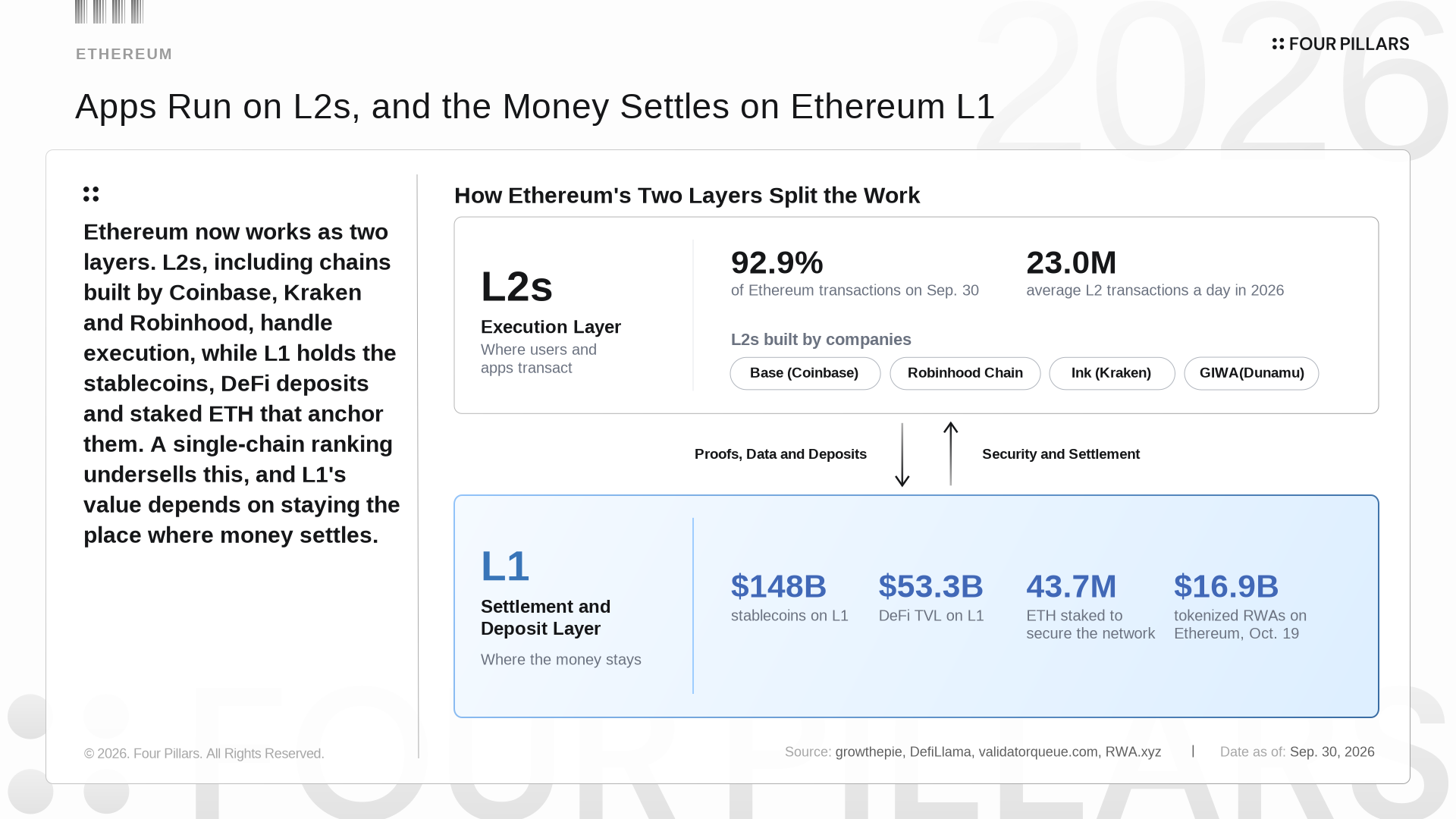
growthepie, DefiLlama, validatorqueue.com, RWA.xyz · As of September 30, 2026
Ethereum operates as a two-layer system. Users and applications primarily transact on L2. As of September 30, L2 processed 92.9% of Ethereum transactions, averaging 23 million transactions per day in 2026. Assets settle on L1. As of September 30, $148 billion in stablecoins and $53.3 billion in DeFi deposits remained on Ethereum L1. L2 sends proofs, data, and deposits to L1, which provides security and final settlement in return. Because of this role division, simple chain data often underestimates Ethereum. L1 lags behind other chains on certain metrics (like DEX trading volume), but once L2 is included, Ethereum’s ecosystem remains the center of crypto finance.
Quote: Steven Goldfeder, Co-founder and CEO of Offchain Labs
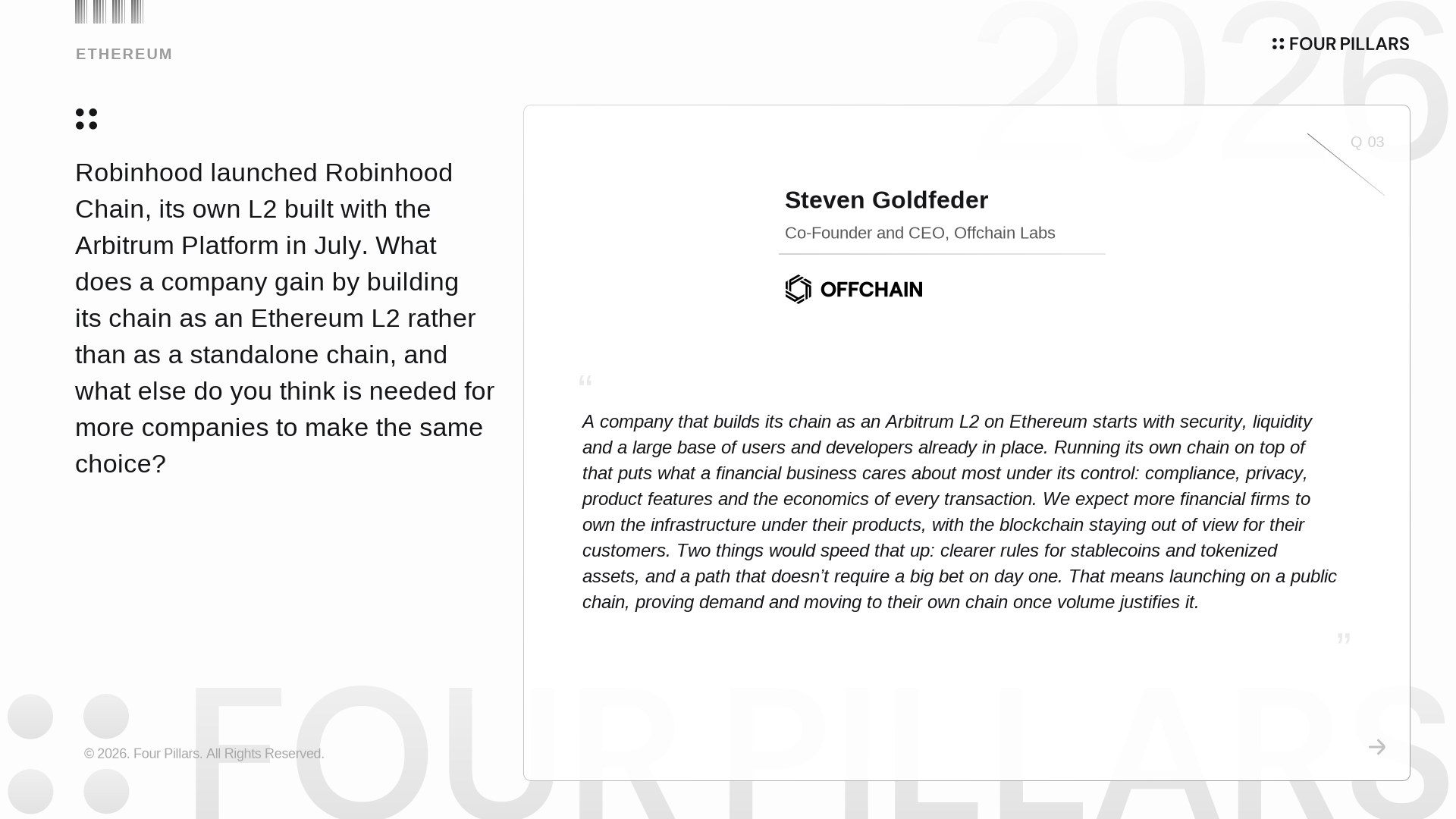
Interview: Steven Goldfeder
Robinhood launched Robinhood Chain in July, which is built on the Arbitrum Platform. As a company that built the chain as an Ethereum L2 rather than an independent chain, what are the advantages? What do you think it takes to get more companies to make the same choice? Companies building their chains as Arbitrum L2 on Ethereum benefit initially from security, liquidity, and a massive user and developer base. Operating your own chain on that foundation allows you to control the elements most important for financial operations: compliance, privacy, product functionality, and the economics of every trade. We expect more financial institutions to own the infrastructure underneath their products while the blockchain remains invisible to customers. Two things will accelerate this process: clearer regulations for stablecoins and tokenized assets, and a path that doesn’t require making a huge bet from day one. This means starting with a public chain to validate demand, then migrating to your own chain once the volume proves reasonable. —— Steven Goldfeder, Co-founder and CEO of Offchain Labs
Ethereum Ecosystem Leads on All Funding Metrics
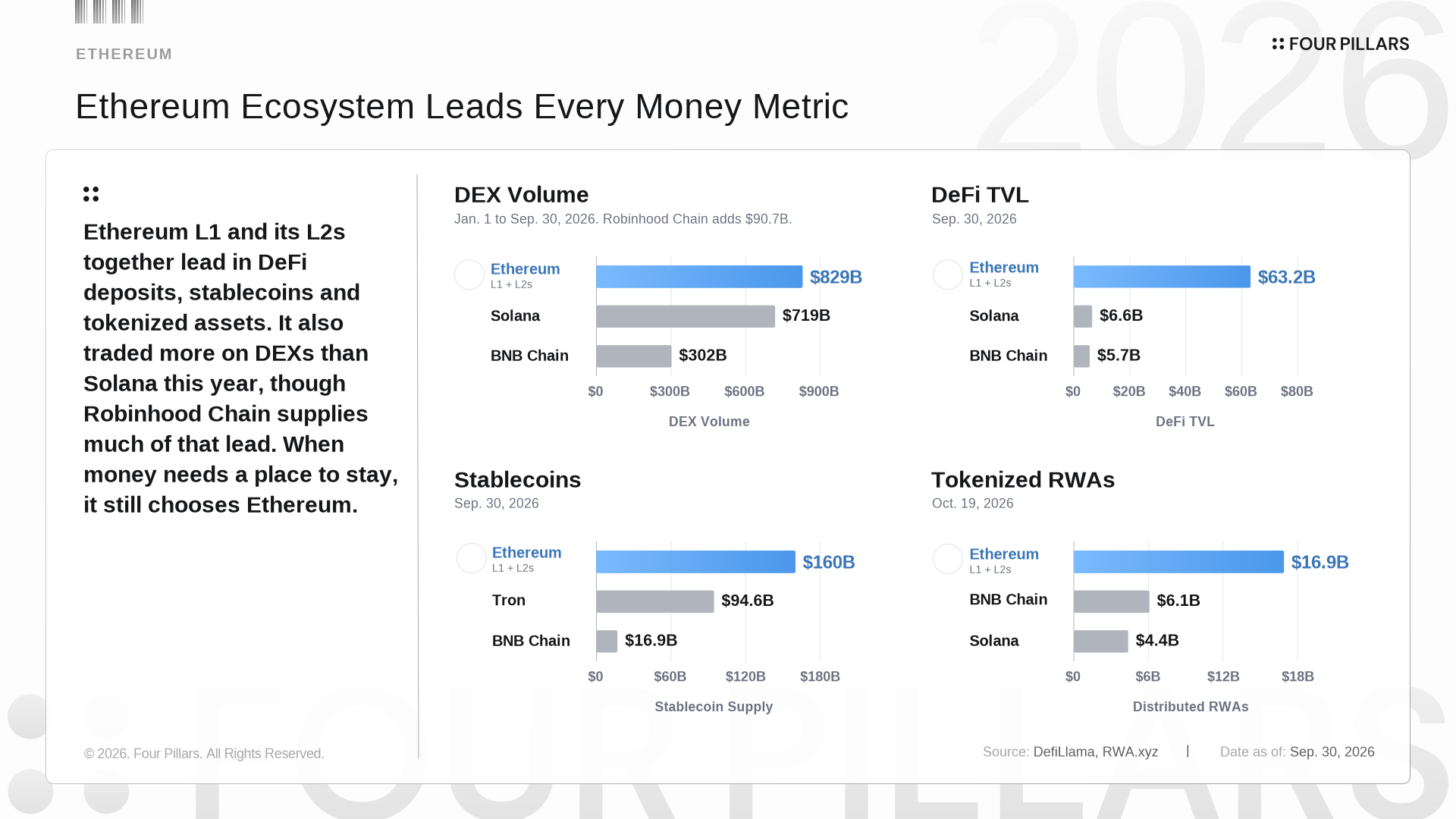
DefiLlama, RWA.xyz · As of September 30, 2026
When L1 and its L2 are counted as one ecosystem, Ethereum ranks first on every funding metric. As of September 30, DeFi deposits (TVL) reached $63.2 billion, more than nine times the second-place Solana at $6.6 billion. Total stablecoins reached $160.1 billion, far surpassing Tron's $94.6 billion. As of October 19, tokenized RWA reached $16.9 billion, nearly three times BNB Chain’s $6.1 billion. During January to September, Ethereum's ecosystem had DEX trading volume of $829 billion, outpacing Solana's $719 billion. However, Robinhood Chain alone accounted for $90.7 billion of that. Excluding it narrows Ethereum's lead to just 2.7%. Ethereum L1 is where funds stay long-term. Transactions can move seamlessly between fast, cheap chains. However, trust-based funds, such as deposits, stablecoins, and tokenized assets, accumulate on Ethereum.
EF Choices to Shrink; Those Who Leave Stay on Ethereum
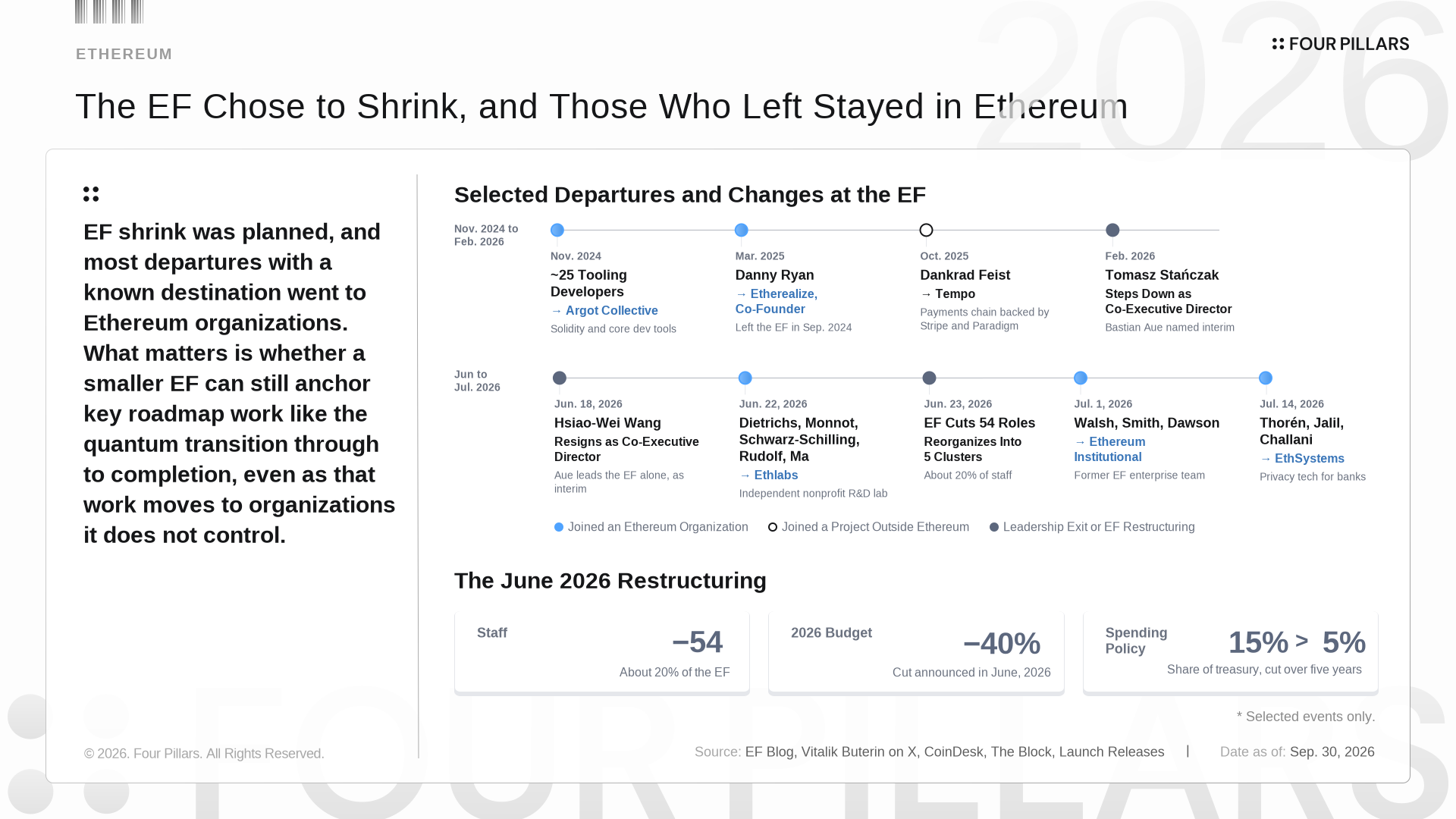
EF blog, Vitalik Buterin on X, CoinDesk, The Block, launch releases · As of September 30, 2026
The Ethereum Foundation (EF) is actively shrinking. On June 23, it cut 54 positions, about 20% of its total staff. According to Vitalik Buterin, it has also cut its 2026 budget by about 40%. These cuts were not rushed decisions. The long-term goal of EF has been to gradually unload its responsibilities, allowing Ethereum to operate independently of the foundation eventually.
Key Organizations in Ethereum Transitioning from Non-Profit to Corporate Backing
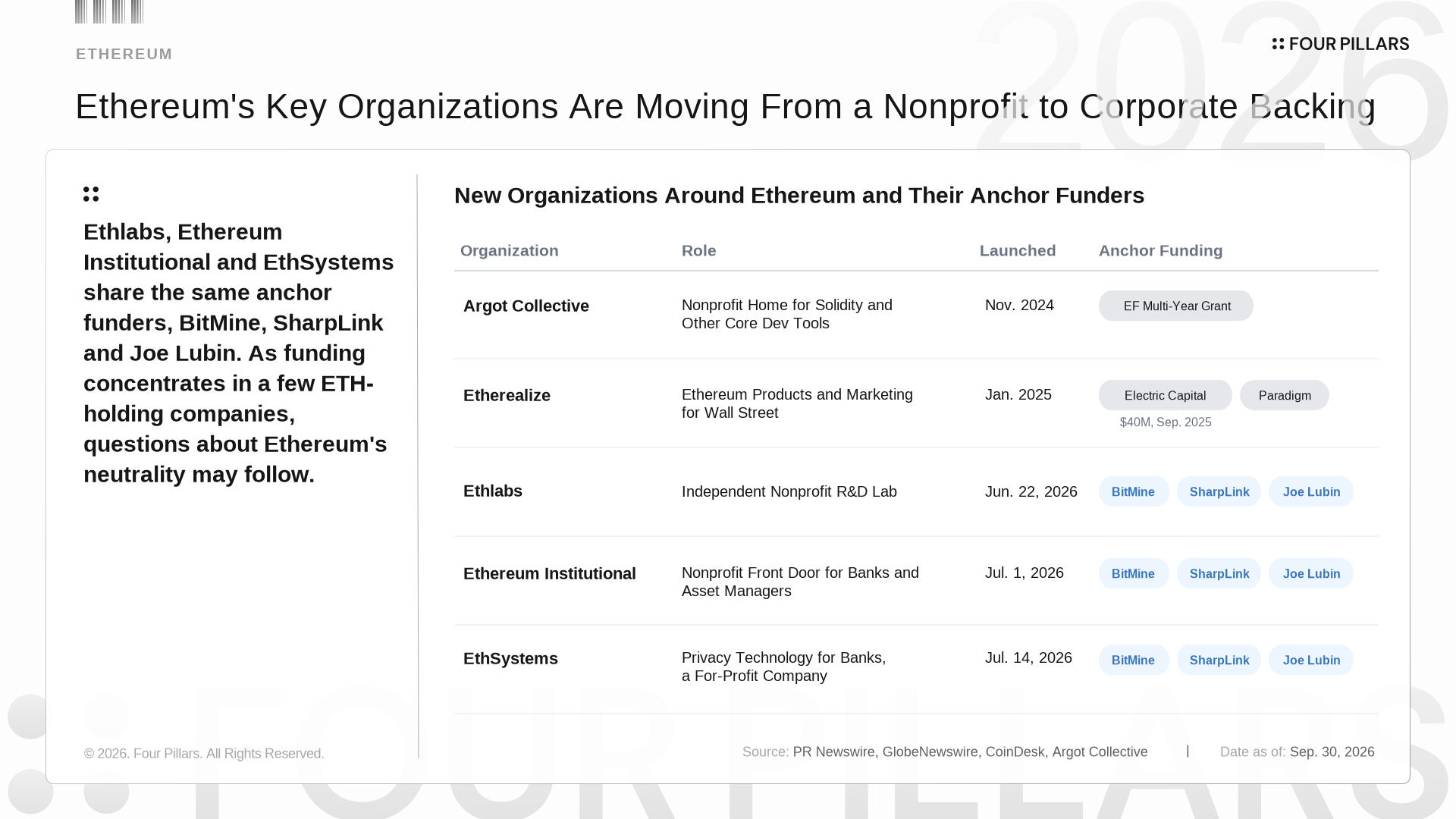
PR Newswire, GlobeNewswire, CoinDesk, Argot Collective · As of September 30, 2026
New organizations are taking on the work abandoned by the EF. In June and July 2026 alone, three were established successively. Ethlabs is an independent research lab; Ethereum Institutional works with banks and asset management companies; EthSystems is building privacy technologies for banks.
Quote: Julian Ma, Co-founder and Growth Lead of Ethlabs
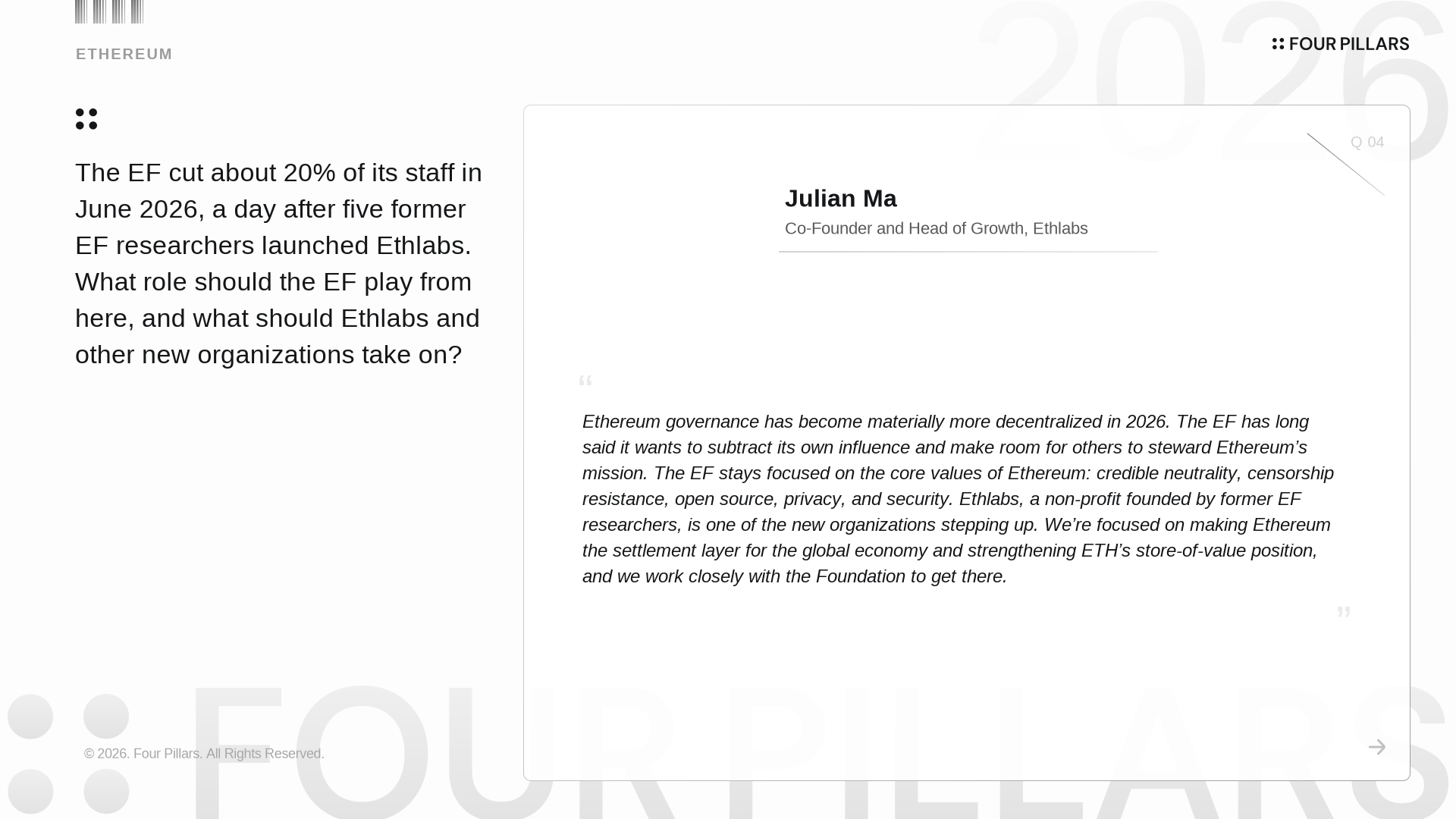
Interview: Julian Ma
The EF cut approximately 20% of its staff in June 2026, one day before five former EF researchers established Ethlabs. What role should EF play going forward? What should Ethlabs and other new organizations take on? In 2026, Ethereum governance has become substantively more decentralized. The EF has long expressed a desire to reduce its influence and make space for others to govern Ethereum. It continues to focus on Ethereum’s core values: trustworthy neutrality, censorship resistance, open source, privacy, and security. Ethlabs, founded by former EF researchers as a nonprofit, is one of the rising new organizations. We are focused on making Ethereum the settlement layer of the global economy and strengthening ETH's store of value status, and we work closely with the foundation to achieve this goal. —— Julian Ma, Co-founder and Growth Lead of Ethlabs
Five Key Goals for 2029 Can Be Adjusted, Four Principles Remain
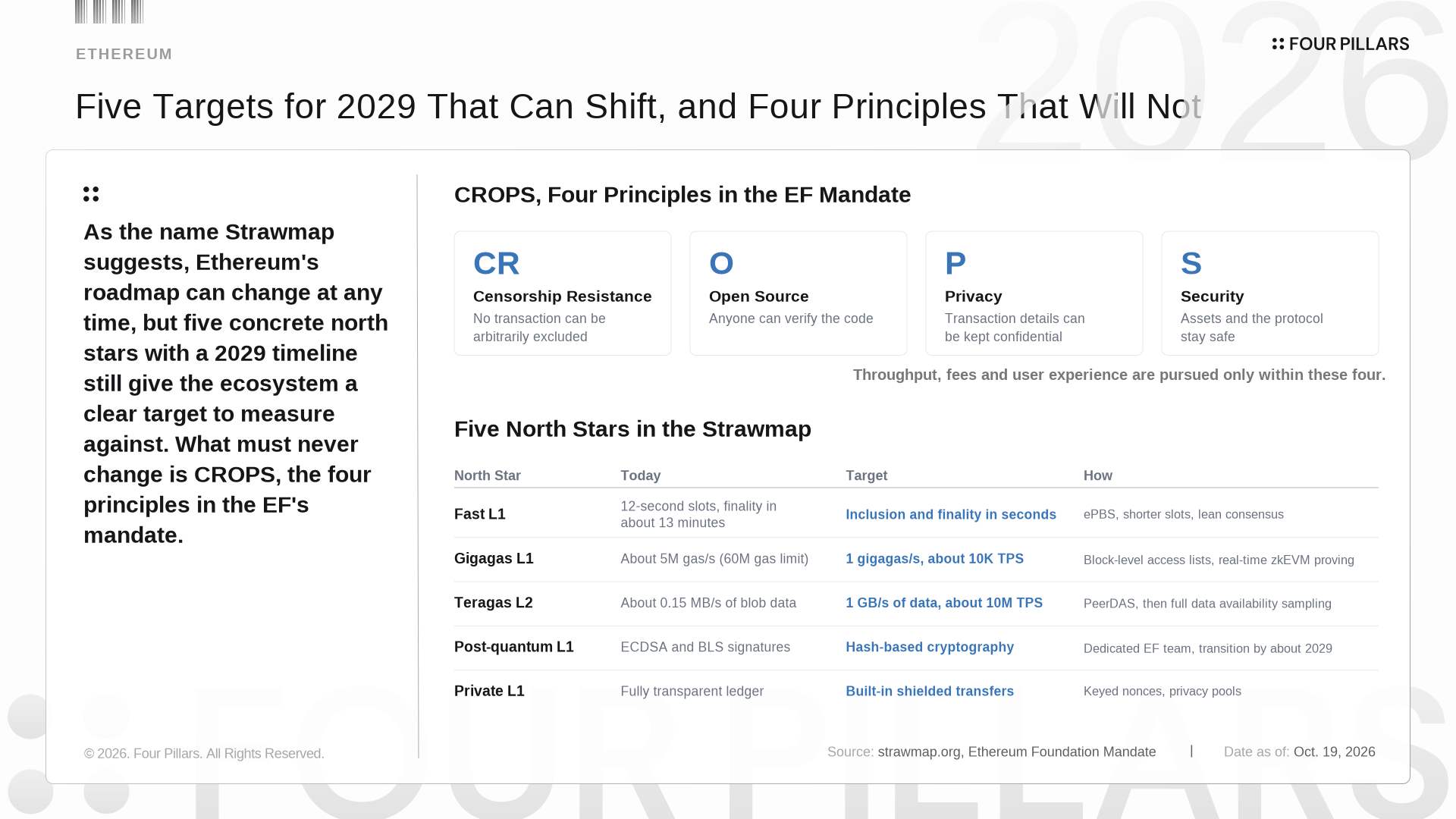
strawmap.org, Ethereum Foundation Mandate · As of October 19, 2026
In February 2026, the EF's architecture team released the Strawmap (draft roadmap). A month later, the EF released its governance documents, outlining a series of principles termed CROPS that will never change. CROPS stands for Censorship Resistance, Open Source & Freedom, Privacy, and Security. The name Strawmap combines "strawman" (a draft submitted for review) with "roadmap." It indicates that a complete official roadmap is impractical and subject to change at any time. Nevertheless, the Strawmap still lists long-term goals with concrete numbers, providing benchmarks to measure progress within the ecosystem. In comparison, CROPS is a standard that no other goals can replace. The goals of the Strawmap must be pursued without compromising CROPS. However, the EF itself is not the owner of Ethereum but rather a steward building Ethereum alongside others. It remains unclear whether CROPS can continue to serve as a standard in the broader Ethereum ecosystem beyond the EF itself.
The Ethereum Roadmap Now Prioritizes L1 Scalability, Privacy, and Quantum Resistance
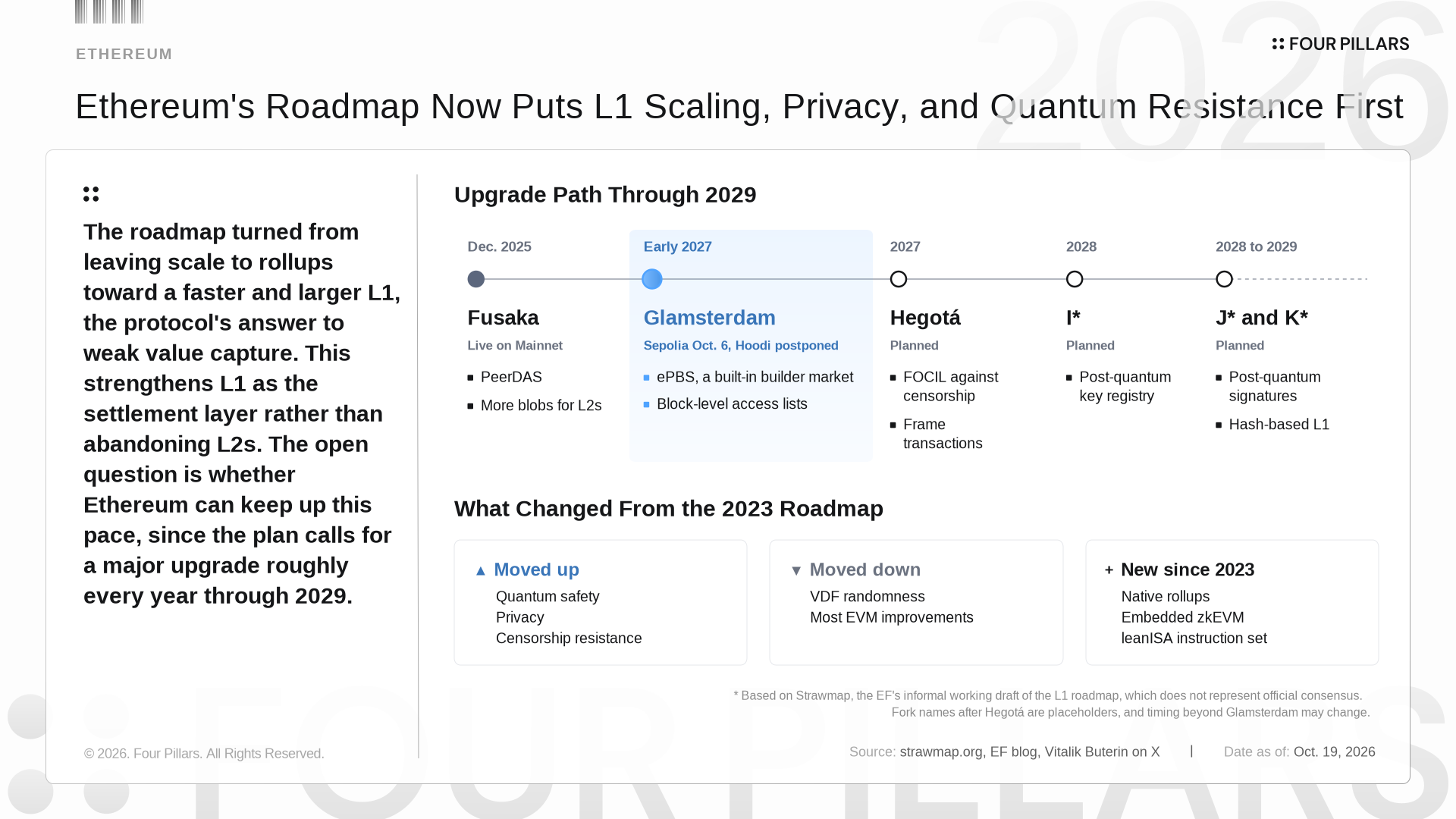
strawmap.org, EF blog, Vitalik Buterin on X · As of October 19, 2026
Since the rollout of the rollup-focused roadmap in 2020, Ethereum has been developing around a minimized L1, delegating execution scaling to L2. The Strawmap repositions L1 at the center, bringing scaling and even privacy into L1 itself. The upcoming Glamsterdam hardfork will include ePBS (separating block proposers from builders) and BALs for parallel execution. The planned Hegotá fork in 2027 will increase frame transactions and FOCIL (a censorship resistance mechanism). Based on these changes, the forks in 2028 and 2029 aim to increase block size, shorten block times, and transition to quantum-resistant signatures. The key question is the pace that the roadmap demands. The plan requires a hardfork roughly every six months until around 2029. However, more than a year after Fusaka went live in December 2025, Glamsterdam’s mainnet date remains uncertain. If Glamsterdam and Hegotá are delayed, everything that follows will also be pushed back. For Strawmap to succeed, both of these hardforks need to launch on the mainnet by the end of 2027.
Quote: Felix Lange, Head of Geth at the Ethereum Foundation
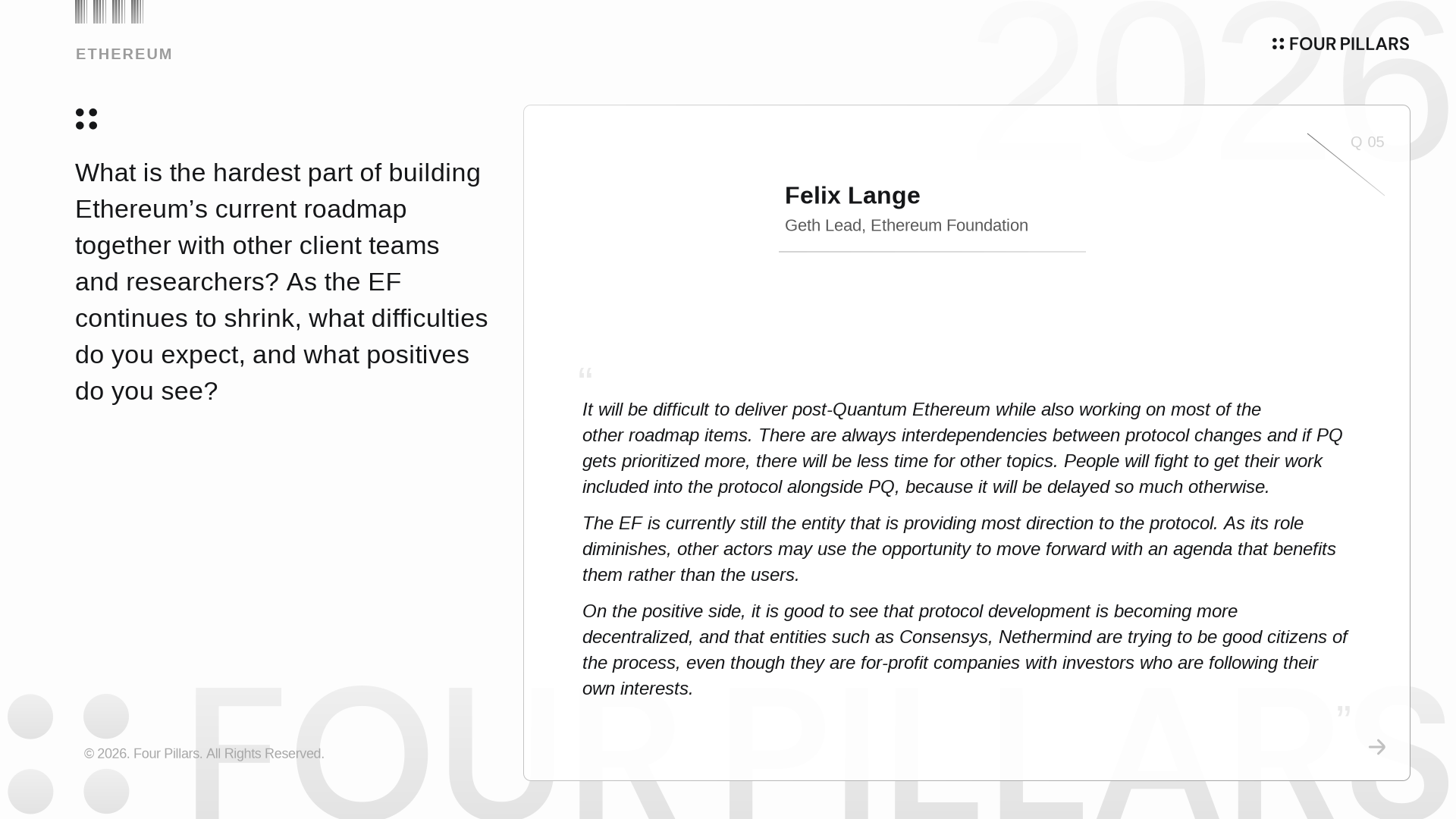
Interview: Felix Lange
What has been the most challenging part of collaboratively building the current roadmap for Ethereum with the other client teams and researchers? As the EF continues to shrink, what challenges do you expect to encounter, and what positive aspects do you see? Delivering a post-quantum Ethereum while advancing other major roadmap projects will be extremely challenging. There are always interdependencies between protocol changes, and if post-quantum (PQ) is given higher priority, the timing for other issues will be reduced. People will try to get their work included with PQ, or else it’ll be significantly delayed. Currently, the EF remains the entity providing most of the direction to the protocol. As its role diminishes, other actors may take the opportunity to advance agendas that favor themselves over users. The positive side is that it's encouraging to see protocol development becoming more decentralized, with entities like Consensys and Nethermind striving to be good citizens in this process, even though they are for-profit companies with investors pursuing their own interests. —— Felix Lange, Head of Geth at the Ethereum Foundation
EIP Overall Trends: Proposal Steady Growth, Increased Protocol Attention
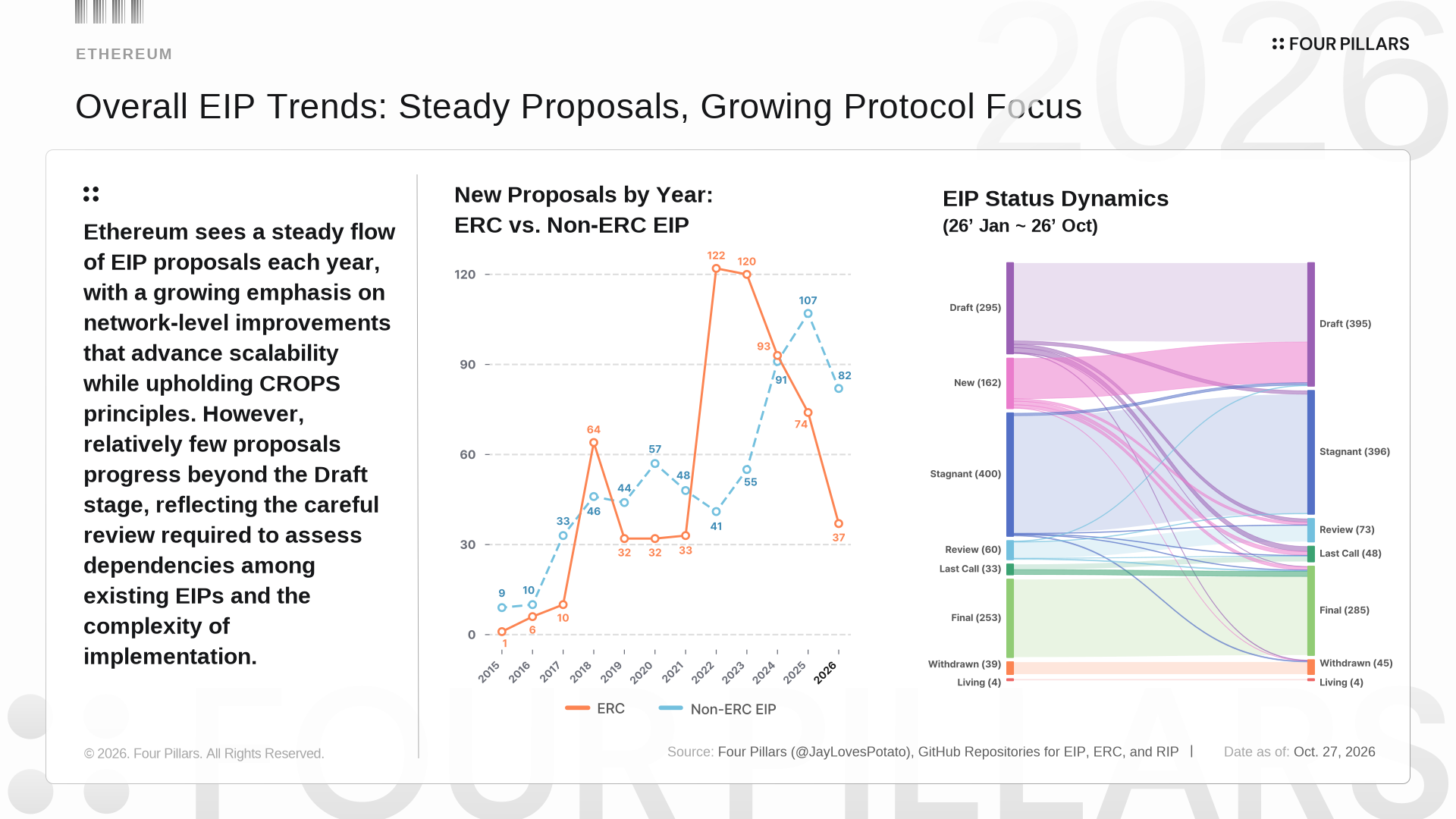
Four Pillars (@JayLovesPotato), GitHub Repositories for EIP, ERC, and RIP · As of October 27, 2026
From 2022 to 2026, as blockchains garnered widespread attention, approximately 160 to 180 new EIPs have been proposed each year. These proposals align with Ethereum's goal of scaling while maintaining CROPS (Censorship Resistance, Open Source, Privacy, and Security). The performance improvements for Glamsterdam and the focus on Censorship Resistance in Hegotá are key examples. Relatively few proposals advance past Draft, reflecting the extensive discussions and testing required to assess the dependencies on existing EIPs and the complexities of implementation. (The right chart contains EIPs written in earlier years that were officially added to the repository in 2026, explaining why the number of new proposals exceeds the 2026 figure on the left.)
Ethereum is Expanding Beyond the Foundation, but Are New Contributors Joining?
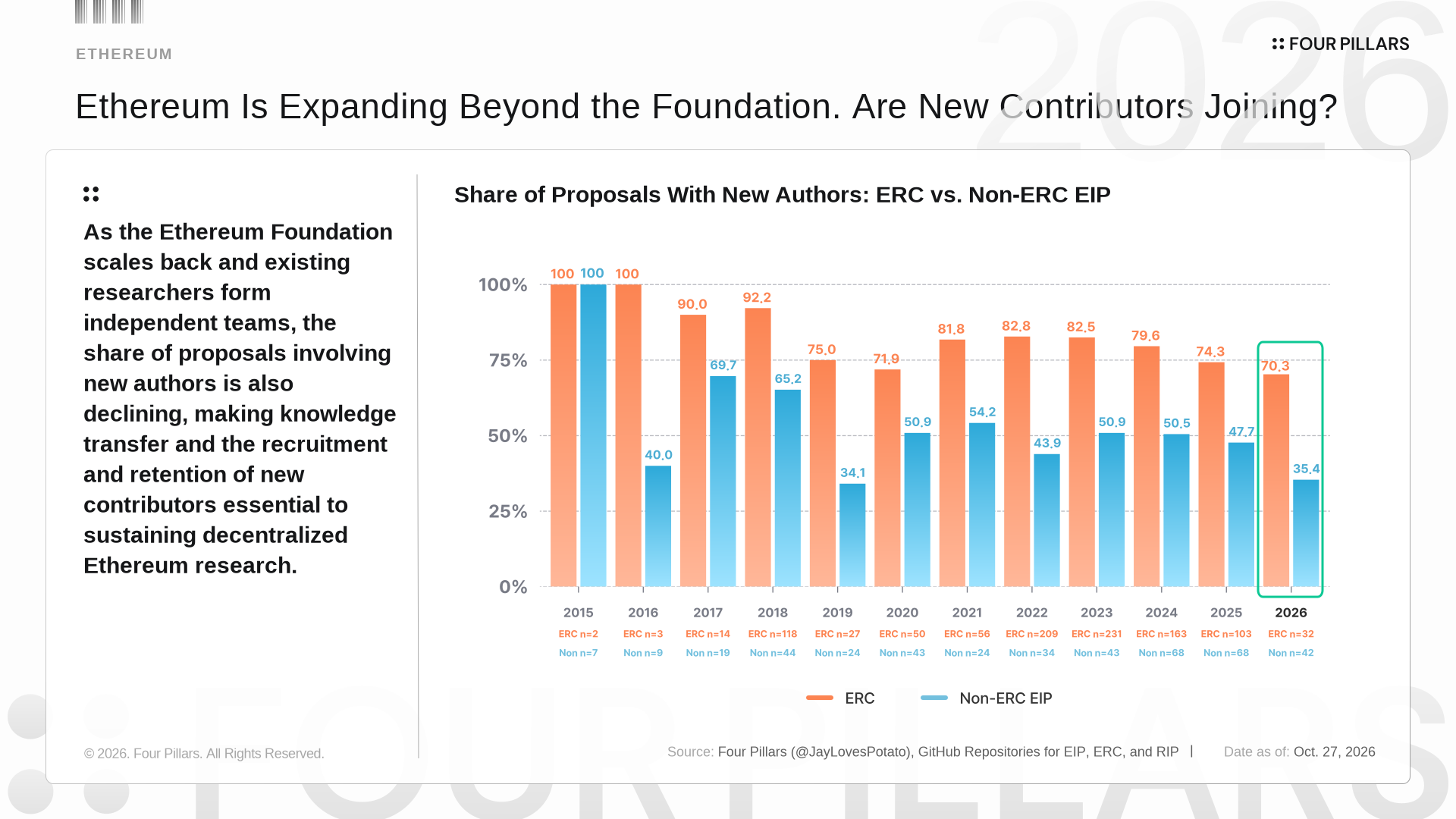
Four Pillars (@JayLovesPotato), GitHub Repositories for EIP, ERC, and RIP · As of October 27, 2026
The proportion of proposals involving at least one new author generally sees ERCs outperform non-ERC EIPs. However, in 2026, this ratio has decreased to 70.3% and 35.4%, respectively, with non-ERC EIPs reaching their lowest level since 2019. As the Ethereum Foundation narrows its focus and scales down, alongside researchers forming independent teams, these figures raise the question of whether there are enough new contributors entering while existing contributors continue to work outside the foundation. The future depends significantly on how the Foundation and its spin-off entities transfer accumulated knowledge and protocol design context to new researchers and help them become long-term contributors.
Barbell Structure of On-Chain Market
On-chain markets are increasingly exhibiting a barbell structure, with growth concentrated at both ends: speculative markets and institutional finance.
2026 has been a tough year for the crypto industry overall, but the on-chain economy has been particularly hard hit. By the end of September, the total market capitalization of crypto had fallen 3.4% year to date, Bitcoin dropped 4.5%, while DeFi TVL fell 17.2%. The gap was most pronounced earlier in the year, when DeFi TVL significantly contracted along with the overall retreat in on-chain activity. The poor performance of DeFi is notable as it is primarily composed of crypto assets and stablecoins. In principle, this should provide some cushioning for the overall decline in the crypto market. However, the decline in DeFi TVL has indeed outpaced that of the market itself, indicating that this weakness reflects more than just falling asset prices. It points to users proactively withdrawing funds from DeFi or becoming less willing to use on-chain protocols, a dynamic we will explore in the following slides.
2026 Experienced a Wave of Shutdowns of On-Chain Protocols
The challenging market environment of 2026 has exposed many on-chain business models as still fragile. Across the entire industry, protocols have been hindered by insufficient product-market fit, meager revenues, drained funding runways, and increased security costs, prompting an increasing number of teams to cease operations. The wave of shutdowns indicates that the raised funds and impressive user data are not enough to sustain a protocol’s existence. As financing becomes more difficult and users more selective, protocols increasingly need enduring demand and credible paths to profitability to survive. Security incidents have further elevated this threshold, as several shutdowns in 2026 were directly or indirectly related to significant exploits.
Quote: TN Lee, CEO of Pendle
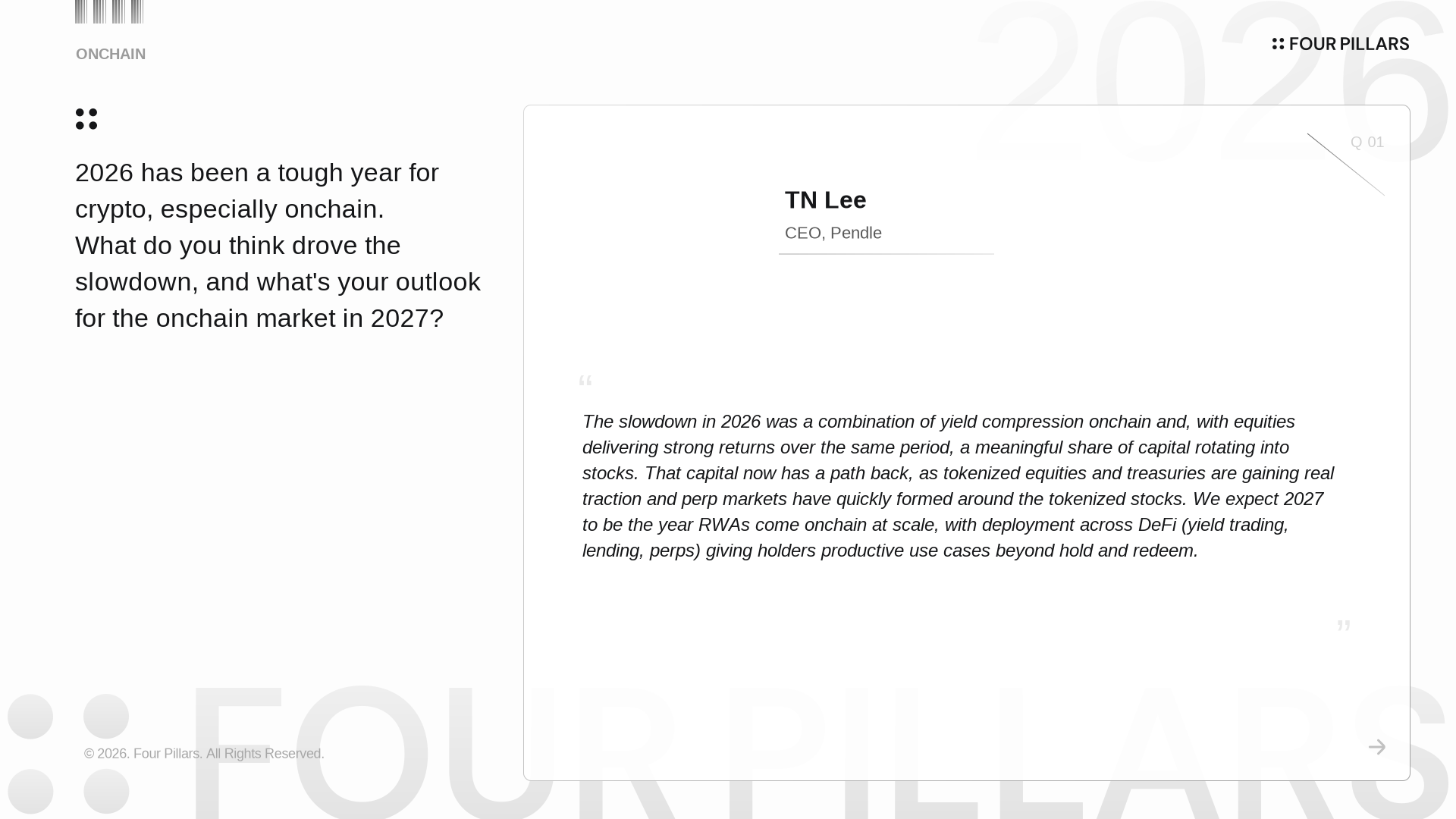
Interview: TN Lee, CEO, Pendle
2026 has been a difficult year for the crypto industry, particularly in the on-chain domain. What do you think has led to the slowdown? What is your outlook for the on-chain market in 2027? The slowdown in 2026 has been due to the compression of on-chain yields, combined with strong stock returns during the same period, prompting a significant amount of capital to rotate into stocks. These funds now have a flowing route back, as tokenized stocks and government bonds are gaining real traction, and a perpetual contracts market is rapidly forming around tokenized stocks. We expect 2027 to be a year of large-scale digitalization of RWA, with its deployment in DeFi (yield trading, lending, perpetual contracts) providing holders with productive use cases beyond mere holding and redemption. —— TN Lee, CEO of Pendle
Security Vulnerabilities Are One of the Biggest Barriers to On-Chain Adoption
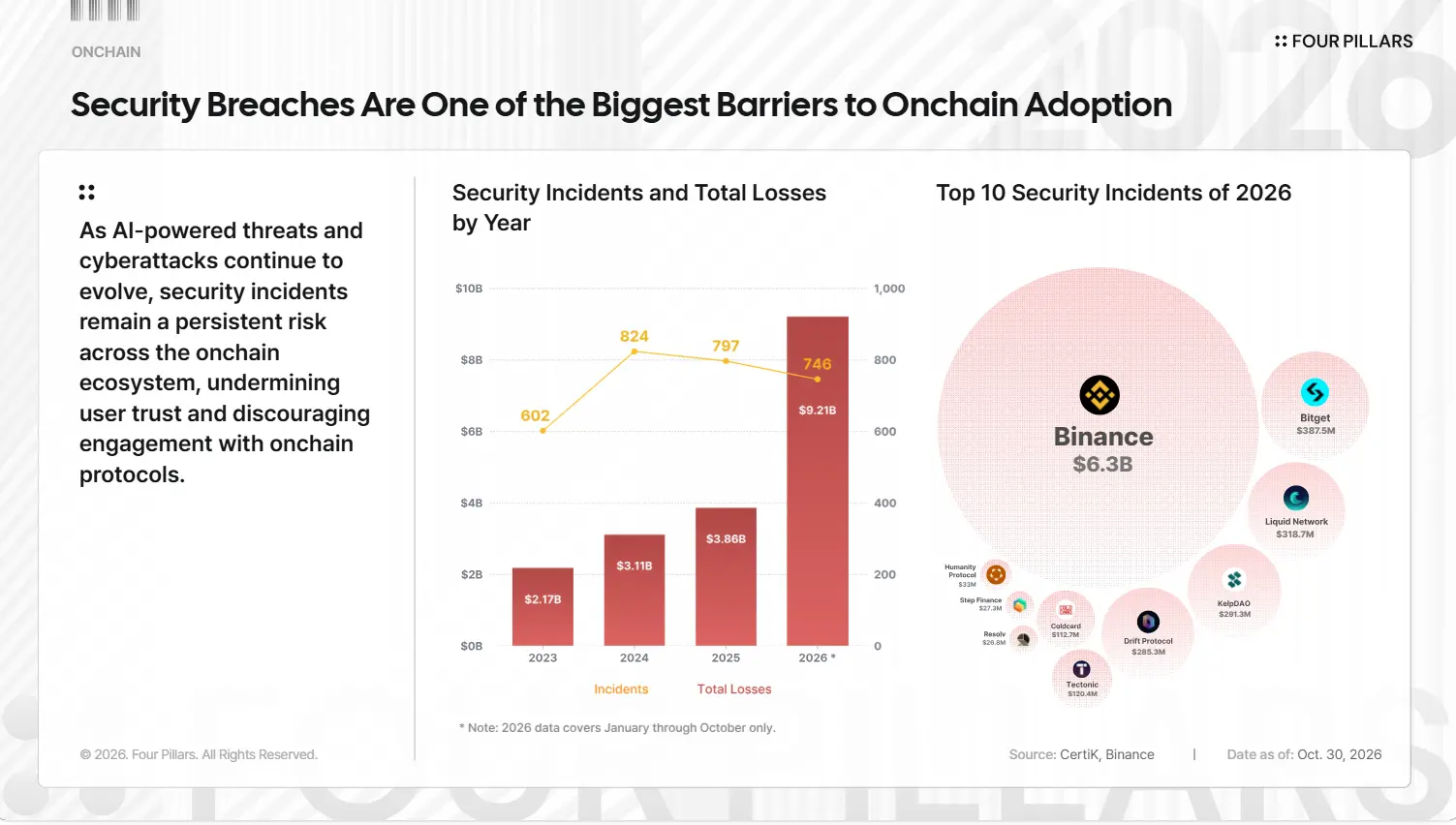
Security risks reached a new level in 2026. Over 750 security incidents caused about $9 billion in losses, largely driven by the $6.3 billion Binance event, which remains the largest crypto security incident to date. While the number of incidents remains high, the scale of losses has skyrocketed. As AI renders cyber attacks more complex and scalable, security is becoming a structural barrier to on-chain adoption. For users, the increased risk of large-scale losses adds a layer of uncertainty to the use of on-chain services and weakens trust, making it increasingly difficult to rationalize the risk-return tradeoff of participating in crypto.
Quote: Jun Choi, Head of Growth at OtterSec

Interview: Jun Choi, Head of Growth, OtterSec
As AI capabilities enhance, do you anticipate that attacks on on-chain protocols will accelerate, or can AI-driven defenses and better security infrastructure keep pace? AI helps security teams identify vulnerabilities for projects more efficiently; however, black hats also benefit from many of the same capabilities. In response, we have seen demand for custom security services that go beyond smart contract audits, as well as ecologically coordinated efforts like STRIDE and SIRN. As AI expands what attackers can do, security teams will also adapt by taking a more holistic approach and prioritizing incident response when issues arise. —— Jun Choi, Head of Growth at OtterSec
On-Chain Yields No Longer Offer Attractive Premiums
FRED, CoinDesk Indices, DefiLlama, Ethena, Sky · January 1 – September 30
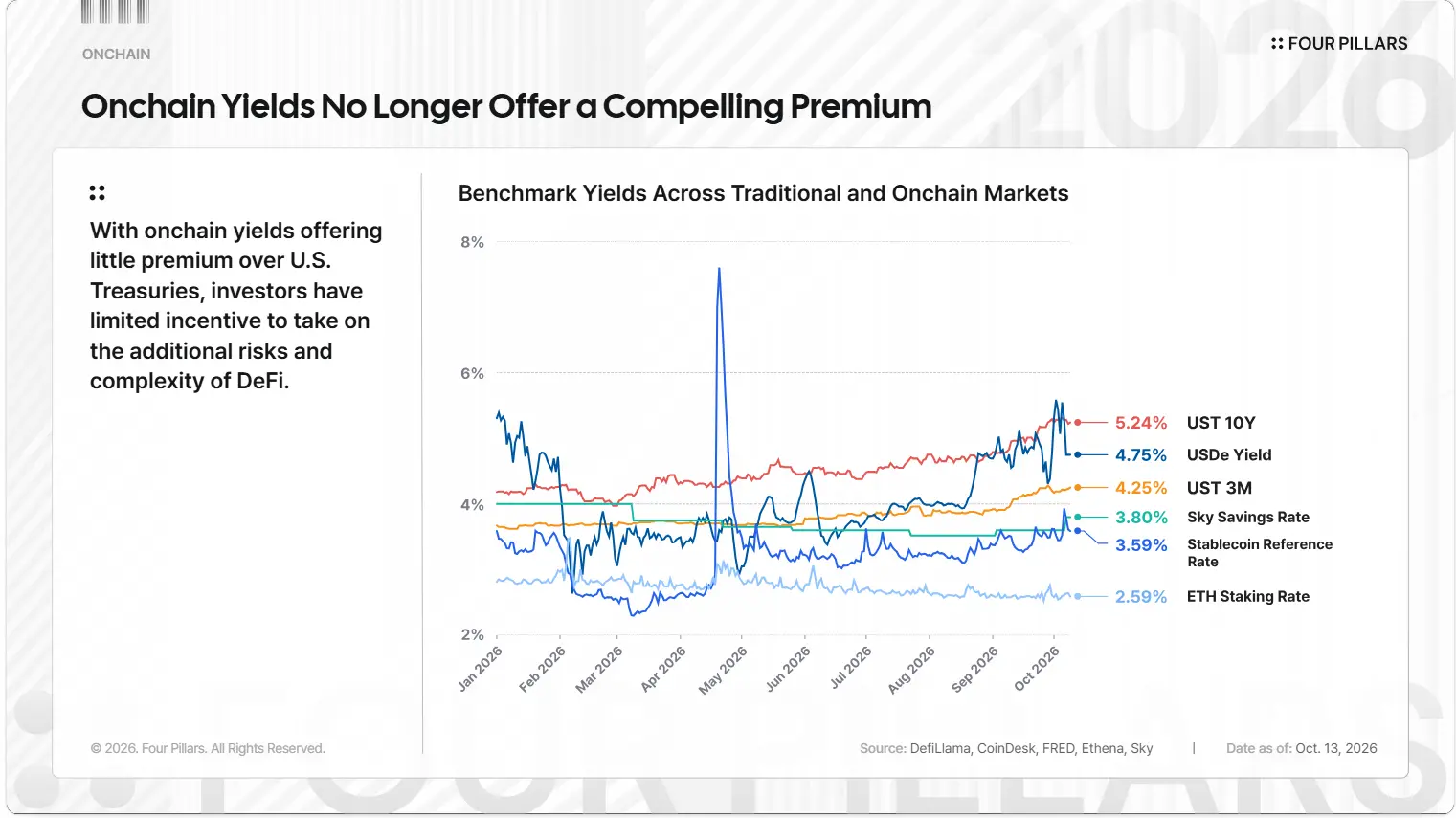
On-chain yields no longer offer the premium they once did. As of mid-October, the 10-year U.S. Treasury yield was 5.24%, the 3-month was 4.25%, while USDe was 4.75%, Sky Savings Rate was 3.80%, and stablecoin reference rate was 3.59%, with ETH staking only at 2.59%. In other words, investors can now obtain comparable or even higher yields in traditional markets without assuming additional smart contract and liquidity risks associated with DeFi. Due to the still high-security risks, the risk-return tradeoff of deploying funds on-chain has become less attractive, helping to explain why users may be increasingly unwilling to participate in DeFi.
Quote: Guy Young, Founder and CEO of Ethena
Interview: Guy Young, Founder and CEO, Ethena
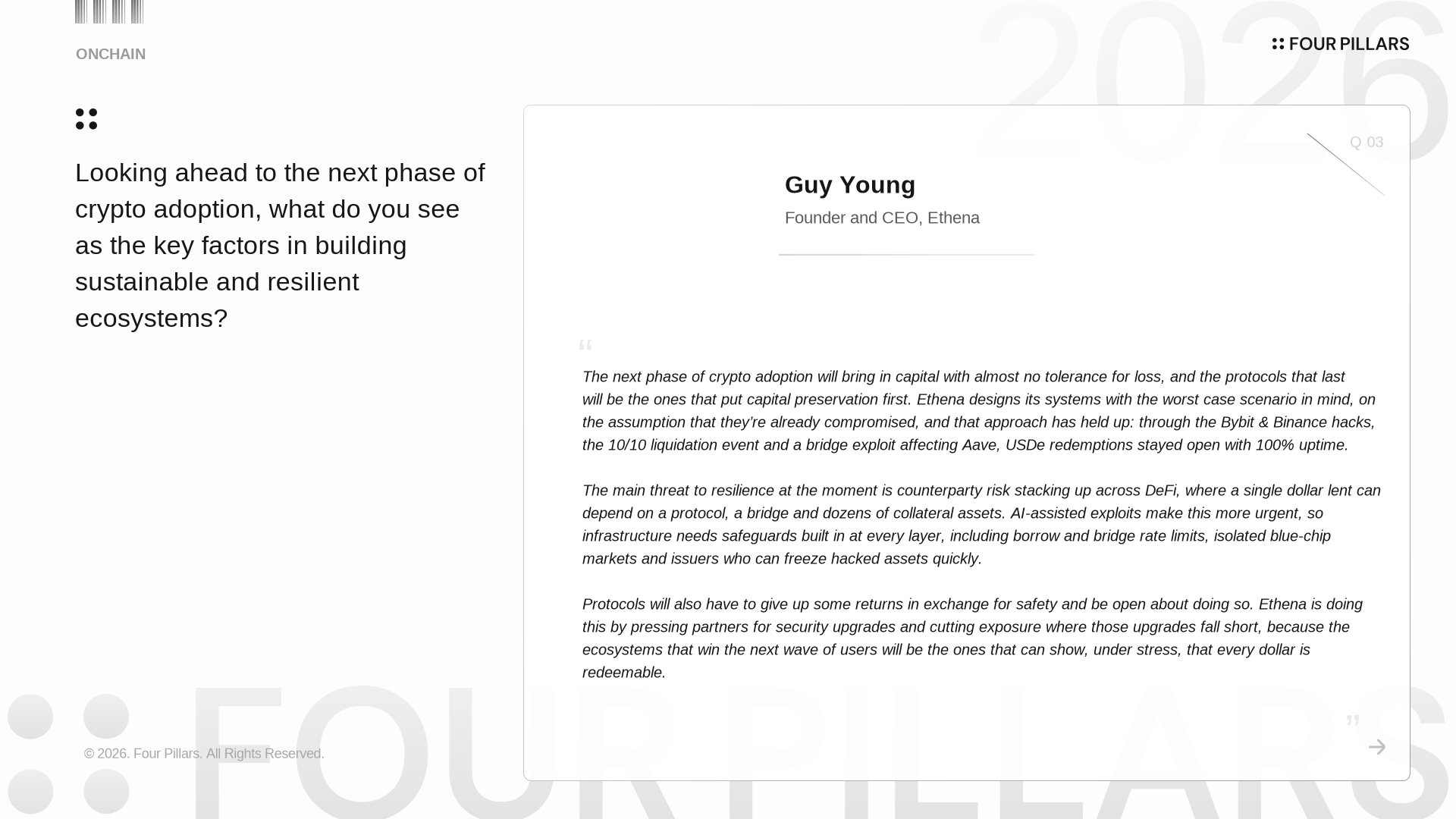
Looking forward to the next phase of crypto adoption, what do you think are the key factors to build a sustainable and resilient ecosystem? The next phase of crypto adoption will bring capital that can scarcely tolerate losses, and the protocols that survive will be those that prioritize capital preservation. Ethena designs systems with worst-case scenarios in mind, assuming the system is compromised, and this approach has stood the test: during Bybit and Binance hack events, the 10/10 liquidation event, and cross-chain bridge vulnerabilities affecting Aave, USDe redemptions have consistently remained open, operating 100% normally. The greatest immediate threat to resilience is the compounding counterparty risks in DeFi, where a dollar lent may rely on one protocol, one cross-chain bridge, and dozens of collateral assets.
AI-assisted vulnerability attacks make this urgency even more pronounced, thus infrastructure needs to be built with defenses at every layer, including rate limits for lending and cross-chain bridges, isolated blue-chip markets, and the ability for issuers to freeze stolen assets quickly. Protocols must also drop some profit potential in exchange for security and be transparent about doing so. Ethena is achieving this by urging partners to upgrade security and scaling back exposure when upgrades are not met, as winning the next wave of users will belong to those ecosystems that can demonstrate that every dollar is redeemable, even under stress. —— Guy Young, Founder and CEO of Ethena
The On-Chain Ecosystem is Increasingly Exhibiting a Barbell Structure
DefiLlama, Dune, rwa.xyz · As of September 30, 2026
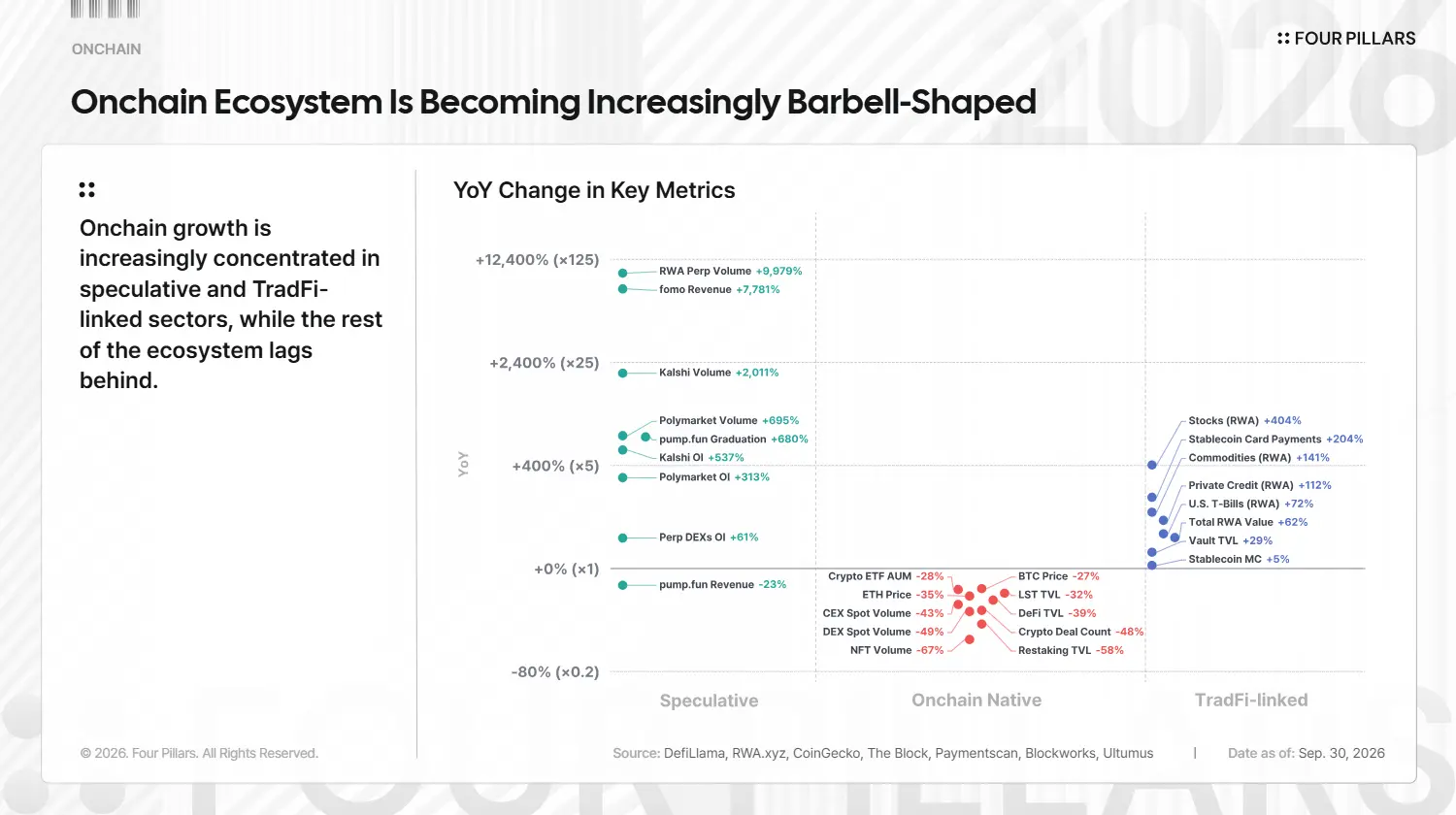
In 2026, the on-chain market is increasingly polarized. Growth is concentrated at both ends of the ecosystem: speculative markets and assets linked to traditional finance. Prediction markets are one of the most evident winners, with Kalshi trading volume growing 2011% year-on-year, Polymarket by 695%, and the open interest in perpetual contract DEXs rising 61%. The categories associated with traditional finance also expanded significantly, led by tokenized stocks’ +404%, stablecoin card payments’ +204%, and private credit’s +112%. This aligns with the broad rise of RWA perpetual contracts and tokenized stocks throughout 2026. In contrast, many of the traditional on-chain natives are shrinking. DeFi TVL declined 39% year-on-year, DEX spot trading volume fell by 49%, NFT trading volume dropped by 67%, and restaking TVL decreased by 58%. This disparity indicates that on-chain demand is no longer expanding evenly within the crypto realm but is increasingly concentrated around speculative products with clear user demand and financial products tied to traditional markets.
DeFi Protocols Are Adjusting Product Designs for Institutions
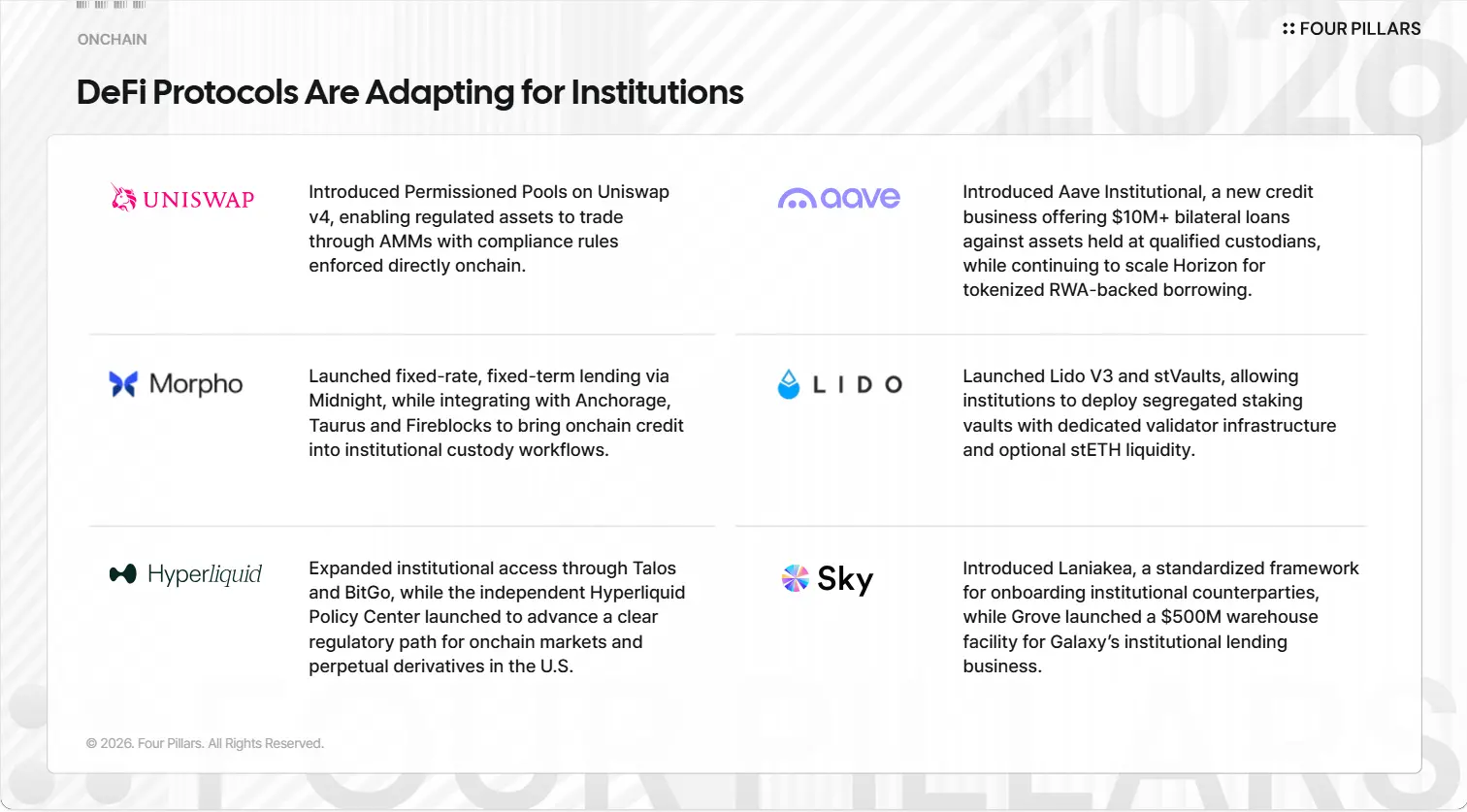
Project announcements
With institutional capital becoming an increasingly important source of growth, DeFi protocols are redesigning products around the needs of professional investors. This transformation is visible throughout the technology stack, with protocols increasingly adding features like permissioned markets, predictable credit terms, qualified custodian access, isolated staking, and institutional-grade compliance and risk controls.
Quote: Merlin Egalite, Co-founder of Morpho
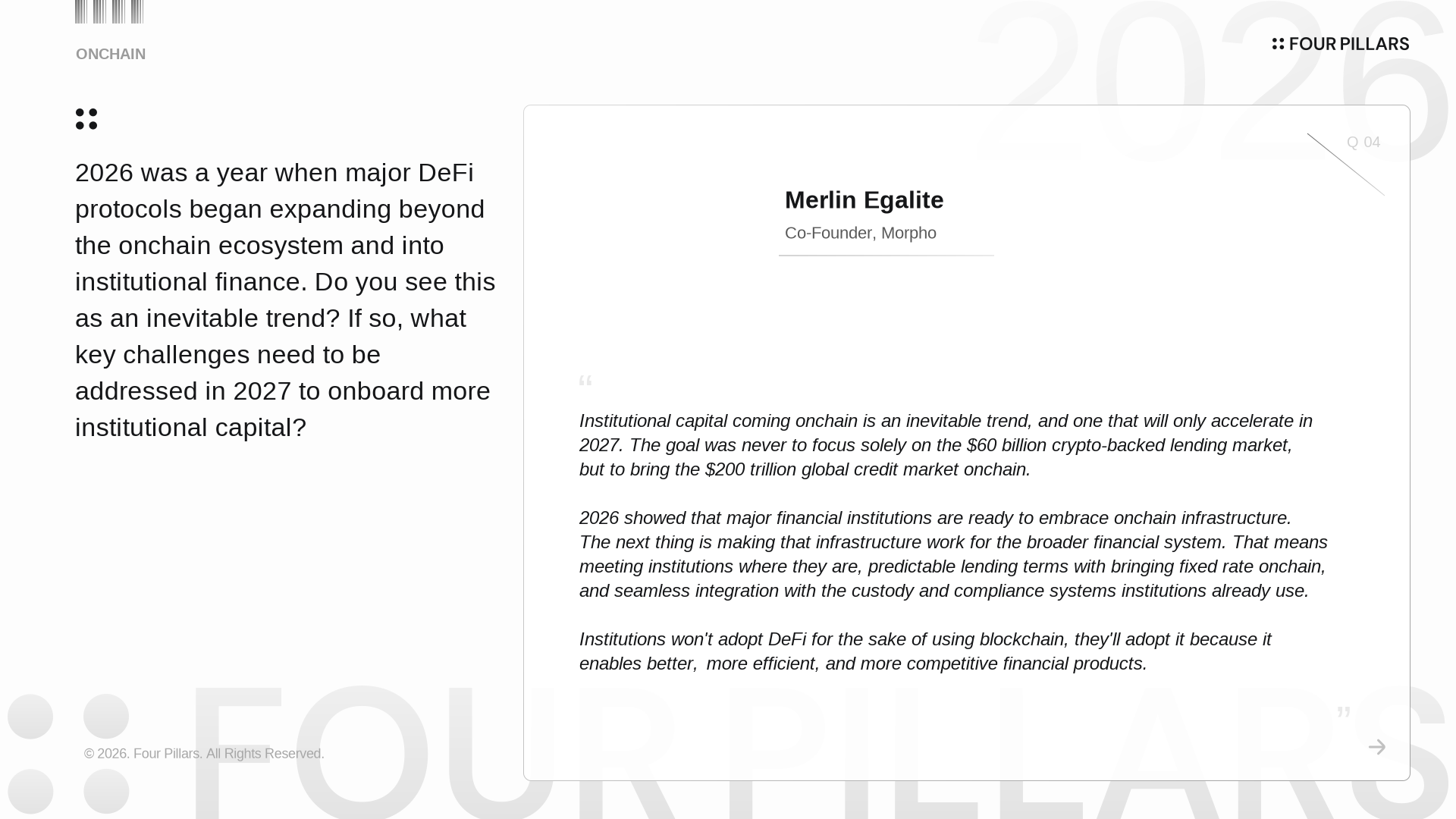
Interview: Merlin Egalite, Co-founder, Morpho
2026 has been a year where major DeFi protocols have begun to expand beyond the on-chain ecosystem into institutional finance. Do you think this is an inevitable trend? If so, what key challenges need to be addressed in 2027 to attract more institutional capital? Institutional capital moving on-chain is certainly an inevitable trend and will accelerate in 2027. The goal has never been to only focus on a $60 billion market of crypto-backed lending but to bring the $200 trillion global credit market on-chain. 2026 has shown that major financial institutions are ready to embrace on-chain infrastructure. The next step is to make this infrastructure serve the wider financial system, which means meeting institutions where they are, offering predictable loan terms through fixed rates, and seamlessly integrating with custodial and compliance systems they are already using. Institutions will not adopt DeFi to use a blockchain; they will adopt it because DeFi can deliver better, more efficient, and more competitive financial products. —— Merlin Egalite, Co-founder of Morpho
The Institutions Are Moving On-Chain
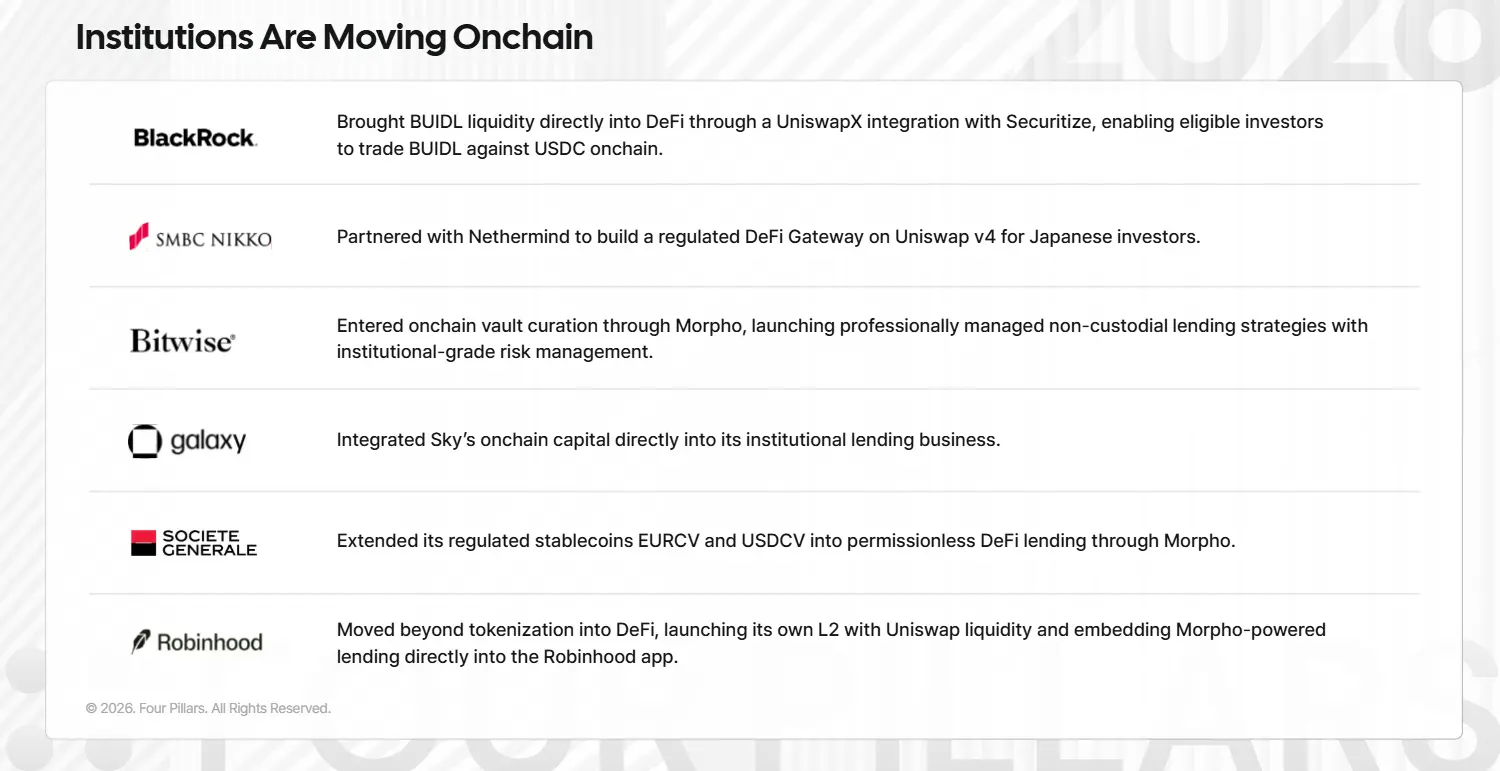
Company Announcements
Institutional adoption is no longer a one-way story of DeFi adapting to traditional finance. Financial institutions themselves are increasingly moving on-chain, using DeFi protocols as the infrastructure for trading, lending, liquidity, and asset distribution. BlackRock and Securitize are bringing BUIDL liquidity to UniswapX, SMBC Nikko is building regulatory-compliant DeFi gateways on Uniswap v4, while Bitwise is entering treasury management through Morpho. Galaxy is integrating Sky's capital into institutional lending, and Société Générale-FORGE is deploying regulated stablecoins onto the Morpho lending market, while Robinhood is embedding both Uniswap liquidity and Morpho-driven lending into its own chain ecosystem. Overall, these moves indicate that traditional financial institutions are increasingly viewing DeFi as usable financial infrastructure rather than an experimental market.
Everyone is Targeting the Same On-Chain Opportunity
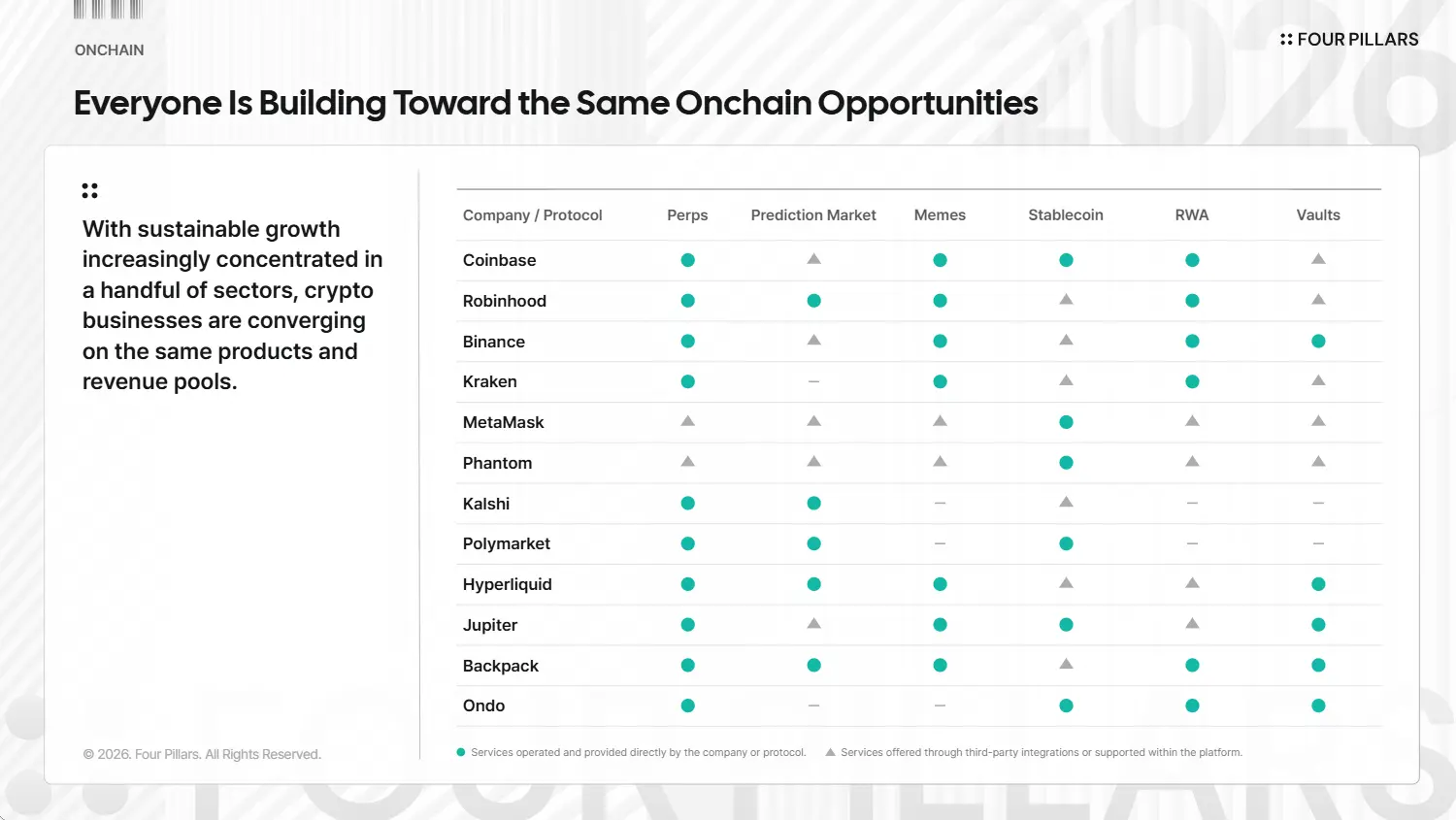
Four Pillars · As of September 30, 2026
As on-chain growth increasingly concentrates on a few validated categories, companies in the crypto ecosystem are gravitating towards the same opportunities. Speculative products like perpetual contracts, prediction markets, and meme coins continue to attract strong user demand, while stablecoins, RWA, and treasuries become the clearest areas of growth linked to traditional finance. The prediction markets alone recorded record trading volumes in 2026, while RWA perpetual contracts rapidly expanded. Thus, exchanges, wallets, trading venues, and protocols that initially had entirely different business models are increasingly delivering the same products. Coinbase, Robinhood, Binance, Hyperliquid, and Jupiter all expanded in these categories, either cutting directly in or through integrations. The result is a crypto industry with an increasingly converging product strategy, as everyone competes for the same limited pool of demand and revenue.
Quote: Taisuke Isono, General Manager of the DeFi Technology Department at SMBC Nikko Securities
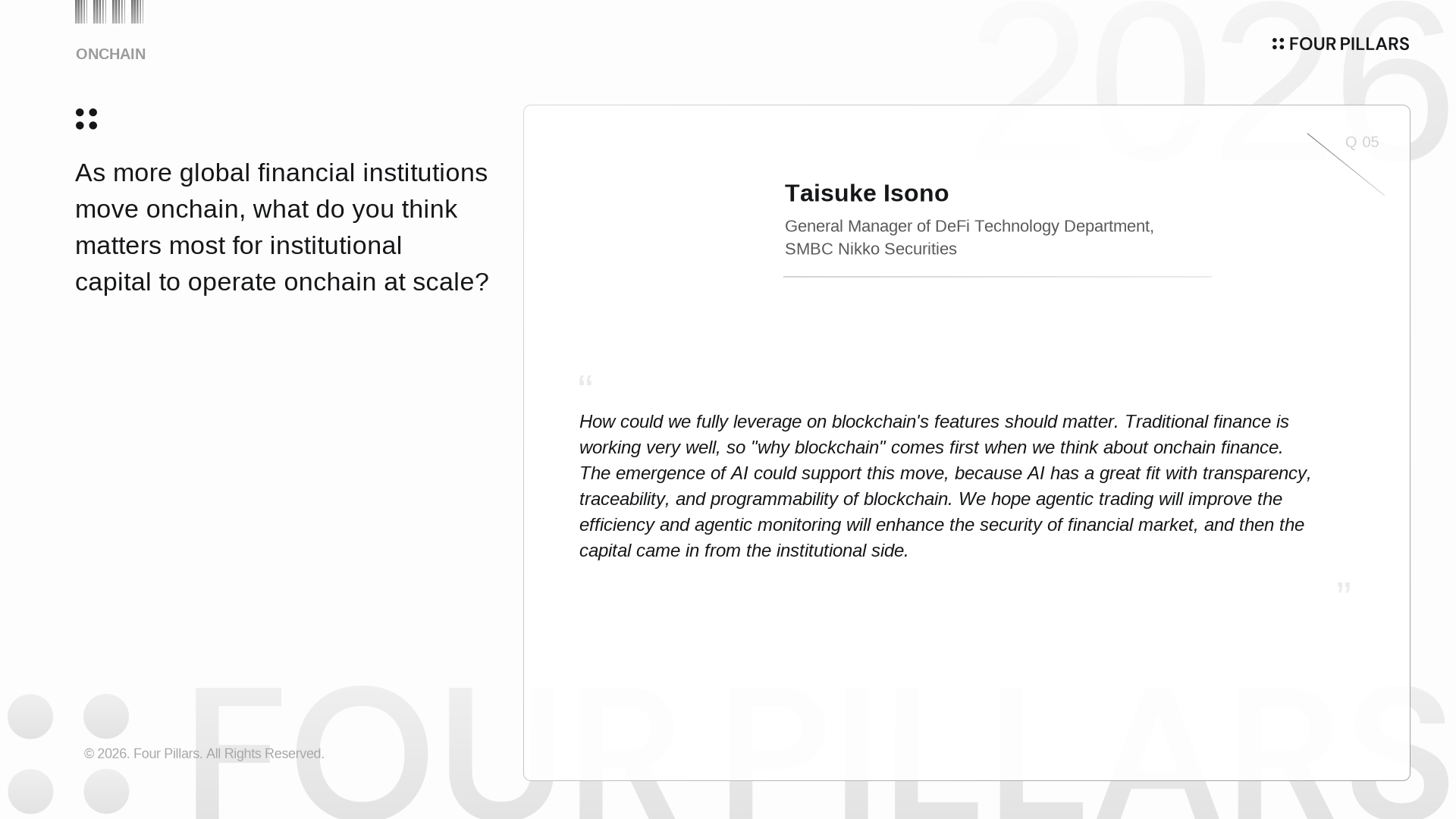
Interview: Taisuke Isono, General Manager, DeFi Technology Department, SMBC Nikko Securities
As more global financial institutions move on-chain, what do you consider to be most important for institutional capital to operate on-chain at scale? The key is how to fully leverage the features of the blockchain. Traditional finance is operating well, so when we think about on-chain finance, the fundamental question is, "why use blockchain?" The emergence of AI can support this transition, as AI aligns well with the transparency, traceability, and programmability of blockchain. We hope agentic trading can enhance efficiency in financial markets and agentic surveillance can improve the security of financial markets, thus leading to the entry of capital from the institutional side. —— Taisuke Isono, General Manager, DeFi Technology Department, SMBC Nikko Securities
2026 and Beyond
Key developments and projections for the future of digital assets in Asia.
Note: This section includes a series of in-depth interviews and insights from various sources on the Asian digital asset landscape in 2026.
免责声明:本文章仅代表作者个人观点,不代表本平台的立场和观点。本文章仅供信息分享,不构成对任何人的任何投资建议。用户与作者之间的任何争议,与本平台无关。如网页中刊载的文章或图片涉及侵权,请提供相关的权利证明和身份证明发送邮件到[email protected],本平台相关工作人员将会进行核查。