Insider trading, or was it a lucky bet?
Written by: Gino Matos
Translated by: Chopper, Foresight News
According to records from TrumpAlert, Donald Trump publicly urged Nvidia to reinstate Jensen Huang at 02:54 UTC on November 23 (Note: times in this article are in UTC).
Bubblemaps reports that 11 Polymarket accounts deposited funds between 03:49 and 10:44 that morning and placed their first bets approximately 6 minutes after each deposit.
The earliest deposit was made 55 minutes after Trump’s post, and the last deposit was about 3 hours before Nvidia announced Jensen Huang's return at 13:55.
Trump's endorsement, coupled with Jensen Huang's own willingness to return, gave traders a public reason to buy cheap "Yes" contracts. At that time, Polymarket predicted the probability of "Jensen Huang's return" was very low, with Bubblemaps mentioning a minimum buying price of only 1.5 cents per contract.
Public records tracked wallet 0x307 receiving 99.49 pUSD at 10:44:40, while Polymarket's records show a buy order of $99.29 just one second later, buying "Jensen Huang returns before December 31," priced at about 10 cents per contract. Nvidia's announcement was issued approximately 3 hours and 10 minutes later.
Previously, on November 17, Nvidia's Chairman Harvey Jones had publicly stated that the possibility of reinstating Jensen Huang was not considered, despite Huang expressing his willingness to return.
Why the $350,000 is noteworthy
Bubblemaps pointed out that 16 accounts injected funds in two batches: five accounts on November 16 and eleven accounts on November 23. Each account began trading approximately 6 minutes after depositing funds, and only traded on Nvidia-related markets.
This batch of accounts collectively bet about $20,000 and generated profits of about $350,000, with a return exceeding 17 times; the four largest winners together gained $275,800. Bubblemaps attributes the $350,000 to all 16 accounts, thus it is uncertain how much the accounts from November 23 profited.
The five accounts from November 16 cannot be explained using "public information." Their deposits occurred between 15:39 and 21:12, with the first deposit even happening before media reports at 16:52 that day indicating Trump's support for Huang's return.
According to Polymarket's closed data, one of the accounts realized a profit of about $94,900 on a November contract.
Bubblemaps stated that the identities of the operators of these accounts are unclear, and the on-chain connections between accounts have not been established. Therefore, evidence is needed for "held by the same group" and "exposed to confidential information."
Nvidia's SEC filing recorded the reinstatement date as November 22 but did not specify more detailed hours. If the board voted before Trump's post, insiders may have already known the outcome while the public waited; if the vote occurred after the post, then Trump's endorsement happened first.
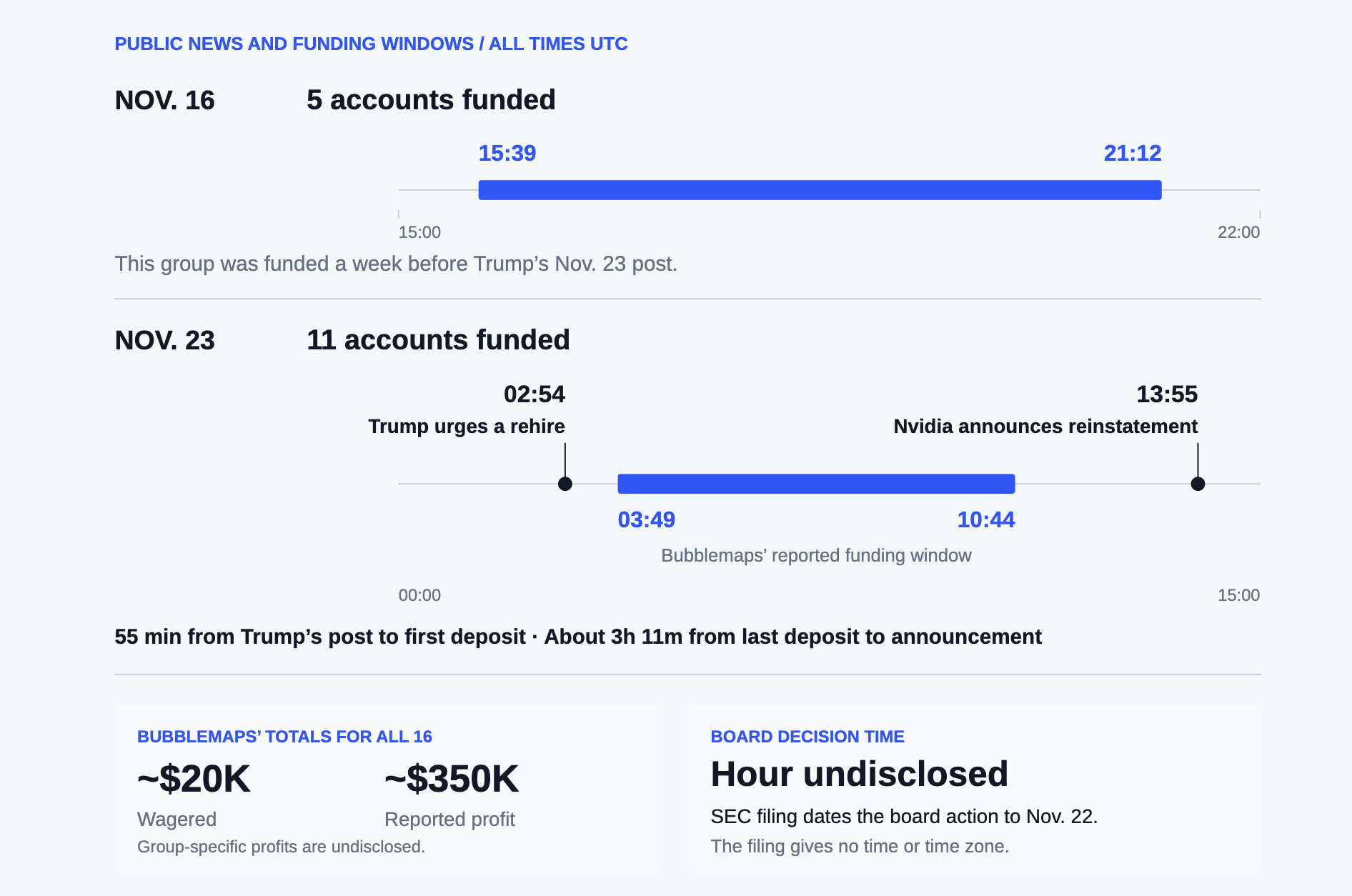
Two funding time windows before Jensen Huang's reinstatement. Five accounts deposited from November 16, 15:39–21:12, a week earlier than Trump's post on November 23; eleven accounts deposited from November 23, 03:49–10:44, falling between Trump's post at 02:54 and Nvidia's announcement at 13:55.
Under what circumstances would these bets constitute insider trading
The CFTC in a guideline on February 25 categorized "violating trust and confidentiality obligations, and misuse of significant non-public information" as prohibited actions.
It cited the Kalshi example: A candidate betting on their own election, and a video editor betting on unpublished YouTube content, both involve identifiable information sources. Applied to the Nvidia case, this standard requires evidence to prove that the account operators learned about the board's decision through improper disclosure or had an obligation to protect that information.
Timing concordance, abnormal returns, and bets on Nvidia all guide investigators in seeking related evidence.
Polymarket stated that its international platform uses machine learning systems, blockchain analysis, and trading monitoring tools, and prohibits insider trading.
If wallet-level tracking ultimately proves that the 11 accounts on November 23 are unrelated to Trump and his camp, then these profits could merely be a result of cheap bets leading investors to a radical interpretation of public information.
Assuming a trader sets the probability of success at 10% and buys in at 3 cents, their expected return rate before costs would be approximately 233%, but most of the time they would still incur losses.
Conversely, if on-chain researchers can link even one account to "improperly disclosed board decisions," then that account's trades would fall under the CFTC's standards.
Once confirmed cases arise, it will also examine whether Polymarket's own monitoring independently identified such anomalous patterns.
Trump's post gave the 11 accounts on November 23 a plausible public explanation. The five accounts that injected funds a week earlier on November 16 still need another explanation. Whether the board voted before Trump's post will determine if the reinstatement was finalized before his post.
The unresolved question is: Do these traders interpret public information better than the market, or do they possess information that the public market does not have?
免责声明:本文章仅代表作者个人观点,不代表本平台的立场和观点。本文章仅供信息分享,不构成对任何人的任何投资建议。用户与作者之间的任何争议,与本平台无关。如网页中刊载的文章或图片涉及侵权,请提供相关的权利证明和身份证明发送邮件到[email protected],本平台相关工作人员将会进行核查。