Coinbase has played four self-rescue cards intensively in November alone.
Written by: Ma He, Foresight News
On November 25, Coinbase's stock price once dipped below $102, falling over 60% from its yearly high of $263, and a staggering 77% from its historic high of $444.6. Its stock performance has thoroughly shattered the decent outlook of this year's Q3 financial report.
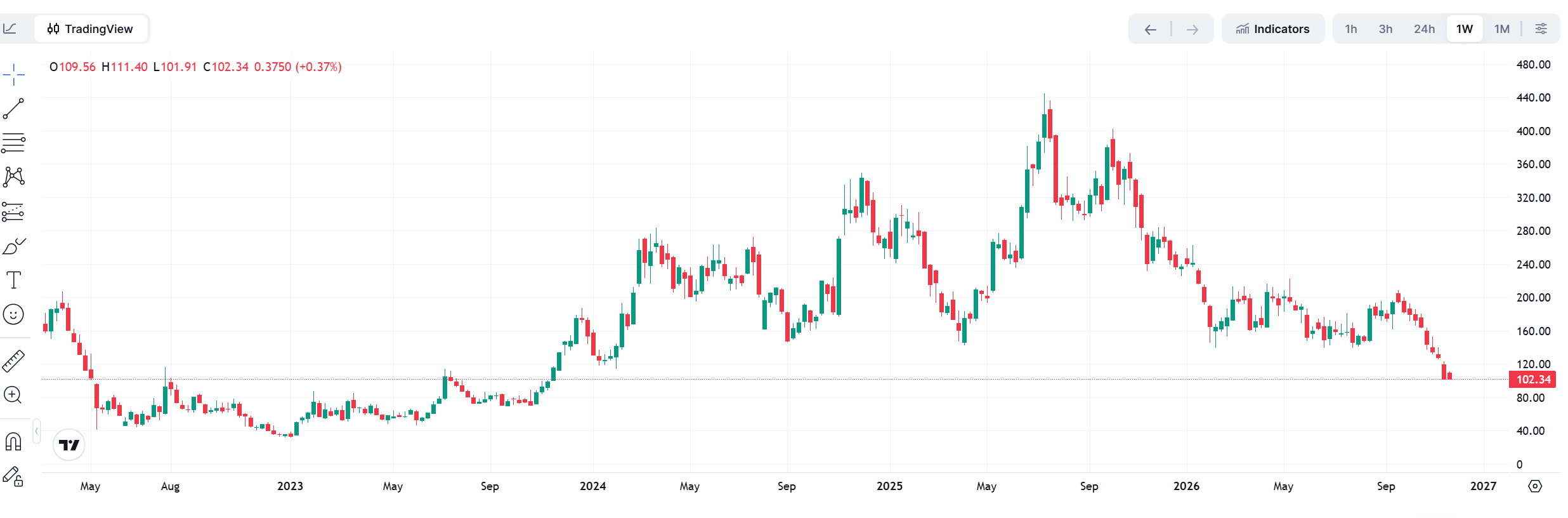
On the surface, the net profit for this year's Q3 reached $719 million, but $715 million of that was derived from paper gains of investment-oriented crypto assets, accounting for as much as 99.5%. When the fluff is removed, net trading revenue plunged 44% year-over-year, and adjusted net profit plummeted 82% to $77.7 million, with a cumulative net loss still existing for the first nine months of the year.
What makes the market more restless is that, as of October 25 at the start of Q4, trading revenue was only about $165 million, while adjusted expenses were set to rebound from Q3's $975 million to over $1 billion in a single quarter.
The entire crypto industry has fallen into a downturn, with Bitcoin prices experiencing a rare seven-week consecutive decline and currently struggling below $60,000.
With the old engine losing speed and no turning back, Coinbase has played four self-rescue cards throughout November.
$2 Billion Buyback: Market Support or Internal Dilution Relief?
On November 25, CEO Brian Armstrong took to the X platform to confirm that the company has been repurchasing COIN stock within the authorized limit this quarter, stating that crypto and AI are reshaping financial services and the current market misalignment is the window to deploy capital.
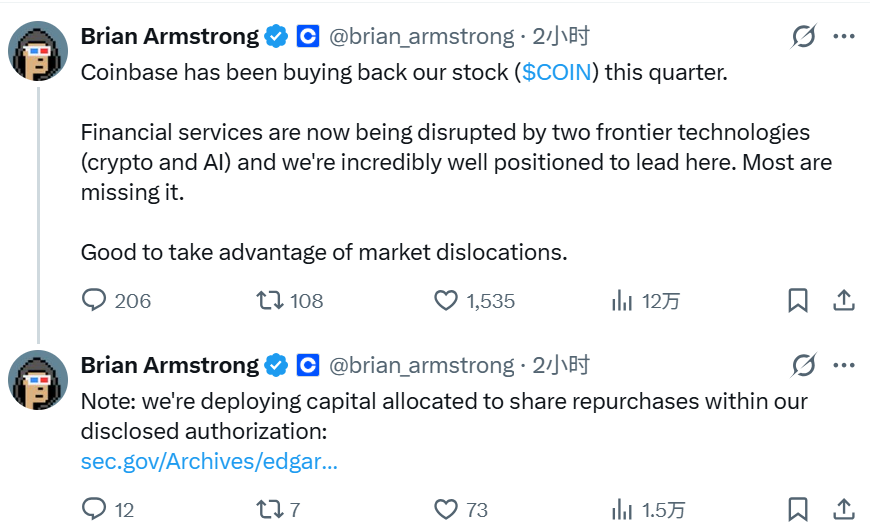
The statement sounded confident, but the financials are a bit heartbreaking. According to disclosed SEC filings, by Q3 of 2026, Coinbase had repurchased about 38,000 shares at an average price of $139.91, costing approximately $5.316 million, with a total repurchase of about 10.17 million shares amounting to around $2 billion. Compared to the current stock price of $102, it has long been underwater.
Even more intriguing is the change in equity.
Burdened by high equity incentives, despite burning through $2 billion in real money recently, it only offset over 85% of the dilution since Q4 2024. The company's total shares increased slightly from 263 million in Q1 of this year to 265 million in Q3.
On one hand, executives are methodically cashing out by reducing holdings under a 10b5-1 plan, while on the other hand, the company is using shareholders' money to cushion dilution halfway down the slope; this buyback is less about value bottom-fishing and more about providing a painkiller to stabilize market confidence.
Strong Push into Derivatives and Pro Restart
With spot trading fees no longer sustainable, Coinbase shifted its focus to derivatives and professional trading in November.
In October, after completing the integration of INTX and Deribit (the company had warned of short-term fluctuations in trading volume during the migration period), a global compliant derivatives architecture covering U.S. and non-U.S. clients began to take shape: on November 19, non-U.S. qualified users were the first to open BTC and ETH options based on Deribit liquidity, while U.S. institutions accessed through Coinbase Prime, and retail investors still have to wait in line.
Spot leverage was also introduced, with Coinbase Advanced opening spot margin trading, supporting up to 10 times leverage on mainstream assets (around 5 times for others), accepting more than a dozen types of collateral and sharing margins with derivatives; however, the threshold for American individuals is extremely high, needing to meet the "qualified contract participant" standard of having $10 million in self-directed investment assets, subject to state and usage restrictions. By the end of 2026, Coinbase will also restart Coinbase Pro, consolidating spot, futures, perpetuals, options, and stocks into a unified account.
The actions are aggressive, and the costs are equally direct.
Over the past year, Coinbase's share of the global crypto trading market has nearly doubled to 10.7%, yet revenue has plummeted, with the Achilles heel being that the highly profitable U.S. retail spot trading volume has collapsed by nearly 60% year-over-year. Now, to combat large offshore players and on-chain DEXs, whether through Coinbase One, which waives spot trading fees, or the low-fee derivatives and Pro, every additional share of traffic comes at the cost of dismantling the once stable high-fee moat.
Self-Operated Prediction Market Launch in 2027
If derivatives are the defense, the prediction market is the fastest spear in Coinbase's hands.
This business has already surpassed $200 million in annualized net income, but during the off-season for sports events, the activity level of the prediction market still heavily depends on the volatility of crypto and other cyclical contract renewals.
The real highlight is Coinbase's upcoming "burning the bridge after crossing."
Currently, the product mainly relies on Kalshi for contract supply, but the revenue sharing cost is very painful: in Q3, the company's trading fee rate unexpectedly surged to 16.8% of net revenue, directly pointing to the external exchange share brought about by the growth of the prediction market.
Since Kalshi has already helped run its business model, Coinbase decided to fully reclaim it.
With the acquisition of The Clearing Company in 2025 and the registration qualification of Coinbase Clearing obtained in September 2026, according to Bloomberg, the company plans to launch a self-operated prediction market for U.S. retail and institutions in the first half of 2027.
Even bolder plans are written on the roadmap—creating a "USDC native, internal clearing" framework. Once implemented, user deposits turned into USDC will remain on the platform, allowing Coinbase to earn prediction fees with one hand while benefiting from U.S. Treasury interest with the other, effectively killing two birds with one stone.
However, the only current variable remains the tug-of-war between state and federal regulations, as well as potential spillover risks from lawsuits related to Kalshi.
Base: Adding On-Chain Leverage to Wall Street Assets
The calculations on the on-chain battlefield are far more astute than they appear.
According to DefiLlama data, Base chain currently has a TVL of $4.95 billion, still maintaining a high level.

Official data shows that since the launch of tokenized stocks on Base, cumulative trading volume has surpassed $1 billion, with new additions like Coca-Cola and Walmart stocks in November. With U.S. stocks already being commission-free on Robinhood, Coinbase's true killer move lies in its combinability—currently, a significant proportion of tokenized U.S. stocks have been deposited into protocols like Aave as collateral.
Base has transformed stocks that could not circulate during Wall Street's off-hours into on-chain collateral that operates 24/7, satisfying its own lending platform while integrating with Base App for perpetuals, predictions, payments, and AI Agent automatic settlement scenarios, directly competing with Robinhood for pricing power of "full-asset exchanges."
On November 22, Base leader Jesse Pollak stated in an interview that Base is still exploring the possibility of launching a token but is currently not in a hurry to advance, aiming to avoid distractions that could affect platform growth.
Currently, Brian Armstrong is hinting at shifting more focus to clients and products, with key realization timelines pointed towards 2027. This feels more like seeking a grace period check from Wall Street during a performance slowdown.
The $102 stock price has already sentenced the old story to death; the key going forward will be whether Coinbase can close the profit abyss with these new licenses, self-operated contracts, and on-chain assets before the retail spot trading cash cow runs completely dry in the coming quarters.
免责声明:本文章仅代表作者个人观点,不代表本平台的立场和观点。本文章仅供信息分享,不构成对任何人的任何投资建议。用户与作者之间的任何争议,与本平台无关。如网页中刊载的文章或图片涉及侵权,请提供相关的权利证明和身份证明发送邮件到[email protected],本平台相关工作人员将会进行核查。