Author: Xu Shan, Geek Park
On November 12, Jensen Huang, who has led NVIDIA for 33 years, suddenly resigned from his positions as CEO, president, and board member due to revelations of two extramarital affairs, effective immediately.
Silicon Valley was set to face a fierce storm.
On November 17, Huang expressed deep regret on social media for troubling the board, while clearly stating that he was willing to return anytime if it aligned with the best interests of shareholders, employees, and the company. This statement caused NVIDIA's stock price to surge from $150.45 to $155.35 in just 27 minutes. However, during the earnings call on the same day, board chairman Harvey Jones coldly shut the door, announcing the unanimous acceptance of his resignation and stating, “we do not intend to reinstate him as CEO”, also revealing that they had hired a headhunter firm, Heidrick & Struggles, to find a successor.
The capital market and tech circle immediately voted against him in the most violent manner. In the seven trading days following Huang's departure, NVIDIA's stock price fell by about 28%, with a market value evaporating by approximately $1.16 trillion. Meanwhile, a petition website called “Stand with Jensen” collected around 204,500 signatures within eight days.
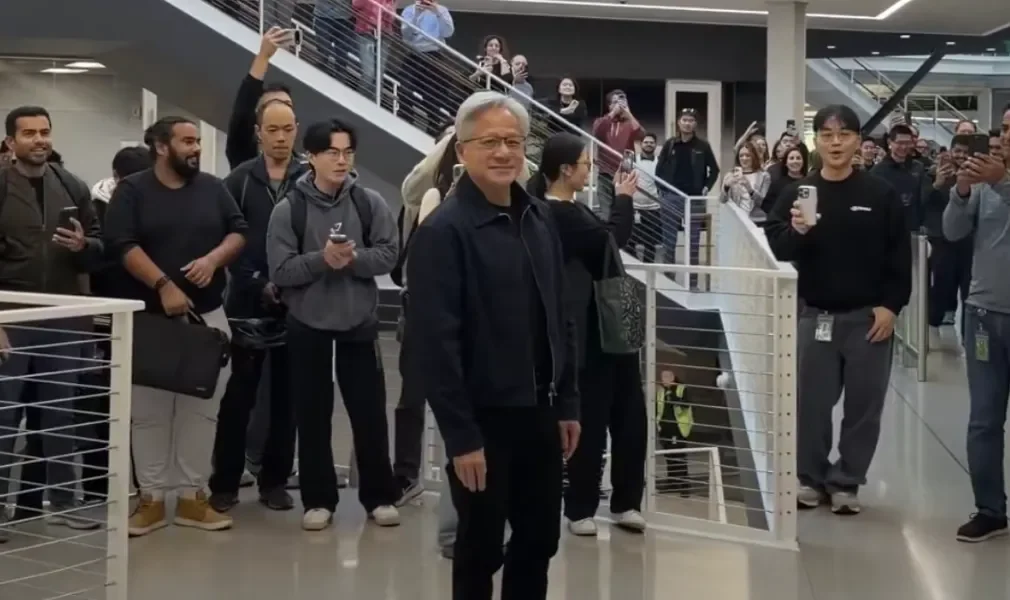
By November 23, only 11 days later, NVIDIA's board overturned its public statement made six days earlier. After two meetings over the weekend, the board unanimously passed a resolution to restore Huang to all his original positions.
On that day, the lobby and multiple balconies of NVIDIA's headquarters in Santa Clara, California, were crowded with hundreds of employees who cheered and applauded, shouting “Jensen! Jensen!” and “Let's get to work.” By the end of the day, NVIDIA's stock soared by 31.48%, increasing its market value by approximately $954.4 billion, recovering to about $3.99 trillion.
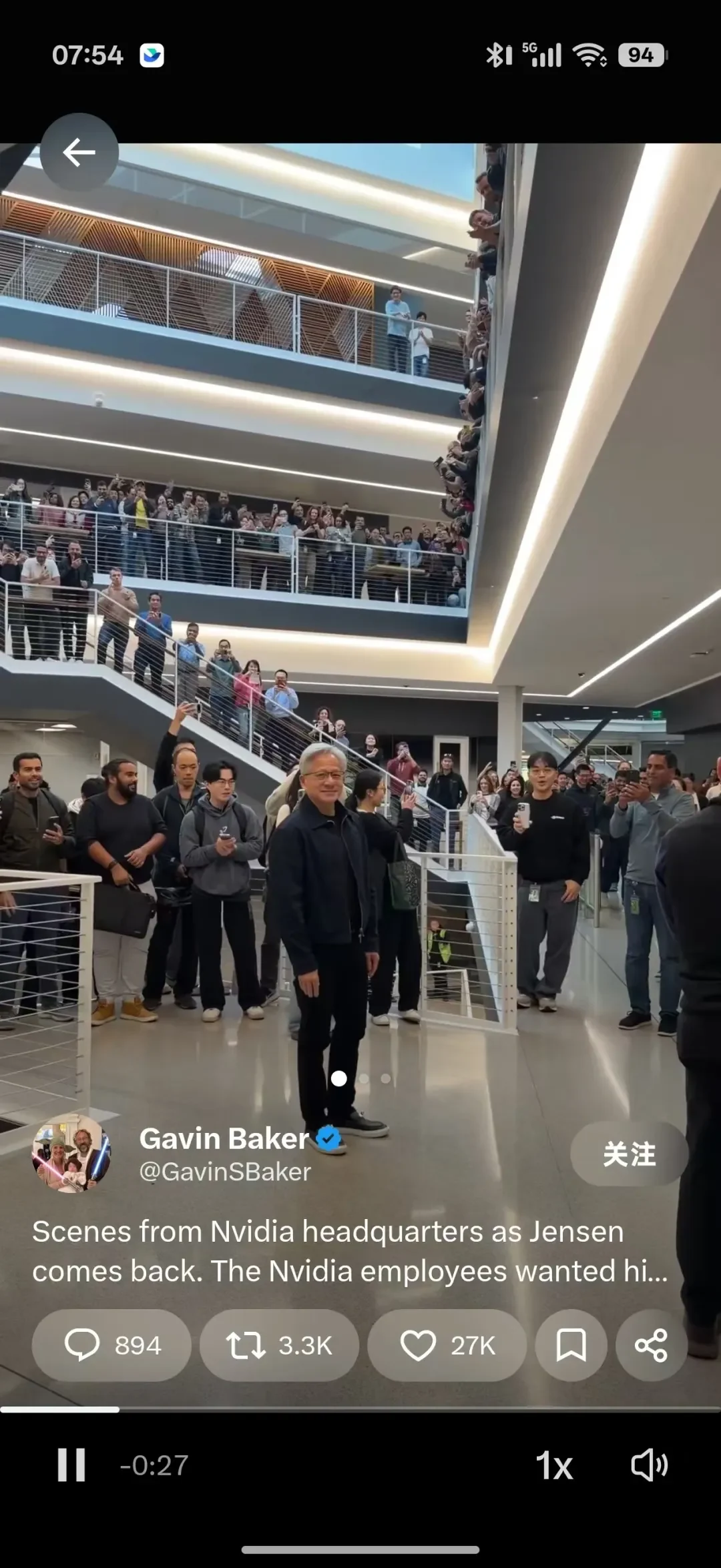
Image: Employee post: if you come for the king, you best not miss (Source: X@aburducky)
The uproar of the news has faded, and the emotions of people and the stock market have taken a super rollercoaster ride in just under two weeks.
Yet these 11 days of extreme tugging have clearly revealed the fragile structure of NVIDIA and the entire AI industry, which is usually obscured by a trillion-dollar market value.
Three "Return to Come"
Silicon Valley's history is never short of super founders' "returns," but placing Jensen Huang's 11 days in the historical coordinate system reveals that the underlying logic of power games has fundamentally changed.
In 1985, Steve Jobs lost a power struggle with Apple CEO John Sculley and left after being stripped of his powers by the board. He founded NeXT, and it wasn't until the end of 1996 when Apple acquired NeXT that he returned to Apple as interim CEO in 1997.
That time, Jobs was gone for a full 12 years.
In the business world at that time, the rules of modern corporate governance outweighed the halo of the founder, even if Apple later struggled, the board's authority still maintained decency for over a decade.
By November 2023, time had been drastically compressed.
The OpenAI board removed Sam Altman on the grounds of "lack of honest communication" and just five days later, Altman announced his return, followed by a reorganization of most board members. Altman's ability to flip the script quickly was primarily due to the fact that he held two powerful cards: over 700 of the approximately 770 employees signed a joint threat to leave with him, and his backer, Microsoft, immediately expressed readiness to take him and his entire team.
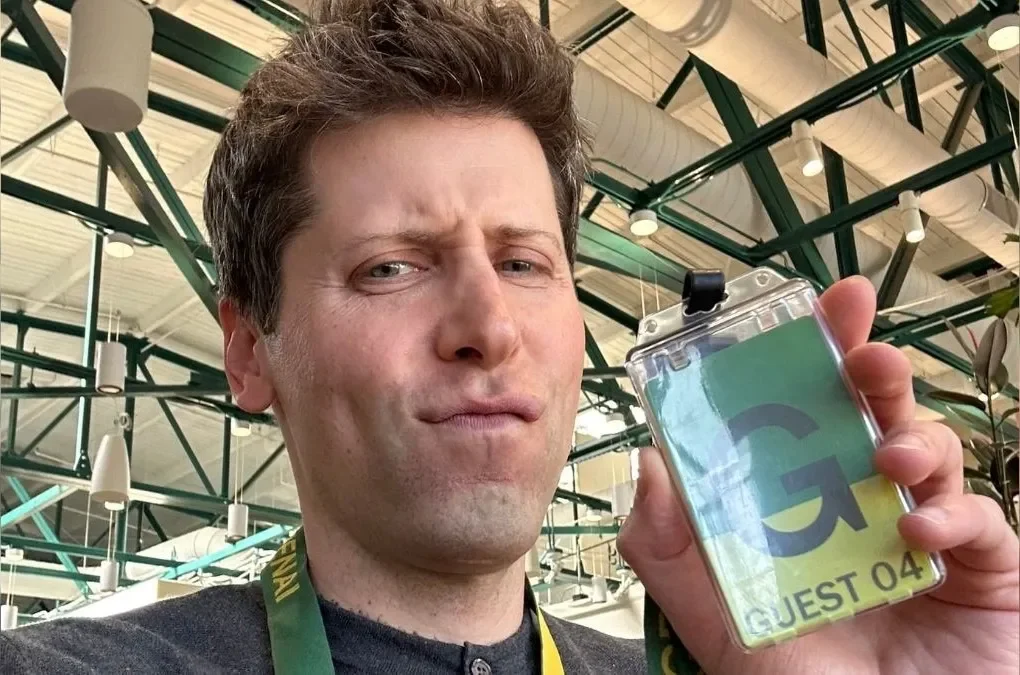
Image: Sam Altman selfie with visitor badge in 2023 (Source: X@sama)
Jensen Huang's situation was actually more nuanced. During the turmoil, there were gloomy predictions from the outside. The Daily Economic News pointed out in an analysis of Huang's return path that he lacked a strong external ally like Microsoft, making the chance of a quick reversal low.
Even the economist Nouriel Roubini, known as “Dr. Doom,” publicly stated that Huang had “absolutely no chance” of returning, reasoning that NVIDIA's future depended on technology that could still function without him. Regarding equity leverage, Huang only held about 3.58% of NVIDIA shares, which was far from enough to forcibly rewrite the board's will.
So why did the board swallow its harsh words of “no intention to reinstate him” in just a few days?
Because the pressure this time came from a collective force formed voluntarily by employees, customers, shareholders, and the secondary market. Without a single Microsoft backing, the entire ecosystem stood up.
Main shareholder and Atreides Management Chief Investment Officer Gavin Baker publicly pushed for his return; Leo KoGuan, an investor who had already invested about $1.3 billion in NVIDIA this year, made it clear that without Huang, he would not invest another penny. Coupled with the $1.16 trillion market value loss over the seven trading days, every minute was counting down for the board.
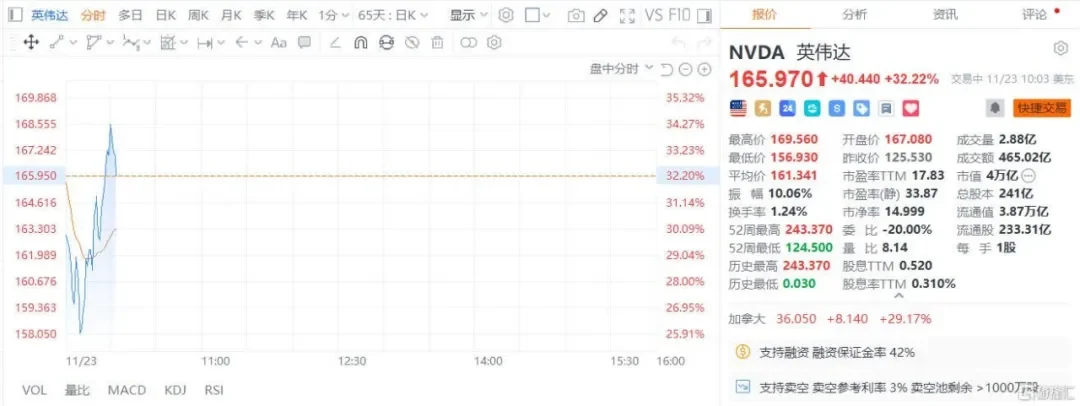
Image: NVIDIA's stock surged over 30% on the day Huang returned (Source: Futu)
Harvey Jones initially stated that Huang's personal behavior did not align with the company's code of conduct, which is typical mature corporate governance logic.
But this logic has failed among today's super tech giants. When a company's $4 trillion valuation directly bets a considerable part on the brain and intuition of the founder, the board's card of "acting by the rules" can hardly be played.
Although the so-called independent investigation was announced to continue, the scale of power had already tilted by November 23, as evidenced by the nearly trillion-dollar increase in stock market value in a single day.
The Myth of Flatness and Pressure Testing
If we shift the perspective back to NVIDIA's headquarters, the 11 days without Huang were essentially a pressure test for the company's organizational structure, one that was unprepared. The results were quite thrilling.
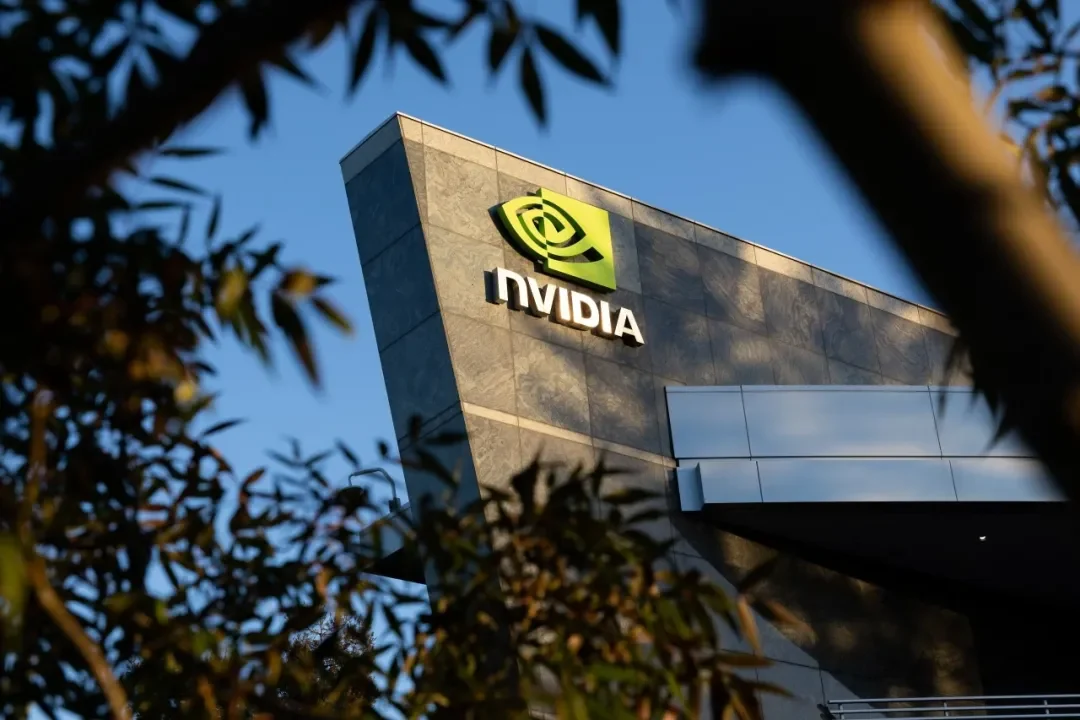
Image: NVIDIA headquarters building in Santa Clara (Source: Tom's Hardware)
The CFO Colette Kress, who took over as interim CEO, was initially trying to stabilize the situation.
On November 18, just six days after Huang's departure, she held the first all-hands meeting. In an hour-long session that was both in-person and live-streamed, Kress tried to motivate the team, urging everyone to “look forward” and emphasizing “we can cope.” However, according to attendees, the prevailing sentiment in the room was that everyone hoped for Huang's return.
The signal of restless hearts quickly emerged from various corners. The workplace community Blind analyzed 627 posts made by 531 NVIDIA employees from November 12 to 16, finding that 56% explicitly supported Huang's return. On the petition website with over 200,000 signatures, 10,257 signatories claimed to be current NVIDIA employees, which represented about a quarter of the company's total workforce according to self-reported data.
What made management even more restless was the unrest among core talents.
On November 15, just three days after the resignation news broke, NVIDIA's robotic learning engineer, Daschen, publicly stated that Huang's departure made him decide to also end his own career chapter at NVIDIA. Shortly thereafter, the technical director of development, Nader Khalil, directly wrote a warning letter to 10 board members and 60 executives, pointing out that if Huang did not return, a batch of irreplaceable core talents was considering leaving.
At that time, even tech media reporters began to speculate whether Huang would start a new semiconductor company altogether. While this was purely unfounded speculation, it indicated external concerns about the instability of NVIDIA's talent base.
Why did a giant with a cluster of top engineers experience such drastic upheaval just days after its leader left? The answer lies precisely within NVIDIA's management philosophy, which it usually takes great pride in.
In recent years, the business commentary community has hailed Huang's extreme flat management as a model. He never holds one-on-one reporting meetings, emphasizing that all information is directly communicated in large groups, with dozens of subordinates reporting directly to him, and external reports even claim this number reaches about 60. This structure is incredibly efficient in favorable conditions, eliminating internal friction within large companies' hierarchical systems, allowing Huang to function like a super central processing unit, directly orchestrating every core module of the company.
However, the flip side of the coin was fully exposed during these 11 days. Extreme flatness essentially represents an organizational structure that does not cultivate successors.
Because there is no pyramid-shaped reporting hierarchy, there is fundamentally no “number two” figure in NVIDIA that oversees the overall situation; no executive possesses the authority and overall vision to allocate resources across departments. When that singular central processing unit is suddenly removed, the 60 high-speed gears instantaneously lose their central coordination.
This also explains why once the board decided to replace the leader, they could only immediately look for candidates outside the company.
Heidrick & Struggles contacted Arm CEO Rene Haas to explore the possibility of having him lead NVIDIA. However, on the very day the reinstatement announcement was issued on November 23, Haas turned around and announced that he would extend his contract with Arm until 2033.
No outside candidates dared to easily take on this hot potato, and since there were no suitable heirs internally, NVIDIA experienced a genuine understanding of the dual vacuum of power and capability during these 11 days. When the news of Huang's reinstatement was finally settled, NVIDIA's director of robotics research, Jim Fan, posted on social media, “Jensen 2.0 LFG!!!,” which actually reflected the entire core R&D team’s relief as if they had survived a catastrophe.
Support from Silicon Valley
The most intriguing scene throughout this upheaval was the collective stand taken by the titans of Silicon Valley.
On the “Stand with Jensen” petition list and the line of public support, stood a row of tech leaders who usually act independently. Garry Tan, president of Y Combinator, and Amjad Masad, CEO of Replit, both signed; Epic Games CEO Tim Sweeney publicly criticized the NVIDIA board, stating that if they didn’t let Huang return, “it would be as foolish as Apple firing Steve Jobs back in the day.”
The loudest supporter was Elon Musk.
During these 11 days, he publicly voiced support multiple times, comparing Huang's importance to NVIDIA to that of Michael Jordan to the Chicago Bulls. Once the reinstatement was finalized on the 23rd, Musk immediately posted, declaring: “The mistake has been rectified.”
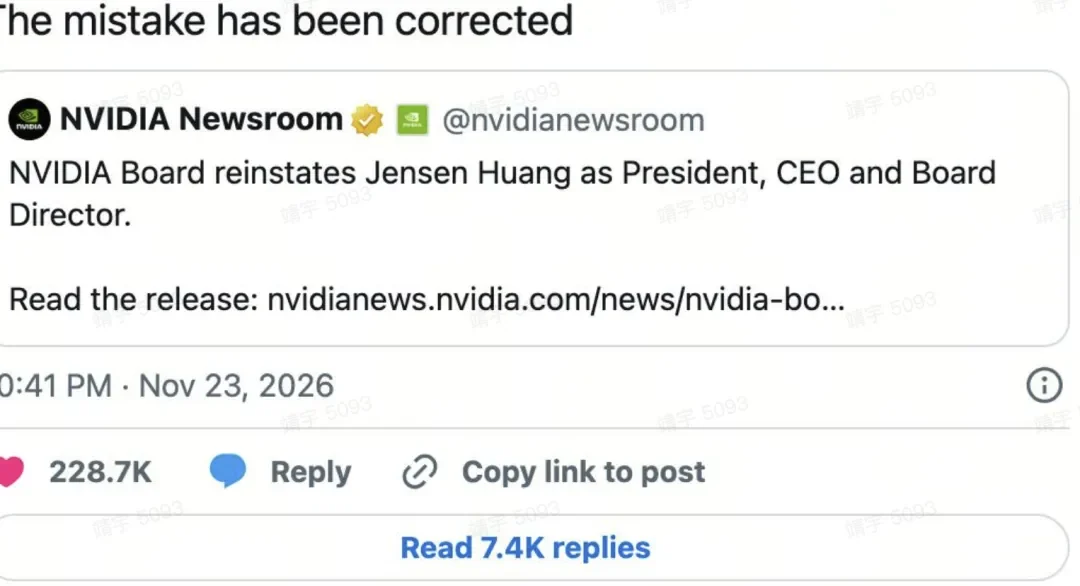
Image: Musk's response on X (The mistake has been corrected) (Source: X@elonmusk)
Silicon Valley has always adhered to the law of the jungle, where undermining competitors and competing for computing power is commonplace. Why did this group of shrewd business leaders suddenly show such profound camaraderie towards the CEO of another company?
A figure Musk disclosed previously explains it all. SpaceX just completed a $40 billion debt financing, and the purpose of this huge sum is very clear: to purchase NVIDIA chips.
Putting this $40 billion chip bill on the table instantly clarifies the business logic behind all the support. From Musk's SpaceX to Sweeney's game engine, and to the hundreds of hungry AI startups in the YC incubator, today, the entire tech industry's computing power foundation is firmly tied to NVIDIA’s chariot.
For these downstream customers, a GPU is just the visible part of the bill; they are also betting on NVIDIA's product roadmap, the certainty of architecture iterations, and the seamless delivery capability between the software ecosystem and hardware cluster.
From the outside perspective, the reason this complex and precise computing power machine can systematically roar ahead is that the only guarantor is Jensen Huang. Just as Huang wrote in his statement on the 17th, “NVIDIA is a once-in-a-lifetime company,” and in the eyes of his customers, this company absolutely cannot at such a critical juncture hire a professional manager from outside to experiment.
Silicon Valley stars are superficially supporting a legendary founder, while in reality, they are desperately buying insurance for their computing supply chain.
This is an exceedingly rare scene since the outbreak of the AI revolution. The entire industry’s deep dependence on a single computing supplier has now, for the first time, been starkly exposed in the form of a personnel crisis. The NVIDIA board thought they were only managing an internal executive uproar in a listed company but inadvertently kicked against the load-bearing wall of the entire AI industry. Customers absolutely do not allow this wall to shake at this moment, even for just a brief ten-day wobble.

Image: A meme comparing Huang to Jordan’s return and winning the championship (Source: X)
After this thrilling 11 days, the long-standing “key person risk” hanging over NVIDIA was not alleviated but rather clearly priced by the capital market's violent fluctuation of over $1 trillion, and it has solidly fixed itself in place.
This eleven days proved to the entire industry and the whole world that Jensen Huang is irreplaceable. Moving forward, NVIDIA's board will find it even more challenging to impose substantial constraints on this super founder, and Wall Street and Silicon Valley have thoroughly ripped off their facade, no longer pretending that this $4 trillion empire can operate smoothly without him.
On the day of his reinstatement, when Huang returned to the Santa Clara headquarters, he rarely took off his iconic leather jacket and changed into a dark blue coat.
He placed his hands on his chest in the lobby and sincerely apologized to the applauding employees, admitting he had made a very serious mistake, and thanked everyone for giving him a second chance. Then, the 33-year veteran, who oversees the lifeblood of global computing power, smiled and, like a rookie just starting out, said to the audience:
“This is my first day at work. I don’t have a computer, so the IT department needs to provide me with a new RTX Spark.”
免责声明:本文章仅代表作者个人观点,不代表本平台的立场和观点。本文章仅供信息分享,不构成对任何人的任何投资建议。用户与作者之间的任何争议,与本平台无关。如网页中刊载的文章或图片涉及侵权,请提供相关的权利证明和身份证明发送邮件到[email protected],本平台相关工作人员将会进行核查。