Author: Cury, Deep Tide TechFlow
Deep Tide Introduction:
Early Bitcoin investor Vinny Lingham posted a summary on Twitter, mentioning the reasons everyone was bullish on Bitcoin in 2021, including global money printing, inflation reaching a thirty-year high, institutional buying, and halving... Now all of these have happened, yet the coin price remains around $59,000, lower than the peak five years ago. This post sparked extensive discussion from both bulls and bears. Bulls began to propose new directions such as native yield and entering mainstream financial models, while skeptics pointed to the reality of high macro interest rates and a lack of real use cases. This means that the industry's phase of telling stories with old slogans has come to an end, and everyone must begin to seriously confront the actual driving forces behind Bitcoin's second half.

Those who have held Bitcoin for five years are likely feeling some indescribable emotions watching the market recently.
In 2021, Bitcoin peaked at nearly $69,000, and five years later, the current price is still hovering around $59,000.
Veteran in the Bitcoin community, Vinny Lingham, shared a heart-wrenching post on social media. He didn’t spin tales but directly listed the core narratives from five years ago when everyone was bullish on Bitcoin, such as:
- Governments around the world printed trillions of dollars in response to the pandemic, and M2 money supply surged more than 40% compared to early 2020;
- U.S. inflation reached a thirty-year high, with real interest rates stuck in negative territory for a long time;
- With a hard supply cap of 21 million coins, Bitcoin is regarded as the ultimate anti-inflation tool and digital gold by the entire network;
- Traditional large institutions like MicroStrategy and MassMutual are buying Bitcoin and adding it to their balance sheets;
- The halving in 2020 occurred as expected, coinciding with a flood of retail and institutional funds entering the market.
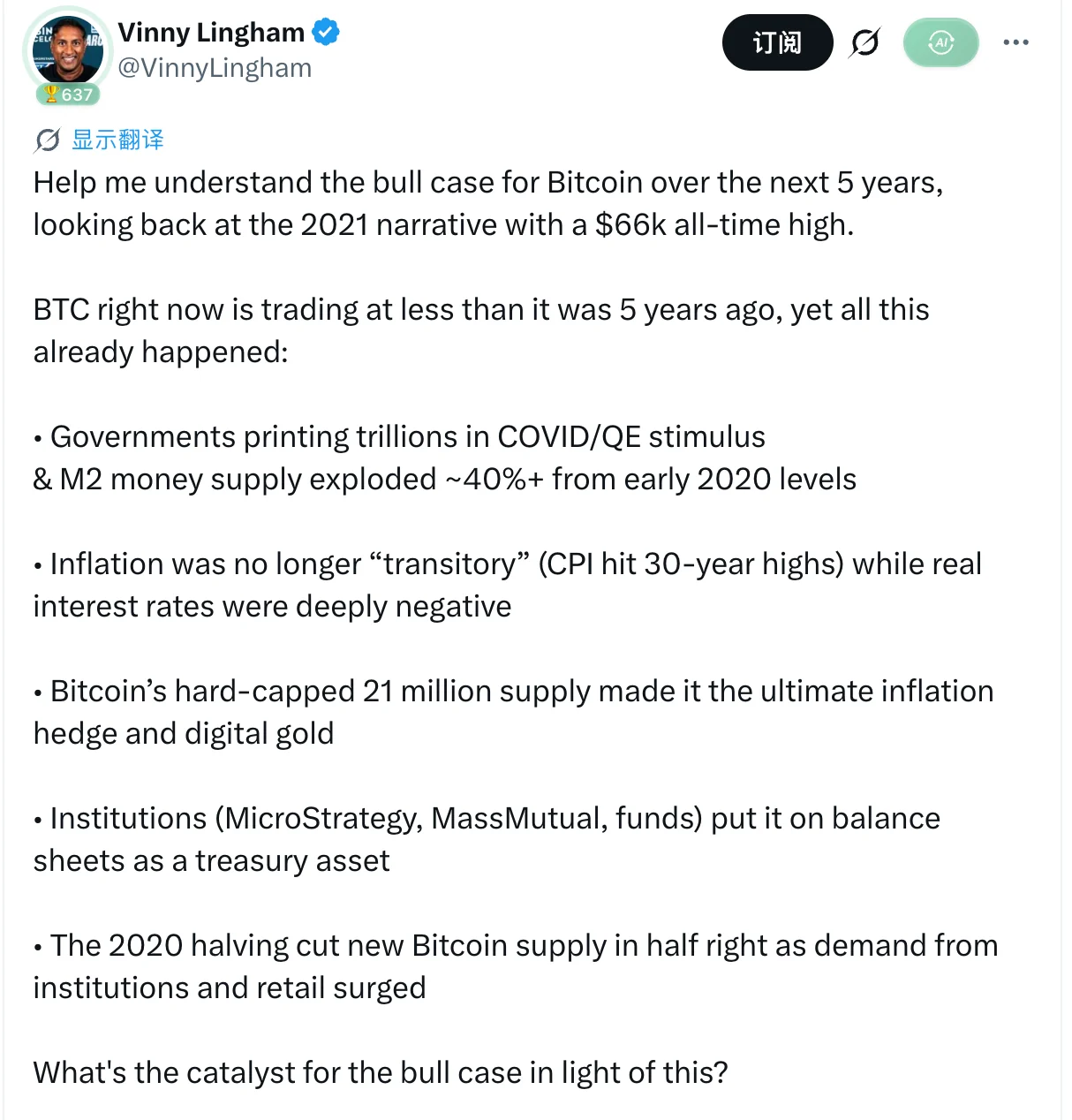
The logic that was used to demonstrate a super bull market back then has all turned true in the past five years, with each point even exceeding expectations.
Thus, he posed a question that left many speechless: since all the biggest trump cards from that year are now played out, why is the price still lower than back then? If the previous stories have all been told, what can everyone rely on to keep rising in the next five years?
Bulls' New Cards: It Can't Just Be a Silent Gold Bar, It Must Also Yield and Integrate
This tweet quickly attracted a large number of familiar faces from within the community. Bulls in the comment section did not continue to repeat the old saying of "digital gold," but instead presented some new tools in response.
Some industry professionals believe Bitcoin needs to learn from Ethereum and transform into a productive asset that generates returns.
For instance, Stacks founder Muneeb believes:
If Bitcoin is just sitting quietly in cold wallets as collateral, it's not enough now. He pins the catalyst for the next stage on Bitcoin's native yields, akin to how Ethereum transitioned to PoS, allowing Bitcoin holders to earn interest, combined with subsequent technological updates and the next halving in 2028, providing reasons for funds to stay on-chain.
Of course, this also bears self-interest as he is reflecting on his own products.
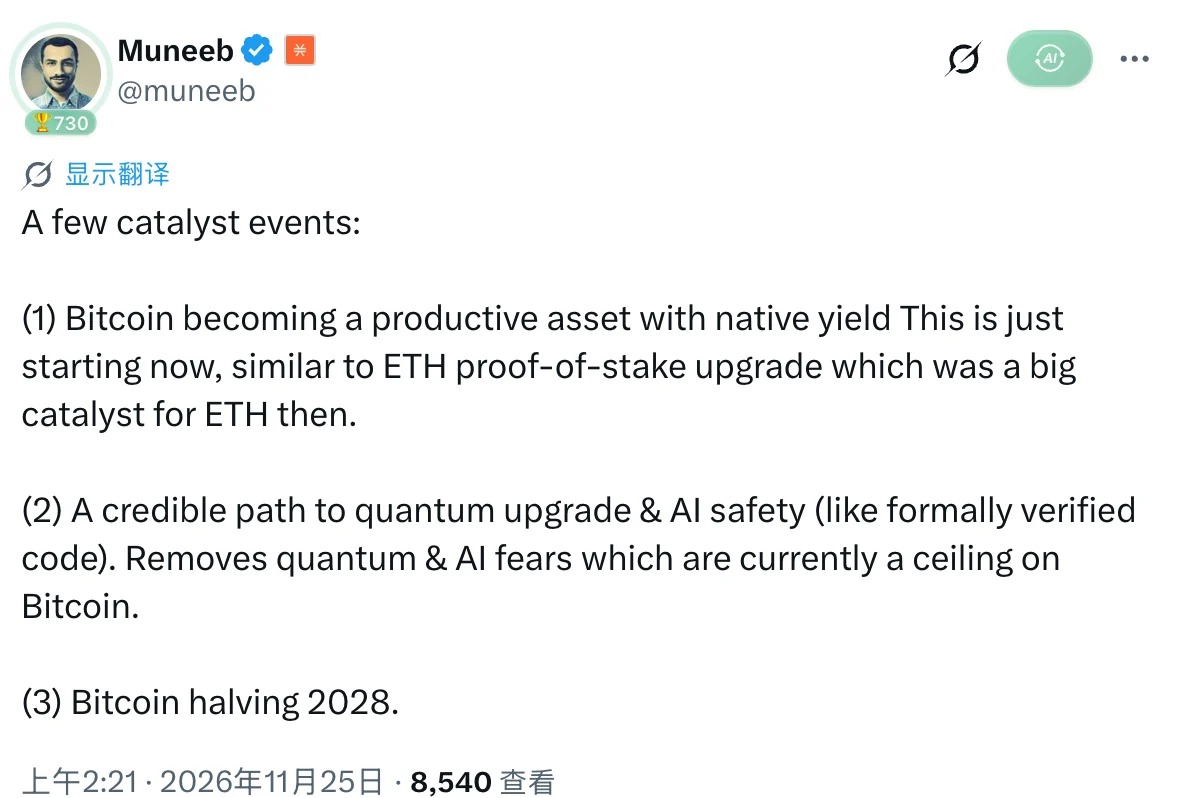
However, he also mentioned the most universal catalyst would still be the next halving of Bitcoin in 2028. As is well known, the mining rewards are decreasing, and after the next halving, the reward for miners verifying and packing blocks will drop from the current 3.125 BTC to 1.5625 BTC.
Some feel that the real big money has just arrived at the doorstep.
Nick Ducoff, head of institutional business at the Solana Foundation, took a different angle and thought people shouldn't be too pessimistic. Although spot ETFs have been approved, in the eyes of mainstream wealth advisors on Wall Street, Bitcoin is still considered a niche oddity. The real future driving force is its ability to be included in traditional private banking investment models, even if it's just officially recommended for a 1% allocation, the incremental effect would be entirely different.
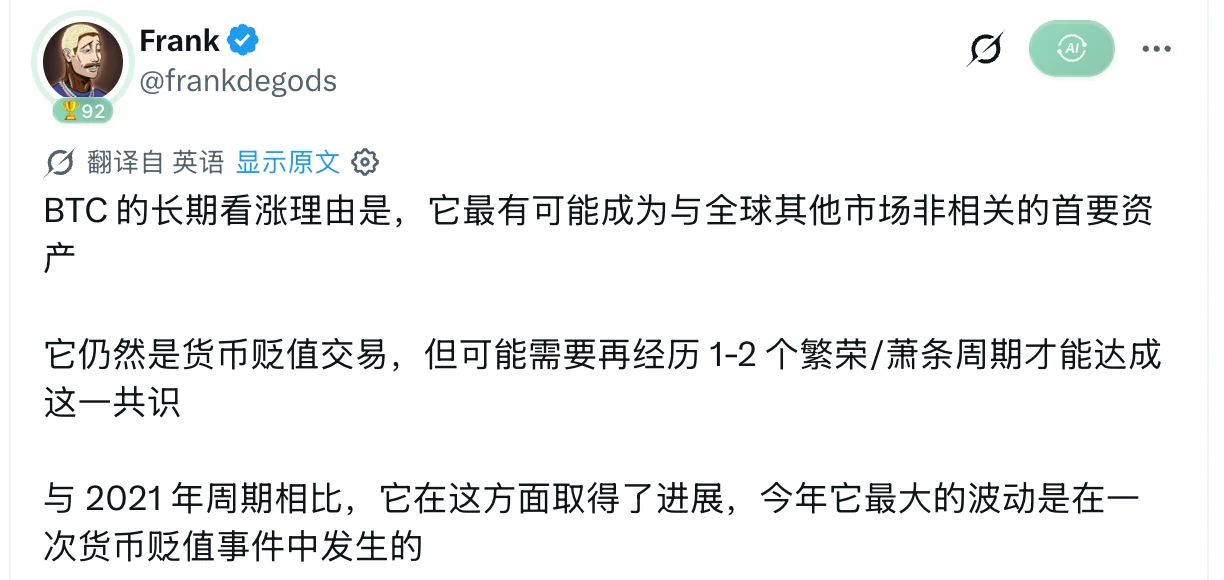
NFT and Meme trader Frank extended the timeline further. In his view, Bitcoin is likely to become an independent asset unrelated to other global markets, but to make the traditional world fully pay up, it might require enduring another one or two bull-bear cycles.
At present, the Federal Reserve is in a rare hawkish phase not seen in thirty years, and everyone is still in a headwind, but in the long term, the government’s direction of continuing to produce inflation has not changed.
As for early player Charlie Shrem, his attitude is more laid-back. He believes there is no need to get tangled up in these so-called reasons, bull markets never come because some reason turned out to be valid; they arise only after the market has risen when people retrospectively attribute the success to certain narratives.
As long as each dip's bottom gradually rises, the market will naturally transition to the next cycle.
Skeptics: Don't Challenge the Federal Reserve + Quantum Resistance Not on the Agenda
While bulls are excitedly searching for logic, industry insiders on the other side poured cold water on reality thoroughly.
Mike McGlone, senior commodity strategist at Bloomberg Intelligence, offered a direct reminder: Don't go against the Federal Reserve.
He believes Bitcoin's current high volatility and high elasticity essentially still classify it as a high-risk asset that follows macro liquidity. It rises the most when the liquidity is abundant, but in a high-interest-rate environment, liquidity tightening is the biggest ceiling over it; it is not the safe-haven asset many imagine that can detach from the real economic cycle.
In addition to the macro environment and utility value, underlying security risks have also been put on the table.
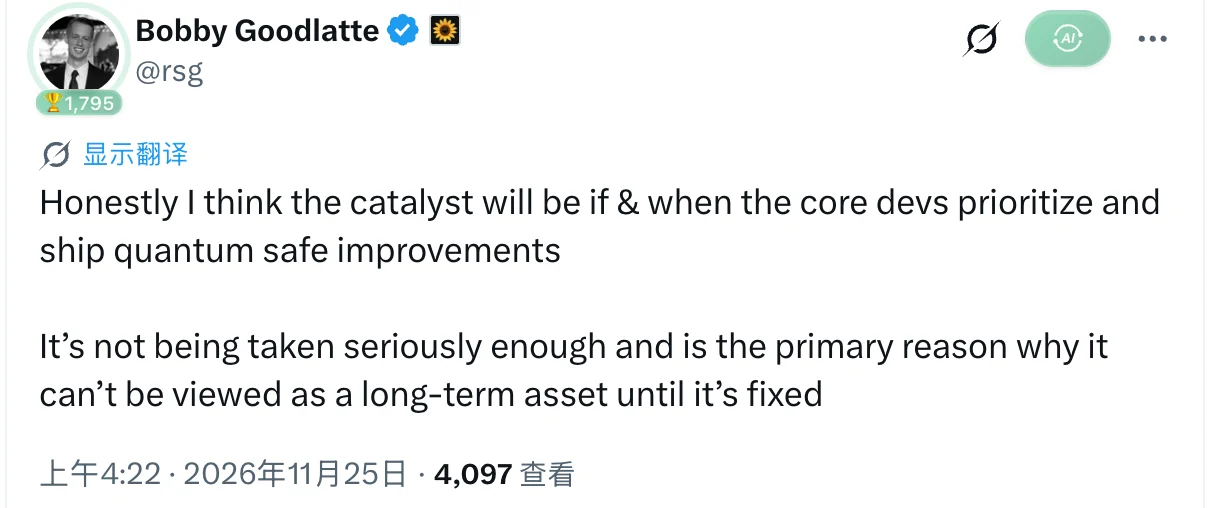
Bobby Goodlatte, a former product designer at Facebook and a well-known angel investor in projects like Coinbase, pointed out that Bitcoin's core developers have yet to treat quantum resistance as an urgent matter. As long as the old addresses that directly expose public keys have not been thoroughly protected at the code level, this risk will always linger, leaving institutional investors cautious when considering long-term investments spanning decades.
This discussion is worth watching because everyone has finally stopped shouting slogans without engaging.
For over a decade, every major rise in Bitcoin has been supported by grand concepts; people have become accustomed to concluding that as long as inflation is discussed and fiat currency depreciation is mentioned, the price of coins should rise. But as these predictions from years ago have gradually come true, while the coin price remains stagnant, simply relying on sentiment has indeed made it challenging to boost consensus further.
From the debates in the comment section, it can be observed that the bulls have been forced to seek more concrete elements, such as how to generate cash flow from assets and how to integrate into traditional financial managers' systems; while skeptics stubbornly cling to macro rates and actual implementations.
For those holding positions, this debate at least clarifies one thing:
The phase of relying on those old stories to win without effort has already ended. In the upcoming cycle, if Bitcoin wants to step up to a new level, it must provide more concrete evidence in terms of real returns and macro financial environments.
免责声明:本文章仅代表作者个人观点,不代表本平台的立场和观点。本文章仅供信息分享,不构成对任何人的任何投资建议。用户与作者之间的任何争议,与本平台无关。如网页中刊载的文章或图片涉及侵权,请提供相关的权利证明和身份证明发送邮件到[email protected],本平台相关工作人员将会进行核查。