Author: Tiger Research
Translator: Deep Tide TechFlow
Deep Tide Guide: Following the introduction of the "Virtual Assets User Protection Act" in 2024, South Korea's regulatory authorities have initiated the second phase of legislation: the draft of the "Digital Asset Basic Act." This significant bill codifies the previously unwritten market practices into comprehensive legal standards for the first time, establishing a clear system of four categories of digital asset business licenses, while also introducing disruptive regulatory arrangements for the issuance of Korean won stablecoins and local ICO rules.
The Tiger Research team has deeply analyzed the far-reaching impact of the bill on four core entities: centralized exchanges, traditional financial institutions, overseas stablecoin issuers, and Web3 foundations. This includes accountability for false statements during token listings, the 20% shareholding limit for major shareholders in exchanges, and the monopolization of stablecoin syndicates by banks versus offshore tax considerations, thereby comprehensively deconstructing the arduous transition of the South Korean crypto market into a highly regulated era.
Key Takeaways
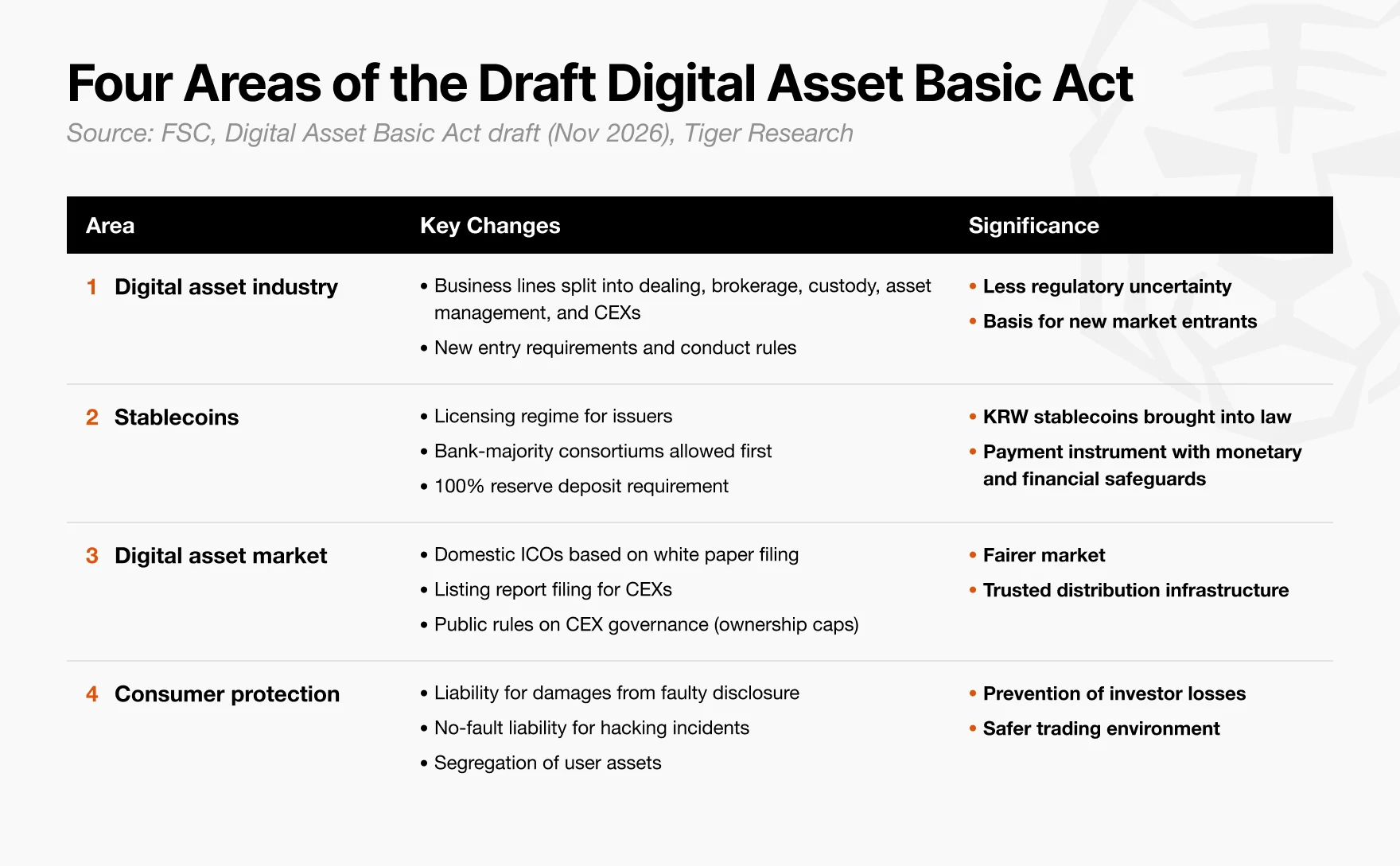
- Comprehensive framework of the bill: The bill clearly defines four types of digital asset business forms and establishes a stringent compliance framework for the issuance of Korean won stablecoins, domestic token Initial Public Offerings (ICOs), and centralized exchanges.
- Centralized exchanges (CEX): The submission of token listing reports has been formally upgraded to a legal obligation, with exchanges held strictly liable for any significant false statements, and major shareholders capped at a 20% ownership limit.
- Local financial institutions in South Korea: The initial issuance of Korean won stablecoins is only open to a consortium where "banks hold an absolute majority of the shares," although the breakdown of licenses also opens new custodial and brokerage opportunities for brokerages and trust companies.
- Overseas stablecoin issuers: Outbound issuers that have obtained regulatory licenses in their home countries must establish registered branches in South Korea and meet a minimum capital requirement of 5 billion won as well as asset isolation requirements.
- Web3 foundations and project parties: The effective lifting of the domestic ICO ban in South Korea has occurred, but due to significant tax incentives in overseas crypto hubs like Singapore and Dubai, the likelihood of massive project returns to the domestic market remains low, coupled with extremely stringent information disclosure thresholds.
Transforming Market Implicit Rules into National Legal Systems
Approximately two years after the first phase of the "Virtual Assets User Protection Act" officially came into effect in July 2024, Kim Jae-seop, a member of the ruling party, the People Power Party, formally proposed the draft of the "Digital Asset Basic Act" in February 2026 (the second phase of digital asset legislation). The bill still needs to go through a lengthy and intense legislative debate and clause negotiation before it is officially passed by the National Assembly.
Even so, the core significance of this draft lies in its elevation of the previously administrative-guided "unwritten implicit rules" to legally binding national statutes, clearly delineating the legal boundaries of various market activities and filling the long-standing legal void in the stablecoin system and domestic issuance mechanism.
Following the impact of this bill, the four core participants in the South Korean digital asset market will need to undergo disruptive restructuring of their long-term strategies: 1) centralized exchanges (CEX), 2) local financial institutions, 3) overseas stablecoin issuers, and 4) Web3 foundations and project parties. This article aims to go beyond the dry dissection of legal texts and principles, deeply analyzing the strategic dynamics and industry reshaping of these four market players under the new regulatory framework.
Centralized Exchanges (CEX): Legal Responsibility for Token Listings and 20% Shareholding Cap
Under the new regulatory framework, centralized exchanges must not only submit an official token listing verification report to the Financial Services Commission (FSC) for each token they list but must also publicly disclose this information. They are liable for any false statements or significant omissions present in the report. The legal risks associated with token listing reviews have increased sharply, leading to a drastic tightening of listing strategies among exchanges.
1 Mandatory Disclosure of Token Listing Verification Reports
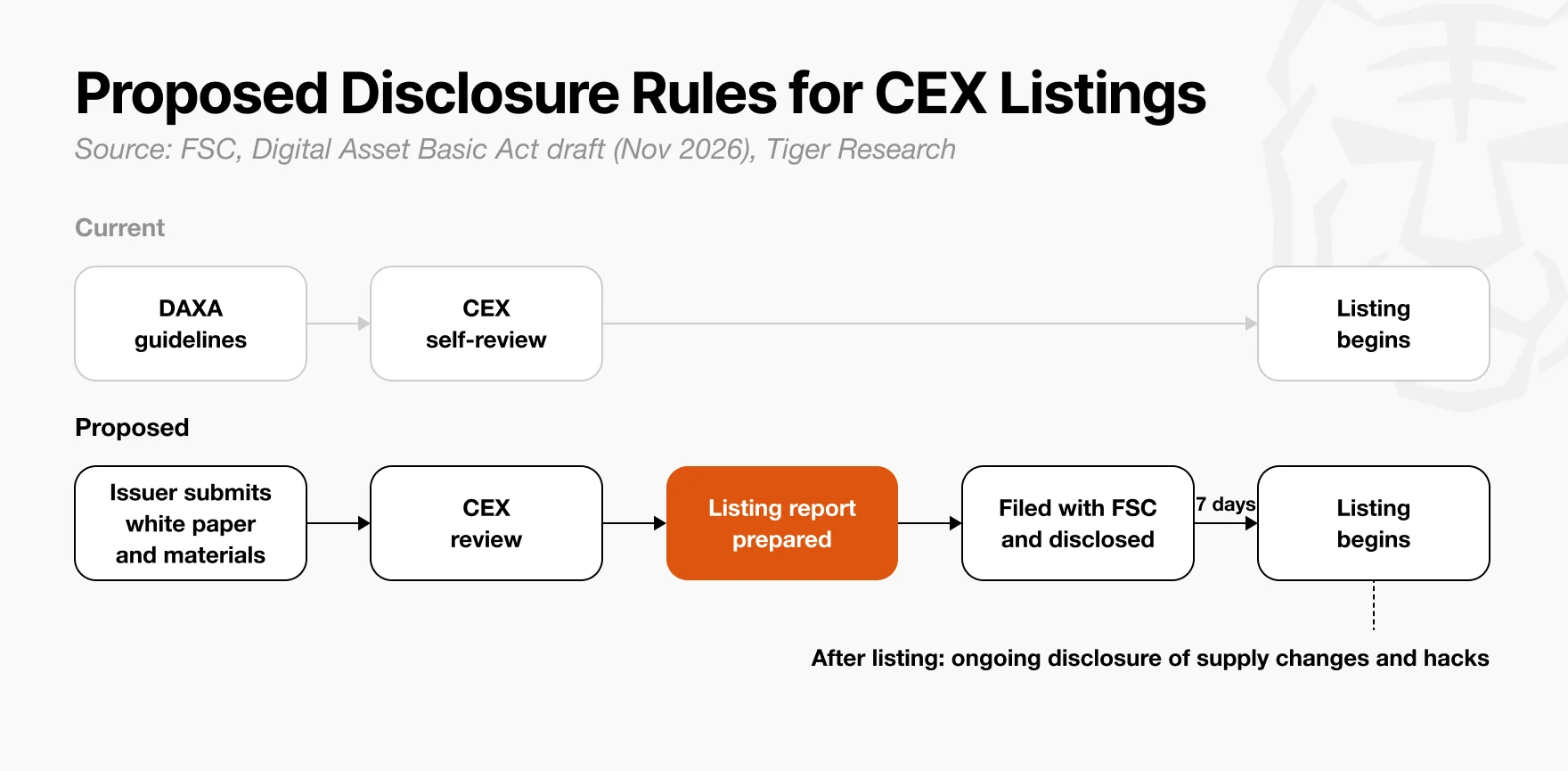
Article 11 of the draft clearly stipulates that digital asset exchanges (as defined in the bill as "digital asset trading intermediary business entities") must submit a token listing verification report covering the issuing entity, technical white paper, token economics allocation, and potential conflicts of interest to the regulatory authorities when deciding to list any asset, and must publicly release this report.
Even more crucially, Article 15, Section 1 establishes a very harsh civil liability mechanism: in the event that the token listing report contains false records, significant false statements, or omissions of important facts, the exchange must bear legal responsibility for damages suffered by the investors as a result.
This provision directly undermines the previously common "fast-track listing" model utilized by major exchanges in South Korea. Previously, facing popular overseas tokens or trending meme assets, platforms like Upbit and Bithumb would often complete a lightning-fast listing in the shortest possible time to reap massive transaction fees; however, moving forward, as each listed asset could become a potential trigger for collective lawsuits by investors, the legal and compliance departments of exchanges will have to conduct prolonged due diligence, forcing them to pull back to a more robust and time-tested range of mainstream assets.
2 Designated Exchange System and 20% Shareholding Limit
Article 42, Section 1 of the draft introduces a highly impactful "Designated Exchanges" system: for leading platforms that meet specific thresholds regarding trading volume and market influence, the Financial Services Commission can directly designate them as systemically important exchanges and impose equally stringent public governance requirements as traditional securities exchanges.
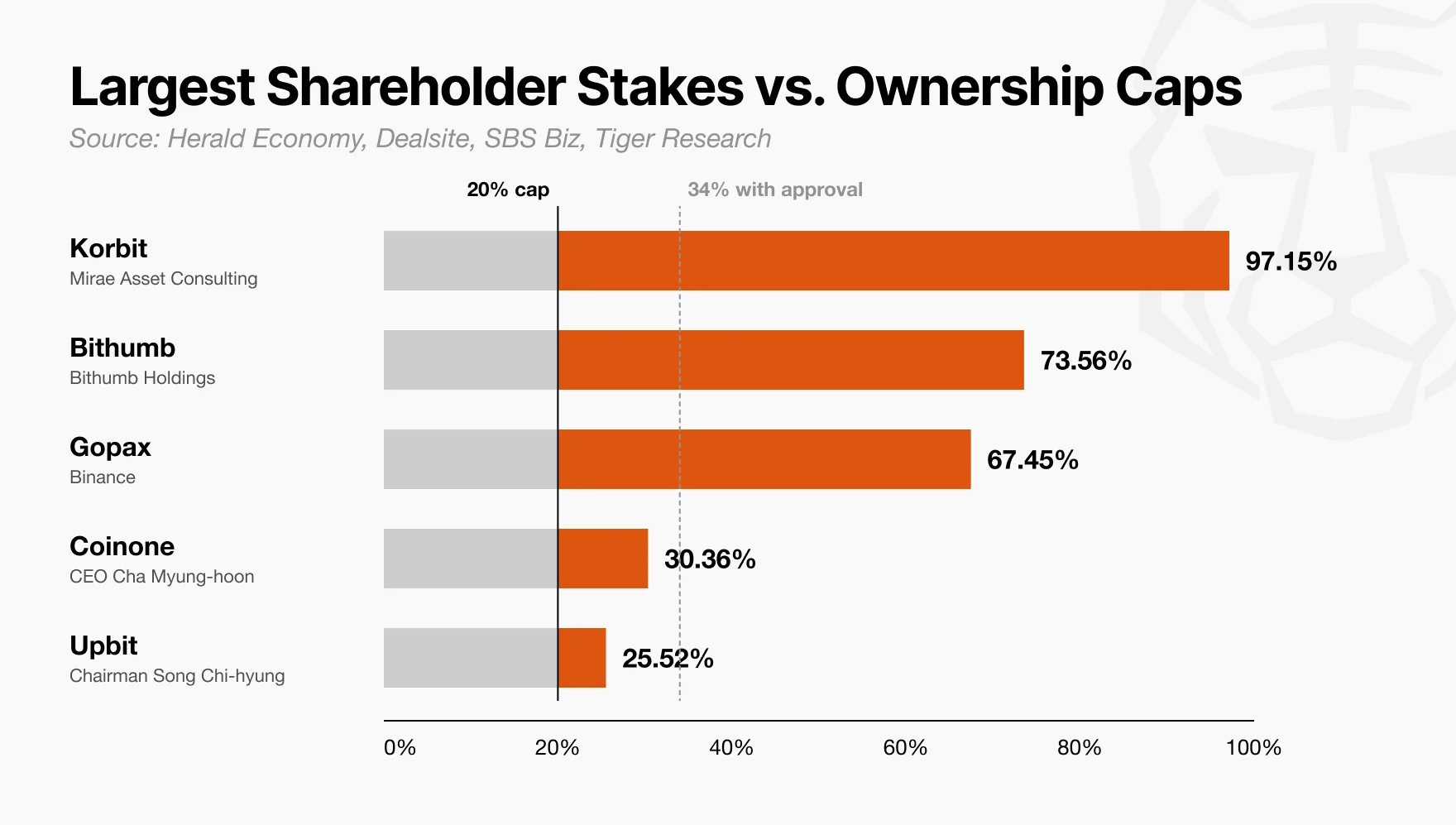
Perhaps the most shocking provision to the industry is found in Article 43, Section 1: any single shareholder (including their concerted actions) in a designated exchange cannot hold more than 20% of the direct or indirect shareholding.
This ownership cap directly targets the two dominant exchanges in South Korea: Upbit's operator Dunamu (whose founder Song Ji-hyung and affiliates hold nearly 30%) and Bithumb (whose largest single shareholder Lee Jung-hoon holds over 30%). If the bill is ultimately passed as it stands, the core founders of these two platforms will be compelled to forcibly dilute or transfer a substantial portion of their shareholdings to the market within a statutory period. This not only disrupts the longstanding oligopoly governance structure of South Korean crypto exchanges but also opens a massive capital opportunity for traditional financial conglomerates and tech giants to strategically invest in the crypto exchange center.
Local Financial Institutions in South Korea: A Diverse New Business Landscape Beyond Stablecoins
Long kept firmly outside the door of digital assets, traditional commercial banks, brokerage firms, and trust companies will encounter a historic institutional breakthrough with this bill.
1 Korean Won Stablecoins: Bank-led Consortiums and Financial Technology Access
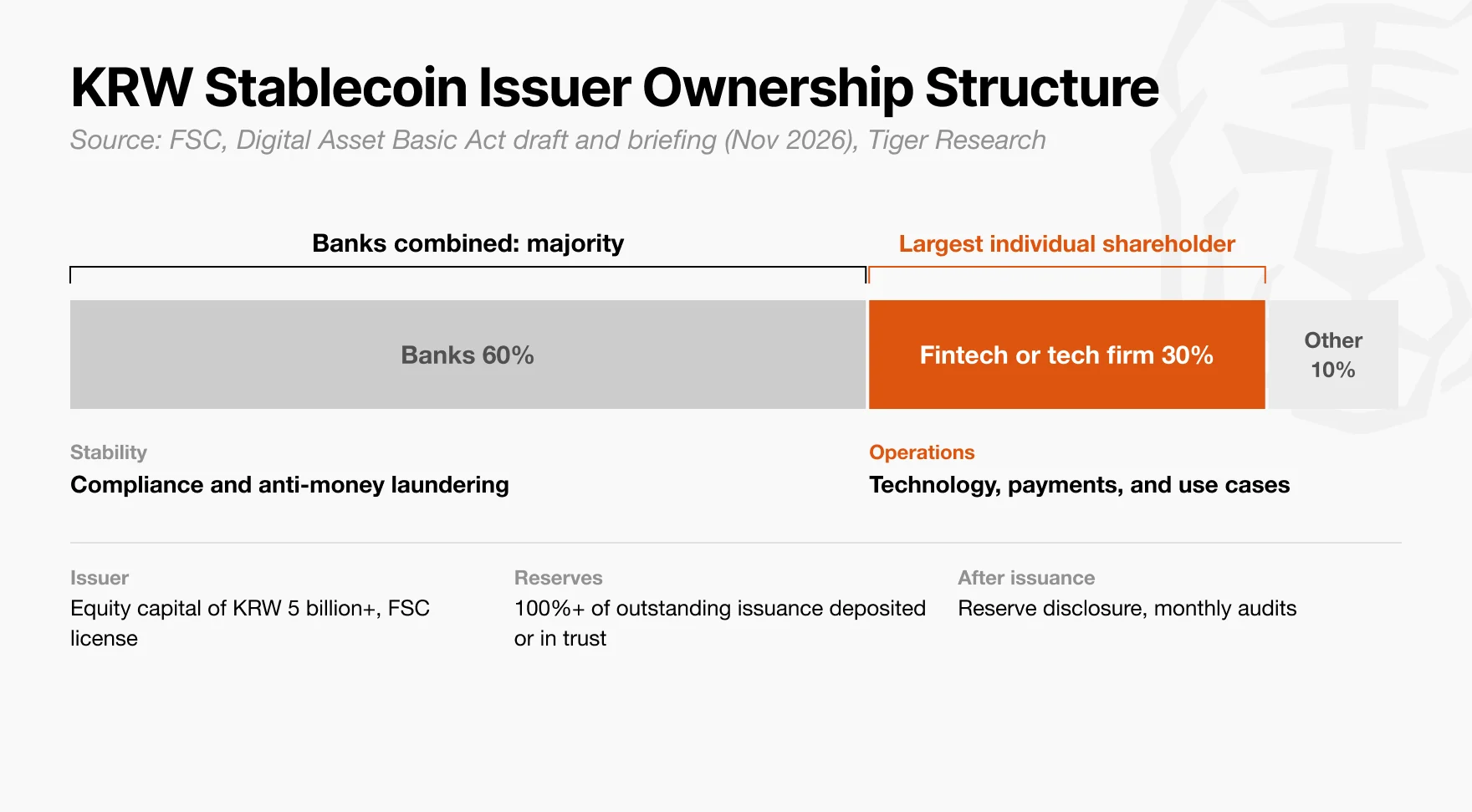
Article 21, Section 1 of the draft formally establishes the entry license for fiat-collateralized stablecoins (specifically KRW Korean won stablecoins). In order to prevent systemic financial risks similar to the collapse of Terra-Luna, the regulatory authorities have set stringent capital and governance red lines:
Issuers must have a minimum paid-in capital of at least 5 billion won (approximately 3.7 million USD) and set up a 100% independently isolated liquidity reserve account for fiat currency at a commercial bank designated by the Bank of Korea. More crucially, during the initial phase of the bill's implementation, only consortia where "commercial banks hold an absolute majority of the investment and voting rights (Bank-majority)" will be allowed to apply for licenses; pure financial technology companies or Web3 native entities can only gain entry by forming a consortium with large commercial banks.
2 Diverse New Tracks Created by the Segregation of Four Types of Business Licenses
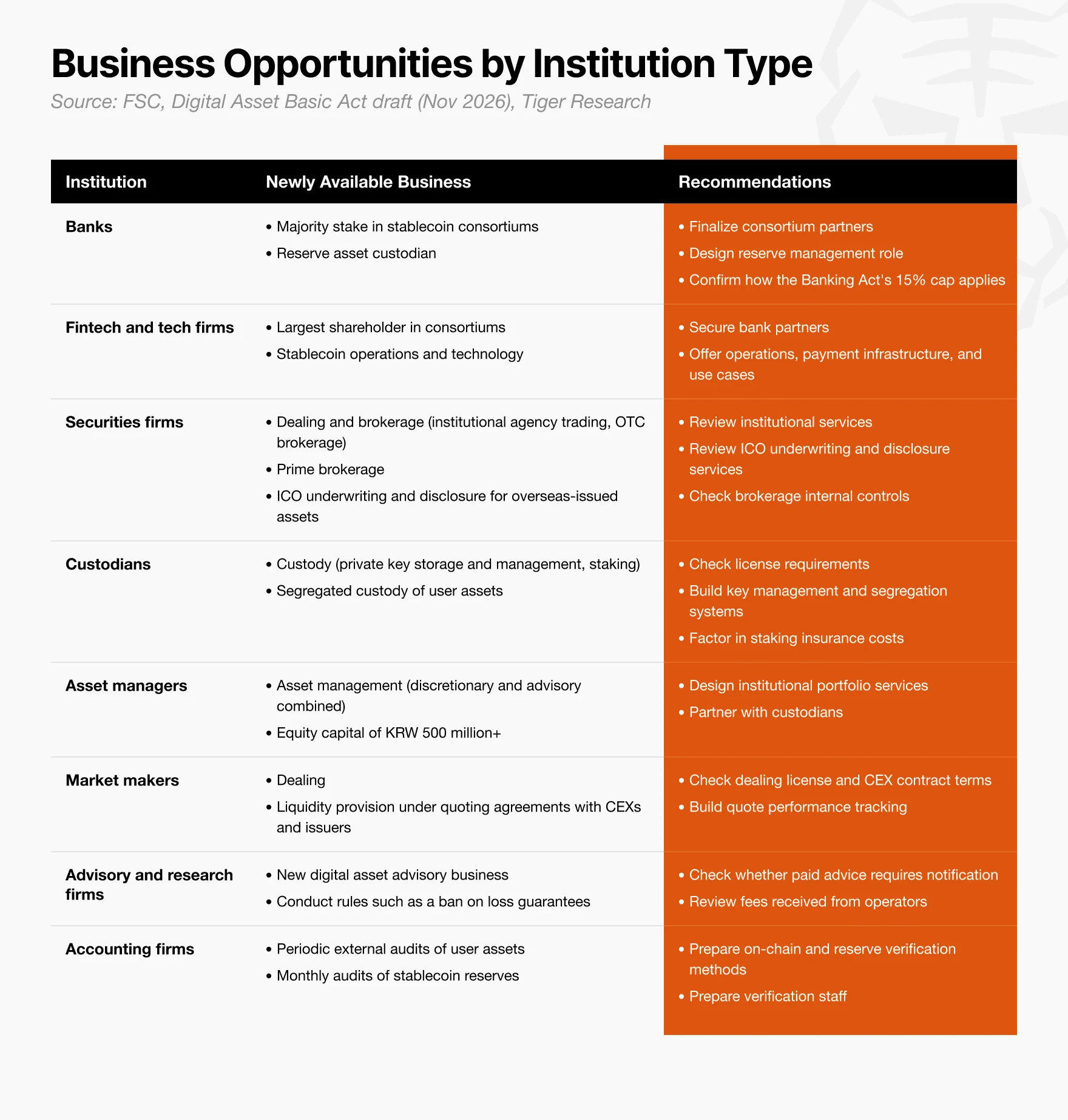
The draft entirely abandons the previously vague and broad concept of "Virtual Asset Service Provider (VASP)" and meticulously divides the digital asset industry into four independently licensed business types, drawing lessons from traditional capital market legislation:
- Digital asset trading intermediary business: Responsible for matching orders (i.e., pure order book exchanges);
- Digital asset custodial business: Independently safeguarding customer assets;
- Digital asset brokerage business: Executing trading orders on behalf of clients;
- Digital asset consulting advisor business: Providing investment analysis and asset allocation advice.
This refined licensing approach allows traditional brokerages to connect the crypto asset trading module directly to their existing securities applications by applying for independent brokerage and consulting licenses, without needing to invest heavily in building their own exchanges. Meanwhile, large trust companies and commercial banks can quickly seize custodial dominance in a separate custody license track, leveraging their strong sovereign credit backing.
3 Unresolved Issues in the Draft
Although the framework has begun to take shape, the bill still leaves significant gaps in many key operational details: Are commercial banks allowed to directly allocate spot digital assets on their balance sheets using their own capital? Can traditional financial institutions directly use Korean won stablecoins in cross-border payments and settlement? These unresolved issues will need to await the subsequent Enforcement Decrees issued by the Financial Services Commission for final determination.
Overseas Stablecoin Issuers: Applicability of Localized Entry and Registration Procedures in South Korea
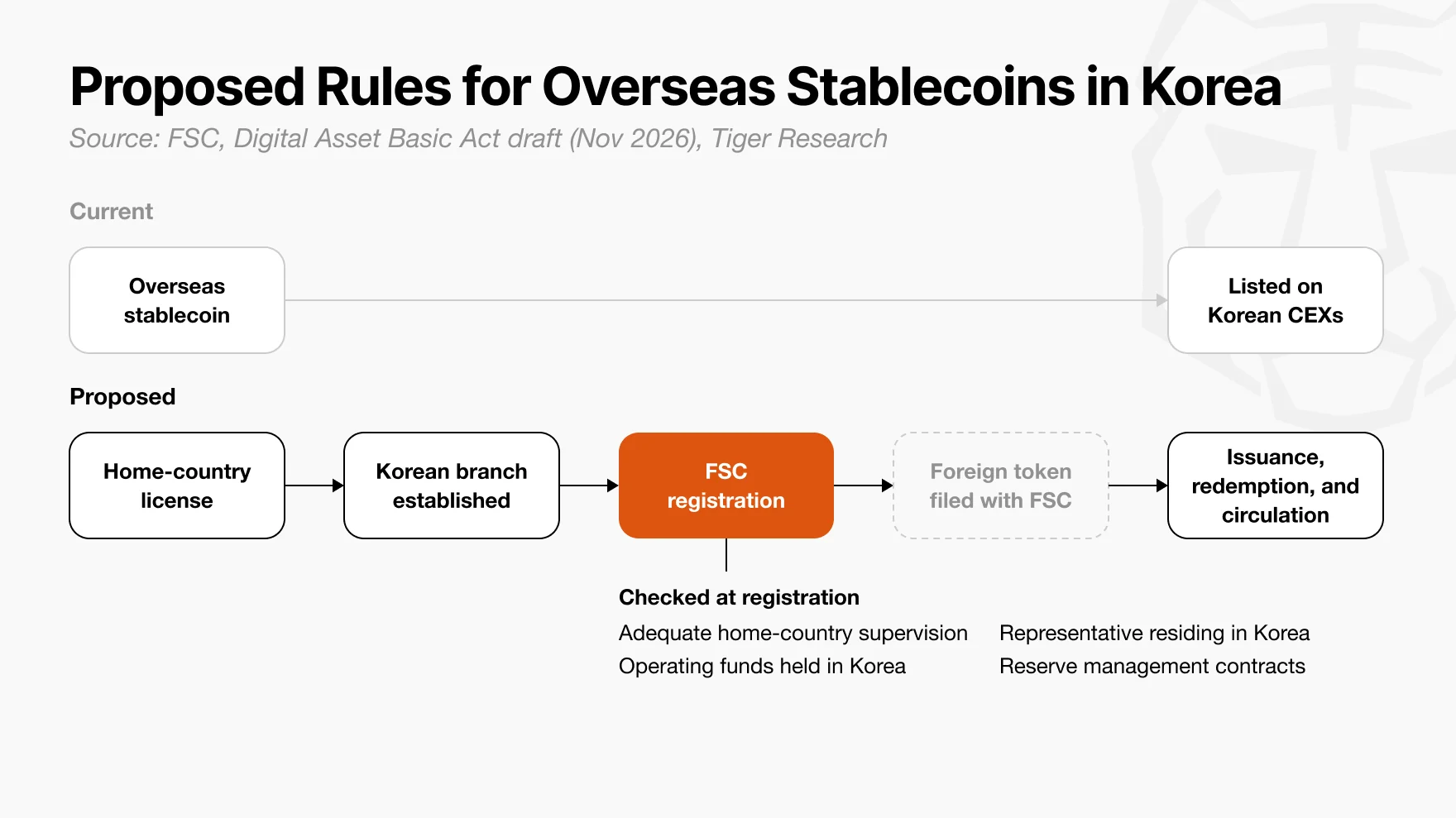
In response to the current monopolistic dominance of foreign dollar stablecoins (such as USDT issued by Tether and USDC issued by Circle) in the South Korean trading market, Article 28 of the draft establishes a highly targeted cross-border regulatory jurisdiction mechanism:
Overseas issuing entities that intend for their stablecoins to maintain compliant trading in major South Korean CEXs and circulate legally among South Korean residents must establish a formal registered branch or designated local agent in South Korea. Additionally, issuers must have already obtained corresponding compliant licenses in their home jurisdictions and regularly submit reserve asset sufficiency ratios and audit reports to the South Korean Financial Supervisory Service (FSS).
This provision signifies that foreign giants must accelerate their construction of local corporate entities and banking settlement networks in Seoul. If certain unregulated offshore stablecoins refuse to meet the aforementioned localization compliance requirements, South Korean regulators will have the authority to directly order major exchanges to enforce mandatory delisting.
Web3 Foundations and Project Parties: Local ICO Ban Lifted but Tax Advantages Remain Unchanged
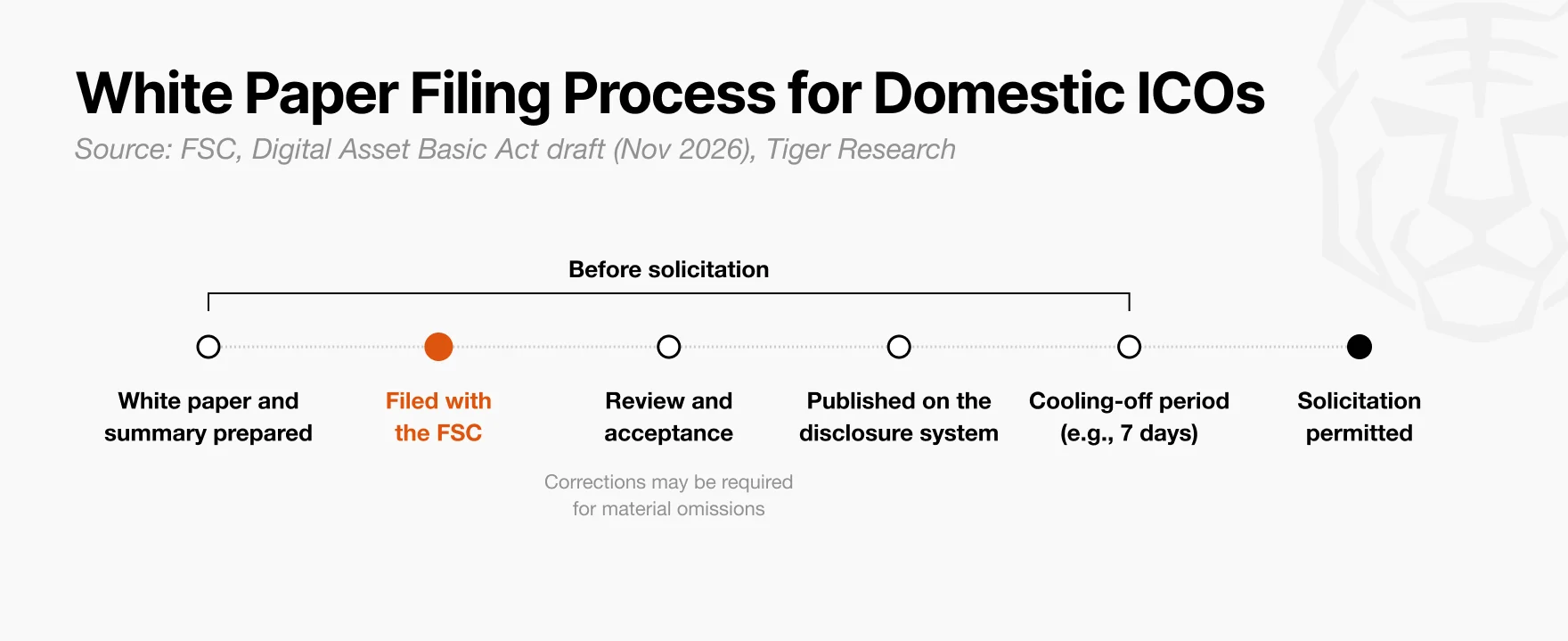
Since the Korean Financial Commission imposed a ban on local ICOs in September 2017, for nearly a decade, most excellent South Korean startup teams have been forced to go offshore, establishing foundations in Singapore, Switzerland, the United Arab Emirates (Dubai/Abu Dhabi), or the Cayman Islands to issue tokens. Article 7 of the draft has finally legally lifted the ban on domestic compliant ICOs.
Nonetheless, Tiger Research's investigation indicates that this loosening of policy is unlikely to trigger a significant influx of overseas foundations in the short term. The core constraint lies in the heavy tax burdens and strict disclosure obligations:
- Significant tax disparity: In Dubai or the Cayman Islands, foundations can enjoy nearly zero offshore tax benefits; however, once the token issuing entity is moved back to Seoul, it will immediately be subject to South Korea's corporate income tax regime of up to 24%.
- High statutory disclosure burdens for white papers: The draft requires local issuing entities to submit detailed technical code audits, token unlocking timelines, treasury fund flow details, and executive holdings to the regulators, taking full legal responsibility for the accuracy of these disclosures.
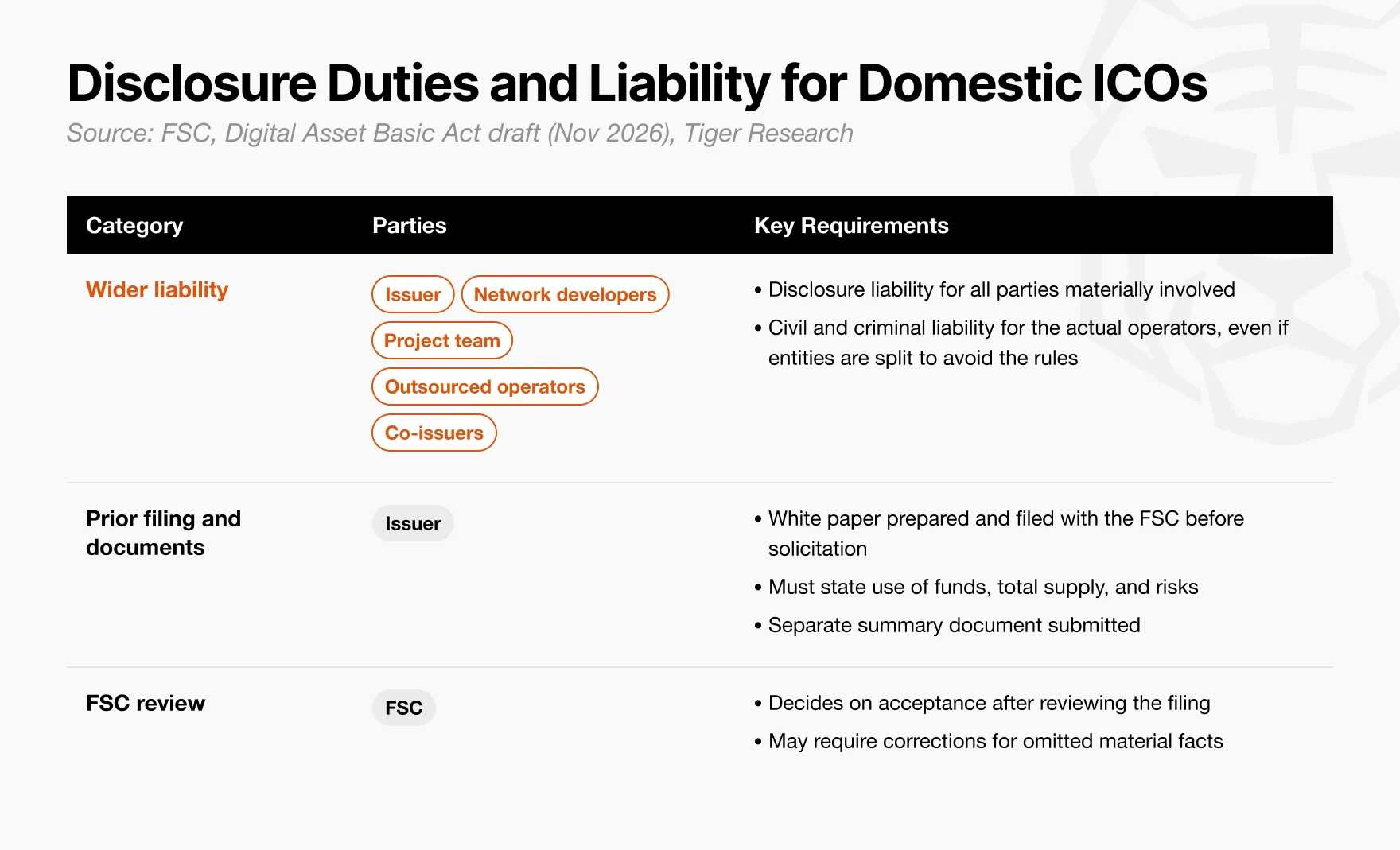
Therefore, for the vast majority of leading Web3 teams with a global vision, maintaining the dual-track structure of "offshore foundation issuance + local technical subsidiary development" remains the most rational and pragmatic solution.
Digital Assets: A Key Step into the Compliant Traditional Financial System
The proposal of the "Digital Asset Basic Act" marks the departure of the South Korean crypto market from years of wild and unregulated development, officially entering a modern era of rule of law closely interlinked with traditional capital markets. Although intense debates will continue in the National Assembly regarding ownership rights surrounding the 20% shareholding limit, the monopolistic tendencies of banks towards Korean won stablecoins, and the high tax's crowding-out effect on local innovation, the overarching trend towards institutionalization, transparency, and compliance in the entire industry has been firmly established.
Disclaimer: The content of this article is intended only for cutting-edge industry research and compliance policy analysis and does not constitute any investment advice, legal opinions, or commercial endorsement.
免责声明:本文章仅代表作者个人观点,不代表本平台的立场和观点。本文章仅供信息分享,不构成对任何人的任何投资建议。用户与作者之间的任何争议,与本平台无关。如网页中刊载的文章或图片涉及侵权,请提供相关的权利证明和身份证明发送邮件到[email protected],本平台相关工作人员将会进行核查。