Written by: DWF Ventures
Translated by: Chopper, Foresight News
Stablecoins have arrived at their moment. They can transfer funds globally at low cost and high efficiency, requiring far fewer intermediaries than traditional banks. Traditional banks, hampered by outdated infrastructure and settlement cycles lasting several days, find it hard to compete.
New banks have emerged as a solution to "fix the inefficiencies of traditional banks" (note: in this article, crypto new banks refer to new players whose primary business is issuing crypto payment cards). The first wave of new banks, such as Revolut and Nubank, gained tens of millions of customers by offering cheaper cross-border payments, faster transfers, and mobile-first designs. However, they still operate on the same settlement tracks as traditional banks and are limited by various market licenses, hampering each expansion.
Stablecoin new banks represent the next iteration. They settle on stablecoin rails, using payment infrastructure from providers like Bridge and Rain, which allows them to cover dozens of markets from day one. Their target user group is the demographic most poorly served by traditional banks: cross-border earners, small and medium enterprises, and residents in areas with limited access to US dollars. They can also offer on-chain yields and self-custody options, which are difficult for fiat new banks to achieve.
This article explores the leaders in the industry, analyzes the different components in the entire tech stack, and examines new products that might change the market.
Market Status
This sector is still small but growing rapidly. According to data from paymentscan.xyz, weekly spending on crypto cards has increased nearly 200% year-on-year. While the number of crypto new banks is steadily increasing, over 86% of spending is still concentrated in the top five credit card projects, with the largest project, RedotPay, accounting for more than 46% of transaction volume.
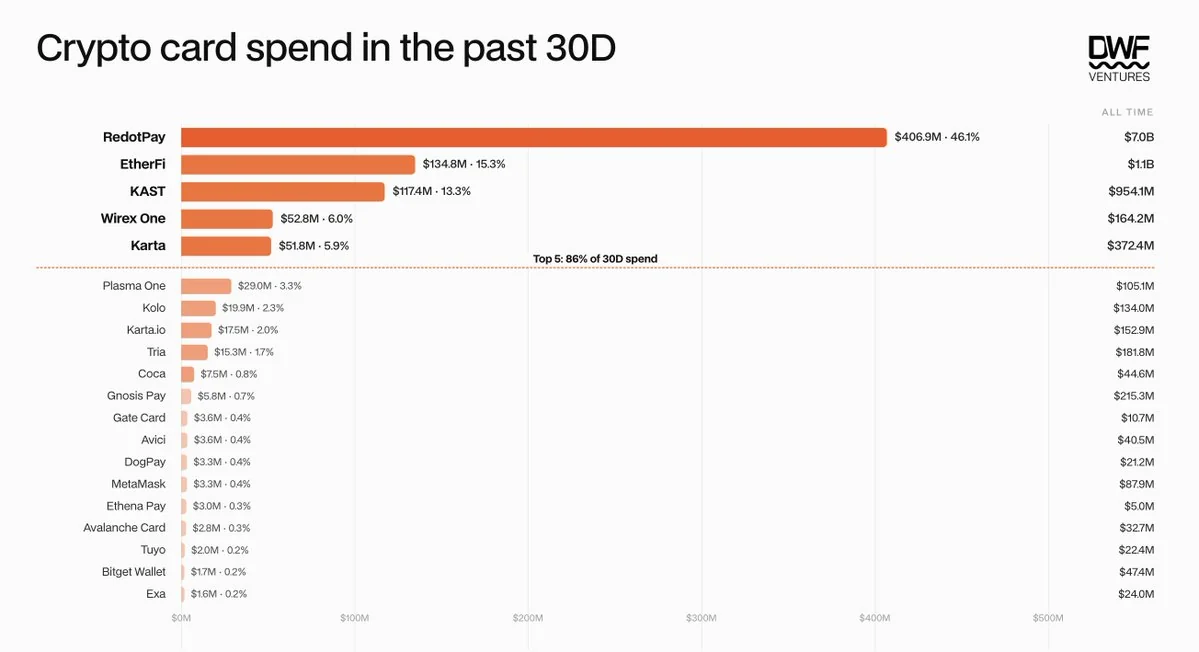
Image Source: PaymentScan
This concentration indicates that users consider not just functionality when choosing projects, but also trust in the issuer, brand reputation, and early distribution are equally important. Leading cryptocurrency projects are designed for everyday consumption and perform strongest in emerging markets like Asia-Pacific and Latin America, where demand for US dollars is high. Users are increasingly viewing these applications as places to save and earn. On average, every time they reload $1, users only spend $0.65 to $0.75. Projects like EtherFi and KAST, where the proportion of user spending from deposits is lower, offer annual percentage yields (APY) of 7% to 9% on US dollar stablecoin deposits. This far exceeds the interest rates of traditional banks, indicating that yields, like crypto spending, are an important draw.
Recharge vs Spending Ratio and Yield Comparisons of Various Projects
The infrastructure behind these new banks is largely commoditized. A few card issuers like Rain power many leading projects. Therefore, these card projects primarily compete on distribution and functionality. Cashbacks and yields are now everywhere, while local deposit and withdrawal channels and non-USD balances remain scarce. Most card spending is also settled in USD, so users spending in other currencies face foreign exchange fees of 0.5–2%, which can wipe out almost all cashback. Thus, we believe localization and multi-currency settlement are the clearest paths to growth.
What is the Key to New Bank Profitability?
Today, revenues from card projects come from three sources: transaction fees from card usage, foreign exchange/cryptocurrency conversion fees, and deposit and withdrawal fees. Profitability remains uncertain. This is because a large portion of these revenues is returned to users in the form of cashbacks, which essentially are customer acquisition costs. After accounting for cashbacks, most projects earn less than 1% from card spending, while the subsidy costs per $1 spent can soar to 2–3%. Cashbacks have upper limits, which help cap customer acquisition costs, but clearly, incentives are still necessary for growth, and this may come at the cost of profitability. A report from Blockworks covered the actual cashback amounts paid per dollar spent in payment card projects, most still reporting losses.
RedotPay is an exception; it competes on coverage rather than rewards. It holds licenses in Hong Kong, the USA, Canada, and Argentina and supports multiple payment methods. Compared to traditional remittances, it offers cheaper and accessible alternatives for regions like Africa and Latin America, enabling it to maintain market share even with higher rates.
Revenue Composition and Cashback Costs of Various Projects
With payment card functionality now widely available, new banks are beginning to explore other areas such as savings and investments. Building on-chain allows them to experiment with new revenue sources, some of which can be shared with users. Examples include:
Issuing their own stablecoins: Payment card projects can earn interest on idle user balances rather than letting it flow to issuers like Circle or Tether. KAST issues its own stablecoin through M0, while EtherFi issues through Ethena. The balances held by EtherFi users could generate approximately $2 million annually at a 4% yield.
Lending: Users can use their in-app held assets as collateral to borrow, utilizing third-party protocols like Aave or Morpho, rather than using the new bank’s own balance sheet. ether.fi Cash operates its lending service on Aave V4, with loans exceeding $47 million.
Perpetual contracts: A new experiment aimed at on-chain users, also part of Phantom's journey toward becoming a super app. Phantom has integrated perpetual trading into its wallet through Hyperliquid, becoming one of the top builders on Hyperliquid since its launch. Coupled with its payment card, Phantom is moving toward a super app where users can consume, save, and trade all in one place.
How to Maintain Growth
Returning to user demand, it can be categorized into three main areas: savings, yields, and connections.
Savings are the easiest feature to provide yet the hardest to win over because they rely on trust. Trust accumulates slowly through licensing, regulatory protection, and a long verifiable track record. Once won, it serves as a foundation for growth, especially in countries with weak local currencies, where people tend to prefer to hold savings in US dollars as it is clearly more advantageous than using local currency.
Yields are the next battleground. When yields become standard, users will gravitate toward providers that offer attractive and sustainable returns. The advantage lies with providers who have their own yield sources. Ethena Pay is an early example. Deposits earn from Ethena's own strategy, and every $1 deposited increases demand for USDe, generating more income for the protocol, creating a virtuous cycle that allows yields to grow along with the user base. The type of yield is also important; the inherent value of dollar yields is greater than that of token yields, the latter being less attractive to a wide user base.
Connections are currently the most lacking area for most new banks. Enabling users to convert crypto assets into local currency and deposit them into their actively used accounts. The moat here is strong, as very few competitors have complete local withdrawal channels, and catching up will take a long time.
What's Next in the Market?
Clearly, simply offering cryptocurrency spending and cashback functions is no longer sufficient to stand out among numerous competitors.
The next step is to launch more profitable products, making each application a super app for users to manage, appreciate, and invest funds. Features like multi-currency settlement and access to local payment channels are difficult to provide, but they are key for applications to win users in specific regions. Building these takes time, but the new banks that can truly scale will reap the biggest rewards.
免责声明:本文章仅代表作者个人观点,不代表本平台的立场和观点。本文章仅供信息分享,不构成对任何人的任何投资建议。用户与作者之间的任何争议,与本平台无关。如网页中刊载的文章或图片涉及侵权,请提供相关的权利证明和身份证明发送邮件到[email protected],本平台相关工作人员将会进行核查。