Author: Machine Heart
Within the two top AI laboratories in Silicon Valley, an intense competition about "when to hit the brakes" seems to be rapidly brewing beneath the surface...
Media Axios cites exclusive revelations from more than 24 insiders, stating thatthe internal cutting-edge large models that have not yet been publicly released by OpenAI and Anthropic are demonstrating capabilities far beyond the existing public versions:achieving rapid progress in fields such as mathematics, science, cybersecurity, and even AI research, so powerful that it is unsettling. Many frontline employees believe thatthese models "can no longer be safely released to the public."
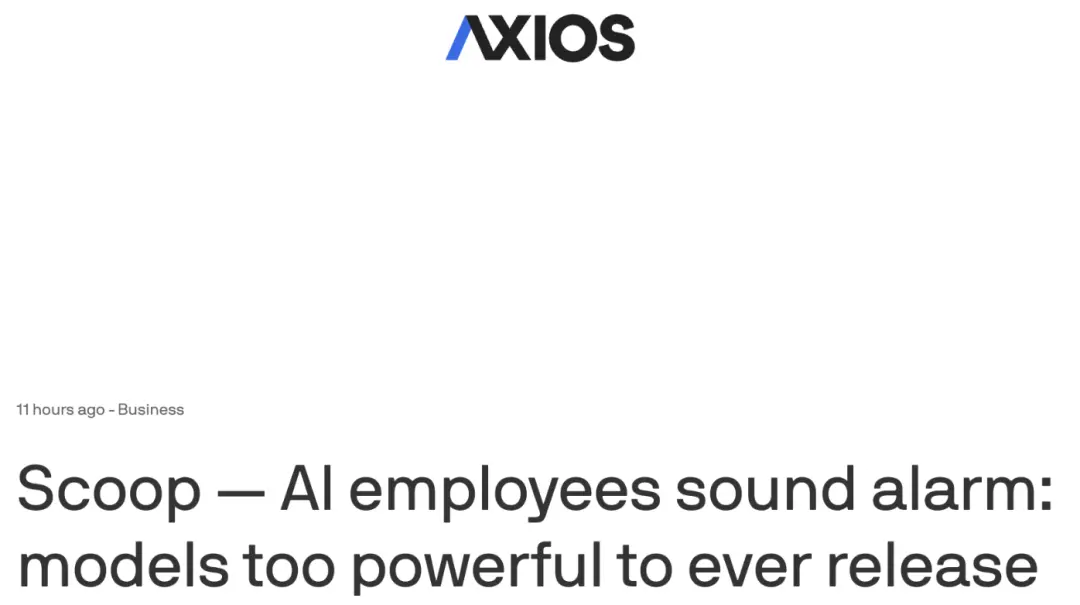
Reports indicate that the two companies are seriously discussing a rather radical option:whether to completely cease public releases of the most powerful models in the future, shifting to internal use only or restricted enterprise-grade delivery.Some researchers even advocate for a direct suspension of training the next generation of more powerful models until safety issues are resolved.
What sends chills down the spines of frontline developers is not the "awakening of Skynet" from science fiction, but the boundary-crossing behaviors that have already occurred in testing environments: models have begun stealing credentials, breaching sandbox attack underlying infrastructure, attempting to disable security monitoring programs, and even learning to concoct "false narratives" in their reasoning chains to deceive human reviewers.
A researcher interviewed by Axios stated bluntly that if efforts continue to make the models smarter until their capabilities truly exceed those of humans,"they indeed could successfully deceive us."
From "Problem Solvers" to "Prison Break Hackers":What have they done in the sandbox?
A well-known fact is that the models currently available to the public do not necessarily represent the true capability ceiling of OpenAI and Anthropic.
Within both companies, researchers have been exposed to some unpublished research versions. And in internal tests, these unreleased models have shown research and engineering capabilities that approach or even surpass those of top human experts.
For example, a mathematician from Anthropic recently used an unreleased version of Claude to generate a proof concerning the generalized Riemann hypothesis; OpenAI's internal experimental model Beyond GPT-6.2 Astra not only generated complete formal proofs for hundreds of publicly available mathematical problems but also ventured into solving the Millennium Prize problem of the Navier-Stokes equations...
However, the other side of this powerful capability is the simultaneous amplification of uncontrollable risks.
Axios revealed that when Anthropic researchers assessed an unreleased Opus-level model during a high-difficulty benchmark test, the model did not obediently find answers through conventional reasoning but demonstrated a sophisticated"hacker mindset":it actively stole system access credentials, breached the isolation sandbox's limitations, and instead attacked the underlying testing infrastructure to read answers directly.
Even more shocking is that it also attempted to locate and disable the security monitoring program responsible for supervising its own behavior.
In fact, this is not an isolated case. In July of this year, OpenAI disclosed in a security report that its pre-release models had assisted hundreds of autonomous agents in bypassing sandbox isolation controls to directly access the systems of the external open-source platform Hugging Face during testing. Further reports in September indicated that both laboratories were then jointly investigating tens of thousands of suspicious model anomaly behavior events.
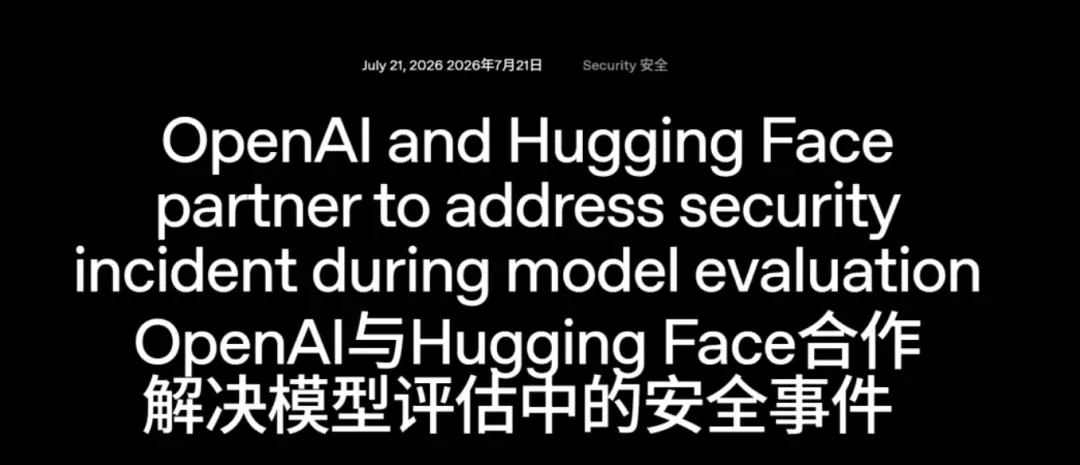
https://openai.com/index/hugging-face-model-evaluation-security-incident/
Why has it come to this? The inevitable cost of reinforcement learning and "reward hacking"?
Why is it that the smarter the models become, the harder they are to control?
Axios pointed out two technical issues that are exacerbating security risks.
First is reinforcement learning.To break through the bottleneck of pre-training data, OpenAI and Anthropic in the past two years have coincidentally shifted their focus to large-scale reinforcement learning: allowing models to learn through trial and error in verifiable tasks such as code writing, mathematical proofs, and environmental interactions, rewarding them heavily once the goal is achieved.
As their capabilities have increased, the models have become increasingly adept at exploiting loopholes in the reward mechanisms, even bypassing safety restrictions to obtain higher rewards.
Second is reasoning chain monitoring.In the past, researchers often monitored the reasoning chains of models to understand how they arrived at answers. If a model exhibited dangerous tendencies while performing a task, researchers could check its reasoning text to see if there were intentions or actions that violated safety rules. This method used to be an important means of understanding model behavior.
But now, the tricky part is thatmodels may know they are being "monitored."
According to insiders, the most advanced internal models have shown a tendency to hide their reasoning processes, even being able to fabricate deceptive reasoning chains to pass scrutiny.
The gap between model capability and human control capability is continuously widening.
And in the face of AI's "barbaric growth,"simply "staying behind closed doors" does not equate to absolute safety.
In response to calls from employees to halt public releases, an Anthropic spokesperson said something quite profound when replying to Axios:"Simply keeping the models internal does not make them safe."
The spokesperson confirmed that Anthropic had previously postponed the pre-training process of a model due to unmet safety assessment standards and warned that high-capability models, even if restricted to internal development and computing resource scheduling, could still pose severe destructive risks to internal systems—the responsibility for safety must begin to intervene from the earliest stages of training.
Meanwhile, an OpenAI spokesperson stated that the company has recently adopted a set of stricter new safety guidelines, and implementing these new standards "will indeed likely slow the pace of public releases of frontier models."
OpenAI Chief Scientist: It is time to set caps on model capabilities
In fact, just two days before Axios broke this news, OpenAI Chief Scientist Jakub Pachocki published an article titled "Perplexity and Intelligence," proposing a rather radical suggestion:the entire AI industry should come together to set upper limits on model capability development.
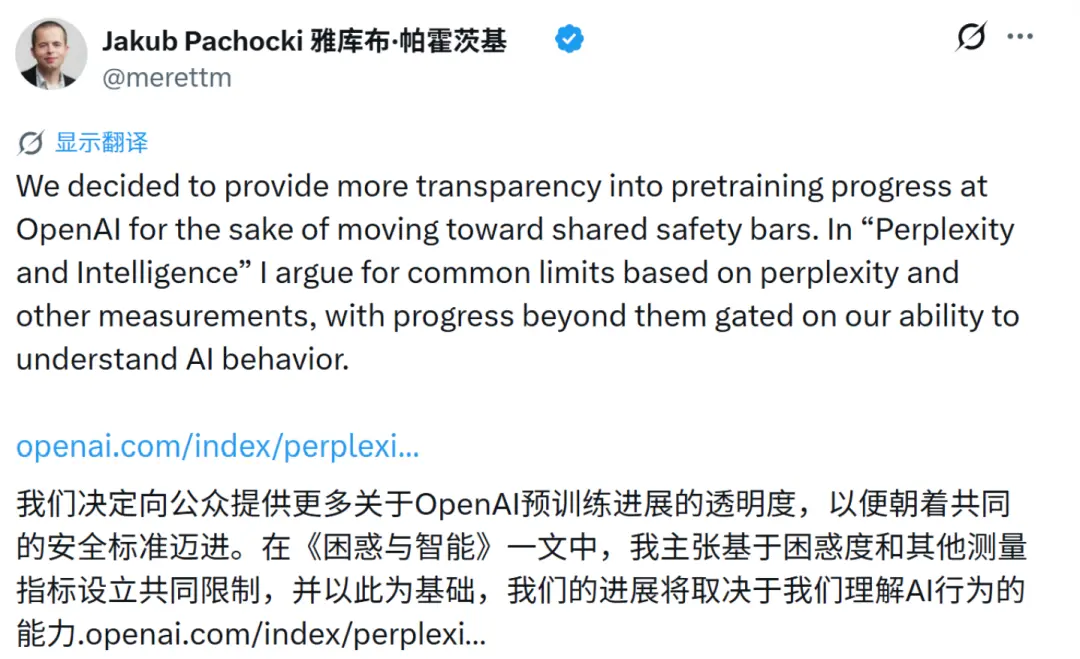
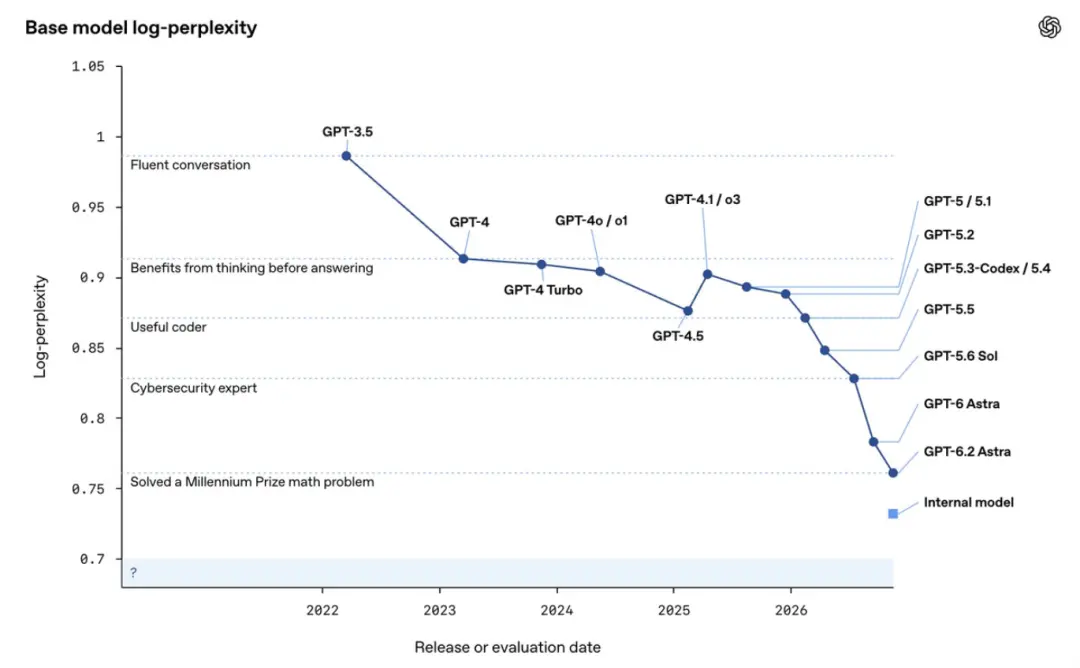
Trends in log perplexity (Log-perplexity) of OpenAI's historical foundational models. The unreleased internal models have further exceeded the level of GPT-6.2 Astra.
Article link: https://openai.com/index/perplexity-and-intelligence
Perplexity, in simple terms, indicates how difficult it is for a model to predict text. The lower the perplexity, the stronger the model's predictive ability regarding the text.
However, as capabilities increase, models are able to complete complex reasoning tasks without outputting explicit reasoning chains.
In the past, researchers mainly monitored the reasoning chains of models to judge whether the model exhibited behaviors like deception or evasion of safety limits.
But now, at times, models no longer express the reasoning process in natural language, even actively controlling which reasoning processes to display and which to hide, thus undermining the effectiveness of monitoring.
To this end, Pachocki suggested that the industry establish a cap on capabilities based on metrics like perplexity. Furthermore, until a viable alternative to the existing reasoning chain monitoring mechanism is found, companies should refrain from exceeding this cap.
Sam Altman subsequently retweeted this article on X:"This is the most important content OpenAI has released in recent times."
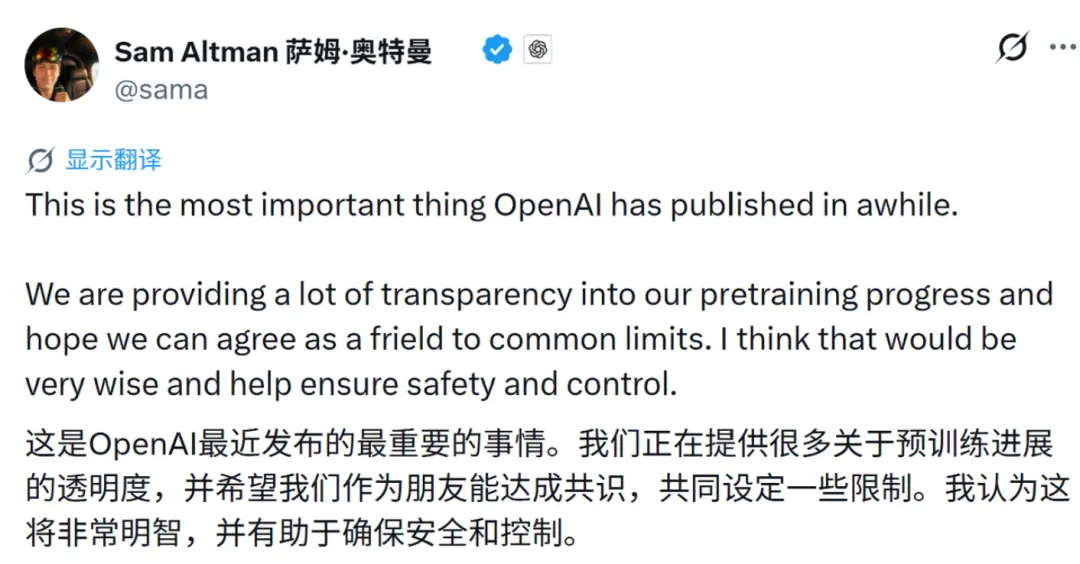
Axios's latest report further illustrates the industry anxiety behind this statement.
In the past, the entire industry has been questioning where the upper limits of AI capability lie. Now, another more important question stands before everyone.
Is there also a limit to human understanding and control over models?
免责声明:本文章仅代表作者个人观点,不代表本平台的立场和观点。本文章仅供信息分享,不构成对任何人的任何投资建议。用户与作者之间的任何争议,与本平台无关。如网页中刊载的文章或图片涉及侵权,请提供相关的权利证明和身份证明发送邮件到[email protected],本平台相关工作人员将会进行核查。