Despite the stock market decline and rising financing costs tightening the financial environment, Federal Reserve officials may not find it necessary to stop raising interest rates as long as economic activity and employment do not deteriorate significantly.
Written by: Wu Yu, Jinshi Data
After a series of consecutive declines in the US stock market, the market began to reassess the Fed's room to continue raising interest rates. Although there was a strong rebound in the US stock market on Monday, the risk sentiment on Wall Street has clearly weakened, with corporate bond credit spreads widening, and the tightening of financial conditions equivalent to an additional 100 basis points hike by the Fed.
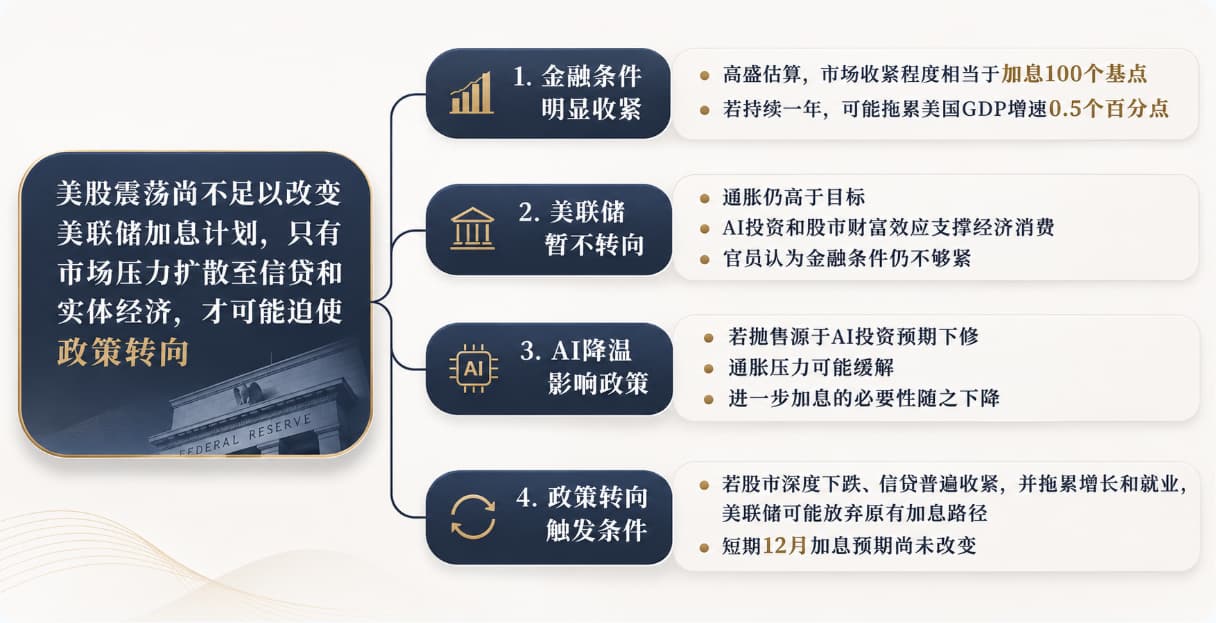
This puts new pressure on the policy decision-making led by Fed Chairman Kevin Warsh. However, Axios reported on November 23 that the current market fluctuations in the past few days are not enough to change the Fed's rate hike plans. Inflation remains above target, while the AI investment boom and rising stock market continue to support the economy and consumption; some officials even believe that moderate tightening of financial conditions assists in achieving monetary policy goals.
Tightening of the market is equivalent to a 100 basis points hike, and the Fed does not temporarily reject it
Last week, the US stock market experienced five consecutive days of decline, with the S&P 500 index (SPX) dropping 3.7% on Friday alone. On Monday, the market rebounded sharply, with the S&P 500 index closing up 4.73%, but still down over 4% cumulatively since November, with larger declines in major tech stocks.
While the stock market is under pressure, the spread between higher-risk corporate bonds and US Treasuries has widened, indicating that the financial environment is tightening. Goldman Sachs economists estimate that as of last Friday, the tightening of financial conditions was equivalent to a 100 basis points hike by the Fed; if this state continues, US GDP growth could be reduced by 0.5 percentage points over the next year.
However, this does not mean that the Fed will immediately adjust its policy. The Fed raised interest rates by 25 basis points in September, and the market generally expects another hike in December, with most officials also leaning towards raising rates one to two more times next year. For policymakers who already believe that rates need further increases, the market tightening financial conditions is somewhat equivalent to completing part of the tightening task ahead of schedule.
Fed Governor Lisa Cook stated in a speech in Chile last week that inflation continues to remain above target, and there are no clear signs that it is falling, thus current financial conditions are still too loose. She also noted that existing monetary policy has not curtailed AI infrastructure development, and rising stock prices continue to support consumer spending.
This reflects the policy trade-offs currently faced by the Fed: while stock market declines and rising financing costs help suppress demand, officials may not find it necessary to stop raising rates as long as economic activity and employment do not deteriorate significantly.
The cooling of AI investment may ease inflation, or trigger a policy shift
The AI investment boom is an important variable for the Fed in assessing market risks. The construction of data centers and related capital expenditures have driven up the demand for certain goods and services, becoming one source of inflationary pressures. Therefore, for some Fed officials, a moderate cooling of AI investment is not a bad thing, provided that its impact is limited to related industries and does not evolve into a broad economic contraction and employment deterioration.
Goldman Sachs economist David Mericle points out that if financial conditions tighten further, the Federal Open Market Committee (FOMC) may eventually decide that continuing to raise rates is unnecessary. In particular, if a new round of stock market sell-offs is primarily triggered by market concerns over AI spending, it may reduce the need for further rate hikes, as the demand for AI itself is pushing up inflation.
However, if the market decline spreads from stocks to the broader credit sector, the Fed's policy space will change. Axios notes that if the stock market falls sharply again, and corporate financing conditions are generally tightened, the Fed will find it difficult to continue adhering to its original rate hike plans. At that point, the drag on the economy from tightened financial conditions may exceed the tightening effect brought about by additional rate hikes.
In this round of market fluctuations, stocks and bonds have shown a traditional inverse movement: when the stock market falls, investors buy bonds, pushing yields down, reflecting market expectations that the Fed will ultimately provide policy buffers as pressure intensifies. This differs from previous rounds of significant market turmoil, including the outbreak of the Iranian war in March this year, the impact of US tariff policies in April 2025, and the 2022 Fed tightening cycle.
The Fed's focus shifts to whether market pressure spreads
New York Fed President John Williams previously described market changes as a return of financial conditions from a state of excessive looseness to a normal level, rather than having posed a significant restriction on economic growth. This judgement means that the Fed still tends to view market volatility as a repricing of risks, rather than a signal that policy must shift.
However, Williams emphasized overnight that inflation is still too high, and the Fed still has work to do to ensure inflation consistently returns to the 2% target. Therefore, the focus of the market is not only on whether stock indices can rebound, but also on whether financial pressure will spread from the stock market to the credit market, and whether the economy and employment will thus experience a more pronounced cooling.
In the short term, expectations for a rate hike in December have not been disrupted by market fluctuations. What could truly change the Fed's course is a deeper decline in the stock market, widespread tightening of credit, and the chain reactions of a slowdown in AI investment affecting economic growth and employment.
免责声明:本文章仅代表作者个人观点,不代表本平台的立场和观点。本文章仅供信息分享,不构成对任何人的任何投资建议。用户与作者之间的任何争议,与本平台无关。如网页中刊载的文章或图片涉及侵权,请提供相关的权利证明和身份证明发送邮件到[email protected],本平台相关工作人员将会进行核查。