Authors: Shafu Elfouly, Jasper Kim, Danny Organ (Circle Agentic Works)
Compiled by: Deep Tide TechFlow
Deep Tide Guide: When AI agents handle complex tasks in the real world, they are often limited by invisible barriers such as paywalls, CAPTCHAs, and advanced data interfaces. The stablecoin giant Circle's lab, Agentic Works, recently released a groundbreaking benchmark index that quantifies the substantial impact of giving agents on-chain wallets on their operational capabilities.
In 1,470 rigorous comparative tests of mainstream large models, agents equipped with a USDC budget and the ability to autonomously procure microservices saw their task completion rate leap from 53.7% to 84.5%, while the average incremental cost per task was only $0.046. This proves that granting agents on-chain financial autonomy is a highly cost-effective path to breaking capability bottlenecks.

Core Questions and Experimental Design: When Agents Hit the "Wall of No Funds"
In today's AI application paradigm, an uncapitalized agent often can only "scrape the surface": it can draft a beautifully crafted business email for you but cannot send it; it can vividly describe the harmonic progression of a symphony but cannot directly generate playable audio. When tasks need to cross paid APIs, advanced retrieval databases, or third-party microservices, ordinary agents will immediately hit an invisible wall.
To explore the true boundaries of the agentic economy, Circle's lab, Agentic Works, initiated a rigorous large-scale controlled experiment: giving AI agents a preloaded USDC on-chain wallet and enabling them to discover and purchase third-party microservices autonomously when encountering bottlenecks. The experiment centered around three core propositions:
First, can agents with a USDC budget and the ability to autonomously procure paid microservices successfully complete a higher proportion of originally failed tasks? Second, can this capability for external microservices significantly improve the quality of the final deliverables? Third, how much additional real cost must be incurred on average for each task to achieve this leap?
Task Completion Rate Soars by 30.8%: Comprehensive Assessment of Seven Cutting-Edge Large Models
The experimental results showed astonishing consistency and explosive potential: in evaluations of 21 complex real-world tasks covering seven mainstream cutting-edge large models, agents with a USDC budget experienced a comprehensive, stair-step increase in task success rates.
In the uncapitalized baseline control group, agents could only use ordinary public web searches and read-only tools, resulting in an average task completion rate of only 53.7%; however, with the introduction of the USDC wallet and microservice invocation permissions, the average completion rate skyrocketed to 84.5%, an impressive net increase of 30.8 percentage points. Whether in top proprietary models or lightweight open-source models, the empowerment with procurement capabilities resulted in a qualitative transformation of their operability when facing anti-crawling blocks, structured data extraction, and advanced computational tasks.
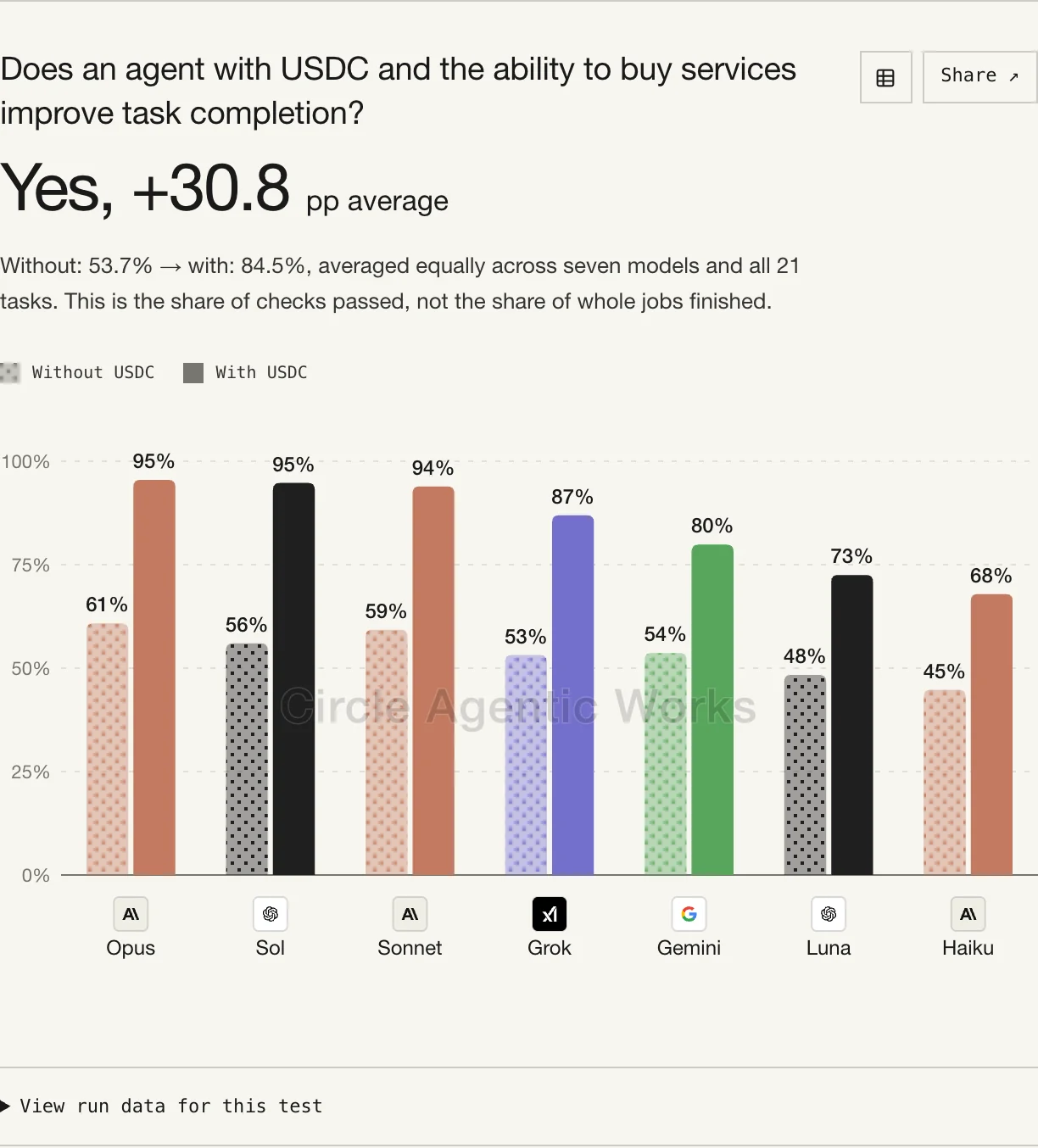
Figure: Average completion rate of seven cutting-edge large models increased by 30.8 percentage points with a USDC budget
Significant Improvement in Delivery Quality: Rigorousness and Key Item Accuracy Fully Enhanced
Many people worry that granting agents autonomous spending budgets may lead to the "illusion" of tool abuse or blindly piecing together answers. However, rigorous quality control assessments dispelled this concern entirely.
In all test batches where agents claimed to have "completed," independent evaluators conducted strict verification of each required item and conclusion: the full correctness rate of uncapitalized agents was only 68.2%, while this proportion rose to 78.9% in the funded group (a pooled increase of 10.7 percentage points). In all successful submissions of final answers, the single-point accuracy for specific data items surged from 56.7% to 88.1%. This indicates that the intervention of microservices not only helped agents break through obstacles but also significantly enhanced the objective factual accuracy of final deliverables from the ground up.
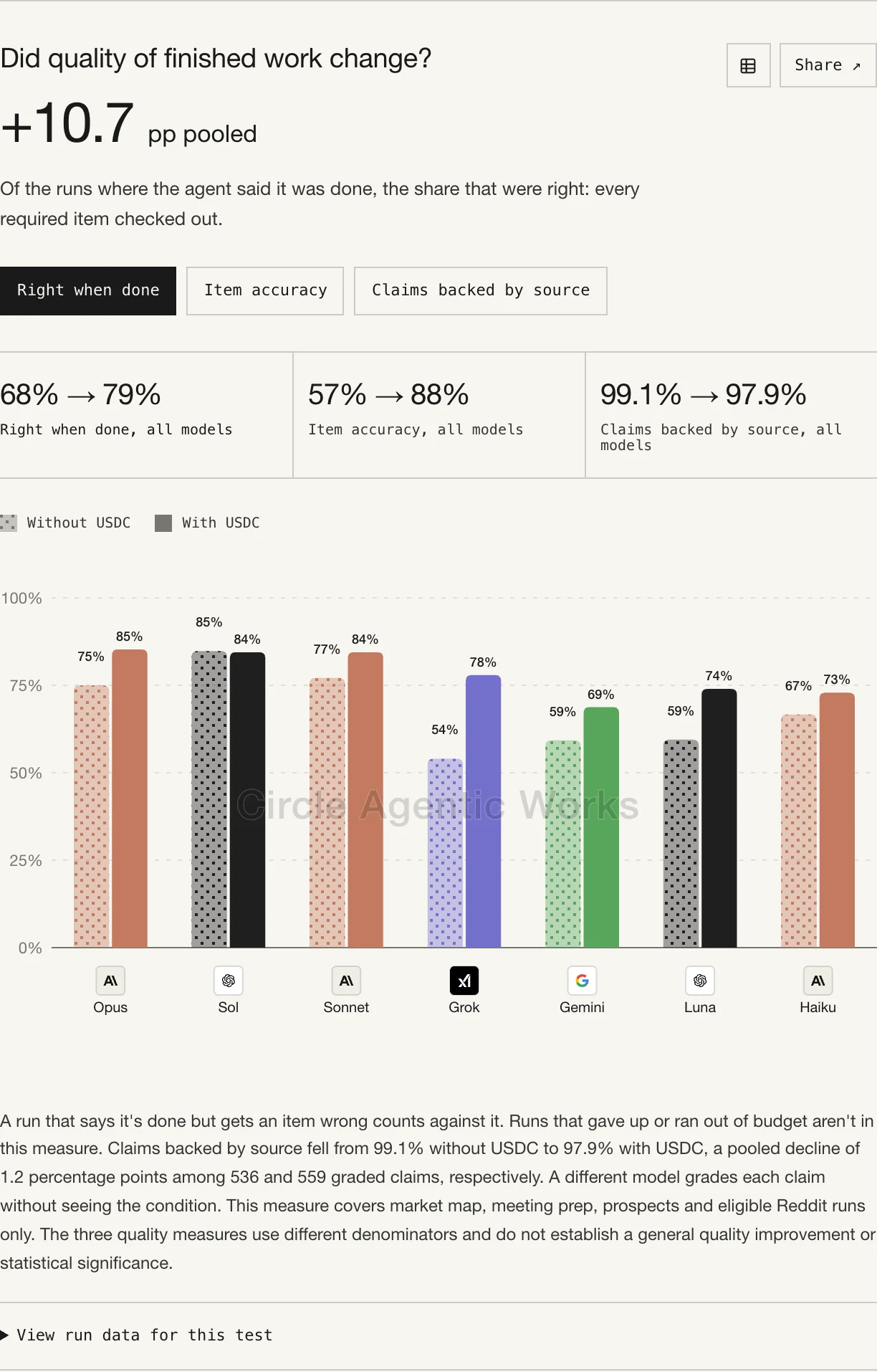
Figure: Task overall quality in the completed delivery test group improved by 10.7 percentage points, with key item accuracy reaching 88.1%
Extremely Affordable Economic Calculation: Average Additional Cost of Only 30 Cents per Task
For enterprise-level applications and practical deployments, the most critical consideration is always the return on investment: in exchange for an over 30 percentage point surge in completion rate, how much additional cost does the enterprise need to bear?
The actual incremental cost of models and microservices is astonishingly small: among all seven models, the average total expenditure per task only rose from $0.101 to $0.147, with an average incremental expenditure of merely $0.046 (equivalent to less than 30 cents!), representing an increase of only 45.6%. This minuscule expense includes the token fees generated by the model itself, as well as the actual costs incurred by agents for procuring CAPTCHA decoding, advanced scraping, and professional analysis microservices during execution.
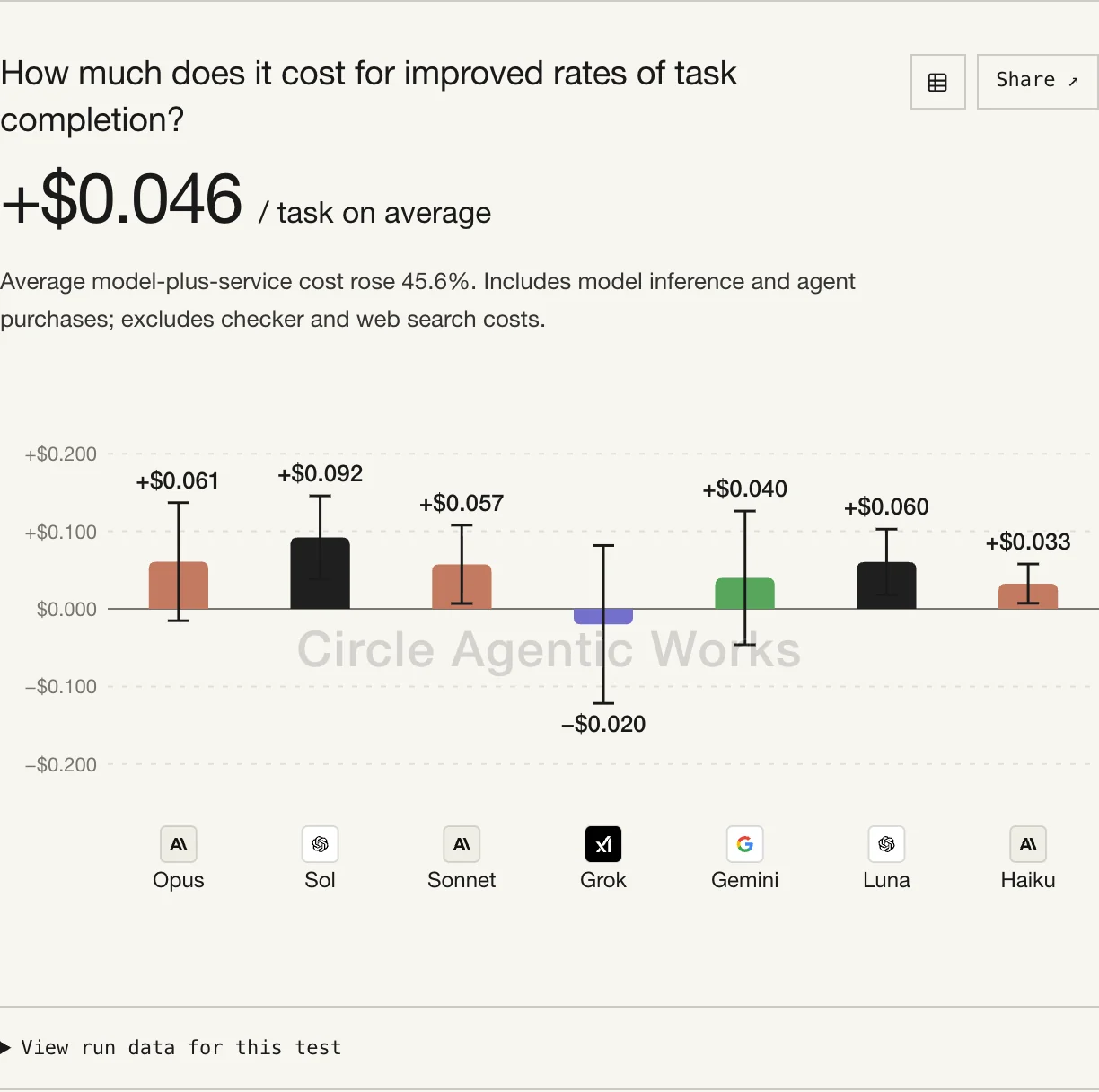
Figure: Average incremental expenditure of each task increased by only $0.046 after equipping with a procurement budget (approximately 30 cents)
Return on Investment Frontier: The Synergistic Compound Interest of Model Capabilities and Commercial Microservices
If we plot the increase in task completion rate against the incremental cost on the same coordinate system, we can clearly see an "Efficiency Frontier Curve" driven by on-chain microservices.
The data reveals a profound business insight: agents do not need unlimited large funds to create miracles. Because most third-party practical microservices (such as data transformation, advanced validation, and vertical queries) are priced extremely cheaply in decentralized markets (often only a few cents or less per instance), a small amount of on-chain funds can leverage significant changes, unlocking computational deadlocks that have plagued models with hundreds of billions of parameters for hours.
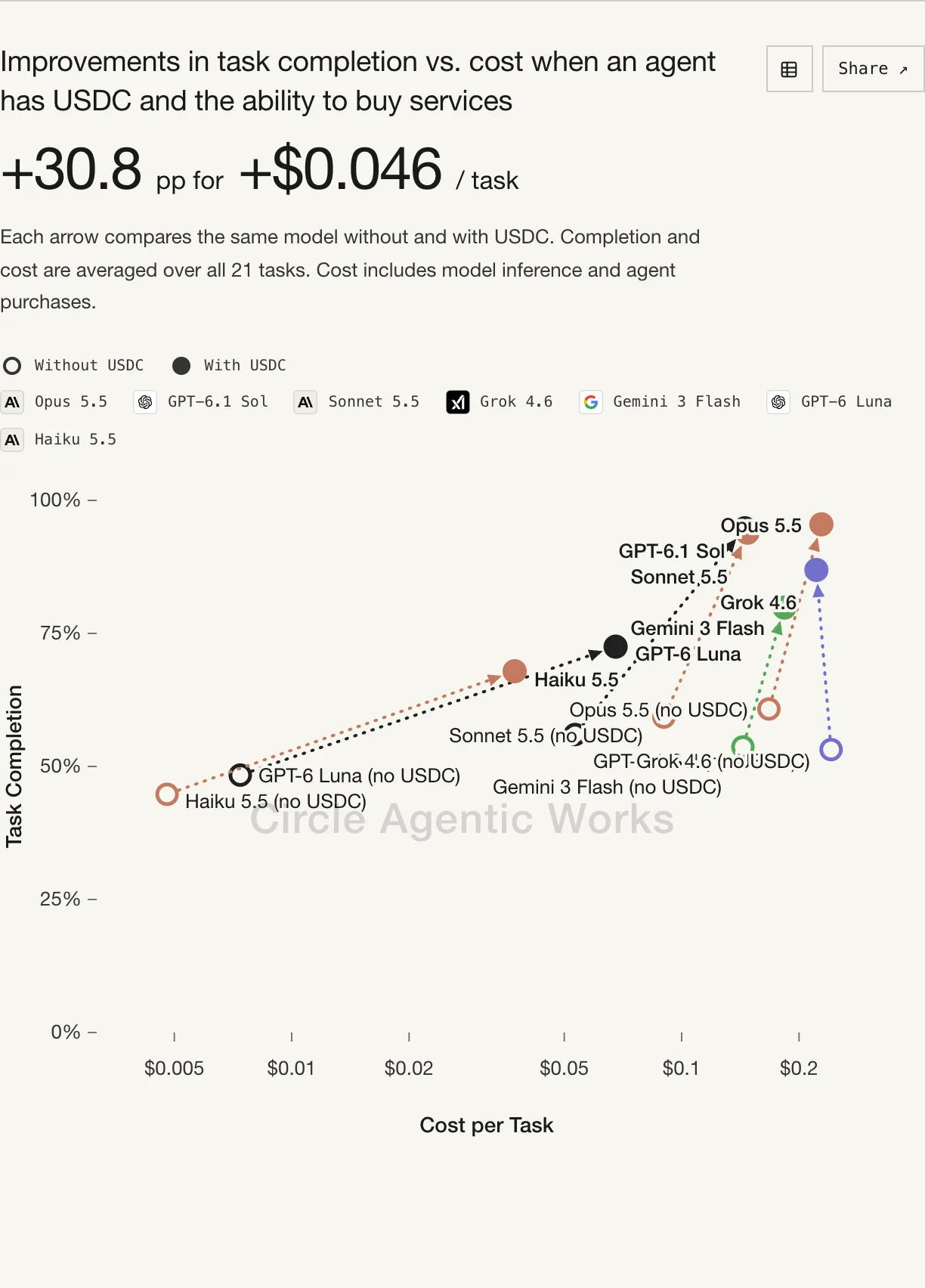
Figure: Investment return rate (ROI) efficiency frontier between task completion rate increase and marginal cost increase for seven models
Total Cost of Research and Empirical Summary: Opening New Paradigms of On-Chain Machine Autonomy Economy
This pioneering empirical research conducted by Circle involved 1,470 real runs (each model tested independently five times under two conditions for 21 tasks), with the cumulative total research cost for all seven models being only $238.28 (an average of just $34.04 per model), where the model inference tokens accounted for $136.26, agent self-procured microservices accounted for $46.34, and assessment testing expenses accounted for $48.84.
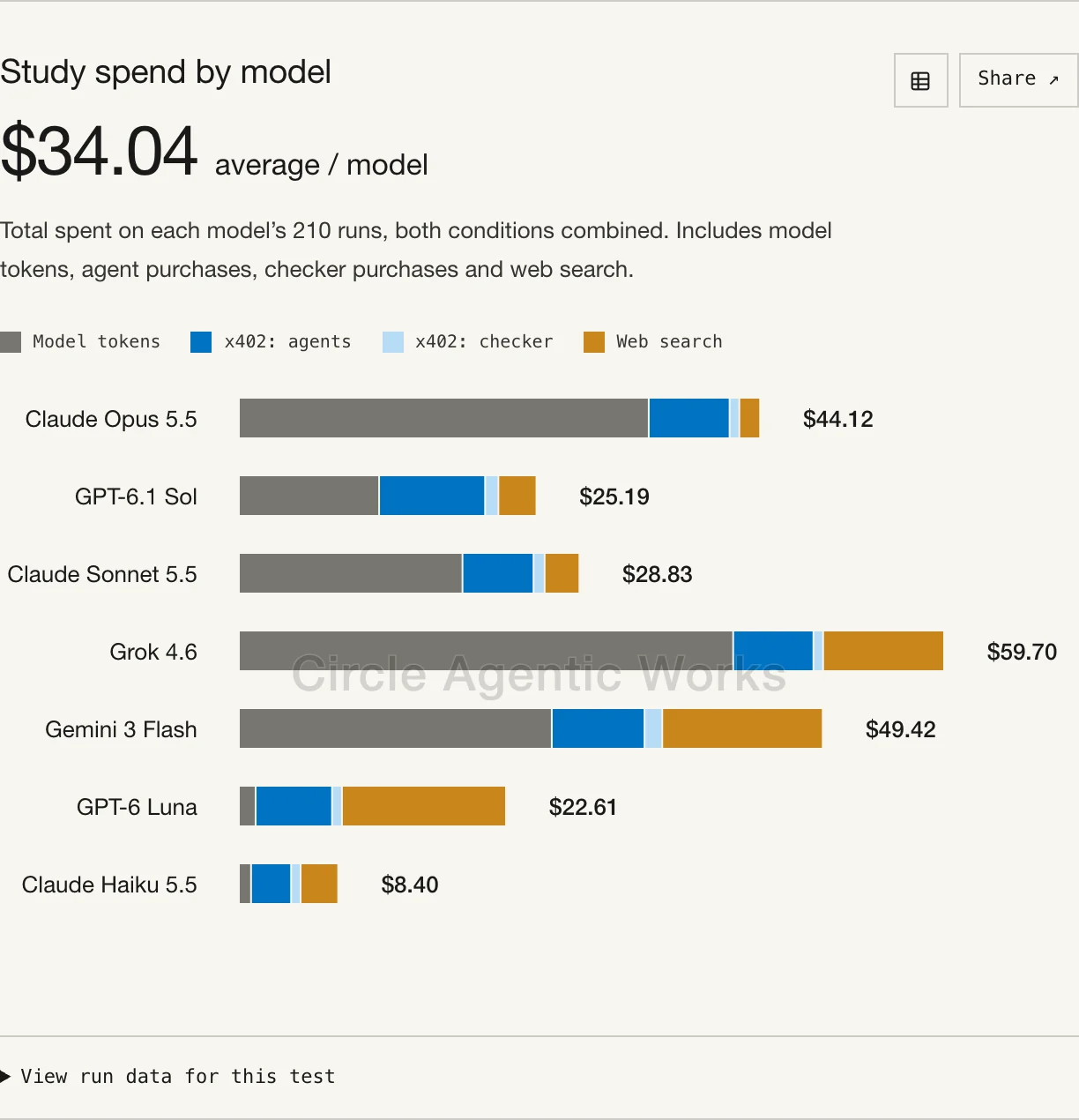
Figure: Overview of cumulative expenditures across models for inference and microservice invocation during the 1,470 tests (average $34.04 per model)
This research conveys a milestone message to the entire tech community and Web3 ecosystem: the agentic economy is no longer a mere fantasy lingering in white papers. By introducing lightweight, fast, and low-friction on-chain stablecoin payment interfaces like the Circle Agent Stack, developers are empowering autonomous agents with the key to truly integrate into human commercial civilization. Agents with wallets can not only think but have also learned to efficiently exchange value on-chain, much like rational economic individuals, which is the core singularity for the next generation of productivity explosion.
免责声明:本文章仅代表作者个人观点,不代表本平台的立场和观点。本文章仅供信息分享,不构成对任何人的任何投资建议。用户与作者之间的任何争议,与本平台无关。如网页中刊载的文章或图片涉及侵权,请提供相关的权利证明和身份证明发送邮件到[email protected],本平台相关工作人员将会进行核查。