Public chains, LRT, and chain games have all changed their businesses.
Written by: blocmates
Translated by: Chopper, Foresight News
The crypto space is full of double standards. The most obvious one is that any crypto company or project that announces a transformation is almost always met with harsh criticism.
In any normal business environment, it is completely acceptable for a team to try some ambitious initiatives, fail to find product-market fit (PMF), and then change direction to try again.
But in the crypto industry, for some reason, maybe tracing back to Bitcoin’s perfect birth and its resistance to change, raising a hand to admit one is looking for a new direction has become heretical.
I believe we should celebrate these transformations. Many of these teams could have taken the easy route: spending millions in treasury funds, awarding themselves high salaries, and going to tropical islands for a bunch of unnecessary external events.
What we will showcase is a dozen projects that chose the harder path, trying to explore new things that the market is actually willing to recognize.
MegaETH
In some ways, I was not surprised that MegaETH decided to enter the product space.
Of course, their L2 has stunning throughput data, but that data has always been discussed in the context of "what new applications their infrastructure can support." Their token TGE is directly linked to the relevant KPIs of on-chain applications.
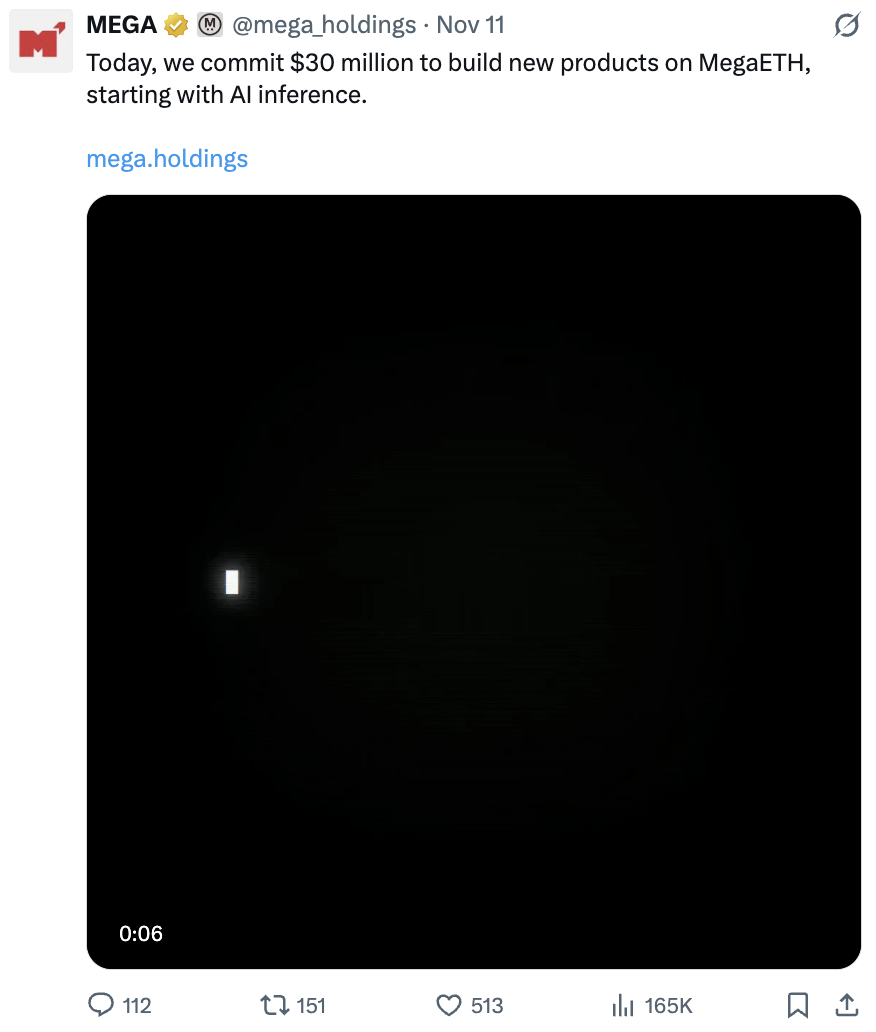
So when they announced allocating $30 million to create their own product, with the first being an AI inference market called Purified Intelligence, the comments on crypto Twitter were indeed surprising.
Purified Intelligence is their first official flagship application set to launch in December.
Of course, inference service providers have already validated this market, with successes like OpenRouter and Venice.
MEGA’s idea is that the current differences between these service providers are too large. Many third-party service providers can run the same batch of open-source models cheaper than the original labs, but trust and verification issues prevent these more competitive offers from being interchangeable, which is not optimal for end consumers.
Their goal is to standardize this supply, provide verification services, so users can be confident that they are getting real models with guaranteed data processing, and at the best price.
ether.fi
Some new readers may not remember, ether.fi initially was a liquidity re-staking protocol (LRT) integrated with EigenLayer.
Yes, technically it still has a liquidity re-staking protocol, but ether.fi is now better known for its new banking services.
What they now offer, to be honest, is a complete set of services: Visa cards, yield vaults, lending, trading, and now their own native stablecoin.
Among the batch of EigenLayer protocols in 2024, the LRTs have performed well; they remained and leveraged their massive treasury to push out new products. Each of these projects has considerable total value locked (TVL), providing unique capital bases to utilize.
Renzo
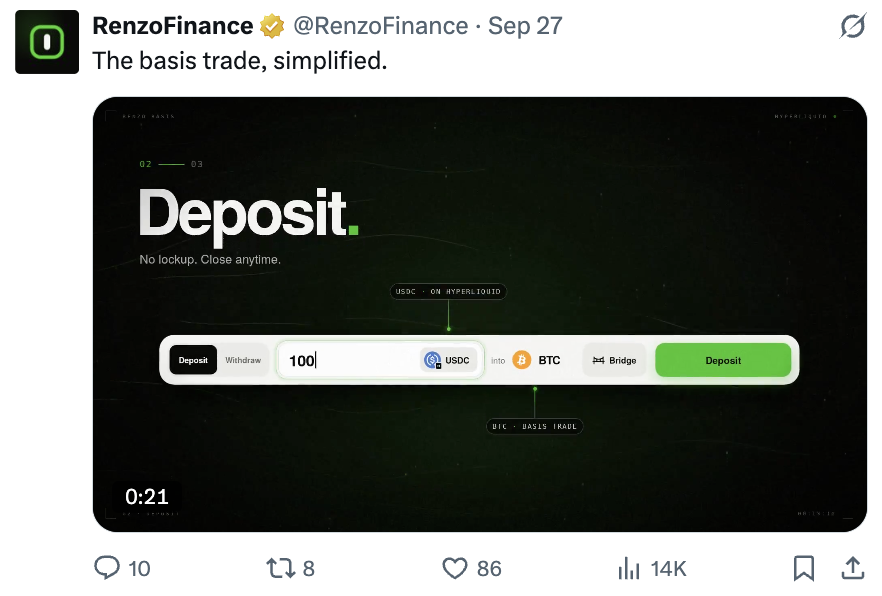
Renzo Protocol is now rebranded as Renzo Finance, repositioning itself as a fund manager that "packages trading strategies into vaults and charges management and performance fees."
On the same day of the rebranding, they launched Renzo Basis—a delta-neutral basis yield vault on Hyperliquid. They are also seeking partnerships with other exchanges and decentralized exchanges to build their vault product portfolio.
Kelp
After the hacking incident, Kelp had to undergo significant introspection.
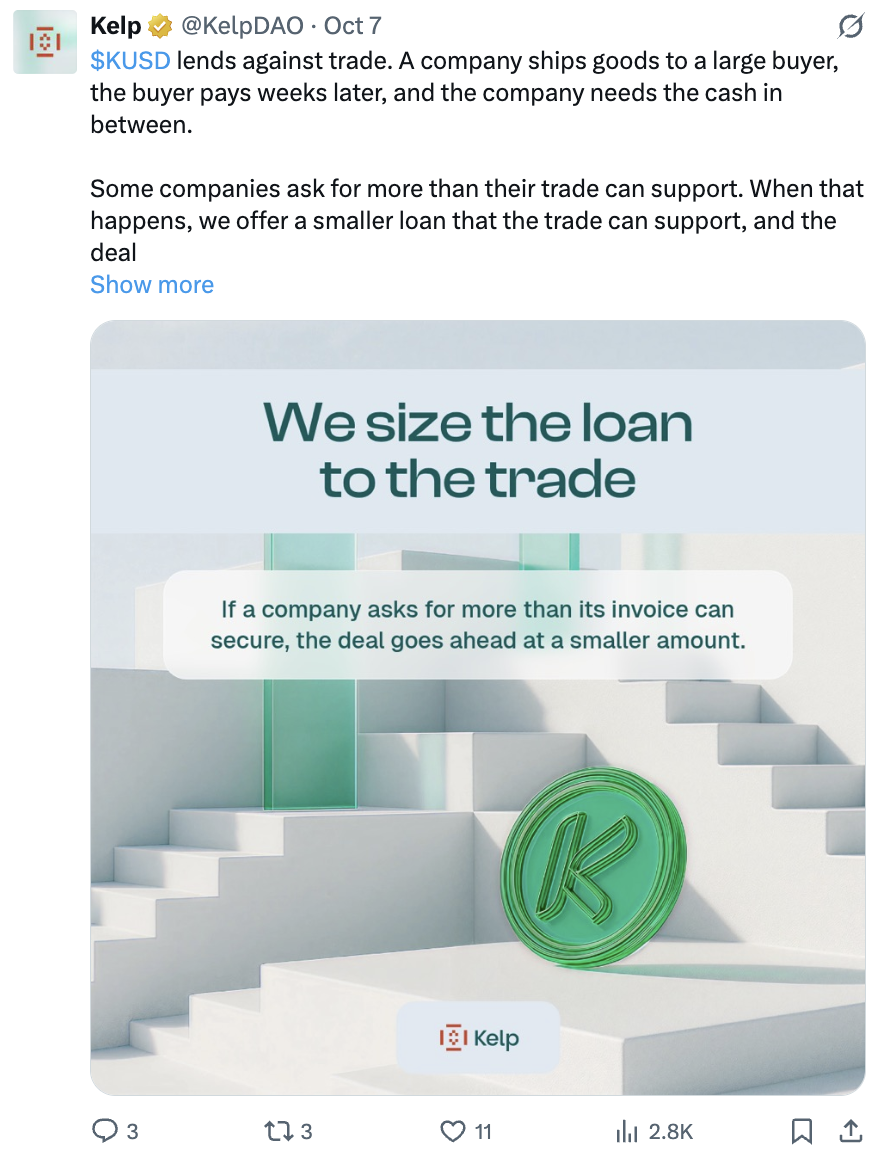
They may have gone to the same yoga retreat as the Renzo team since they are also focusing on strategy vaults, but their focus is on yield.
In addition, they plan to launch their own stablecoin KUSD, aimed at providing funding for institutional payments and forex settlements.
Bedrock
Unlike other companies, Bedrock has shifted its focus from Ethereum to Bitcoin. This makes sense for their business as most of the TVL comes from Bitcoin.
Similarly, they are focusing on yield vaults, allocating Bitcoin to DeFi, institutional products, and delta-neutral trading, among other directions.
Puffer
The Puffer team sticks to its infrastructure-led tradition, focusing on pre-confirmation and Based Rollup solutions.

Their idea is that since transaction confirmation can be done in 50 milliseconds while still staying on Ethereum, they can become the settlement layer for AI agents.
Swell
Swell may be the LRT project best at adjusting direction; as early as April, Swell announced it would shut down SwellChain and shift its focus to Faro.
Faro is a non-custodial AI trading application built on Hyperliquid.

Abstract
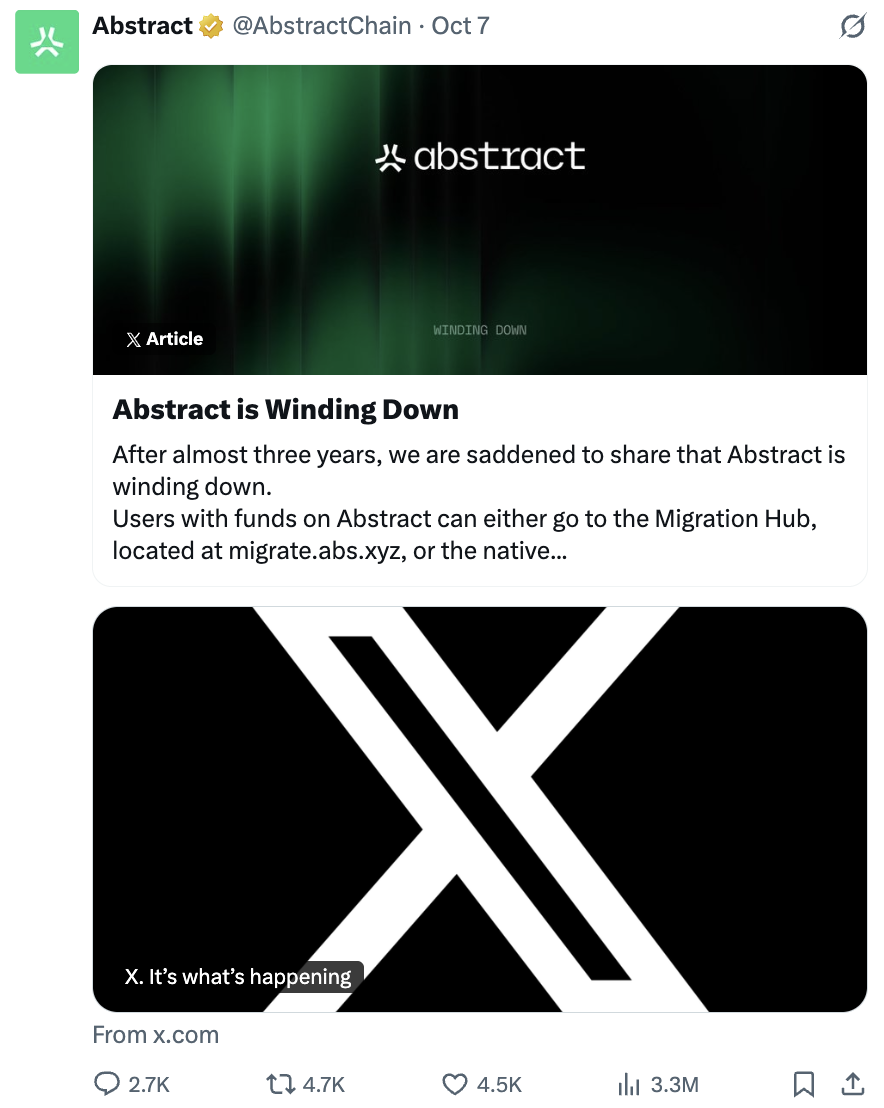
Abstract, I would call it a "withdrawal" rather than a pivot. Abstract and Igloo, the parent company of Pudgy Penguins, decided to shut down the Abstract chain and focus on the IP, NFTs, and PENGU token of Pudgy Penguins.
It must be acknowledged that the team repeatedly rejected calls to issue the ABSTRACT token, and indeed brought in brands like Disney and Red Bull, but ultimately failed to establish a foothold for this "consumer chain."
Nillion
Nillion originally aimed to create a "blind computer" for privacy-preserving computations on encrypted data, but now the team is shrinking from general infrastructure to a single primitive: hiding intent.
They call it "Covenants," and details can be found in our previous report.
Through these examples, you will find that the trend of "building infrastructure" to "building products" is accelerating.
Moonbeam
Moonbeam was once the flagship EVM parachain on the Polkadot chain. Moonbeam announced in July that it would migrate operations (and the GLMR token) to Base.
The new direction is packaged as a network where "agents can find each other, negotiate terms, and settle on-chain," with each task being placed under custody and scored based on proof.

Harmony
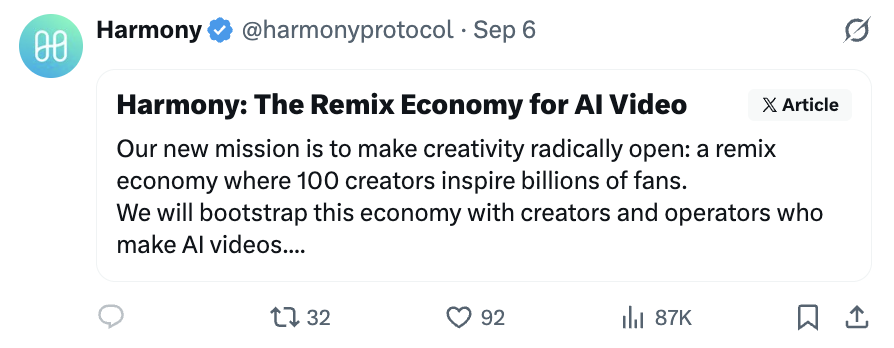
Harmony was the darling of the sharding technology world in 2019; after being hacked in August, it is becoming an AI video company.
The attack forged about 30 trillion ONE and forced Ethereum to do a chaotic rollback, sparking discussions of "either shutting down or reissuing ONE on Ethereum." Ultimately, the latter was adopted.
In their new economic model, users can make prompts and remixes for video stories, while the protocol emits tokens to subsidize GPU expenses.
Golem
Yes, it's the Golem from the ICO era in 2016. They are still around and still hold hundreds of millions in the treasury.
Their latest project is less about a "pivot" and more about an extension of their business.
The project is named Arkiv, aiming to be a queryable and tamper-proof Web3 database. The project will use GLM to pay gas, announced earlier this month at the Devcon conference.
Immutable
The "king of crypto games" is now selling marketing software to mainstream game studios, which is quite disheartening!
Immutable cut almost its entire in-house game team in June, shifting focus to Audience, an AI platform for game publishers
In the meantime, its IMX token has dropped 99% from its peak.
In August, it opened Audience to a batch of Steam studios in their pre-launch phase, but this platform has no blockchain components. Is blockchain gaming dead? Or was betting on these AAA studios a mistake?
The Future Direction of Our Industry
At some point, we must face reality. In those naïve early days of cryptocurrency, many ideas that raised millions of dollars were at best fanciful.
Does this mean founding teams should bury their heads in the sand, completely ignoring the market's ultimate feedback on their ideas?
In my view, we should welcome these directional changes. These teams are among the first to realize they have not achieved PMF.
We should flip the standard: those to be blamed should be the teams that raised absurd amounts and continue to pound the market with products that are already clearly said to be unworkable.
These teams harbor incredible talents, and it is a great pity to waste their potential and investors' money on a doomed idea.
What can we learn from these pivots? I am excited to see these strong teams and real funds being invested in products instead of infrastructures that no one will ultimately use.
The "winners" of this cycle—stablecoins, perpetual contracts, tokenized stocks—share a commonality: they are products that people genuinely want to use and are willing to endure the clumsy apps to do so.
The victory of crypto comes from delivering these products into the hands of more people. For this reason, I am pleased to see more companies focusing their energy on products and glad that the dream of achieving PMF might be just one pivot away.
免责声明:本文章仅代表作者个人观点,不代表本平台的立场和观点。本文章仅供信息分享,不构成对任何人的任何投资建议。用户与作者之间的任何争议,与本平台无关。如网页中刊载的文章或图片涉及侵权,请提供相关的权利证明和身份证明发送邮件到[email protected],本平台相关工作人员将会进行核查。