Author: AiPlot Research Institute
Focus: RWA / Digital Assets / In-depth Analysis of Financial Infrastructure
Website: https://aiplot.com/?utm_source=aicoin
1. In the same market, two seemingly opposite things are happening
Recently, two pieces of news provided two very valuable perspectives.
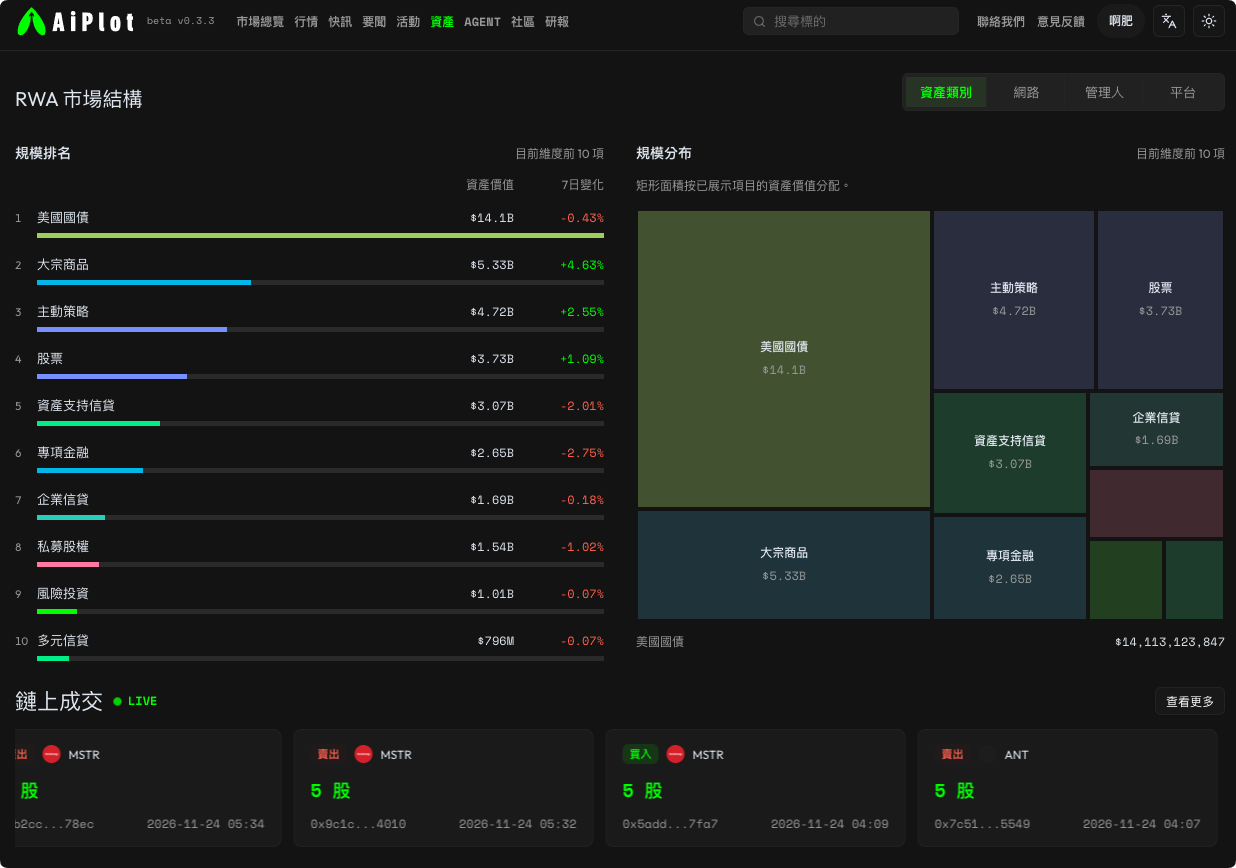
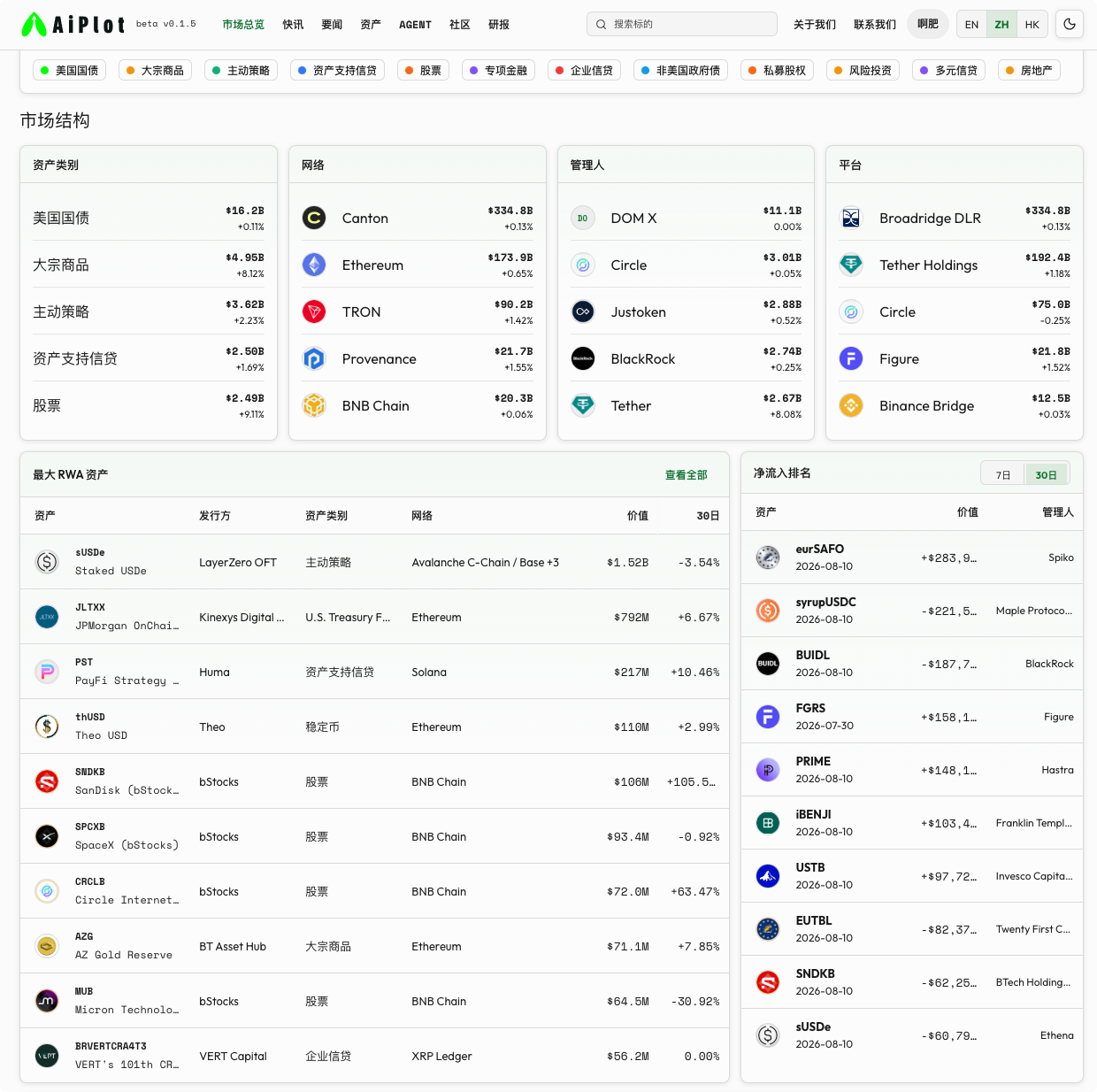
Firstly, the net scale of a certain RWA tracking list has decreased from $23.19 billion at the end of October to $20.53 billion, a surface reduction of about $2.67 billion. However, around $1.66 billion of this was due to changes in statistical coverage, not true funds exiting; for products continuously tracked throughout the month, the actual scale decreased by about $794 million. Meanwhile, Franklin OnChain U.S. Government Money Fund increased by about $552 million while BlackRock BUIDL decreased by about $471 million.
The second focuses on a different change: LlamaRisk proposed to Aave to add six tokenized stocks issued by Coinbase to the Aave V4 Base Equities Hub for use as collateral. The proposal includes NFLXc, ORCLc, PLTRc, AMDc, NOWc, and MSTRc, with different collateral rates and limit thresholds set; as of the announcement, this is still a governance proposal, not an entirely finalized configuration.
Putting these two things together reflects the current true state of the RWA market:
Asset scale may decrease due to statistical definitions, product migration, and fund rotation, but the financial uses of assets may continue to increase.
Therefore, RWA research cannot just look at whether the total scale is increasing; it must also examine where the funds are going and whether tokenized assets are starting to be used for financial functions beyond trading.
2. The decrease of $2.67 billion cannot be directly equated with a fund withdrawal
Any RWA scale data contains at least three layers of information: whether the assets are counted, how the NAV or market prices of the assets themselves changed, and whether real subscriptions or redemptions occurred from investors.
The market methodology distinguishes between market cap and total asset value. The former equals the token supply multiplied by the secondary market price, applicable to assets with publicly traded prices; the latter equals the token supply multiplied by the NAV reported by the issuer, applicable to many funds and private credit products without active secondary markets.
This means the scale change of a list may come from four different reasons:
- Products being included or excluded from the statistical scope;
- Assets migrating from one product or network to another;
- Changes in the underlying asset prices or NAVs;
- Real subscriptions or redemptions by investors.
From the perspective of asset rotation, Franklin OnChain's fund increased by about $552 million while BUIDL decreased by about $471 million, resembling more a product migration or preference shift within the same broad category of assets rather than funds completely exiting tokenized government bonds and money market funds.
BENJI's Total Asset Value is approximately $1.39 billion, growing about 103.45% over 30 days; BUIDL's Total Asset Value is approximately $1.55 billion, declining about 28.98%. The timing of these two pages does not completely align with the tracking window in the announcement, so they should not simply be stitched together as the same statistical set. However, they support a directional judgement: There is a clear scale differentiation emerging between tokenized money market funds.
3. Franklin's growth and BUIDL's decline: Product differences are more important than brand competition
Franklin Templeton's official information shows that BENJI represents a fund share of the Franklin OnChain U.S. Government Money Fund, with transfer agents recording share ownership through blockchain integration systems. BENJI supports multi-chain transfers on the whitelist and reflects fund returns through daily token issuance.
The underlying asset class of BENJI is U.S. Treasury bonds, with an NAV of $1, supporting daily subscriptions and redemptions. The number of holders is 1,142, covering networks such as Stellar, Base, Arbitrum, Ethereum, Aptos, Avalanche, Solana, and Polygon.
BUIDL, on the other hand, is an institutional product for U.S. accredited purchasers. Its minimum subscription amount is $5 million, requiring KYC and whitelist processes, and supports daily subscriptions and redemptions; its current Total Asset Value is about $1.55 billion, with 100 holders.
The changes in the scale of these two products cannot be simply explained as "Franklin won, BlackRock lost." It is more worthwhile to analyze their product distribution structure:
- BENJI has a lower minimum investment threshold, with the page showing a minimum investment amount of $20, but investor eligibility is still subject to product rules and KYC restrictions;
- BUIDL primarily serves institutional accredited purchasers, with a significantly higher minimum subscription amount;
- BENJI has broader multi-chain distribution and more holders;
- BUIDL's positioning is more towards institutional cash management, on-chain collateralization, and professional financial applications.
Therefore, scale growth may reflect different sources of funds rather than just a simple evaluation of product superiority. One product may have more holders, while another may have a higher institutional transfer volume and stronger collateral use cases.
AiPlot can clearly present these differences in content operation: the same type of U.S. Treasury RWA should not only compare asset values but also compare the number of holders, minimum subscription thresholds, redemption frequencies, number of networks, transfer volumes, and funds flow. This is how we can explain "why scale has grown" rather than just reporting "who is ranked first."
4. A new phase for tokenized stocks: From all-weather trading to on-chain collateralized lending
The initial selling point of tokenized stocks was mainly trading time and asset accessibility. Investors could gain on-chain price exposure during traditional stock market off-hours, and the assets could be recognized by wallets, trading protocols, and other on-chain applications.
Aave has further advanced this use case. Aave's official announcement states that seven Coinbase tokenized U.S. tech stocks—AAPLc, AMZNc, GOOGLc, METAc, MSFTc, NVDAc, and TSLAc—are now available on Aave V4 on Base as collateral to borrow USDC.
The structure of this market is important. Users can combine different stock tokens as collateral, but the stock tokens themselves can only be used as collateral in the initial stage and cannot be directly used as lending assets, nor can stock-to-stock borrowing occur. Each asset has an independent collateral rate, and USDC is the asset that can be borrowed.
This means tokenized stocks have transitioned from being "tradable assets" to being "financing assets." Their value chain has thus changed:
- Users hold exposure to stock prices and total returns;
- Deposit tokenized stocks into Aave;
- Borrow USDC using stocks as collateral;
- USDC is used for trading, liquidity management, or other on-chain applications;
- Assets release liquidity without being sold.
This is where RWA truly begins to combine with DeFi. The value of tokenization is no longer just transferring traditional assets onto the chain; it is enabling assets to enter the on-chain credit system.
5. The proposal to add six new stocks truly reflects the logic of risk management
LlamaRisk's governance proposal intends to add NFLXc, ORCLc, PLTRc, AMDc, NOWc, and MSTRc.
The proposal does not set the same collateral rate for all stocks but establishes different parameters based on volatility, market liquidity, and liquidation risk: the suggested collateral rate for NFLXc is 65%, for ORCLc and PLTRc it is 58%, for AMDc it is 49%, for NOWc it is 50%, and for MSTRc it is 47%. Each asset has a new limit cap of $5 million, with a total limit cap of $30 million, and the USDC borrowing limit remains at $21 million.
This design indicates that once tokenized stocks enter lending protocols, the research focus has shifted from "can it be traded" to "is the collateral sufficiently safe."
Special attention should be given to MSTRc. Proposal materials show that MSTR's volatility is higher than that of other newly added stocks, and its common stock capital structure has higher priority financing tools such as convertible bonds and preferred stock ahead of it. Therefore, MSTRc, despite having higher market attention, should not receive the same collateral parameters as low-volatility stocks based solely on market capitalization or trading enthusiasm.
Aave also clarified that the prices of tokenized stocks are provided by Chainlink's tokenized stock data source, which pauses updating outside of U.S. stock trading hours and maintains the last price. During weekends or U.S. market holidays, collateral prices will not change with the underlying stocks in real-time; position health is primarily measured by the accrual of interest until the price source resumes and reflects market changes.
This is an important risk reminder:
24/7 on-chain lending does not mean that underlying stock prices are continuously discovered 24/7.
When the underlying market is closed, oracles stop updating, and stock tokens continue trading, there may be a time lag in collateral prices. Protocols must absorb these differences through collateral rates, liquidation incentives, limit caps, and risk reserves.
6. The legal rights of tokenized stocks determine whether they can be used as collateral
Coinbase's official information states that Coinbase Tokenized Stocks are issued by Coinbase, with each token corresponding to real stocks that are regulated and held in bankruptcy-remote custody, issued under the Base B20 token standard, and can be traded, lent, and used within the Base ecosystem.
Aave further explained that these stocks are held by Alpaca Securities LLC, with the underlying stocks kept in a segregated account, and the issuer, acting as a trustee, maintains the relevant rights for holders; token holders obtain economic exposure to the real stocks, not just synthetic certificates that track prices.
However, this does not mean that all tokenized stocks have the same legal rights. Researchers still need to confirm:
- Whether the token represents stock ownership, beneficial rights, or contractual tracking rights;
- Whether dividends are paid directly, reinvested, or retained by the issuer;
- Whether the holders have voting rights;
- Whether the assets are isolated by an independent custodian;
- Whether in the event of issuer bankruptcy, holders can directly claim the underlying stocks;
- Whether Aave accepts the asset itself or a token backed by the issuer's credit support.
For DeFi protocols, whether an asset can be used as collateral depends not only on price and liquidity but also on whether legal rights can be liquidated, transferred, and enforced. The "borrowability" of tokenized stocks is essentially testing whether their asset rights structure is sufficiently clear.
7. What do these two updates imply for the Hong Kong RWA market?
If the Hong Kong RWA market only focuses on the number of products issued, it may overlook more important financial uses.
First, Hong Kong needs to pay attention to the complete chain from the issuance of tokenized funds to secondary trading, and then to collateral financing. A tokenized fund only approaches being an on-chain financial asset when it can be held, transferred, redeemed, and used as collateral.
Second, fund flow tracking must differentiate between fund withdrawals and product rotations. If a certain tokenized fund's scale decreases, researchers should simultaneously check if similar assets are increasing, whether there are changes in holders, whether there is network migration, and whether there are changes in statistical coverage.
Third, the core advantage of institutional participation in Hong Kong may lie in the connectivity of compliant assets with bank settlement. If tokenized funds can access bank tokenized deposits, regulated trading platforms, and institution-level custody, there is an opportunity to upgrade from a single product to cash management and collateral management tools.
Fourth, the Hong Kong market needs to establish risk parameters suitable for institutional assets. Tokenized Treasury bonds, money market funds, gold, and high-volatility stocks cannot use the same set of collateral rates, liquidation discounts, and limit caps. AiPlot can place asset scale, volatility, trading volume, holder distribution, and network activity within the same observation framework to provide a basis for product comparison.
8. Conclusion
The recent decrease in RWA scale cannot be directly explained as a complete withdrawal of funds. The dynamic data has already shown that changes in statistical coverage account for a significant portion of the apparent decrease, while there is a clear product-level fund differentiation between Franklin and BUIDL.
More importantly, tokenized stocks are transitioning from trading products to lending protocols. Aave's Equities Hub indicates that the next step for RWA is not simply to add more assets, but to allow real assets to become usable collateral in the on-chain financial system.
This will redefine the competition criteria for RWA from three aspects:
- Whether assets have clear, enforceable legal rights;
- Whether assets possess sufficient liquidity and verifiable prices;
- Whether assets can enter lending, repurchase, collateral, and cash management processes.
Therefore, the most important question in the future is not "Did RWA scale rise or fall this month?" but rather:
How much of the scale change is due to definitional shifts, and how much is due to fund rotations; and can the assets that remain transform from passive holdings into usable collateral within the on-chain credit system?
For more data and analysis, please follow Aiplot:
https://aiplot.com/?utm_source=aicoin
📖 Community Communication:
Telegram:
https://t.me/+IIYMcJigBAo4Mjg1
The content of this article only represents the author's personal views and does not represent the stance of this platform. The opinions, conclusions, and suggestions in the text are for reference only and do not constitute any investment advice related to this platform. The market is risky; investment requires caution.
免责声明:本文章仅代表作者个人观点,不代表本平台的立场和观点。本文章仅供信息分享,不构成对任何人的任何投资建议。用户与作者之间的任何争议,与本平台无关。如网页中刊载的文章或图片涉及侵权,请提供相关的权利证明和身份证明发送邮件到[email protected],本平台相关工作人员将会进行核查。