Author: Rhythm
Bitcoin mining consumes a large amount of computing power, but these calculations have almost no other use apart from maintaining network security. The rise of AI has prompted a number of crypto projects to try a different model: allowing GPUs to earn block rewards while completing AI computations. (Related reading: Pearl strengthens against the trend, can the FP8 upgrade become a new catalyst for the market?)
But there is a key difference here: proving that a GPU has performed a computation does not equate to proving that there are customers willing to pay for these computations.
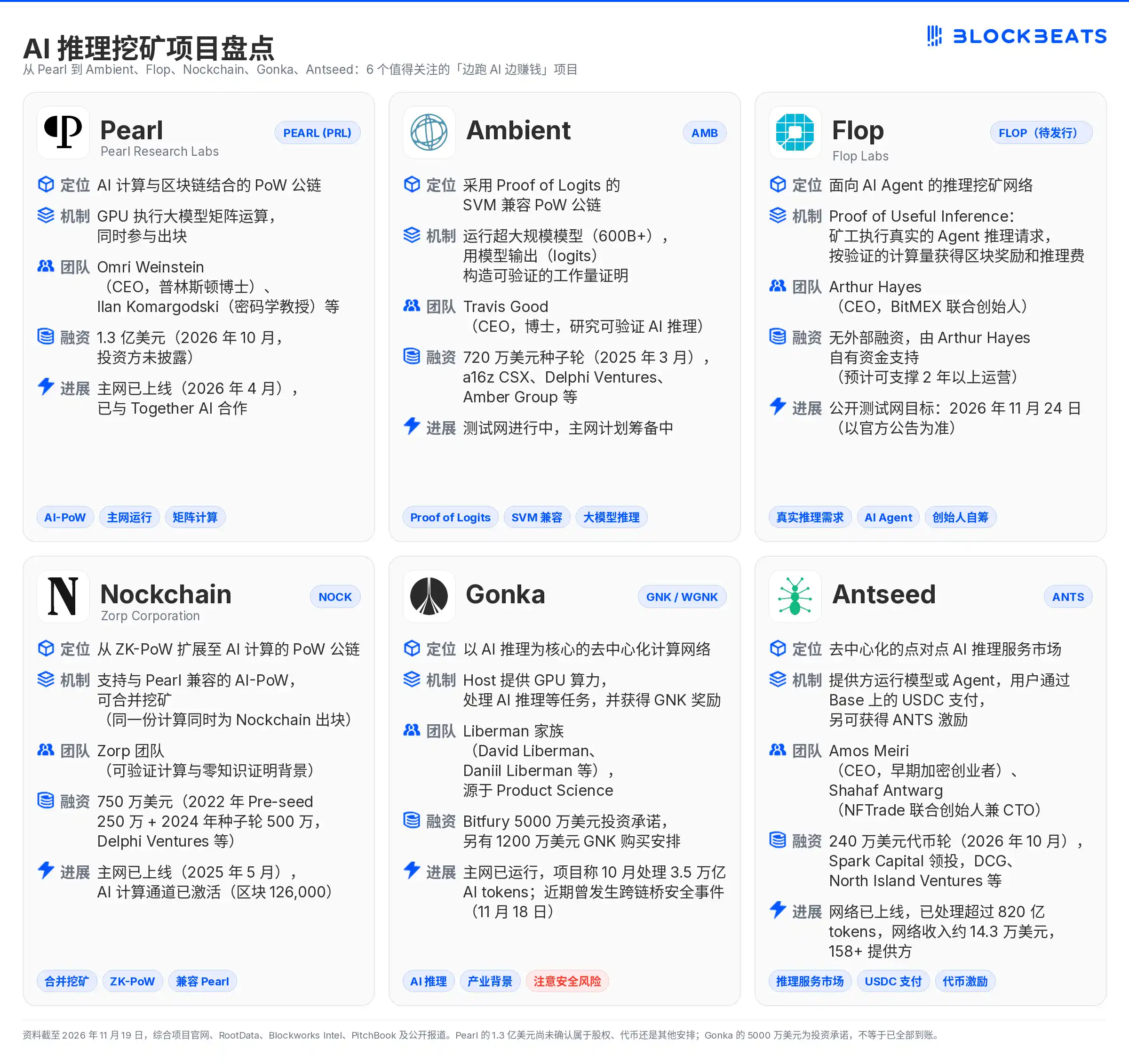
Pearl, Ambient, Flop, Nockchain, Gonka, and Antseed are all attempting to solve this problem. The six projects approach the issue from different angles: Proof of Work, verifiable inference, and computing power trading markets, yet their technical pathways, funding backgrounds, and actual progress vary greatly.
Pearl: Matrix multiplication substitutes hashing, market value nearing $900 million
Pearl adopts a Proof of Work mechanism that replaces hash functions with matrix multiplication. It is based on a fork of btcd, with a total supply of 2.1 billion coins and a target block generation time of 194 seconds. Miners execute chunked matrix multiplication with an integrated random number (NoisyGEMM), and then generate proofs under 65 KB using Plonky2.
In simple terms, while Bitcoin requires miners to constantly calculate hashes, Pearl changes the task to matrix multiplication, which is inherently required for AI, theoretically allowing for simultaneous mining.
However, the protocol only verifies whether the computation has been completed, but does not verify whether there are real customers willing to pay. Thus, miners can also generate random matrices and receive the same rewards.
A sample covering 8,012 mining processes in June 2026 showed that based on computing power, H100 only accounted for 3.1%, while H200 and B200 combined accounted for about 0.5%. The rest mainly came from consumer-grade graphics cards. In terms of paid services, the only visible main offering is the Gemma-4 31B endpoint on Together AI, which is priced about 25% lower than similar services.
Team background: Pearl Research Labs co-founder Omri Weinstein holds a Ph.D. in computer science from Princeton University and has conducted research at NVIDIA and VAST Data; Ilan Komargodski is an associate professor of computer science at the Hebrew University; Idan Sugarman has a background in venture capital and commercialization.
Funding situation: On October 25, 2026, it raised $130 million, although the nature of the transaction has not been confirmed and cannot be directly identified as VC equity financing or token financing.
As of November 19, Pearl's total network computing power is around 106.38 EH/s, with PRL priced at $2.34, and a circulating market value of approximately $897 million.
The team is attempting to lower the mining costs of real inference through the FP8 upgrade (PIP-3), but the proposal is still in draft form. Pearl has already demonstrated that it can convert AI computations into PoW but has yet to prove that most PoW comes from genuine AI demand.
Ambient: Proving the model has not been tampered with, product more mature than chain
Ambient adopts Proof of Logits. Miners hash commit the logits of each generated token, and validators randomly select a token to recompute and verify the results from the previous position. The verification overhead in the project design is less than one-thousandth of the full generation cost.
It aims to prove not "how much GPU has calculated," but "whether this content was generated by the specified model."
Ambient has already provided API services for three models, with the main GLM 5.2 input priced at $0.6 per million tokens, output at $2; for comparison, the corresponding output prices for Claude Opus 4.8 and GPT-5.5 are $25 and $30, respectively. SWE-bench Pro scores 62.1%, which is between Claude's 69.2% and GPT's 58.6% scores.
Team and funding: Founder and CEO Travis Godwin Good primarily researches verifiable AI inference. In March 2025, Ambient completed a seed round of $7.2 million, with investors including a16z CSX, Delphi Ventures, Amber Group, and Big Brain Holdings.
However, the progress on the chain and tokens lags behind that of the product. The official website discloses that it has processed a cumulative total of 134 billion tokens and has 126,000 users, but the data is stagnant since June; the chain is still in the testnet phase, and the token documentation states that it has not yet been published, while the mining page mentions payments made in AMB.
Ambient is more like an AI API company with existing products, but whether a decentralized network can truly handle these businesses remains to be verified.
Flop: Arthur Hayes funds it himself, letting Agent place orders first
Flop adopts an account-based Layer-1 with Proof of Inference. AI Agents submit inference requests containing model hashes, delays, FLOPs, and fees, with miners bidding to execute them, returning the TOPLOC activation commitment and co-signed execution records, after which validators write the hashed proof into the block.
In contrast to Pearl, Flop requires that orders exist before miners begin computation. After the task is completed, verifiable records are retained, which can be sampled within seven days; cheating may result in the forfeiture of the entire deposit.
The hardware threshold is relatively low; GPUs with 16 GB of memory can participate in some tasks.
Team and funding: BitMEX co-founder Arthur Hayes became the CEO of Flop Labs in August 2026. The project explicitly states it will not conduct external equity or token financing, instead, Hayes provides the funds himself, estimating the project can operate for over two years at zero revenue.
The white paper plans that miners, validators, Agents, and stakers receive rewards of 75%, 10%, 10%, and 5%, respectively, but at the current stage, the design still awards 99% to miners and 1% to the auditing pool.
The biggest issue is delivery. Hayes announced on November 13 that the testnet would launch on November 24, but the official website still displays different timelines, and the first two plans did not materialize as expected. The token has not yet been issued.
Flop's logic is the most straightforward: computations are generated only from real orders. But before the network goes live, this remains an unverified business model.
Nockchain: One computation, two chains mining simultaneously
Nockchain originally adopted ZK-PoW, requiring miners to perform fixed Nock computations and generate STARK proofs. The Logos upgrade in August 2026 introduced AI-PoW at block 126,000, allowing miners to perform INT8 chunked matrix multiplication compatible with Pearl and use recursive STARK proofs.
This means that the same computation can participate in mining on both Pearl and Nockchain, akin to one graphics card doing two jobs.
The subsequent Anthropos upgrade adjusts the target block ratio for AI-PoW and ZK-PoW to 70% and 30%, respectively.
Team and funding: Nockchain was initially developed by the American company Zorp Corporation. Zorp was founded in 2022, focusing on the Nock programming language and verifiable computations, completing $2.5 million in Pre-seed and $5 million in seed round financing, the latter led by Delphi Ventures. The total $7.5 million belongs to Zorp's company funding, not to be confused with protocol treasury funding.
As of November 19, the AI channel's computing power increased from an initial 71 PetaMAC/s to 16.71 ExaMAC/s, growing approximately 230 times, theoretically equivalent to about 8,400 H100 GPUs. Recently, the proportion of AI blocks was 68.75%, with NOCK priced at about $0.018, and a circulating market value of approximately $43 million.
However, the top five entities control about 79% of the block share, and the AI channel is still executing matrix multiplication, not actual user conversation reasoning.
Nockchain has proven the feasibility of cross-chain computation reuse, but it has not yet proven that these computations have independent commercial demand.
Gonka: Largest scale of real model computation but facing cross-chain crisis
Gonka adopts multi-model Proof of Compute. Governance-approved models form computing groups, with the Host running both Network Node and vLLM-based ML Node simultaneously, earning rewards based on computing contributions.
Unlike Pearl, Gonka requires miners to run specified real models, with a higher hardware threshold: a minimum configuration requires four A100 GPUs with about 320 GB of memory, while larger models need eight H100 GPUs.
As of November 19, the project dashboard shows around 1,560 graphics cards online, with a daily processing volume of 135.9 billion tokens, about 17.9 times that of Ambient’s corresponding daily volume of 7.6 billion. However, these tokens cannot all be considered as paid reasoning directly.
Team and funding: Gonka was co-founded by David Liberman, Daniil Liberman, and others, with early technical backgrounds coming from a software performance optimization company, Product Science.
Capital support mainly comes from Bitfury, including about $12 million in GNK community pool token purchase arrangements and a $50 million investment commitment announced in December 2025. The latter cannot be directly equated to all funds being received.
On November 18, Gonka's cross-chain bridge experienced a security incident, with around $1.05 million in assets being transferred out and unbacked WGNK emerging. On the same day, the K3 sBOLD treasury also suffered a loss of about $3.43 million, and the two incidents cannot be unverified as the same attack.
After the bridge was suspended, the prices of GNK and WGNK diverged significantly: GNK panel quotes were about $0.22, CoinGecko at about $0.17, CoinMarketCap at about $0.013; the WGNK/USDT pool was only about $0.0123, while another WGNK/ETH pool was about $0.10.
The scale of Gonka's AI computation has already taken shape, but security issues at the asset level have temporarily led to a lack of trustworthy unified pricing for the tokens.
Antseed: No chain creation, directly making an AI inference trading market
Antseed is the only one among the six projects that does not establish an independent consensus layer.
It employs a peer-to-peer AI service protocol, allowing providers to publish services via BitTorrent DHT, and buyers connect with them directly, settling through a cumulative payment channel using USDC on Base, with a protocol fee of 4%.
This can be understood as "AI version of Xianyu": people with idle computing power or model APIs can list them, and buyers pay per use. The project claims that some services are 38% to 69% cheaper than official ones, reducing the risk of model impersonation through signatures, model fingerprints, and a reputation mechanism.
Team and funding: Co-founder and CEO Amos Meiri participated early in exploring technologies related to Colored Coins; co-founder Shahaf Antwarg was a co-founder and CTO of the NFT trading platform NFTrade.
In October 2026, Antseed completed a $2.4 million token round of financing, led by Spark Capital, with participation from DCG, Collider, North Island Ventures, and others.
According to the project's own browser Antscan, as of November 19, it has processed approximately 980 billion tokens in total, of which about 669 billion have been paid; completing 774,800 settlements, with a transaction volume of $405,000, approximately 295 sellers and around 31,700 buyers.
However, the homepage of the official website still shows 82 billion tokens, a $143,000 transaction volume, and 162 providers, which differs significantly from Antscan.
The tokens have not yet officially circulated. The official website states that the ANTS supply hard cap is 1.04 billion coins, with a circulating amount of zero, while Antscan shows that approximately 145 million coins have been minted, and the related status needs further clarification.
Antseed has already conducted real transactions, but the scale remains small. Even estimating based on the cumulative transaction volume of $405,000 and the 4% rate, the corresponding protocol fee is only about $16,200, which does not equate to confirmed actual revenue.
免责声明:本文章仅代表作者个人观点,不代表本平台的立场和观点。本文章仅供信息分享,不构成对任何人的任何投资建议。用户与作者之间的任何争议,与本平台无关。如网页中刊载的文章或图片涉及侵权,请提供相关的权利证明和身份证明发送邮件到[email protected],本平台相关工作人员将会进行核查。