
Author: Heretic Research · HR004
From the income differentiation of 108 front ends, re-evaluate cross-market accounts, professional execution, and clearing infrastructure
TL;DR
- There is still trading demand in the stagnant market, with growth driven by retail deposits attracting new users and the redistribution of existing orders. Fomo reported that over 68,000 users completed their first purchase of crypto assets through Apple Pay; during the same period, the overall transaction volume of the underlying market of Hyperliquid slightly decreased by 3.17%, but the transaction volume contributed by third-party access rose against the trend by 18.51%. We focus on trading service providers that can significantly lower the deposit threshold or intercept paid orders based on execution advantages.
- While third-party fronts capture more transaction share, the industry's fee bonuses are heavily concentrated among established leaders. Over the observation period, total fees charged by third-party access rose by 7.4% month-on-month, yet 67 out of the 108 named products with initial fee records experienced revenue declines; the fee share of the top ten access addresses locked by front-window charges further increased to 78.51%. Given the significant Matthew effect among the leaders and the fact that users are separating information browsing and order execution into different tools, we downgrade our commercial expectations for homogenized new front-end entries.
- Low-fee professional execution tools have been validated for revenue expansion through volume growth, while registration allocation affects the retention of terminal charges. Hyperdash, amidst a background of an average unit fee decrease of 42.98%, boosted its total fee scale to 2.56 times through volume expansion; conversely, the registration allocation of the original Axiom terminal (excluding standalone Perps) accounted for 53.3% of total fees. When assessing transaction targets, we prioritize professional execution tools with sustained growth in paid transaction volume and adhere to evaluating distribution business fee retention based on registration retention after deducting channel profit-sharing (Revenue).
- The next stage's structural opportunity lies in the expansion of cross-market accounts and external calls on underlying trading capabilities. Leading wallets have expanded from single asset management to perpetual contracts and event prediction markets, while professional trading terminals have begun to open API interfaces to external AI agents. We firmly believe in the unified funding accounts across markets, modular execution services available for third-party calls, and the underlying authorization, routing, and clearing settlement infrastructure derived from the elongation of trading distribution chains.
Paper transaction volume is merely fleeting, while registration retention after allocation and irreplaceable backend components are the real barriers.
Introduction|Searching for endogenous growth amidst the Beta tide: in social front ends, where is the money flowing?
When the market lacks unilateral trends and external financing drives, product designs that integrate social signals, trading experiences, and order execution are becoming the core means for platforms to compete for trading willingness. Even for professional developers who are highly sensitive to trading slippage and execution quality, products like Fomo and Pump, with their low-friction mobile interactions, intuitive profit and loss feedback, and leaderboard mechanisms, still demonstrate strong trade inducement capability.
The commercial essence of Social Trading is compressing users' target discovery, external experience borrowing, and their own cost and benefit calculations into the same product interface—while lowering the user's decision-making threshold for trading, it enhances the platform's efficiency in organizing order matching.
However, the increase in front-end interaction activity does not directly equate to the creation of incremental value in the industry. To evaluate the commercial feasibility of this product route, two fundamental financial essence questions must be answered: first, does Social Trading genuinely create real incremental funds and trading demand, or does it merely trigger a zero-sum migration of existing orders across different front-end channels? Second, amidst the expansion of paper transaction volume, why has the majority of named samples failed to achieve synchronized fee revenue growth?
This report penetrates the surface of front-end interaction, dissecting the profit boundaries of the business model along the chain of "user path choice — order flow direction — fee attribution". In industry evolution and the screening of high-potential targets, we emphasize service providers that master cross-market unified accounts, professional-grade order execution capabilities, and underlying trading authorizations and profit-sharing infrastructure; meanwhile, we cautiously assess pure replicas of market display boards and homogeneous trading interface front-end entries. Retail and professional traders invest real capital; the platform must transform the fleeting engagement enthusiasm elicited by the front end into sustainable execution and clearing services to establish long-term fee rights.
01|Coin price rises 43%, spot trading volume drops 6%: the cold market compels the front end to seek growth from real trading
1.1 Price rebound and divergence in trading volume: VC fundraising contraction forces applications to become self-sufficient
The structural rise in crypto asset prices has not translated into increased trading activity or capital expenditure across the industry. In the third quarter of 2026, despite BTC prices rising 43% month-on-month, the spot trading volume of 12 core exchanges tracked by FalconX shrank by 6%, and the amount of VC investment in crypto, as reported by Galaxy, decreased by 20% to $4.519 billion; at the same time, about 76% of funds in the primary market are defensively clustered around mature projects, with only 3 new crypto funds raising capital during the same period (see Figure 1). In the macro environment where mainstream asset appreciation diverges from operational activity contraction, application-level products can no longer rely on external blood transfusions or market beta for natural growth and must capture real trading demand through specific scenario innovations.
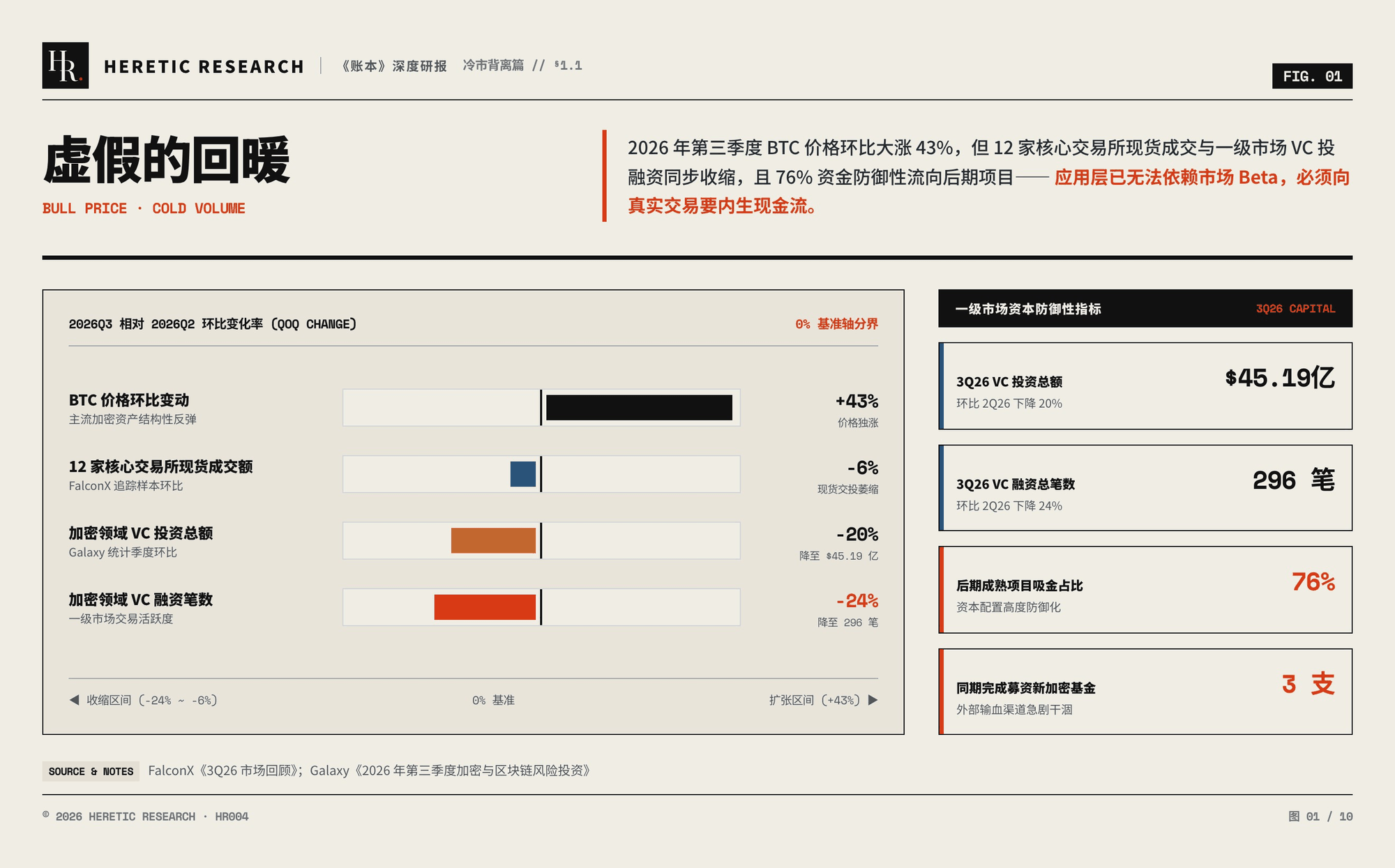
Figure 1|False warming: 2026Q3 coin price rebound and divergence from spot trading volume and VC fundraising contraction
1.2 Squeeze the "discovery—deposit—execution" funnel, turning off-chain attention into on-chain orders
The severe fragmentation of traditional on-chain trading processes has led to significant potential customer loss. Traders typically need to obtain target signals in X or communities, switch to market tools to verify on-chain data, prepare cross-chain funds via wallets, and finally connect to trading terminals to execute orders. The high frequency of switching not only increases operational friction for professional users but also blocks many non-professional observers outside the trading threshold.
Social Trading integrates dispersed pre-decision and post-execution into a single business closed loop through front-end functionality embedding. Users directly enter products from key opinion leader (KOL) positions, community discussions, or trading insights, completing information verification and order submission on the same interface. Whether emphasizing "information discovery, on-chain identity, and trade execution integration" as highlighted by Galaxy or “wallets leveraging closeness to customers and existing funds to extend downstream” proposed by Delphi, the commercial essence remains to bring originally detached trading pre-decision behaviors into the operational radius of the platform. Breaking down "opportunity discovery, fund preparation, and order execution" into a full-chain product architecture not only lowers the front-end customer acquisition conversion costs but also allows the platform to extract multi-dimensional service fees around single-user attention.
02|Copy trading is just the entrance: Slippage, cross-chain friction, and the separation of monitoring and ordering determine order retention
2.1 Mechanical copy trading struggles for retention; research filtering and profit-loss management are the real high-frequency necessities
Pure copy trading stimulus is difficult to maintain long-term retention; users depend more on social products to provide information filtering and trade review functions in actual capital games. From first-hand feedback, whether the trader Logjam uses Fomo as a primary funnel to capture targets and then transitions to X for independent purchasing post due diligence, or the interviewed developer yashhsm, who maintains practical trading stickiness due to intuitive position profit and loss boards and leaderboard feedback despite being aware of mobile slippage issues, both confirm that social functionality plays a dual role in the trading decision chain as "initial filtering of research signals" and "account profit-loss management". Compared to interfaces that solely tempt impulsive ordering, the product's ability to assist users in completing fundamental cross-validation, clearly calculating position profits and losses, and systematically managing trading records is key to building stable user stickiness.
2.2 Unified balances solve initial conversion; slippage, privacy protection, and the separation of monitoring and ordering reshape fee attribution
When users transition from information browsing to real trades, the convenience of underlying account funds, control over trading slippage, and privacy protection capabilities become critical in retaining orders on the platform. Trader LazyCat988 enabled Fomo's unified balance for real transaction conversion due to accelerating multi-chain market rotations and excessive cross-chain allocation friction, but after frequent use was quickly restricted by large slippage and higher-order functionality absence; cryptoklotz mentioned that after purchasing, a bot automatically followed suit within seconds. Another trader, hamouddi, mentioned that after activating privacy mode, they abandoned referral commission income.
Two traders narrated the “separation of monitoring and ordering” path: 0xabooo monitors via GMGN and orders through their trading plugin; molusol uses GMGN and Fomo for data monitoring, then exchanges through Jupiter. Under open underlying liquidity networks like Hyperliquid, external terminals can invoke underlying order books without establishing their own exchanges and can directly split existing commissions through embedded payment parameters (Builder Code) (see Figure 2). These cases illustrate that maintaining user attention may still come at the cost of losing fees: cross-chain fund preparation efficiency, low-slippage execution, and transaction privacy protection determine the real attribution of fees far more than simply expanding social exposure.

Figure 2|Post copy trading retention: Four types of real trader paths and separation mechanism of monitoring and ordering
03|Transaction volume does not equal income: the differentiation of fiat deposit attraction and monetization across existing accounts
The transaction volume growth driven by Social Trading does not equate to the platform's revenue expansion. First purchases of crypto assets by users, cross-category transactions of existing funds, or merely changing order tools can all elevate paper transaction volume, but the corresponding fee mechanisms, customer acquisition costs, and revenue sustainability exhibit fundamental differences. For example, comparing the records of Fomo and leading wallets shows significant financial performance differentiation across different paths of product expansion.
3.1 The reality of Fomo's records: 68,000 new users for first purchases, yet Perps growth is still unable to compensate for the wallet's core decline
Linking social information streams with fiat payment processes can effectively reduce the entry threshold for non-professional investors, but the scale of first purchases does not imply the platform's sustained revenue. Fomo disclosed that as of June 2026, over 68,000 users had completed their first purchase of crypto assets through Apple Pay (accumulating $25 million), confirming the capability of social trading to attract users outside the conventional circle; however, comparing the gross fee records for two successive 28-day windows from September to November, even though its perpetual contract (Perps) business grew by 43.5% month-on-month, it contributed only $452,400 in absolute growth, barely offsetting 2.6% of the core Wallet's periodic shrinkage of $17,239,800 during the same period (see Figure 3). While the new business shows high growth elasticity, its revenue scale is insufficient to counterbalance the contraction of the core business. This establishes the core financial standard for evaluating cross-category expansion: new business must surpass an absolute scale threshold to provide substantial support for overall revenue.
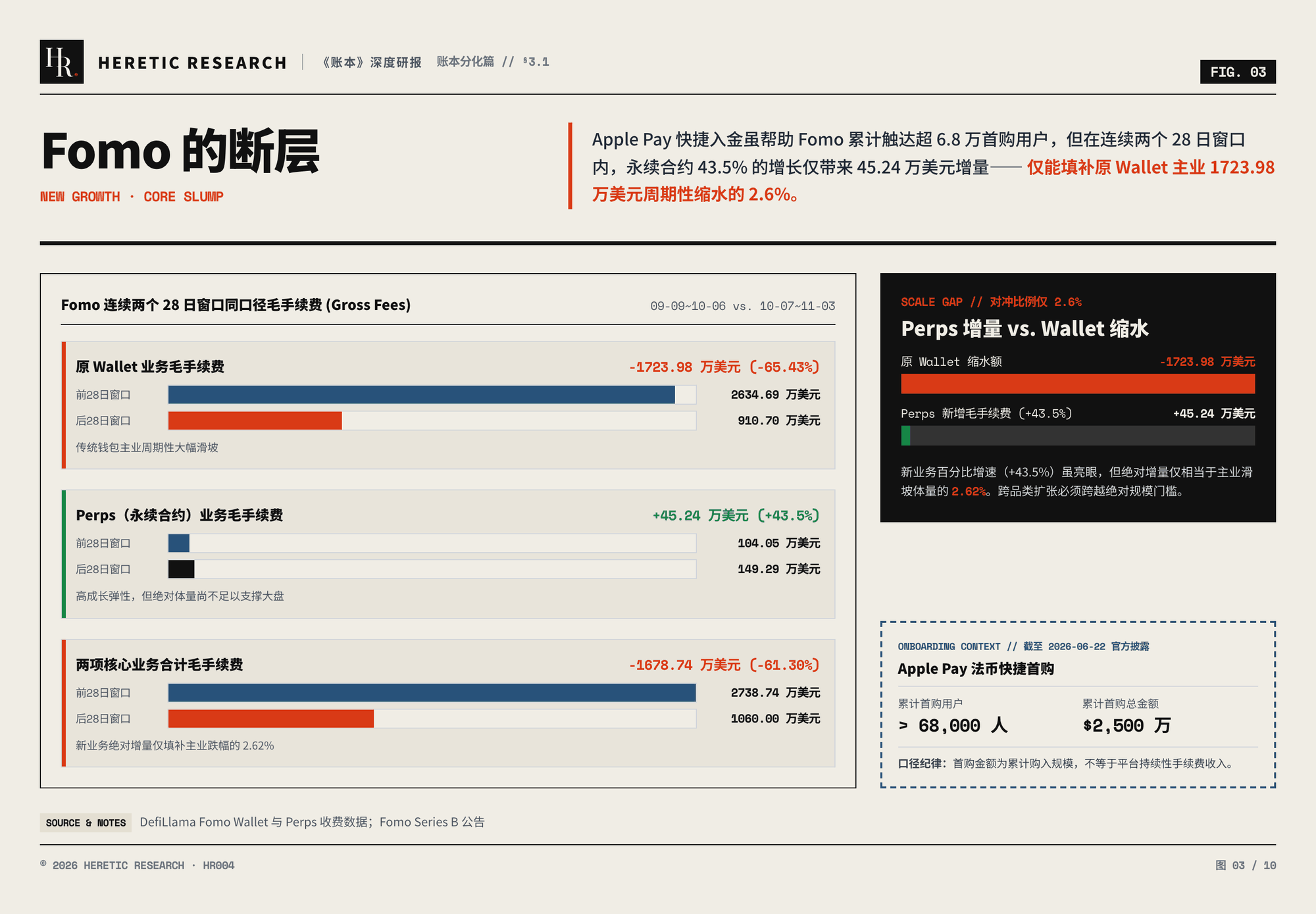
Figure 3|Fomo's gap: Comparison of gross fee offsets and first purchase backgrounds over two consecutive 28-day windows
3.2 Reusing existing accounts: Wallets to enter external venues for derivatives and prediction market businesses
Adding high-stickiness trading categories within existing capital accounts can directly enhance single-customer revenue contributions while avoiding repetitive marketing costs for establishing front-end customer acquisition channels. Top wallets have transformed this cross-selling logic into millions in monthly cash flows through front-end functionality integration: between October 7 and November 3 during a 28-day window, MetaMask and Phantom recorded front-end supplementary fee revenues of $1.8964 million and $1.3732 million USDC, respectively. By extending familiar fund preparation and operational interfaces to derivative markets, traditional wallets have successfully entered into high-frequency trading commission businesses.
Wallets provide front-end entrances, while external venues assume transaction execution. The unverified complete cost of integration has remained unclear. For example, Phantom's integration with the compliant prediction market Kalshi allows users to initiate prediction market trades directly using existing account Cash balances, while customer due diligence, trading accounts, and execution are all managed by Kalshi. This reuse of existing account entrances, engaging external mature trading venues with an already running independent fee model, has been fully validated in top wallets' integration of perpetual contracts.
04|Transaction volume up 18.5%, yet over 60% of named sample products see revenue declines: the truth of fee declines and siphoning among leaders
Social front ends have shortened transaction conversion paths, and the shared liquidity infrastructure has removed the sunk cost of building matching markets, logically leading to an optimistic deduction: as both customer acquisition and business deployment thresholds decrease, a multitude of emerging front ends will widely share the industry growth dividends.
To validate this hypothesis, we extracted on-chain records from all third-party access points (Builders) such as wallets and professional terminals within the Hyperliquid ecosystem, strictly comparing business data across two complete 28-day windows from September 9 to October 6 (front window) and October 7 to November 3 (back window), to penetrate and dissect the sources of transaction growth and their corresponding fee distribution structures.
4.1 Share expansion but average supplementary fee decreases by 9.38%: 18.5% transaction growth yields only 7.4% revenue increment
Against the backdrop of overall market contraction, third-party access points achieved counter-cyclical revenue growth by improving penetration rates. During the observation period, the total transaction volume of Hyperliquid's perpetual contracts slightly declined by 3.17%, but the transaction volume contributed by third-party access points rose against the trend by 18.51%, with their share of total transactions increasing from 5.42% to 6.64%. However, breaking down via the three-factor model of "product fees = market transaction volume × product acceptance ratio × actual average fee rate", the arithmetic revenue increase of $2,134,300 due to share expansion saw an offset of approximately half due to a 9.38% decrease in average supplementary fees, leading to an actual net increase in total fees of only 7.39% from the 18.51% growth in transaction volume (net increase from $7,513,000 to $10,911,700 USDC, see Figure 4). While market share for third-party trading distribution has indeed expanded, the average supplementary fee has declined; therefore, business assessments must penetrate the superficial prosperity of transaction volumes and strictly anchor to the actual fee extraction capabilities of products.
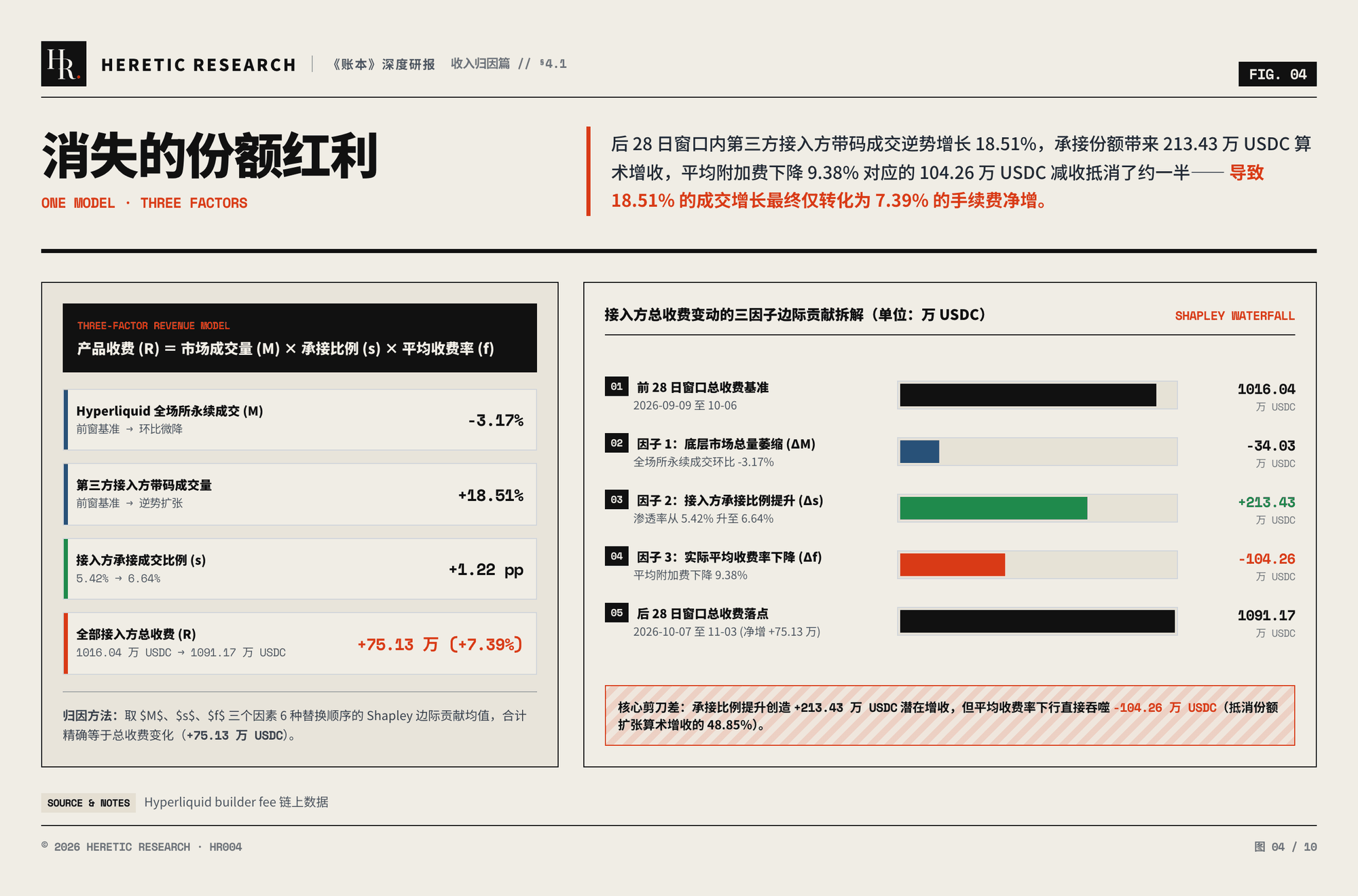
Figure 4|Disappearing share dividends: Hyperliquid access point penetration expansion and three-factor attribution waterfall
4.2 The top ten addresses at the start took 78.5% of supplementary fees; with long tails struggling against fee reduction, 67 out of 108 named products encountered revenue decline
Expansion of distribution channels has not led to inclusive growth; instead, the incremental revenue has accelerated concentration among existing leading platforms. Locking in on the fee sizes from the initial 28-day observation period: the top ten access point addresses at the start remained in the top ten throughout the back window, collectively increasing their fee share to 78.51%, with absolute revenue netting an increase of $1,082,700 USDC—exceeding the total net increase of $751,300 USDC from all access points combined, and this group accounted for 61.87% of the total coded transaction amount in the back window; in contrast, the mid-tier addresses (ranked 11–30) saw substantial declines of $482,900 USDC, leading to a fee share drop of 5.69 percentage points to 12.65%, while the long-tail group ranked 31 and below, despite reducing average fees from $2.11 to $1.61 USDC per $10,000, only accounted for 19.97% of the total coded transaction amount, with a slight fee share increase of 0.43 percentage points to 8.42%, netting a fee increase of $106,900 USDC. The newly emerged group added an additional $44,600 USDC. In the named sample, among the 108 products with initial fee records, as many as 67 (62.04%) experienced revenue declines during the back window, and out of 36 products charged at least $10,000 USDC during the front window, 22 also saw reduced income (see Figure 5). In the absence of sufficient scale elasticity, a new front-end entry that merely reorganizes public on-chain information or stacks copy trading buttons or passively engages in fee reduction competition has struggled to establish sustained commercial pricing power.

Figure 5|Excess siphoning among leaders: Differentiation of share among the three tiers locked in from the initial fees and revenue decline distribution among the 108 products
05|Penetrating fee retention: wallets profit premium, terminals compete for volume, Axiom original terminal's back-window registration allocation accounts for over half of fees
Since over 60% of products in the named sample have fallen into reduced income and the long tail's mere fee reductions also cannot break the deadlock, then on the same underlying liquidity network, who is truly generating incremental revenue? The on-chain ledger shows that front-end distribution has completely differentiated into two clearly different breakout routes: leading wallets are maintaining high unit rates through existing capital account control, while professional trading terminals are pursuing larger transaction scales with lower fees. Simultaneously, total front-end fees (Fees), registration allocation (Supply-side), and registration retention (Revenue) reflect the distribution of fees between channels and platforms, while technical delivery involves choices between in-house building and outsourcing.
5.1 Wallets enjoying high fee premiums through product diversification, yet significant order differentiation has emerged between existing entrances
Leading wallets have exhibited strong pricing power and scale advantages in the expansion of derivatives through their control over users' underlying assets and deposit channels. Over two consecutive 28-day windows, the accumulated supplementary fees of perpetual contracts for MetaMask and Phantom rose to $3.2696 million USDC, accounting for 29.96% of the total fees of all third-party access points, maintaining high unit rate premiums of $5.44–10.00 USDC per $10,000. Phantom allows users to open positions using Cash, CASH, SOL, or USDC within the app, thus eliminating explicit pre-recharge. Funds will still convert to USDC and bridge to Hyperliquid, with perpetual balances managed separately.
However, having an existing wallet entrance does not guarantee growth in performance. While another leading wallet, Trust Wallet, maintained a high fee rate of $9.97 USDC per $10,000, its transaction volume contracted by 15.47% during the period, with supplementary fees down about 11.31% to $1.4155 million USDC (see Figure 6). This indicates that even within existing account entrances, only the head wallets that have established million-dollar fee scales and maintained positive growth in order volume (like MetaMask and Phantom) can hold on to the share dividends from cross-category expansions.
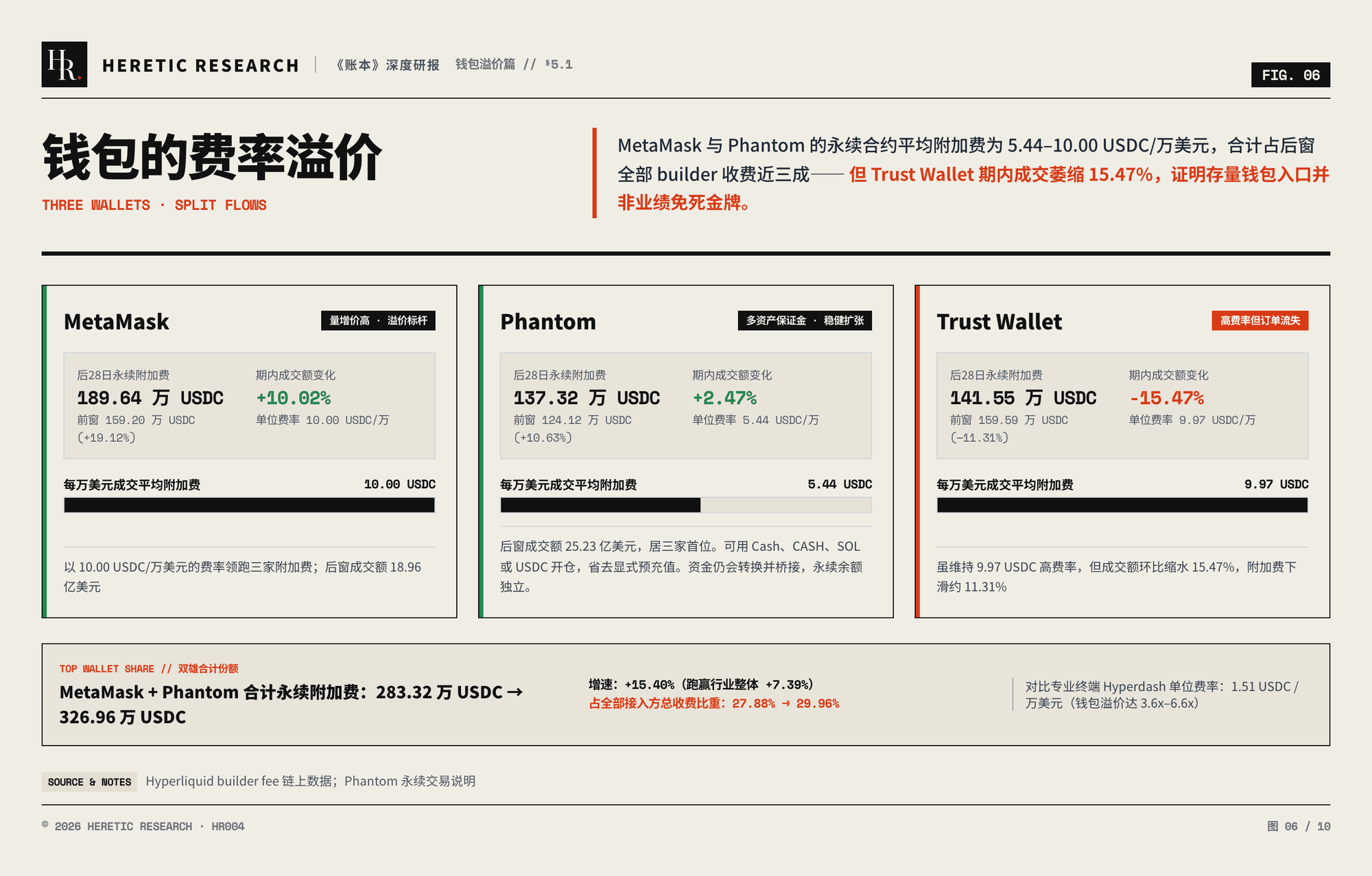
Figure 6|Wallet's fee premium: Differentiation in perpetual contract supplementary fees, unit rates, and order growth among the three leading wallets
5.2 Professional execution tools offset price with volume: average supplementary fees drop 42.98%, transaction volume rises to 4.49 times, weekly fees in the back window increase weekly
In contrast to the high fee cross-selling model of wallets, the low-fee route can only achieve net revenue expansion by fully covering fee discounts through non-linear volume growth, and the professional trading terminal Hyperdash has validated this financial model. During the observation period, Hyperdash managed to expand its transaction scale to 4.49 times (from $1.015 billion to $4.561 billion, capturing an increased share of nominal transaction volume from all builders from 4.21% to 15.98%) while seeing average supplementary fees decrease by 42.98% (from $2.64 to $1.51 USDC per $10,000), pushing total fees to grow 2.56 times compared to the beginning (reaching $687,200 USDC); and this growth was not a result of a one-off spike—the back window saw fees increase weekly, recording $91,500, $173,100, $192,300, and $230,400 USDC respectively, with the last three weeks each exceeding the front window's peak (see Figure 7).
In the back window, Hyperdash accounted for 15.98% of all builders' nominal transaction volume and provided tools aimed at large and high-frequency trading, including time-weighted average price (TWAP) batch execution, iceberg orders, price-following execution, and public position depth analysis. Hyperdash's weekly fees have been increasing, showcasing the capability of the low-fee + professional execution tools route in gaining transactions amidst existing competition.
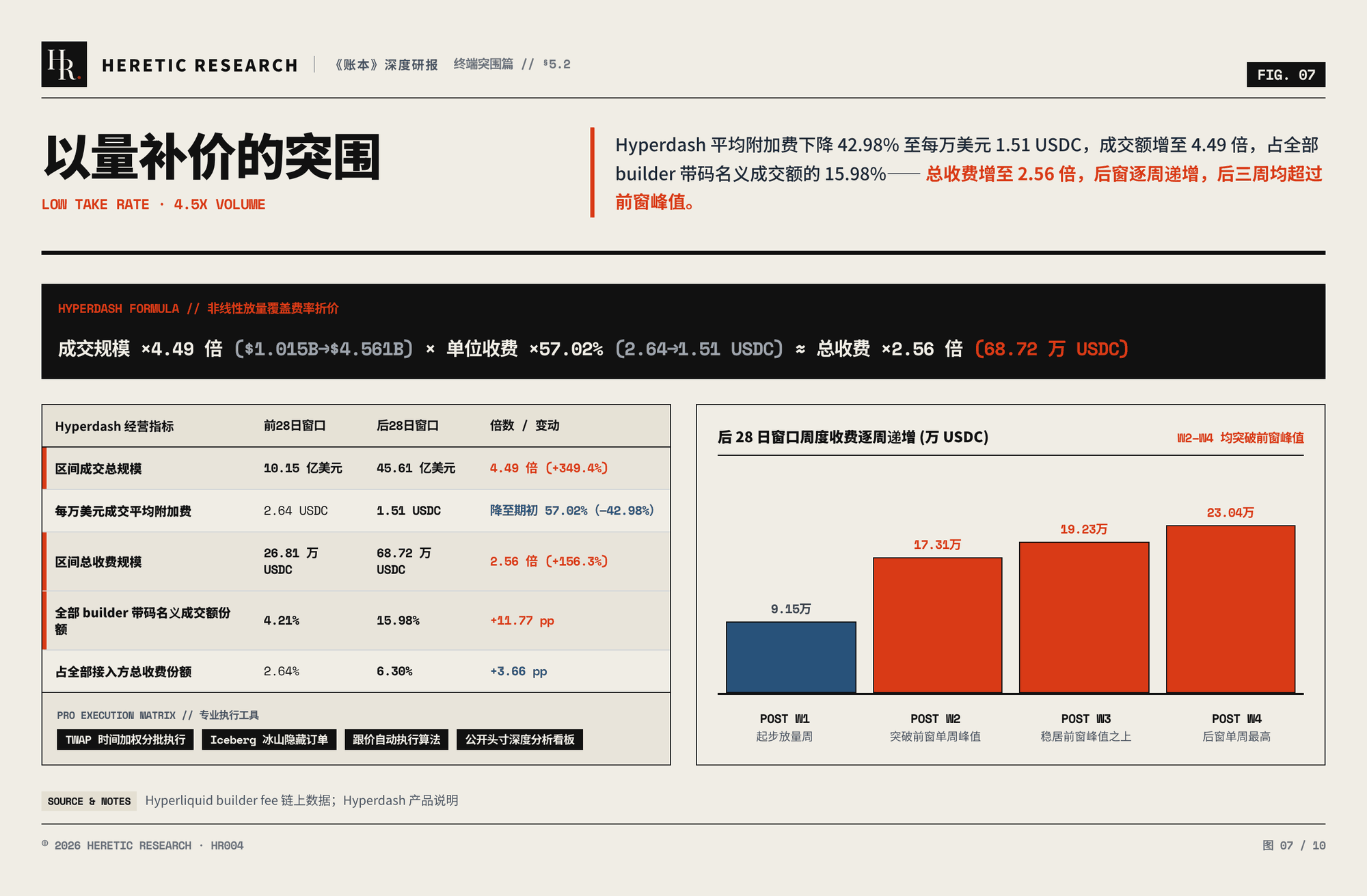
Figure 7|Breakout through volume offsetting price: Hyperdash's volume-price multiplication leap and weekly fee increases over four weeks in the back window
5.3 Axiom original terminal's back-window registration allocation makes up 53.3% of fees, while front-end platforms have existing ToB infrastructure adoption cases
To assess fee retention of trading terminals, it is essential to distinguish between total charges and registration allocation. During the last 28-day window, Axiom's original terminal (full tracking chain, excluding independent Perps) recorded total fees of $21,464,300, with registration allocation at $11,448,100 (53.3%), and registration retention at $10,016,200; during the same period, despite GMGN's total fees on the Solana chain dropping nearly 40% (from $6,589,700 to $3,975,900), its registered supply-side allocation actually increased to $1,462,500 (see Figure 8). Registration retention (Revenue) is the balance of total fees (Fees) after deducting registration allocation but still needs to cover operating costs.
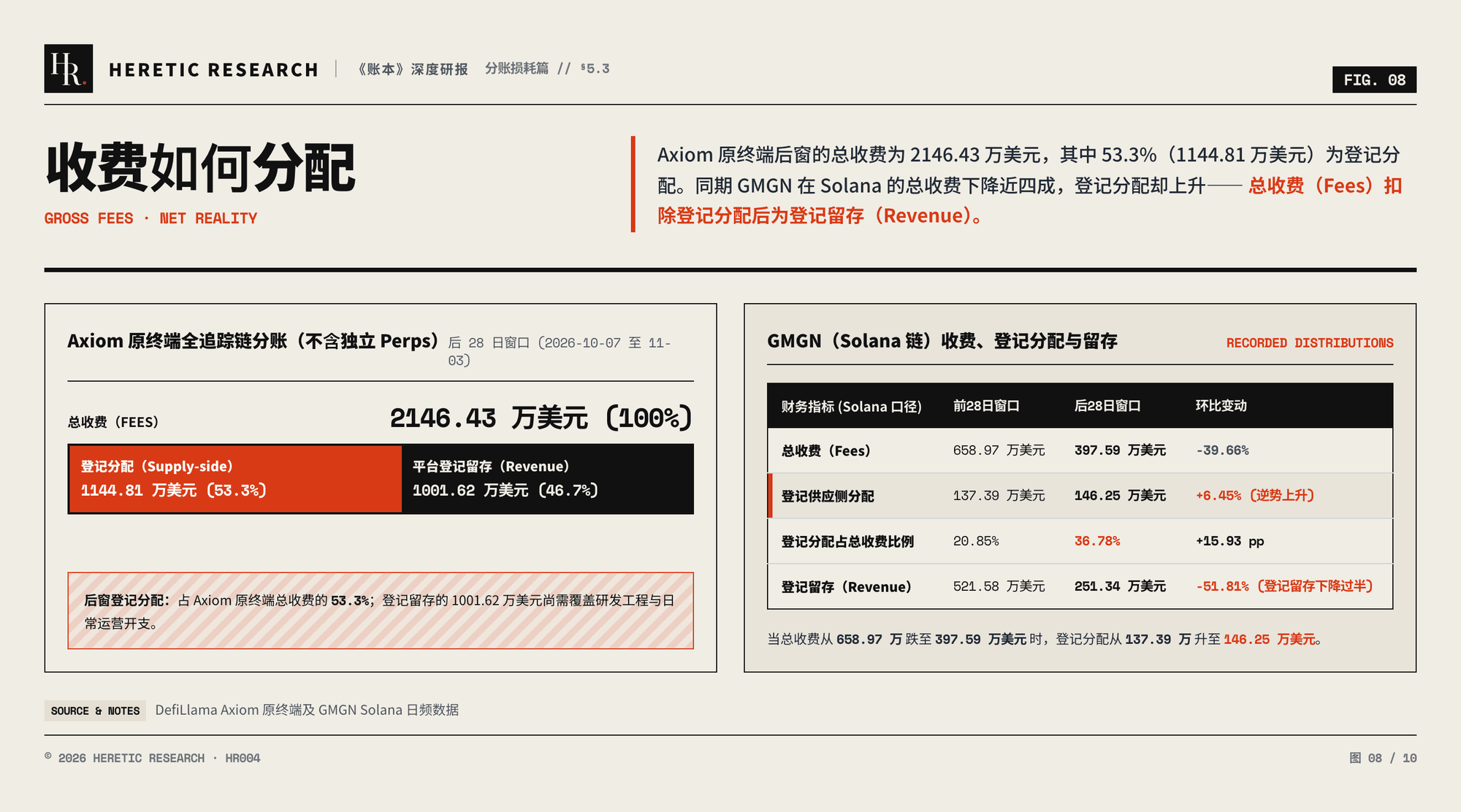
Figure 8|How fees are allocated: Axiom original terminal's registration allocation and retention, as well as GMGN's registration allocation during the fee decline period
Meanwhile, the front-end platforms' decisions on core technical architecture regarding "building vs. buying" have already seen named upstream infrastructure adoption cases. On one hand, Fomo opted to acquire Mobula's software and intellectual property and absorb some team members to enhance internal control over core on-chain data systems; on the other hand, in terms of underlying transaction submission and account security, Fomo employed Pimlico's gas payment and on-chain submission service, while the professional terminal Defined also confirmed the use of Relay's cross-chain routing and Turnkey's key authentication services. These cases reveal adopted relationships and service tasks, with contract amounts and supplier profits remaining unknown. Front-end platforms concentrate R&D resources on interaction and customer acquisition while outsourcing bottom-line funding routing, account authorization, and transaction on-chain submission, forming the core industrial logic in the ToB trading infrastructure sector.
06|Breaking out of homogenized front-end inward competition: cross-market accounts, execution APIs, and backend clearing as incremental opportunities
Moving beyond the current competition over existing fee-sharing, two underlying industrial transformations are opening the next phase of incremental business space: first, the external assets and market categories accessed through existing capital accounts are continuously expanding; second, trading execution capabilities are being uncoupled from a closed single application, opening calls to external products and AI agents through APIs and protocol interfaces.
We expect that within the next 6 to 18 months, the industry competition focus will shift from merely acquiring customers through front-end interfaces to cross-market fund dispatch services and modular execution infrastructure available for multi-channel calls. The breakthrough point for startups will no longer be the repeat construction of another homogenized trading entry but rather the integration into existing traffic entrances' underlying workflows, offering high-conversion-cost professional components.
6.1 Cross-market unified accounts: bridging fragmented sub-accounts to accommodate long tails and prediction markets
The demand conditions within the crypto market are undergoing severe structural differentiation, with product growth highly dependent on the underlying asset categories they cover. In the third quarter of 2026, while spot trading volume on 12 mainstream exchanges fell by 6% month-on-month, the Hyperliquid HIP-3 perpetual contract market supporting permissionless deployment of long-tail and multi-dimensional assets saw its trading volume soar to $261 billion, growing against the trend by 27% (see Figure 9, left).
Leading wallets are transforming single funding accounts into multi-market trading hubs by accessing external professional clearing locations, but this also exposes the structural pain points of fragmented funding in underlying sub-accounts. For example, after Phantom opened the Kalshi prediction market trade to compliant US users on October 28, users initiated trades using their Phantom Cash balances and could directly return to Cash balances after closing; however, the USDC from closing perpetual contracts remains trapped in an independent perpetual contract sub-account, necessitating a manual withdrawal operation (see Figure 9, right). As the number of trading venues accessed by a single front end increases exponentially, technical solutions that can eliminate sub-account fragmentation, provide cross-market unified balance dispatch, margin interoperability, and global position management will possess greater commercial value than merely adding front-end trading buttons.

Figure 9|Fragmented sub-accounts: 2026Q3 long-tail perpetual high prosperity and Phantom's multi-market sub-account funding flow pain points
6.2 Execution as a Service (EaaS): Professional terminals open APIs, becoming the order engines for external applications and agents
Some users have already adopted the "separation of monitoring and ordering," and service providers have begun to decouple trading execution capabilities from their own front-end interfaces, transforming them into ToB/ToAgent infrastructure outputs. Currently, GMGN has officially released API interfaces for external agents, supporting token and position inquiries, swap routing optimization, slippage parameter configuration, and order status tracking; Robinhood has also confirmed in its September announcement that it will allow third-party agents to directly access its trading system through its Trading MCP protocol.
This structural evolution means that core trading execution capabilities are no longer limited to serving end users within their own apps. Trading instructions can entirely stem from community chat windows, third-party wallets, or automated AI agents, delegating the underlying data parsing, permission verification, and low-slippage matching to external professional execution engines. With technical terminals like Hyperdash and Borsa (which provide tiered orders, TWAP, and cloud-hosted execution), if combined with GMGN-style API open paths to create white-label execution services (Execution-as-a-Service), they can transform external traffic entrances into their own order distribution channels, breaking through the ceiling of customer acquisition within their own clients.
6.3 Authorization, routing, and clearing settlement: the backend gold mine most difficult to replace after the distribution chain lengthens
When a single funding account connects to multiple underlying markets, and a single transaction crosses multiple front-end entrances and agent proxies, the engineering and financial complexity of the transaction's middle and backend will rise exponentially. A closed-loop order across channels must sequentially solve four critical issues: cross-chain fund routing (like Relay), external agent fund control (like Turnkey), underlying transaction on-chain submissions (like Pimlico), and precise fee clearing between multiple cooperating parties. The most enduring gold mine is hidden in the financial clearing and data attribution backend after the transaction completion: for instance, Goldsky provides Phantom's enterprise data warehouse with a complete ledger of the minting, transfer, and destruction of the underlying stablecoin CASH to accurately calculate the net balance contributions of each issuing partner and distribute monthly rewards based on that—data services have become deeply embedded in customers' actual financial settlement processes.
Axiom's registration allocation during the last 28-day window amounted to $11,448,100, reflecting the terminal's clearing scale. Phantom supports multi-routing price comparisons while Fomo has enhanced internal data capabilities through its acquisition of Mobula technology. High-potential target screening should primarily focus on suppliers of high-conversion-cost infrastructure binding customer security authorization, underlying on-chain execution, and the financial settlement clearing process (see Figure 10).

Figure 10|Three structural potential industry directions: Core industry track, key verification indicators, and representative high-potential target map
In summary, the three core tracks with the most structural growth potential in this round of Social Trading industrial evolution are: cross-market unified funding accounts (represented by Phantom and MetaMask), externally outputtable modular professional execution engines (represented and observed by GMGN, Hyperdash, Borsa), and deeply embedded authorization, routing, and clearing infrastructure within customer operating settlement processes (represented by Turnkey, Pimlico, Relay, Goldsky). Leading wallets have already recorded derivative supplementary fees, and technology providers also have named adoption cases; the next stage of industrial dividends will continue to concentrate on underlying service providers capable of accommodating multi-market asset expansions, empowering all-channel order distribution, and resolving complex financial clearing pain points.
Conclusion|Navigating through the traffic noise: only platforms that continuously reduce trading friction and execution costs can solidify long-term fee rights
Retail users may complete their first deposits due to social signals and gamified interactions, yet in the ongoing game of real capital, the ultimate determinants for their retention still remain trading fee rates, execution slippage, and the actual account profit and loss. Considering the fee performance of named samples and the aforementioned cases, the harshest reality of Social Trading is: attention can be easily gathered, but the right to charge is extremely difficult to retain cheaply. Some users separate monitoring from ordering, and registration allocation in the back window of Axiom's original terminal also exceeds half of the total fees. In these contexts, merely relying on reorganizing on-chain information flow and stacking copy trading buttons to create "volume prosperity" ultimately serves merely as ephemeral labor for the underlying liquidity networks and referral channels.
From initial deposit to cross-category monetization, from fee inward competition to registration retention, the industry's fee opportunities are shifting from surface interaction interfaces to underlying financial and engineering components. In the next 6 to 18 months, the true winners with long-term pricing power will undoubtedly emerge from those capable of bridging sub-account fragmentation within cross-market unified accounts, opening professional execution engines to all channels and AI agents, and embedding deeply into customer settlement workflows with authorization, routing, and clearing infrastructure.
Narratives always favor the front-end noise, but compound interest is reserved for irreplaceable backend pipelines. Facing the evolution and target differentiation of these three structural industry directions, Heretic Research will continue to delve into on-paper cash flows, using registration retention revenue and real engineering barriers as the sole measure, tracking the commercial realization of the next generation of trading infrastructure. This article is the fourth installment in the HR in-depth research series (HR004), standing firmly on the side of the real ledgers obscured by market sentiment.
免责声明:本文章仅代表作者个人观点,不代表本平台的立场和观点。本文章仅供信息分享,不构成对任何人的任何投资建议。用户与作者之间的任何争议,与本平台无关。如网页中刊载的文章或图片涉及侵权,请提供相关的权利证明和身份证明发送邮件到[email protected],本平台相关工作人员将会进行核查。


