
Every Monday, Wednesday, and Friday, focusing on the cryptocurrency market, Japan, South Korea, A-shares, and Hong Kong stocks, using data to review the market and trends to seize opportunities, produced by PANews.
BTC Hits New Low for July, Market Searches for Bottom Between Panic and Bottom Fishing
Bitcoin is once again being pressed down, during Asian hours on Friday, BTC briefly fell to $61,242, hitting a new low since July, and then barely stabilized around $62,000. From a high of $87,000, it has cumulatively retraced about 30%, with a drop of 28% this quarter.
The main reason is macro headwinds; CoinDesk points out that the U.S. two-year real yield has risen above 2.40%, reaching a new high since 2023, while the real yields for ten-year and thirty-year bonds are at their highest levels in over twenty years. Both Bitcoin and gold do not earn interest, which is a disadvantage in such an environment.
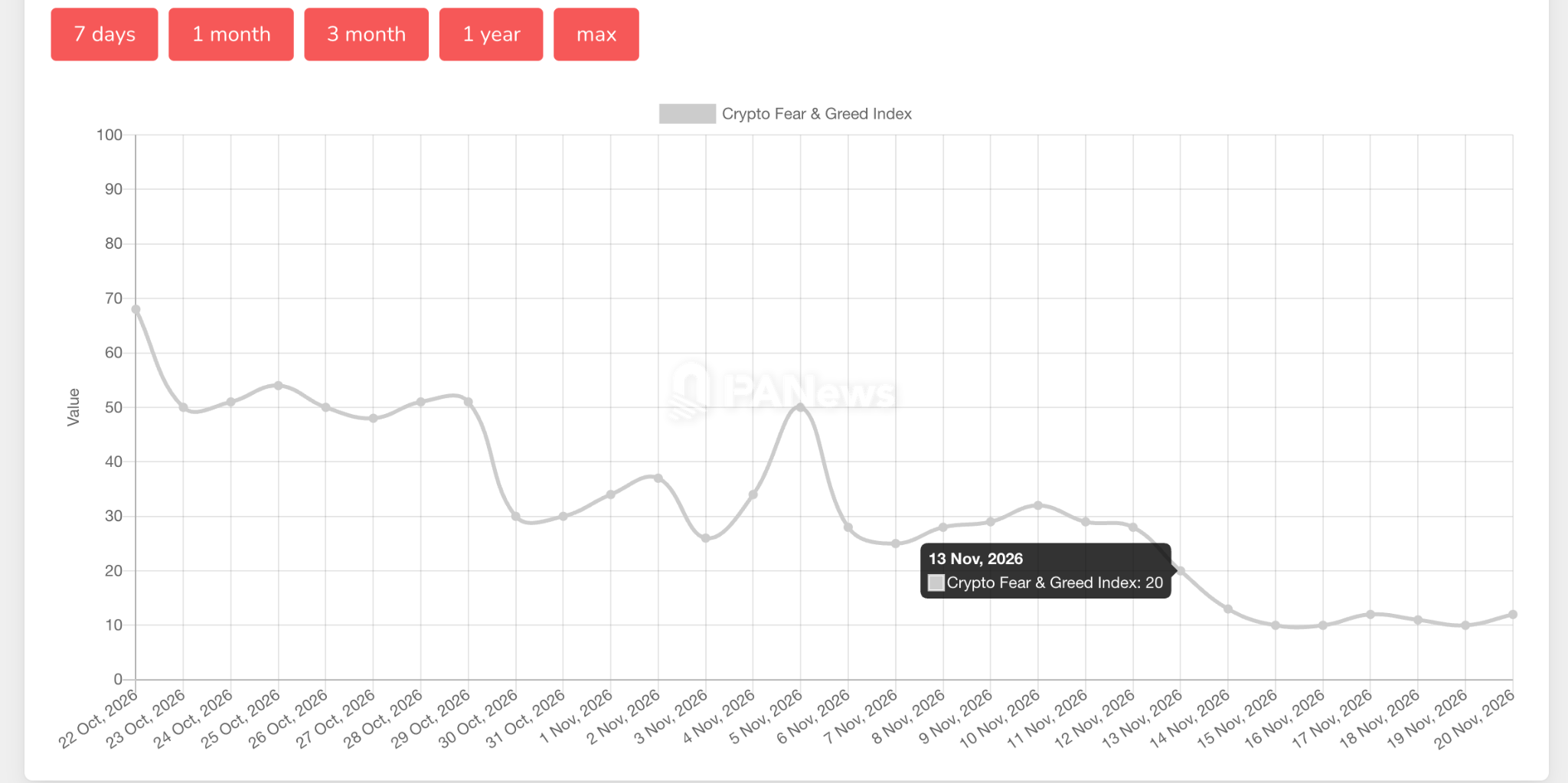
At the same time, the risk-averse sentiment in the derivatives market has reached a cyclical extreme, the proportion of puts traded surged to 70% (Put/Call ratio reached 2.33), the Fear and Greed Index has fallen to the extreme fear zone for seven consecutive days, with the market focusing on purchasing downside protection. A significant liquidation cluster exists near Binance at around $62,030, and liquidity at $61,000 and lower is also attracting traders' attention. Analysis firm Whale Scan states that after Wall Street layered futures, options, ETFs, and other derivative tools, synthetic liquidity dominated price discovery, and the cryptocurrency market has become a "synthetic asset battlefield" based on macro institutions' hedging and liquidity pricing.
In terms of funds, BlackRock's IBIT experienced an outflow of $541 million in a single day on Thursday, marking the largest single-day outflow since its listing in January 2024. The total net outflow for U.S. spot Bitcoin ETFs that day reached $582 million. According to TFTC data, since November, the net outflow has reached $2.9 billion, far exceeding October's $515 million. Moreover, Anthropic's IPO did not help, with the stock priced at $83, opening at $111.50, and closing at $97.17. Nasdaq futures subsequently fell below the 200-day moving average, while BTC showed no response to the rise in tech stocks, instead following the market downward.
The short-term technical structure remains weak; BTC previously lost support at $65,700 and $62,500, constantly forming lower highs and lows during the rebound, with $63,300 now turning from support to resistance. Rekt Capital believes that BTC is entering the range of $59,443—$63,300, and if the daily and weekly charts confirm bearish retests against $63,300, the market may further decline; only a return to $62,500 and a stable close would provide an opportunity to alleviate the current downward pressure.
However, extreme pessimism is giving rise to another trading logic. Some traders have observed bullish RSI divergences on the 4-hour, 6-hour, 8-hour, and 12-hour charts, with volatility also starting to contract, believing that BTC may be brewing a short-term rebound in the $60,000 to $62,000 area, with an initial rebound target pointing to $68,000. But this is more likely to be a correction rather than a trend reversal, with $65,700 and $72,000 remaining key resistance levels that need to be broken through in the upward process.
From a long-term perspective, Ash Crypto believes that according to a four-year cycle, the bear market will end within 30 to 45 days, potentially diving first to $52,000 to $53,000 before reversing. Looking ahead, whether the weekly close on Sunday can hold the $60,000 mark will determine if the market is in a "washout" phase or facing a "capitulation-style sell-off."
ETH Returns to $1,500 to $1,800 Historical Range, Ethereum Upgrade May Be Delayed Until May 2027
Ethereum is following the broader market downward, re-entering the "$1,500 to $1,800" "old floor," which was the starting point for the previous two rebounds. On-chain data shows that short-term holders' average losses have reached 15%, and SOPR has fallen below 0.993, confirming that retail funds are going through a painful capitulation phase.
However, analyst Michaël van de Poppe pointed out an unusual phenomenon: as a high beta asset, ETH's exchange rate against BTC has remained stable over the past 10 days without excessive collapse. He believes that once Bitcoin has bottomed, such assets may witness a strong rebound. Daan Crypto Trades emphasizes that $1,750 is the current key support level; if lost, it will test $1,500 again, while an effective recovery above $1,850 to $1,900 is needed to confirm a reversal. Analyst BLADE reminds that ETH has retracted about 63% from its historical highs, and historically, such a magnitude of retraction is often followed by new highs, making the $1,700 weekly support crucial.
On the fundamental side, the Ethereum ecosystem faces dual challenges. At Thursday's core developer meeting, developers discussed that the "Glamsterdam" upgrade might be delayed until May 2027 due to compatibility concerns between Gas repricing proposals such as EIP-8037/8038 and existing smart contracts. Additionally, the security tool Phylax has raised community concerns about "centralized scrutiny" due to its transaction filtering mechanism, exacerbating the wait-and-see sentiment among funds.
Today's Highlights:
Binance Adjusts the Contract Amount of SNDKUSDT U-based Perpetual Contract
Echo Protocol Withdrawal, Repayment and Unstaking Window Closed
Phala Network's non-upgraded CVM Batch Launches Automatic Upgrade
LayerZero (ZRO) Unlocks 23.29 million Tokens, Worth About $39.12 Million
Kaito (KAITO) Unlocks Approximately 17.6 Million Tokens, Worth About $3 Million
Upbit 24-hour Trading Volume Ranking: BTC, XRP, IRYS, PIEVERSE, MMT
Yesterday's Total Net Outflow for Bitcoin Spot ETF was $582 Million
Yesterday's Total Net Outflow for Ethereum Spot ETF was $131 Million
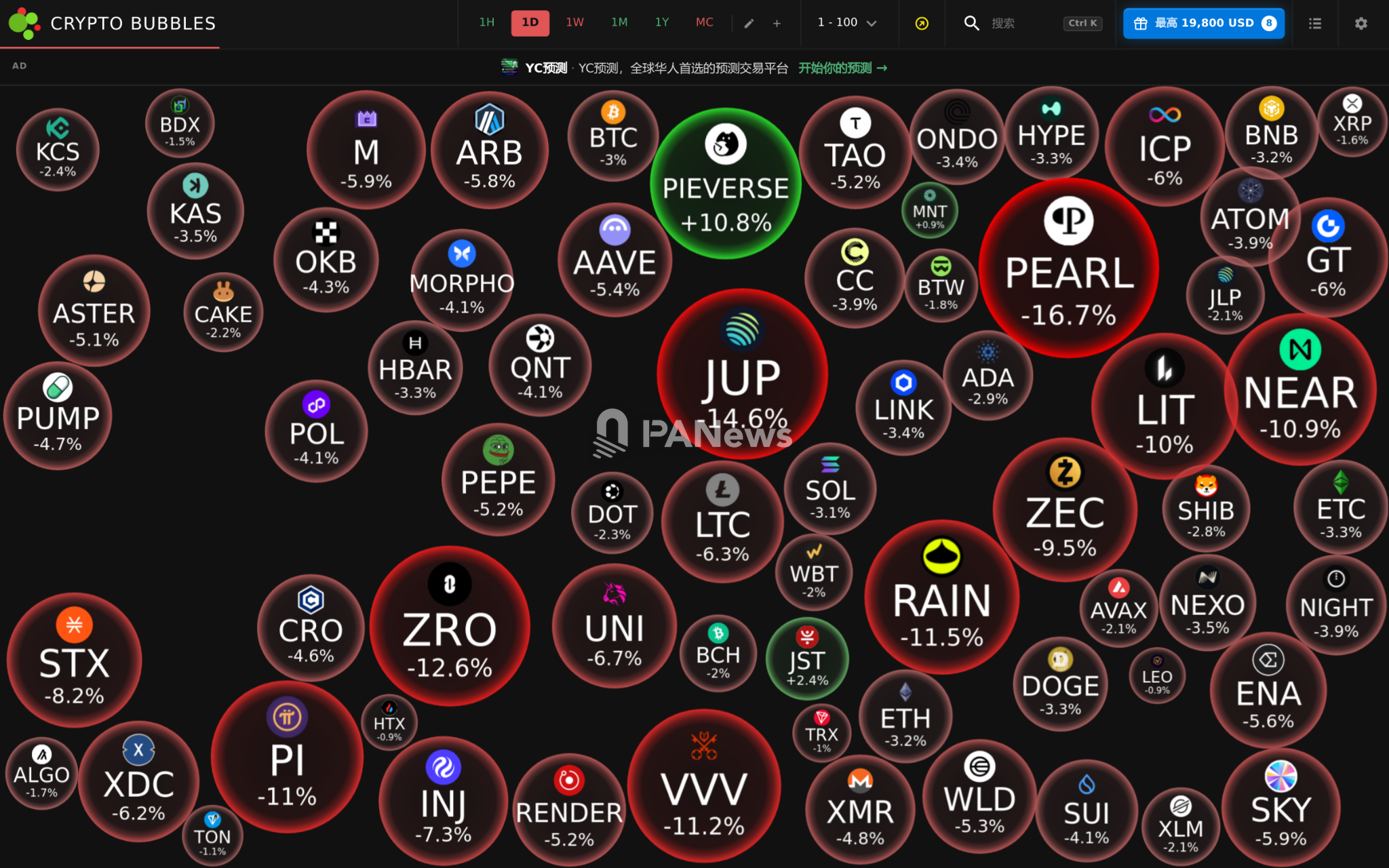
Biggest Gains Among the Top 100 Cryptocurrencies Today: PIEVERSE Up 10.8%, JST Up 2.4%, MNT Up 0.9%, QAI Up 0%, WLFI Up 0%.
Japanese and South Korean Stock Markets Plunge Over 5%, APAC AI and Semiconductor Chains Hard Hit
Despite overnight U.S. stocks seeing Anthropic complete a record $81.3 billion IPO, during trading, it significantly fell below the $100 mark, coupled with warnings from institutions like Capital Economics that AI profit expectations are too high and that industry capital expenditures may face cyclical peaks, leading to systemic sell-offs in the APAC semiconductor supply chain on Friday.
The KOSPI Index closed down 5.21%, hitting a new low in ten months, and during trading, triggered the fourth Sidecar procedural trading pause of the month. Although South Korean officials reported that semiconductor exports surged in the first ten months, breaking the annual export amount of $1 trillion, concerns over valuation bubbles outweighed the fundamental data under the heavy pressure of foreign capital selling over 1.1 trillion Korean won.
Samsung Electronics fell 7.01%, SK Hynix dropped 5.92% (despite the company announcing it would convert Kioxia's convertible bonds to indirectly hold a 14.1% stake), Samsung Electro-Mechanics plunged 12.54%, and upstream semiconductor equipment makers ISU Petasys and PSK saw declines of over 15%; only KB Financial and other high-dividend bank stocks showed slight fluctuations, becoming the only safe haven.
The Nikkei 225 Index in Japan also plunged 5.06%, breaking a four-month low. Bank of Japan Governor Kazuo Ueda's hawkish remarks hinted at a potential rate hike to 1.5% in December, combined with ambiguous guidance on the neutral interest rate end, severely impacted high-valuation growth stocks. SoftBank Group, holding a large amount of AI assets, plummeted 14.48% leading the market decline, semiconductor testing giant Advantest fell 10.32%, Tokyo Electron dropped 7.06%, and Kioxia Holdings fell 11.66%; meanwhile, defensive insurance sectors such as Tokio Marine Holdings (up 2.03%) and Sompo Holdings (up 2.01%) saw significant inflows of safe-haven buying.
Hong Kong stocks and A-shares are also deeply mired in the adjustment of tech stocks, but local industry narratives show strong differentiation. The Hang Seng Tech Index plummeted 3.78%, NetEase fell 17.6%, and HuaHong Semiconductor dropped over 10%; however, Alibaba rose against the trend by 3.48%, benefiting from management’s clear signals during its earnings call about accelerating the replacement of self-developed computing power and capital expenditures declining along with the release of domestic chips after 2028.
The ChiNext Index fell 3.54%, the Shenzhen Component Index dropped 3.09%, the Shanghai Composite Index fell 1.22% to hold at 3,533.79 points, with over 5,200 stocks declining. Under the disturbance of rumors regarding "Samsung's foundry review" and the mismatch of overseas demand cycles, the semiconductor supply chain faced heavy blows, with Tongfu Microelectronics hitting the limit down, Mu Xiyuan falling 12.25%, and Moore Threads down 11.01%; however, nearly 49 billion ETF bottom-hunting funds surged in during the close, decisively entering the defense of the broad market, with Industrial and Commercial Bank of China up 3.30% and China Petroleum up 4.67%, and several high-dividend blue chips hitting historical highs against the trend.
免责声明:本文章仅代表作者个人观点,不代表本平台的立场和观点。本文章仅供信息分享,不构成对任何人的任何投资建议。用户与作者之间的任何争议,与本平台无关。如网页中刊载的文章或图片涉及侵权,请提供相关的权利证明和身份证明发送邮件到[email protected],本平台相关工作人员将会进行核查。