Author: Jae, PANews
At 11:48 AM Eastern Time on November 19, 2026, the opening bell of Nasdaq rang for Anthropic (stock code: ANT).
After two hours and eighteen minutes of accumulated bidding, the first transaction price was fixed at $111.5, a significant increase of 34.3% from the issue price of $83, with the total market value at one point surpassing $2 trillion. With a base fundraising amount of $81.34 billion, Anthropic surpassed SpaceX, breaking the historical record for IPOs in global capital markets.
Just one minute before the official opening, the pre-contract quotation for ANT on the decentralized perpetual contract trading platform Hyperliquid was priced at $111. The two seemingly unrelated markets had a price difference of only 50 cents.
Overnight, it seemed that the cryptocurrency market had taken over the pricing power from Wall Street. But this tiny price difference of 50 cents
held a truth more complex than "accurate pricing."
Wall Street Has Not Opened Yet, but the On-chain Market is Going Crazy
In the past, unicorn IPOs were a highly closed game. Investment banks were responsible for the price inquiry book, institutional investors received the main allocation quotas, and ordinary investors had to wait until the stock was listed to trade. Company valuations could rise significantly in the primary market, but public, continuous, and participatory prices typically only appeared on the day of listing.
Pre-contracts are rewriting this order.
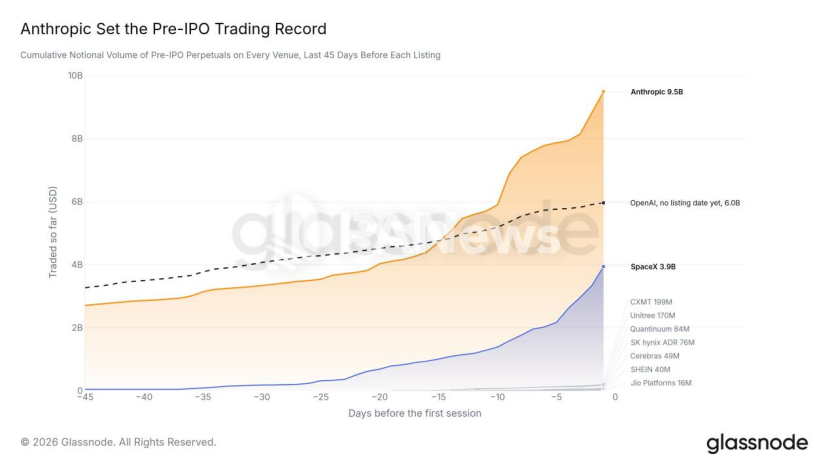
According to Glassnode data, the cumulative nominal transaction amount of pre-contracts for Anthropic in the 45 days leading to its listing reached $9.5 billion, a growth of approximately 144% compared to SpaceX's $3.9 billion during the same period, setting a new record for pre-market trading.
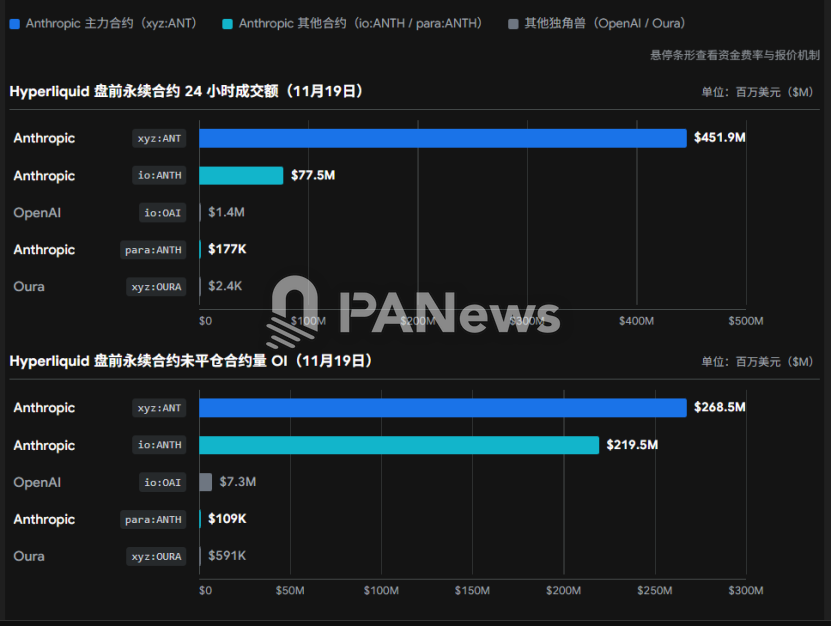
Castle Labs data shows that as of November 19, the 24-hour transaction volume of Entropic pre-contracts on Hyperliquid was about $531 million, and the open interest once reached $496 million, nearly double the peak open position for SpaceX before its listing.
A new market division of labor is taking shape. Wall Street still controls stock issuance and allocations, while the cryptocurrency market has taken over the "pre-trading" segment. Before the stock officially opened, investors worldwide could use stablecoins to trade the price expectations of unicorns. IPOs are no longer just games of inquiry and allocation among institutional investors but have begun to evolve into a public, continuous trading market.
The Truth of 0.2% Error: Watching Nasdaq "Copy Homework"
As the pre-market scale rapidly expands, the price differences between on-chain contracts and traditional markets seem to be narrowing significantly.
Eliezer Ndinga, research head of 21Shares, calculated that the pre-contract price for ANT on Hyperliquid differed from its Nasdaq opening price by only 0.2%. After the opening, the average price difference further narrowed to about 0.1%.
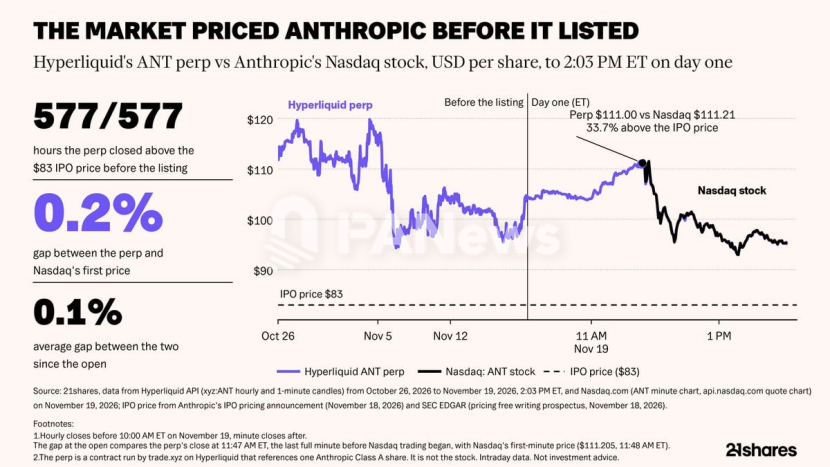
Even considering Nasdaq's official opening price of $111.5, the error is only 0.5%.
If we only observe the two minutes before and after the opening, it seems that the crypto market completed "accurate pricing" ahead of Nasdaq. But pulling the timeline back reveals a different story.
On November 18 at 4:35 PM Eastern Time, just before the IPO pricing, the ANT pre-contract on Hyperliquid was still hovering around $98, 12.11% lower than the next day's opening price. It wasn't until the morning of November 19 that Nasdaq's combined bidding window gradually released indicative quotes of $100, $104, and $110, and the on-chain price followed suit, ultimately hitting $110.48 just four minutes before opening (11:44 AM Eastern), a difference of 0.91% from the first transaction price.
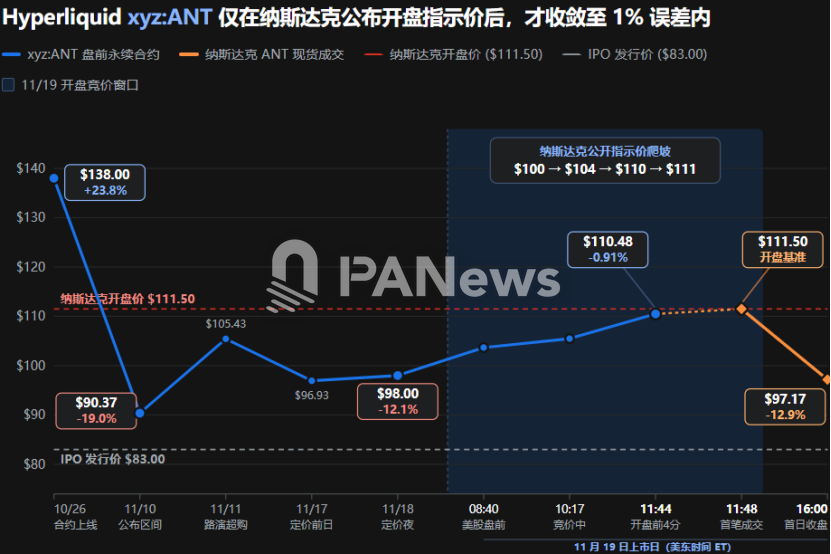
A price difference of under 1% suggests that rather than the crypto market being prescient, it was the traders watching Nasdaq's bidding board on Bloomberg terminals, chasing each price one by one.
This resembles a cross-market information relay rather than unilateral advance pricing by the crypto market.
At the beginning of pre-contracts, the prices reflected a vague consensus on the market's valuation of the assets; as the prospectus, offering price range, and oversubscription status were disclosed, market expectations were continuously revised. By the time of the combined bidding phase, the live indicative prices from the traditional market became the most direct anchor, guiding pre-market prices to converge.
The so-called "accurate pricing" of the crypto market essentially means that it opened a tradable market earlier and then continuously approached the real price as information became more transparent.
Historical Report Card of the Pre-Market: Direction Correct, Price Not Accurate
The "synchronization" of Anthropic feels more like an extraordinary case rather than a replicable norm. Looking back at historical pre-IPO cases, the report card for pre-contracts is far less impressive than ANT.
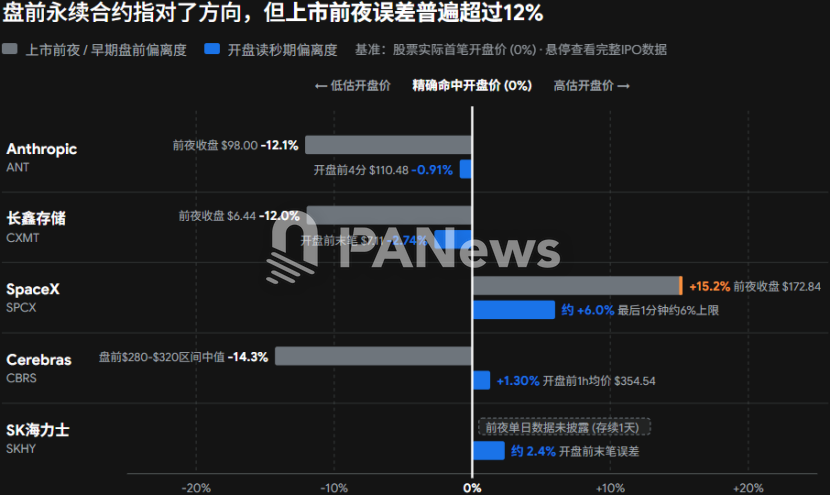
According to Grayscale's statistics on 8 IPOs, the accuracy of pre-contracts in judging the direction of the first-day opening is as high as 7 out of 8. All five subjects that completed the transition at Trade.xyz also conformed to the pattern of "issue price below the prior night's contract price, opening price above the issue price."
In terms of directional judgment, pre-contracts are a qualified "sentiment thermometer." But once it comes to prices, the errors can be dramatically amplified.
The most typical counterexample is SpaceX. On the eve of its listing in June, the pre-contract for SpaceX on Hyperliquid closed at $172.84, implying a first-day increase of up to 28%; however, the next day, Nasdaq opened at only $150, and even in the last minute before the opening, the contract still deviated from the actual opening price by about 6%.
Cerebras and Quantinuum performed even worse, remaining deeply under the issue price after listing. Even Anthropic, after opening high at $111.5, quickly retreated, closing its first day at $97.17. If ordinary investors rushed into the Nasdaq opening price based on the $110 on-chain price, they would have to absorb a floating loss of 12.85% in just four hours.
On the day of Anthropic's listing, the most notable takeaway was not the tiny price difference within 1% in the pre-market.
The crypto market did not prove that it understands the valuation of an AI giant better than Wall Street, but it changed the originally closed IPO pricing process, which was only open to a few institutions, into a public, continuous market that anyone could participate in.
The game of how much a unicorn is worth no longer happens only behind the closed doors of investment banks' roadshows. This represents an extension of pricing power, with Wall Street responsible for issuing stocks and the crypto market responsible for pre-trading expectations. As for who is closer to the truth, that will ultimately be answered by the real money after the opening.
免责声明:本文章仅代表作者个人观点,不代表本平台的立场和观点。本文章仅供信息分享,不构成对任何人的任何投资建议。用户与作者之间的任何争议,与本平台无关。如网页中刊载的文章或图片涉及侵权,请提供相关的权利证明和身份证明发送邮件到[email protected],本平台相关工作人员将会进行核查。