The Monetary Authority of Singapore (MAS) issued S$100 million in tokenized MAS Bills for a 4-week term on November 6, settling via wholesale CBDC, and renamed the testnet to SG Digital Ledger; this contrasts with Hong Kong's EnsembleTX, which provides 24/7 tokenized central bank money settlement, in the battleground of collateral.
Written by: EX.IO Research
On November 19, the Monetary Authority of Singapore (MAS) announced a transaction that seems modest: On November 6, it "natively issued" S$100 million (approximately US$77.5 million) in a 4-week MAS Bills (short-term treasury bills, not medium- to long-term government bonds) on its operational Singapore Dollar Test Network and settled using wholesale CBDC—five Primary Dealers bid, with subscriptions over twice the issuance amount, and the bills mature on December 4.
The amount is not important; the phrasing is important. In its press release, MAS specifically compared two approaches: "natively issued" does not require reconciliation or intermediaries, which differs from "first issuing traditionally, then tokenizing" the bills.
On the same day, MAS Director Chia Der Jiun announced at the Singapore FinTech Festival (SFF 2026) that the testnet would be renamed SG Digital Ledger, repositioning from "experiment" to "operational utility" to support cross-institutional, cross-tokenized assets, cross-form digital currencies, and cross-ledger settlements.
The scarce resource of tokenized sovereign short-term bills is shifting from "can it be issued" to "whose central bank ledger is defaulted to settle collateral." In this matter, Hong Kong and Singapore are taking two different paths to address their shortcomings—this will be unpacked in subsequent sections of the article.
1. The key of this S$100 million is not the amount, but the words "natively issued"
Breaking this matter into four facts reveals why it deserves individual discussion:
- The issuance was completed on the central bank's own ledger network, rather than mapping onto a third-party public chain; settlement was done using wholesale CBDC, not commercial bank money;
- It is natively issued, MAS clearly distinguishes it from the "traditional issuance followed by tokenization" path, noting that the former does not require reconciliation or intermediaries;
- Subscriptions exceeded two times, with participation from five Primary Dealers—this indicates that this is not a simulated trading in a proof of concept; it involves established primary market distribution channels;
- MAS directly highlighted the next intended use: collateral. The press release stated plainly—that this paves the way for "using tokenized assets for secured lending on the test network."
Highlighting point 4 is crucial as it determines the judgment direction of this article: The primary use of tokenized bills is not "to purchase short-term sovereign debt for retail investors," but "to serve as collateral for institutions."
2. From "testnet" to "public utility": What is SG Digital Ledger changing
The renaming seems like a public relations move, but Chia Der Jiun's statements provide three verifiable signals:
Signal One: From "experiment" to "operation." The original wording was "We will now reposition this as an operational utility"—the testnet becoming a public utility (Ledger) means the scope of settlement objects will expand from "participating institutions in the experiment" to "institutions willing to join," with access determined by "market demand." This aligns with MAS's press release that "interested financial institutions and financial market infrastructure providers can engage in the next phase of live testing in 2027."
Signal Two: Collateral is divided into three building blocks, with the first block being legal. MAS has broken down the scale of tokenized collateral management into three segments: (1) clarity of legal and regulatory frameworks (updating the "Guidelines on Tokenized Capital Market Products" and addressing private law issues through the Singapore Academy of Law); (2) high-quality collateral assets (MAS Bills have been tokenized, with the next step to include "widely used foreign government securities and money market funds"); (3) the entire ecosystem (banks, brokers, dealers, clearinghouses, custodians involved together). On the same day, the Guardian Tokenised Collateral Framework was released, covering eligibility, custody, valuation, return, and enforcement across the entire lifecycle.
Signal Three: Interoperability is structured as an "organization" rather than a "paper." MAS stated that through Global Layer One (GL1), a set of interoperable institutional-level digital asset infrastructure standards has already been established, and five global financial institutions have set up the GL1 Organisation in Singapore as an independent, industry-leading entity to advance. On the cross-border front, MAS tested a "synchronized settlement mechanism" across different central bank systems with the Bank of England and the Bank of Thailand, and researched "validating settlement conditions prior to funds release" with the Deutsche Bundesbank.
There is a notable stance differentiation that is easily overlooked: MAS clearly distinguishes between crypto assets and tokenized financial assets in the same speech—"Crypto assets do not represent any underlying assets or value... are unsuitable for retail investors; tokenized financial assets benefit the wholesale market." This statement limits the target audience for Singapore's path: wholesale, institutional, collateral, excluding retail.
3. The real battleground is collateral, not issuance scale
If one only looks at "who issued how many tokenized treasury bills," one might arrive at the wrong conclusion: the scale remains quite small. MAS itself also states that the value of tokenized financial assets relative to the traditional market is still modest.
However, the logic of the collateral line differs from the issuance scale. Collateral is the only scenario in the financial system that "must occur daily, and the amount far exceeds the issuance volume": derivatives margins, repos, secured financing, liquidity management—all depend on it. Tokenization here does not save on "issuance fees," but rather on the time and reconciliation costs of moving collateral. MAS describes collateral as "sits at the centre of derivatives, secured funding and liquidity management," emphasizing that tokenization changes the form and rails of ownership transfer, not the economic substance of the underlying assets.
This statement is the fulcrum of the entire narrative: Whoever controls the "rails" of collateral, controls the default interface of tokenized finance—issuance is just a ticket to entry; the turnover of collateral is what happens continuously.
The complementary BLOOM platform (24 industry members + regional policymakers) and the BLOOM Field Guide released on the same day are also actions on the "operational manual" route: first writing down practices that can be replicated before discussing scale.
4. The divergence with Hong Kong: Both sides are addressing different shortcomings
On the Hong Kong side, the reference is the HKMA's Project EnsembleTX. On November 2, HKMA announced that EnsembleTX has entered a new phase, supporting 24/7 tokenized central bank money (CeBM) interbank settlement for tokenized deposits; the number of participating banks has increased to 12, and industry pioneers to 20. Another HKMA document released the same day details three points: HKMA has completed pilot transactions for Recognized Dealers trading tokenized Exchange Fund Bills in the secondary market; it explicitly stated that the experiment will be expanded to regulated stablecoins; and has launched the tConnect Launchpad with Cyberport to recruit financial institutions and technology firms for use cases.
Putting both locations side by side:
Table Scope Reminder: The following table is a comparison based on official public documents from both regions, not official scope, and cannot be compared line by line. Especially for the "sovereign-type targets" row: Singapore's is a primary native issuance of the same type of instrument (MAS Bills), while Hong Kong's is a secondary market pilot transaction of existing Exchange Fund Bills post-tokenization; the two are not at the same stage and cannot be inferred for issuance scale or maturity superiority.
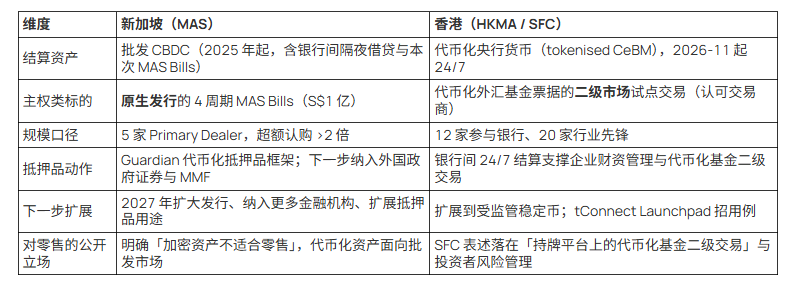
From the public documents, it can be inferred that both sides are addressing different shortcomings (the following is the article's inference, neither party has disclosed internal roadmaps):
- Singapore is addressing "standardization of the chain and legal certainty." Native issuance + central bank-operated ledger + collateral framework + GL1 organization, these four elements point to: transforming "tokenized collateral" from individual cases into a replicable market practice, and making this practice exportable across borders (the cross-border tests with the UK, Thailand, and Germany are hints).
- Hong Kong's public narrative emphasizes "how settlement tracks into commercial loops" (focusing on differences, not deficiencies). The 24/7 CeBM solves the infrastructure issue of "being able to settle outside business hours"; however, more notably, is the reference in HKMA's press release quoting SFC Chief Executive Julia Leung's focus—corporate treasury management and "secondary trading of tokenized funds on licensed platforms." This means, in Hong Kong's public narrative, the settlement track points toward distribution and secondary liquidity on licensed trading platforms, rather than just interbank settlement.
This difference will determine the observation focus for the next 12 months: Singapore will look at "how many non-Singapore institutions onboard collateral into SG Digital Ledger"; Hong Kong will look at "whether 24/7 settlement actually brings secondary trading volume for tokenized assets on licensed platforms," not just the number of new pioneers.
It should be clarified that this judgement is conditional: if both regions ultimately prioritize "cross-border interoperability," then differences may be partly smoothed by standard organizations like GL1; if each maintains sovereign settlement in their own currency, then "whose rails are first adopted by cross-border collateral" will become the true division.
5. Three publicly trackable signals
No conclusive suggestions are made, just listing publicly verifiable and monthly reviewable indicators:
- On the Singapore side: Whether MAS truly includes "foreign government securities and money market funds" as tokenized collateral (this is the next step named in Chia Der Jiun's speech), and whether the list of participating institutions in the 2027 live testing includes non-Singapore custodians/clearinghouses.
- On the Hong Kong side: Whether the regulatory stablecoin expansion of EnsembleTX lands, and the progress of tokenized Exchange Fund Bills moving from "secondary market pilot trading" to normalization in market-making; also, whether the actual transaction volume of tokenized funds on licensed platforms can be publicly tracked.
- On the standard side: Whether GL1 Organisation and HKMA's tConnect Launchpad show overlapping members—the more overlapping members, the more the market is doing "dual-track compatibility," and the lower the cost of regional standard disputes.
🔗 Sources
- MAS, “MAS Announces Successful Issuance of Tokenised MAS Bills on the Singapore Dollar Test Network Using Wholesale Central Bank Digital Currency”, 2026-11-19 — https://www.mas.gov.sg/news/media-releases/2026/mas-announces-successful-issuance-of-tokenised-mas-bills-on-the-singapore-dollar-test-network
- MAS, “Advancing the Future of Finance: From Foundation to Scale” — Keynote Address by Mr Chia Der Jiun at SFF 2026, 2026-11-19 — https://www.mas.gov.sg/news/speeches/2026/keynote-address-by-md-at-the-singapore-fintech-festival-2026
- HKMA, “HKMA advances Project Ensemble pilot phase to 24/7 settlement in tokenised Central Bank Money”, 2026-11-02 — https://www.hkma.gov.hk/eng/news-and-media/press-releases/2026/11/20261102-5/
- HKMA, “Hong Kong FinTech Week 2026”(EnsembleTX, tokenized Exchange Fund Bills secondary pilot trading, tConnect Launchpad, regulatory stablecoin expansion), 2026-11-02 — https://www.hkma.gov.hk/eng/news-and-media/press-releases/2026/11/20261102-3/
- Cointelegraph, “Singapore settles $77.5M tokenized bill sale with wholesale CBDC”, 2026-11-19 — https://cointelegraph.com/news/mas-issues-77m-tokenized-bills-singapore-dollar-test-network
免责声明:本文章仅代表作者个人观点,不代表本平台的立场和观点。本文章仅供信息分享,不构成对任何人的任何投资建议。用户与作者之间的任何争议,与本平台无关。如网页中刊载的文章或图片涉及侵权,请提供相关的权利证明和身份证明发送邮件到[email protected],本平台相关工作人员将会进行核查。